
HR Policies · 16 min read
Employee Handbook for Small Business: What to Include and How to Write It
An employee handbook for a small business is one document that explains how working at your company works: how people are paid, how time off and leave work, what conduct you expect, how to raise a concern, and which policies everyone has to follow. No federal law requires you to have one, but once you do, the law starts to shape what it must say, and by 15, 20 and 50 employees it carries real legal weight.
This guide is part of our series on building a knowledge base for HR, and it is written for the founder, office manager or first HR hire who has been asked to “put the handbook together” on top of everything else. It covers whether you need one, what federal rules add as you grow, what to include, how to write it, and the part most small businesses skip, which is keeping it current and getting each version confirmed.
Key takeaways
- A handbook is not federally required, but it becomes the easiest way to show your team received the policies the law and your customers expect.
- The content grows with headcount: anti-harassment and accommodation at 15 employees, age at 20, and at 50 the family and medical leave notice must be in the handbook if it covers leave.
- Keep the handbook for how working here works, and give rules that change often or need yearly confirmation their own policies.
- A handbook only protects you if each person confirmed the version in force, so every change should go back out for acknowledgment.
Does a small business need an employee handbook?
Strictly speaking, no, because no federal law says a small business must have an employee handbook, and plenty of ten-person companies run happily on a few shared documents and a friendly onboarding call. The question is less whether the law demands one and more whether you can afford the questions, disputes and audit requests that come from not having one.
Three things usually tip a small business into writing a handbook. The first is repetition, when the same questions about pay dates, sick days and holidays arrive with every new hire and the answers depend on who you ask. The second is risk, when a complaint, a termination or a claim makes you realize you can’t show what anyone was told. The third is an outside request, when an insurer, a bigger customer, an auditor or a certification body asks for your written policies and proof that staff received them.
There is also one rule that turns a handbook from optional into something with specific legal content. Once you are covered by the Family and Medical Leave Act, at 50 employees, the federal regulations say the general notice about family and medical leave must be included in your handbook or other written guidance about benefits or leave, if you have such guidance, or handed to each new employee when they are hired.
Sources: 29 CFR 825.104(a), 29 CFR 825.300(a)(3)
Our guide to small business compliance walks through every policy that switches on as a company grows, and the handbook is where most of those obligations end up in front of your people.
What federal law adds to your handbook as you grow
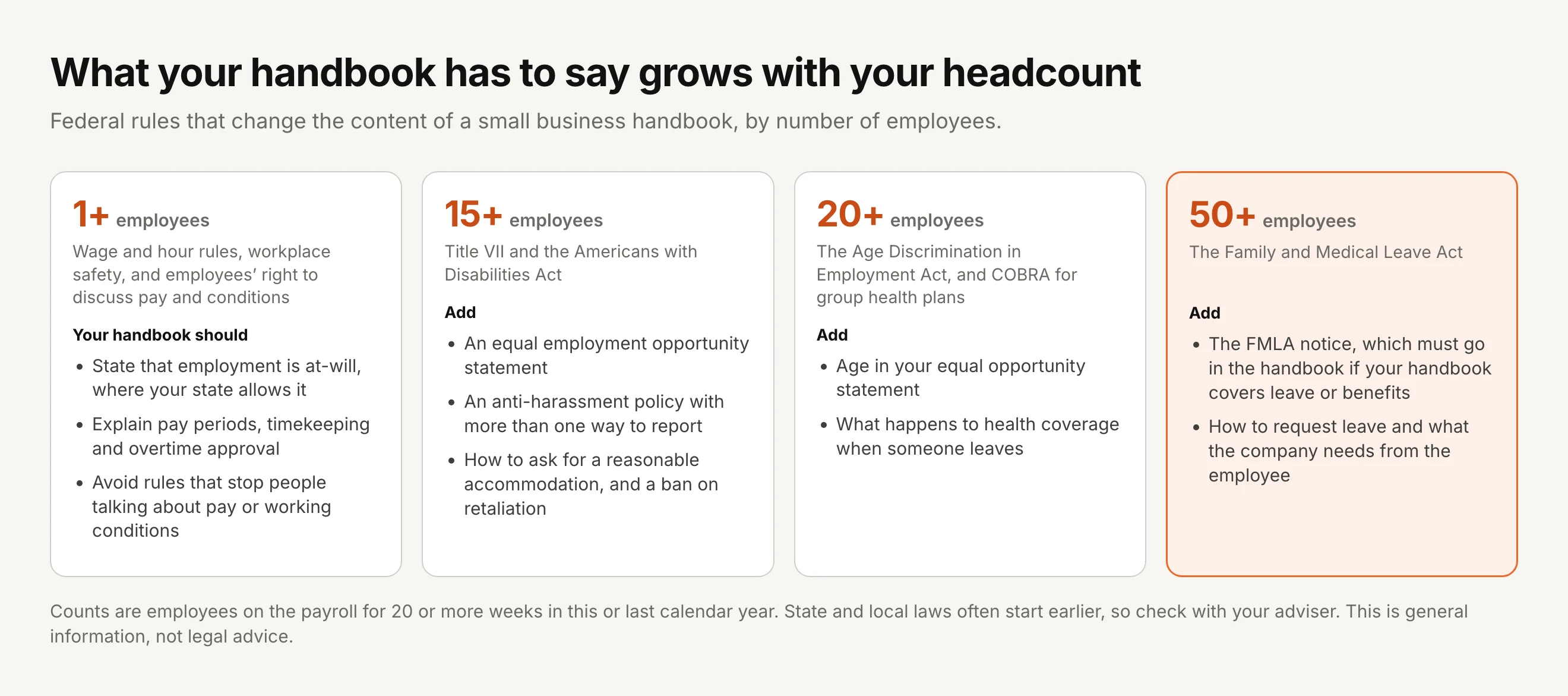
Federal employment law applies in layers based on how many people you employ, which is why a 12-person handbook and a 60-person handbook look so different even in the same industry. The counts generally mean employees on the payroll in 20 or more weeks of this calendar year or the last one.
Sources: 42 U.S.C. 2000e(b), 42 U.S.C. 12111(5)(A), 29 U.S.C. 630(b), 29 U.S.C. 1161(b), 29 CFR 825.104(a)
From the first employee. Wage and hour rules decide how you describe pay, timekeeping and overtime, and the handbook should explain your process for approving overtime rather than pretend overtime can be banned. Most handbooks also state that employment is at-will, which is the default in almost every state, and say plainly that the handbook is not a contract.
From 15 employees. Title VII and the Americans with Disabilities Act apply, so the handbook needs an equal employment opportunity statement, an anti-harassment policy with more than one way to report a problem, a clear process for requesting a reasonable accommodation, and a promise that nobody is punished for raising a concern. We would write these sections from the first hire anyway, because they are what a court or investigator reads first.
From 20 employees. The Age Discrimination in Employment Act adds age to your equal opportunity statement, and if you offer a group health plan, continuation coverage rules apply when someone leaves, which the benefits and leaving sections should mention.
From 50 employees. The Family and Medical Leave Act applies, and the handbook has to carry its general notice if your handbook covers leave or benefits, along with how employees request leave and what they need to provide.
At any size, the National Labor Relations Act. Section 7 of the Act protects most private-sector employees’ right to talk with each other about pay and working conditions, whether or not anyone is in a union. Handbook rules that read as banning those conversations, such as a blanket rule that pay is confidential or that staff may not criticize the company online, have been found unlawful, and the board’s test for these rules has changed several times in recent years, which is a good reason to have the conduct and confidentiality sections reviewed.
Source: 29 U.S.C. 157 (National Labor Relations Act, section 7)
If your team works in more than one state, state and local rules on leave, pay and notices often go further than federal law, so check each location with your adviser and keep location-specific rules in a supplement for that location. This guide is general information, not legal advice.
What to include in a small business employee handbook
A good small business handbook covers the topics below in plain language, in roughly this order, so that a new hire can read it in one sitting and find any answer again later. Treat it as an outline you adapt to your company rather than a template to copy, because a handbook that describes somebody else’s practices is worse than none.
| Section | What it covers | Worth knowing |
|---|---|---|
| Welcome and how we work | Who you are, what you value, how the company is organized and who to ask about what | Keep it to a page, because the rest of the handbook is where the rules live |
| Employment basics | At-will statement where your state allows it, full-time and part-time, exempt and non-exempt, any introductory period | Say clearly that the handbook is not a contract and can change |
| Equal opportunity and anti-harassment | Your equal employment statement, what harassment is, several ways to report it, investigation and no retaliation | Federally required in practice from 15 employees, and wise from the first hire |
| Reasonable accommodation | How to ask for an accommodation for disability, pregnancy or religion, and who handles it | Name a person or role, not just a process |
| Pay and hours | Pay periods, timekeeping, overtime approval, breaks, deductions and final pay | Overtime rules follow the law, so describe your approval process, not a ban on overtime |
| Time off and leave | Holidays, vacation or paid time off, sick time, jury duty, voting, and family and medical leave | At 50 employees, the FMLA notice has to be in here if this section exists |
| Benefits | A short overview of health, retirement and other benefits, with a pointer to the plan documents | The plan documents govern, so the handbook should say so |
| Conduct and attendance | Expectations for behavior, attendance, call-outs, dress and use of company property | Write rules narrowly so they don’t limit people discussing pay or working conditions |
| Technology and confidentiality | A summary of acceptable use and confidential information, linking to the full policies | Pay and working conditions are not confidential information |
| Safety | How to report injuries and hazards, and where the safety programs for each team live | Site-specific procedures belong in their own documents |
| Leaving the company | Notice, returning equipment, final pay and what happens to benefits | Keep it factual and short |
| Acknowledgment | The statement each person confirms, naming the handbook and its version | Our handbook acknowledgment guide covers the wording |
Two sections cause most of the trouble in small business handbooks. Time off is where informal promises live, so write down how paid time off is earned, carried over and paid out exactly as you actually do it. Conduct is where rules are drafted too broadly, so describe the behavior you need rather than banning whole categories of speech.
Handbook or standalone policy?
Not every rule belongs in the handbook, and growing companies get into trouble when they try to keep everything in one document. The handbook works best as the explanation of how working here works, read on joining and again when it changes, while rules that change often, apply to only some people, or need a yearly confirmation are easier to manage as their own policies with their own owner.
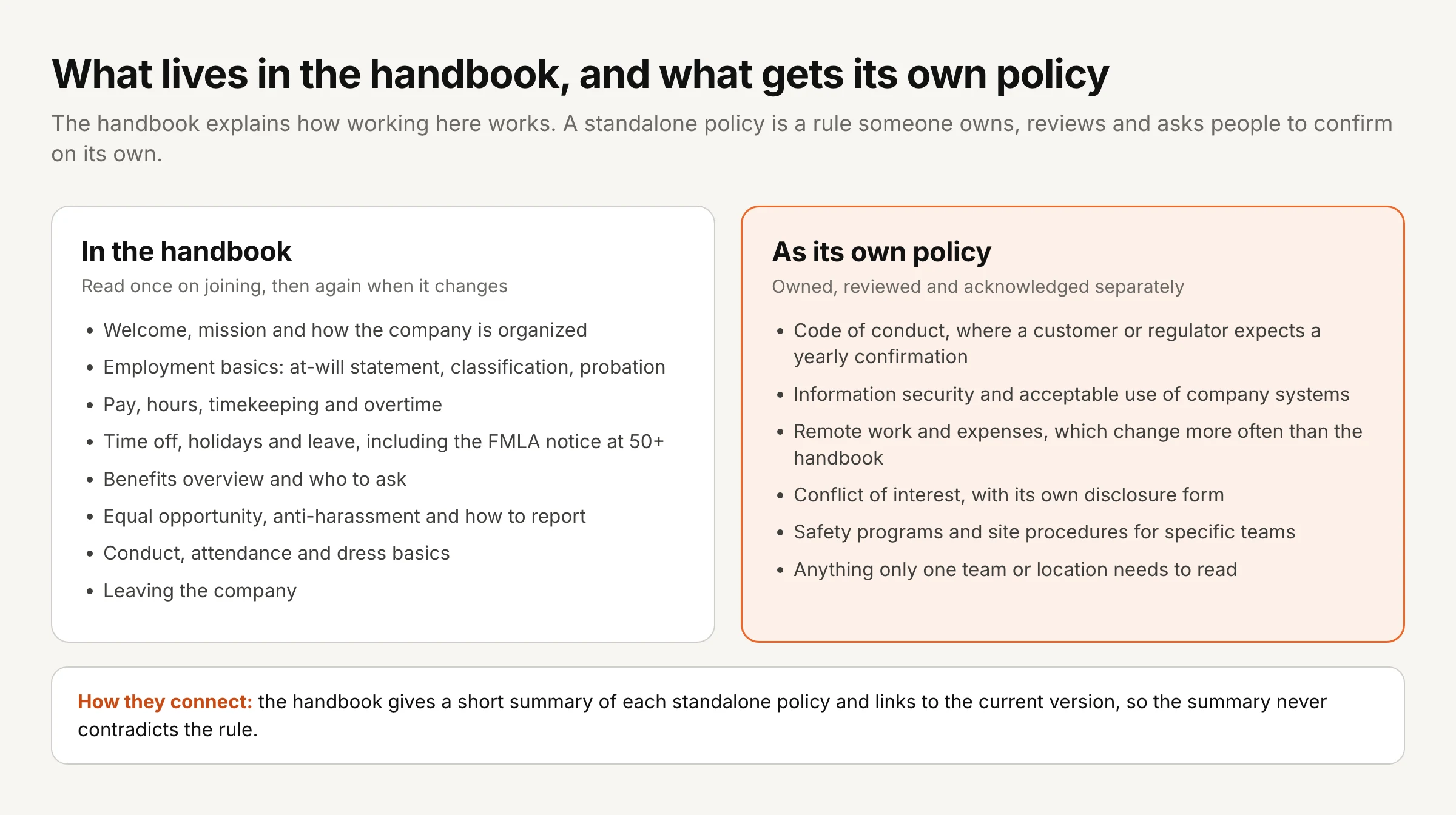
The link between the two matters as much as the split. The handbook should summarize each standalone policy in a sentence or two and point to the current version, so nobody reads an outdated rule in the handbook while a newer one sits elsewhere. We explore this idea further in why HR content works better as a living system than a single book.
Standalone policies also need someone accountable for them. Our guide to the policy owner explains how to assign one person to keep each policy accurate, approved and reviewed, which in AllyMatter is the policy’s Editor.
How to write an employee handbook
Writing a handbook is less about prose and more about deciding what you actually do, so most of the work happens before anyone opens a document. These six steps take a small business from a blank page to a handbook people have confirmed.
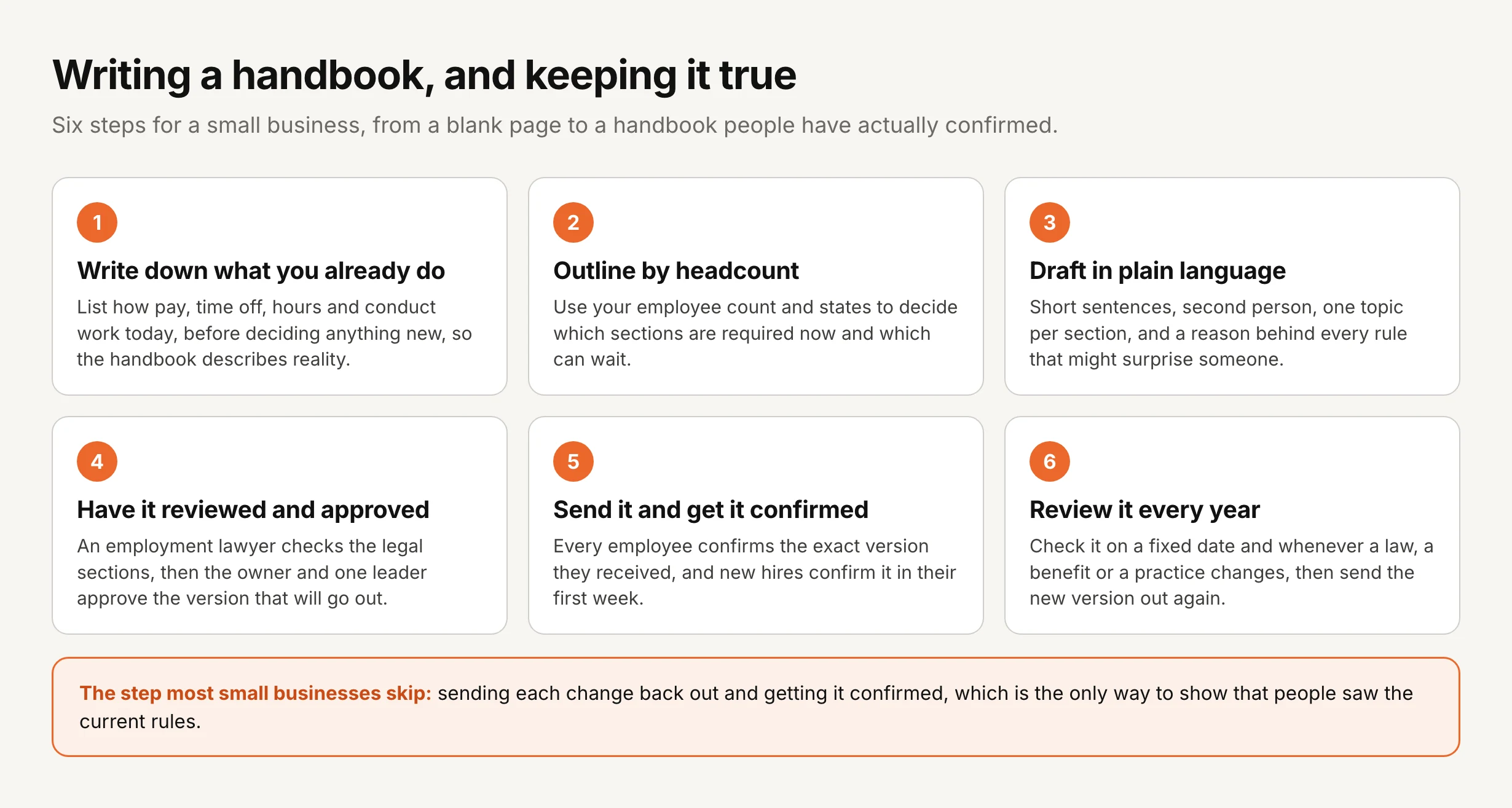
1. Write down what you already do. Before deciding anything new, list how pay, time off, hours, remote work and conduct work today, including the unwritten habits, because a handbook that describes the company you wish you were is one you will break within a month.
2. Outline by headcount and location. Use the federal layers above and the states your people work in to decide which sections you need now, which can wait, and which locations need a supplement.
3. Draft in plain language. Write to the reader as “you”, keep one topic per section, and explain the reason behind any rule that might surprise someone, because people follow rules they understand and remember the ones that come with a reason.
4. Have it reviewed and approved. An employment lawyer should read the legal sections, especially at-will, anti-harassment, leave and conduct, and then the people who own the business should approve the exact version that will go out, so there is a record of who signed off and when.
5. Send it and get it confirmed. Give every employee the approved version and collect a named, dated acknowledgment of that version, and make reading it part of each new hire’s first week.
6. Review it every year. Put a fixed review date on the handbook and revisit it whenever a law, a benefit or a working practice changes, then send the new version back out.
Rolling it out and getting it acknowledged
A handbook that people never confirmed is hard to rely on, because the first question in any dispute or audit is whether this person received this version. The answer should be a record you can open in seconds, showing the person, the version, the date and the statement they agreed to, rather than a folder of signed pages that may or may not be complete.
In AllyMatter, the handbook is sent for acknowledgment to the people it applies to, chosen by tags for your teams and locations, and each person confirms it on the document while signed in. Automatic reminders follow up with anyone who hasn’t confirmed, and each person’s home screen shows what is waiting for them. If your lawyer delivered the handbook as a PDF, you can upload it and get it acknowledged by name in the same way.
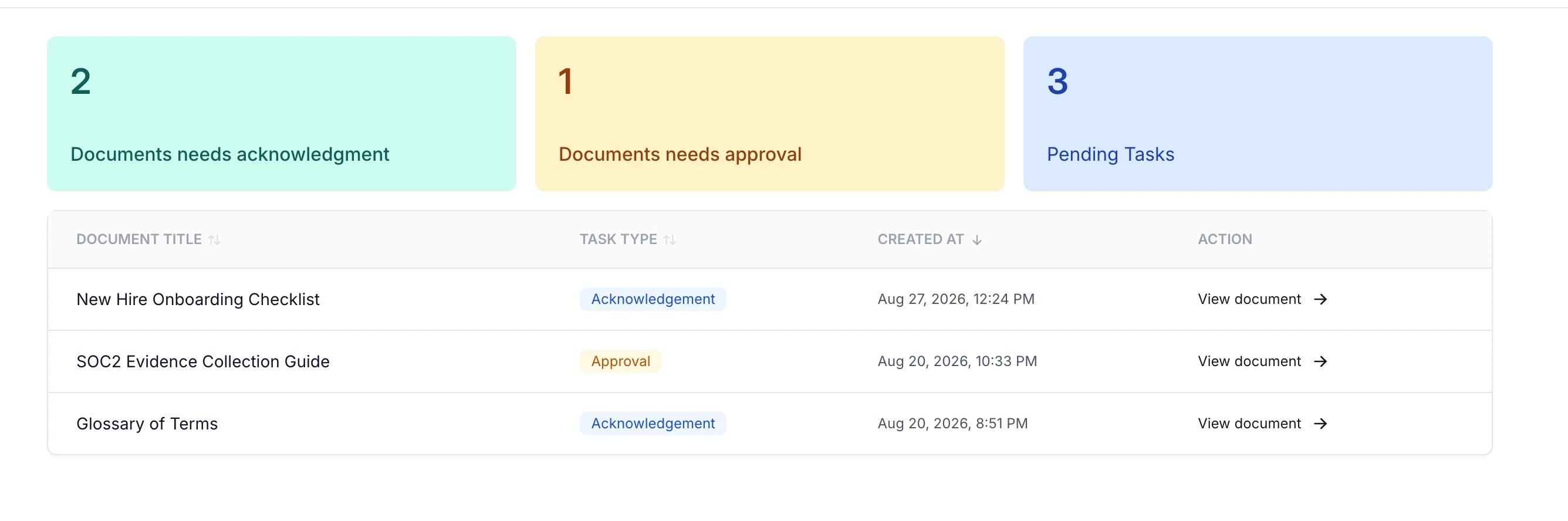
New hires are where small businesses most often slip. In AllyMatter a new employee sees the handbook and policies their tags give them as soon as they are added, and the handbook’s Editor sends them the acknowledgment request, so build that step into your onboarding checklist for the first week. Our employee handbook acknowledgment guide covers the wording of the statement, what counts as proof and what to do if someone refuses to sign.
Keeping the handbook current
Most small business handbooks are accurate the day they are written and quietly wrong a year later, because pay dates, benefits, remote work rules and the law all move. The fix is a routine rather than a heroic yearly rewrite.
Give it a review date. Set a fixed review date or a repeating cycle, usually every twelve months, and in AllyMatter a review alert appears on the handbook when that date arrives until it is reviewed and approved again. If nothing needs to change, approving it again is your record that someone checked it and judged it still valid, and that approved version still goes to anyone who joins afterwards.
Send every change back out. When the handbook changes, the new version goes through approval and back out for acknowledgment, with no exception for small edits, because one changed word in a leave or pay section can change what people are entitled to. Our post on re-acknowledgment after a policy update explains why every version needs its own confirmation.
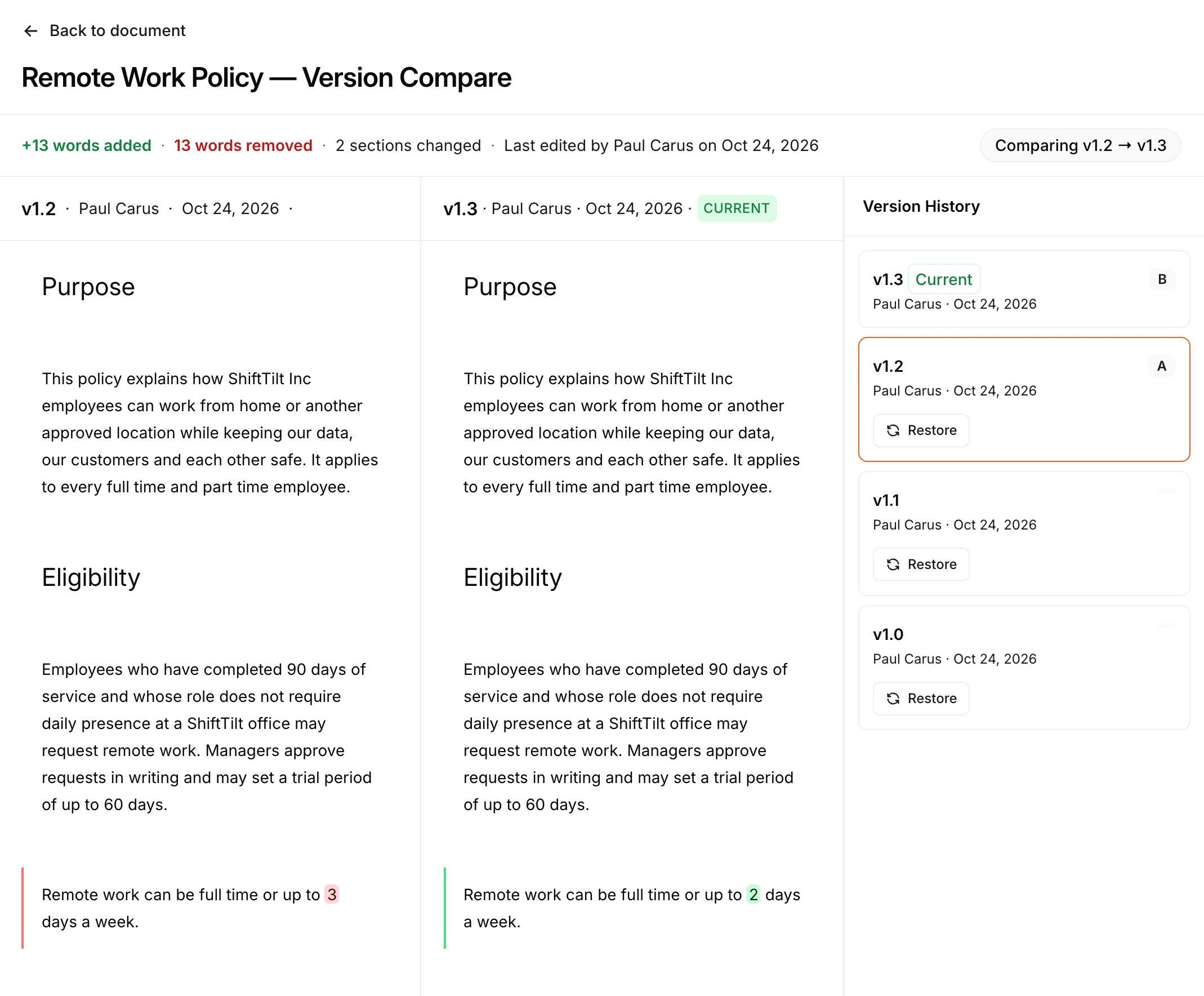
Show people what changed. Asking a whole team to reread a 25-page handbook for two changed sentences is how acknowledgment becomes a box-ticking exercise. Version compare in AllyMatter shows every word removed and added between two versions, so people can read the change itself before they confirm.
Our article on why a startup needs a living HR handbook goes deeper on treating the handbook as something maintained rather than published once.
Common handbook mistakes small businesses make
Copying someone else’s handbook. A borrowed template describes another company’s practices and another state’s law, and the gap between what it says and what you do is exactly what a claimant’s lawyer looks for.
Promising what you can’t deliver. Phrases such as “we will always give a written warning before dismissal” can be read as commitments, so describe what you usually do and keep your discretion.
Rules that are too broad. Blanket confidentiality, social media or “no negativity” rules can reach conversations the law protects, so write them around the actual risk, such as customer data or trade secrets.
Forgetting the leave notice at 50. Crossing 50 employees changes what the leave section must say, and many companies notice only when someone asks for family leave.
No record of who read which version. A handbook updated twice a year with acknowledgments collected once at hiring leaves you unable to show that anyone saw the current rules.
Where AllyMatter fits
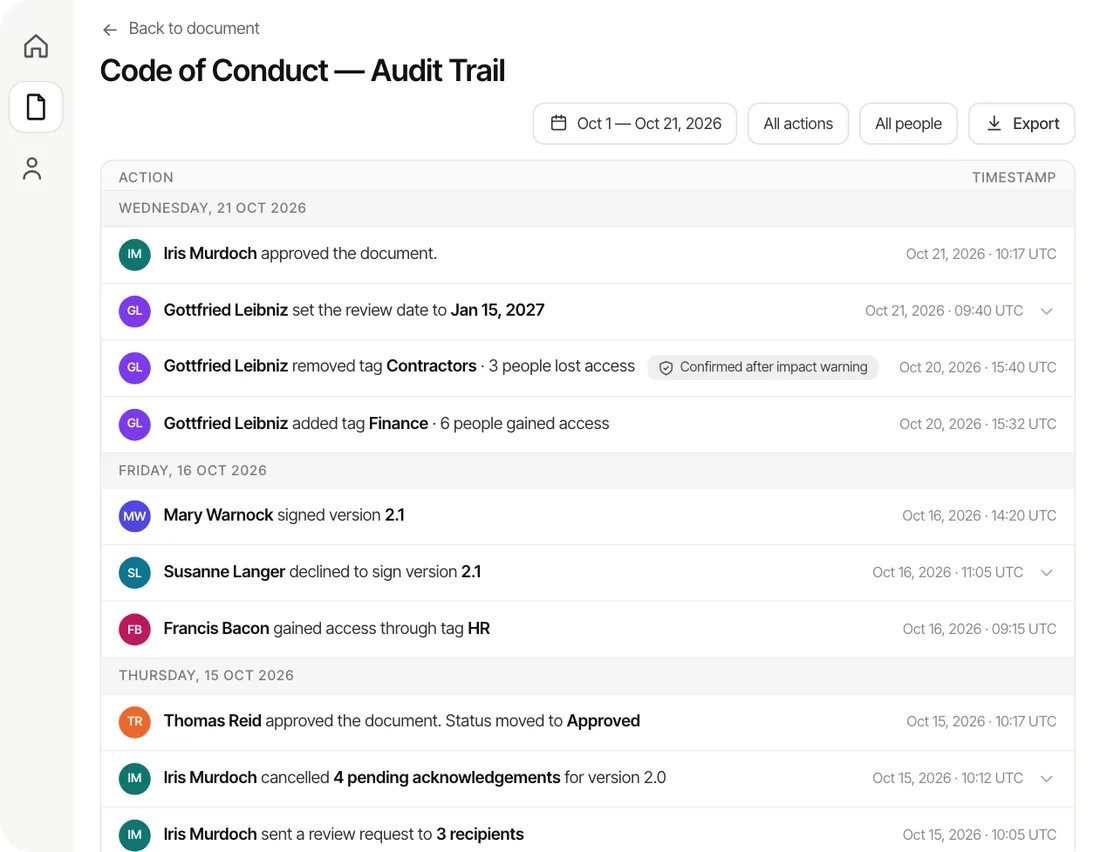
We built AllyMatter as policy management software for small and growing businesses, for companies that need their handbook and policies approved, in front of the right people, confirmed and provable without a compliance department. The handbook and each standalone policy are approved before anyone sees them, sent by tags for teams and locations, acknowledged by name and version with automatic reminders, kept with every earlier version, and reviewed on a schedule, with an audit trail you can export as a PDF or CSV when someone asks for proof. You pay for the people who write and manage policies, while everyone who reads and acknowledges them is free, and on yearly plans we move your existing handbook and policies over for you.
Start your 30-day free trial of AllyMatter. No credit card to start, and a 30-day money-back guarantee if you subscribe and change your mind. Free migration.
Questions about employee handbooks for small businesses
Is an employee handbook required by law for a small business?
No federal law requires a small business to have an employee handbook. Once you have one, though, it has to say certain things, and at 50 employees a handbook that covers leave or benefits must include the federal family and medical leave notice. Many companies also find a handbook is the simplest way to show that required policies, such as anti-harassment, actually reached their people.
How many employees should you have before writing a handbook?
There is no magic number, but most small businesses benefit from a short handbook from the first few hires, because that is when questions about pay, time off and conduct start to repeat. The content then grows at 15, 20 and 50 employees as federal rules switch on.
What should a small business employee handbook include?
At minimum: an at-will statement where your state allows it, equal opportunity and anti-harassment policies with ways to report, how to ask for an accommodation, pay and hours, time off and leave, a benefits overview, conduct and attendance, a summary of technology and confidentiality rules, safety reporting, leaving the company, and an acknowledgment.
How long should an employee handbook be?
As short as it can be while still covering what applies to you, which for most small businesses means a document someone can read in one sitting, with longer topics such as information security kept as standalone policies the handbook links to.
How often should a small business update its handbook?
Review it at least once a year on a fixed date, and update it whenever a law, a benefit or a working practice changes. Every updated version should go back out to your team so people confirm the rules that apply now, not last year’s.
Do employees have to sign the employee handbook?
No federal law requires a signature, but a record that each person received and read a specific version is what protects you when a dispute or an audit comes up. A named, dated acknowledgment of the exact version is the standard most employers aim for.
Can an employee handbook become a contract?
In some states it can, if its wording promises things such as a fixed process before termination. A clear statement that the handbook is not a contract and can change, plus careful wording, reduces that risk, and an employment lawyer can check the language for your state.
A handbook is only as useful as the record behind it, which is why the most valuable thing a small business can do is make sure every version was approved, reached the right people and was confirmed by each of them. Do that from your first handbook, and every one after it gets easier.
Start your 30-day free trial of AllyMatter. No credit card to start, and a 30-day money-back guarantee if you subscribe and change your mind. Free migration.