Every spending rule current, and known to the people who spend.

For finance teams who own the policies behind the controls: expenses, purchasing, delegation of authority and the code for financial officers. Each one approved, sent to the people it covers, and on record by person and by version.

30-day trialUnlimited free viewersNo credit card required

Travel and Expense PolicyVersion 3.1Owned by Finance & Controls
Drafted
Finance team
Elizabeth Anscombe, Controller
New per diem rates, a clearer receipts rule
29 Sep 2026
Step 1 · Finance
Thomas Reid
Chief financial officer
Approved2 Oct 2026
Step 2 · People
Mary Wollstonecraft
HR director
Approved3 Oct 2026
Sent to everyone
Everyone who spends, 88 people
86 of 88

acknowledged version 3.1

The policies you own

Controls run on policies. Each one reaches the people who spend, approve or sign.

Travel and expenses

What is reimbursed and how it is evidenced, for everyone who spends.

Delegation of authority

Who can approve what, and up to how much, for every manager who signs.

Purchasing

How suppliers are chosen, quoted and approved, for the people who buy.

Code of ethics for financial officers

The standard for the people who prepare and sign the accounts.

Record retention

What is kept and for how long, in step with each country’s rules.

Fraud and whistleblowing

How to report a concern about the accounts, where every employee can find it.

Who asks to see them

Wherever you operate, auditors, tax authorities and boards ask the same question: is the rule written, approved and known to the people it governs.

COSO Internal Control, Principles 1 and 12

Policies behind the controls

Standards of conduct set the tone, and control activities are put in place through policies that say what is expected, and procedures that put them into action.

  • Each policy approved and versioned
  • Sent to the people who carry it out
  • Review dates on every policy

17 CFR 229.406

Code of ethics for financial officers

Public companies disclose whether they have a code of ethics for their principal executive, financial and accounting officers.

  • The code approved by the board
  • Acknowledged by each officer it covers
  • Every amendment on record

26 CFR 1.62-2

Expense policy as an accountable plan

Reimbursements stay out of wages when the plan requires a business connection, substantiation within a reasonable period and the return of excess amounts.

  • One current version for everyone who spends
  • Each change sent out again
  • Acknowledgment by person and version

Wherever you have an entity

Local tax and reporting rules

Each country sets its own rules for expenses, records and approvals. Each gets its own supplement beside the group policy.

  • A supplement for each entity or country
  • Sent only to the people it applies to
  • Each change goes out again

Bring your own rules

Your region’s laws, the standards your customers ask for, and your own house rules. Write each one as a policy, approve it, and send it to the people it covers.

  • Laws of every country and state you work in
  • Standards and certifications
  • Customer and contract requirements
  • Your own policies and procedures
Check what your laws requirePolicy and Compliance lists the documents a business has to have in writing, by country and business type.Check your laws (opens in a new tab)

How it helps finance

Built for controllers and finance leads who show control to auditors, boards and tax authorities.

Rules people actually know

Everyone who spends or approves has acknowledged the current version.

The right policy to each role

Managers get delegation of authority, buyers get purchasing, everyone who travels gets expenses.

Approvals on record

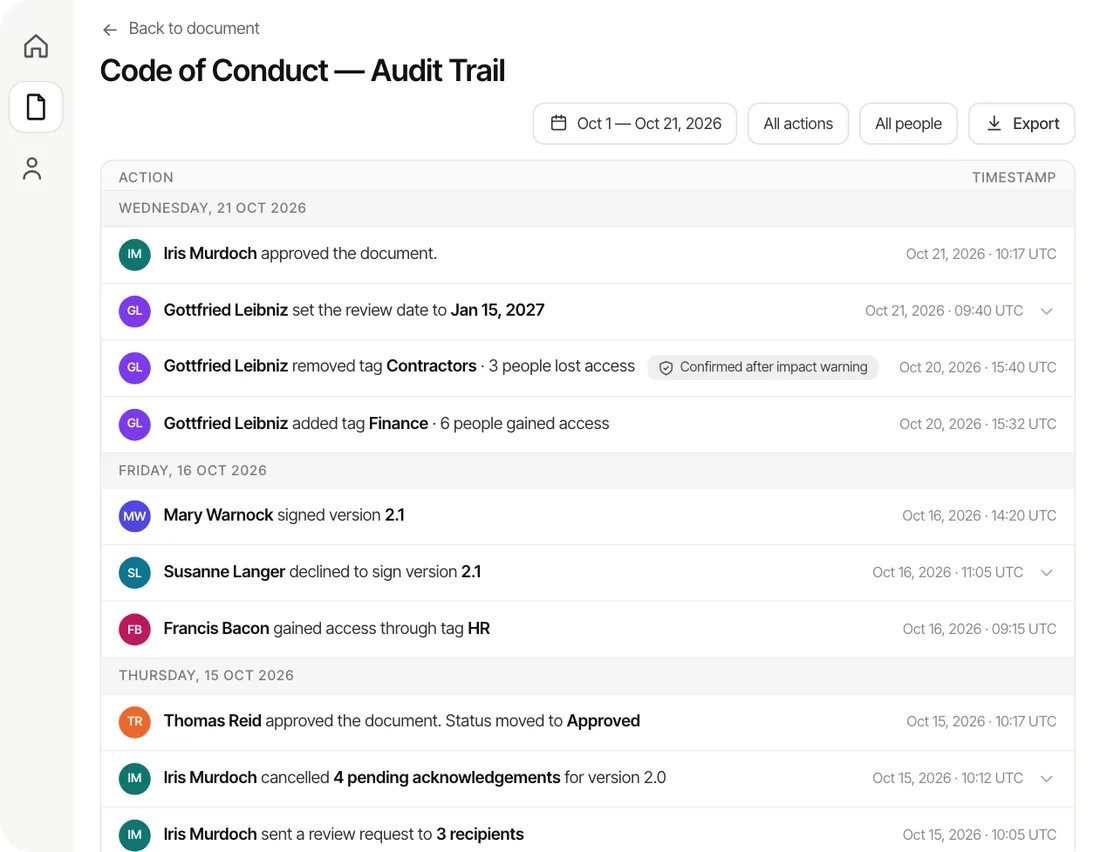
Each approval is logged with the person and the date, ready for the auditor.

No seat cost for employees

Employees and other viewers are unlimited and free. You pay for the people who write.

Every change goes out again

A revised policy is approved, then everyone it covers is asked again, automatically.

Proof on request

Filter the record by date, person or policy and export a PDF or CSV.

Each role gets its own policies

Tag people by role and entity. Each policy reaches only the people it covers, and new managers get theirs on day one.

A record for every person who signs

Show the auditor who has acknowledged which version, with the time and the statement they agreed to.

Working with the rest of the company

Finance writes the policy. Leadership approves it, and everyone who spends follows it.

The CFO approves first

Add the chief financial officer as the first approval step. The policy waits for them.

HR reviews what touches people

Bring HR in as approvers on expenses, travel and anything that touches pay.

The board signs off on authority

Add directors as approvers on the delegation of authority and the code for financial officers.

Each department keeps its own

Finance edits finance’s policies. HR, IT and Safety edit theirs, side by side in one place.

Your auditors, one document at a time

Give an auditor a one-time code to open the policy they are testing.

Your adviser, inside the process

Invite your outside accountant or adviser as an external user to draft and review.

Ready for whoever asks.

Auditors, boards and tax authorities ask the same thing in different words: the current rule, who approved it and who knows it.

Export the record as a PDF or CSV, or let an auditor open the document directly.

  • External auditorsApproved policies behind each control, with review history
  • Your boardAuthority limits and the code for financial officers, approved on record
  • Tax authoritiesThe expense policy in force, and when each version applied
  • Lenders and investorsFinance policies approved, current and followed

Built around your finance team

Roles and entitiesTags such as Managers, Purchasing or Dublin send each policy only to the people it covers.
ApproversAdd the CFO, HR and the board as approvers, one step after another.
AdvisersBring in your outside accountant as an external user to write and review.
AuditorsGive an auditor one document with a one-time code.

Need help writing the policies? Find a consultant for your standard.

Questions

Do employees need a paid seat?

No. They read, acknowledge and sign as viewers, free of charge.

Acknowledgment or signature?

Both are available. Choose for each policy when you send it. e-sign is an add-on on the Scale plan.

What happens when a policy changes?

The new version is approved, then sent to everyone it applies to, who are asked again.

Can an auditor see a document without an account?

Yes. Add them as a one-time viewer and they open that document with a one-time code.

Does everyone have to acknowledge again every year?

Only when a policy changes or expires. If nothing changed at review, the date moves and no one is asked again.

Can Finance keep its policies separate from other departments?

Yes. Each department edits its own policies, and tags decide who reads them.

What happens to someone’s record when they leave?

Their completed acknowledgments stay on record.

Try AllyMatter free for 30 days

  • No credit card needed
  • 30-day money-back guarantee
  • Free migration on yearly plans