Every driver, picker and mechanic has the policy, and you can prove it.
For carriers, warehouses and 3PLs who answer to FMCSA, PHMSA, OSHA and CBP, and to the insurers and shippers who ask the same questions. Every policy approved, in the right hands, and on record by person and by version.
Strong operations already have the policies, on the road and on the floor. The work is keeping the proof as current as the policy.
49 CFR 382.601
Drug and alcohol policy
Drivers hired mid-month and every revised version both get a receipt, so the record keeps pace with the fleet.
Every driver with the Drivers tag gets it, new hires on their first day
A receipt per driver and version, acknowledged or signed
Kept on record after a driver leaves
49 CFR 172.800 to 172.802
Hazmat security plan
The yearly review stays on schedule, and each update reaches every person responsible for carrying it out, as well as the safety office.
A review date that reminds the plan’s editor
Each revision approved, then sent to everyone responsible
Every earlier version kept, ready for DOT or DHS
U.S. Customs and Border Protection
CTPAT security procedures
Validators compare the written procedures with what happens at the dock. Procedures reviewed on a schedule stay in step with practice.
An owner and a review date on every procedure
Acknowledged by the people who carry them out
Shared with the validation team without an account
29 CFR 1910.147
Lockout/tagout program
Conveyors, dock levelers and shop equipment each have documented energy control procedures. Technicians are told every time one changes, and confirm it.
Procedures sent only to the Maintenance tag
Every revision approved, then acknowledged again
Periodic inspection dates kept as review dates
29 CFR 1910.178(l)
Forklift operator certification
Each operator’s certification names who trained and evaluated them, and when. Keep it beside the safety rules they work under, ready to show together.
Safety rules acknowledged by every operator
Each operator’s certification kept with the rules
The record for any operator in seconds
Cal/OSHA 8 CCR 3203, 3395, 3396
Injury and illness prevention, California
California expects a written injury and illness prevention program, plus heat illness plans for outdoor yards and indoor warehouses, in English and the language most of your crew reads.
Each language version kept current together
Sent to the sites and shifts they cover
Reviews on a schedule, with every version kept
How it helps a logistics operation
Built for teams who show policy control to regulators, insurers and customers, across every site and shift.
The right policy to each team
Tags by role and site mean drivers get driver policies, the shop gets lockout procedures and the warehouse gets its safety rules.
New hires covered from day one
Seasonal pickers and new drivers alike: invite them with their tags and their policies are waiting.
No seat cost for the floor
Drivers, warehouse staff and other viewers are unlimited and free. You pay for the people who write.
Every change goes out again
A revised policy is approved, then everyone it covers is asked again, automatically.
Reviews on schedule
Review dates remind the policy’s editor ahead of each yearly review.
Proof on request
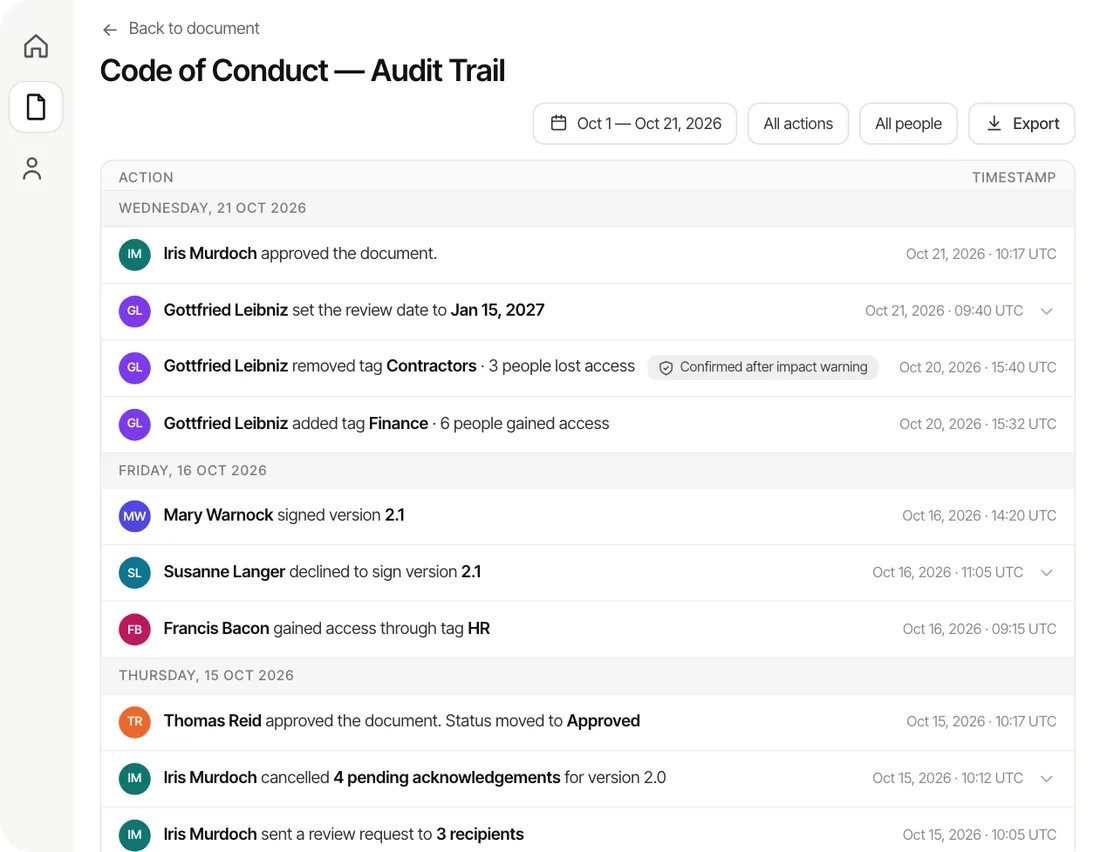
Filter the record by date, person or policy and export a PDF or CSV.
Each team gets its own policies
Drivers, shop, warehouse and yard each see the policies that cover them, and new hires get theirs on day one.
Policies by team
Drug and Alcohol Testing PolicyDrivers38 of 38 acknowledged
Lockout/Tagout ProgramMaintenance12 of 12 acknowledged
Forklift Safety RulesWarehouse64 of 64 acknowledged
Heat Illness Prevention PlanWarehouse, Yard81 of 81 acknowledged
HAHannah ArendtNew warehouse associate · Warehouse tag
“I confirm that I have received and read the Drug and Alcohol Testing Policy.”
16 Oct 2026, 07:42 UTC · IP 203.0.113.24
Policies can go out for acknowledgment or e-sign.
Kept on record, even after she leaves.
The rest of the binder
The headline rules are only part of it. An operation runs on many other policies, and they need the same control.
Phone and distracted driving
A written phone policy, acknowledged by every driver, shows how you keep to the FMCSA texting and hand-held phone rules.
Driver hiring and background checks
Driving records and background reports come with FCRA notice and consent duties, and state fair chance rules.
Emergency action and fire prevention
Where OSHA calls for these plans, they must be written once a site passes ten employees, and kept where people work.
Hazard communication
Batteries, fuel, cleaning chemicals and hazmat freight all bring a written hazard communication program.
Harassment and workplace violence
Staff in California and New York bring state harassment rules with them, and California requires a written workplace violence plan for most sites, yards included.
Handbook, conduct and acceptable use
One current version for drivers, dispatchers and office staff, confirmed when it changes.
Ready for whoever asks.
Inspectors, validators, insurers and shippers ask the same thing in different words: the current policy and who has it. Have the answer ready.
Export the record as a PDF or CSV, or let them open the document directly.
FMCSADrug and alcohol policy receipts, by driver and version
PHMSAThe current security plan, its reviews and who was told of each change
CBPProcedures that match practice, with their review history
OSHA and state plansWritten programs that are current, with proof each worker received them
Insurers and shippersYour safety policies, approved and current, with proof of who received them
Built around your operation
Sites and rolesTags such as Drivers, Warehouse, Maintenance or Memphis send each policy only to the people it covers.
Office and floorDispatch, customer service and office staff run their policies in the same place as the floor and the fleet.
ConsultantsBring in your safety consultant as an external user to write and review.
AuditorsGive an auditor or insurer one document with a one-time code.