OSHA written programs: every required plan current, reviewed and shared
For safety managers and EHS leads who keep the written hazard communication, emergency, fire prevention, lockout, respiratory and bloodborne pathogens programs an OSHA compliance officer asks for first.
Checked against primary sources on 18 October 2026.
Who it applies to
Private-sector employers under the OSH Act, and public employers under State Plans, whose workplaces present the hazard a standard covers, such as hazardous chemicals, hazardous energy, required respirator use or occupational blood exposure.
Who checks
OSHA compliance safety and health officers, or inspectors of an OSHA-approved State Plan
How often
No fixed inspection cycle; inspections follow complaints, referrals, severe injury reports and emphasis programs, while individual standards set annual reviews, inspections and training
Current edition
29 CFR Part 1910 and Part 1926 as published in the eCFR; 1910.1200 last amended by the January 15, 2026 final rule (91 FR 1695) and February 13, 2026 corrections (91 FR 6760), 2026-02-13. Free to read.
Dates to know
Dates for OSHA written programs
Date
What happens
Status
2026-01-15
OSHA final rule moves the 2024 hazard communication compliance dates back four months
Done
2026-05-19
Hazard communication: manufacturers, importers and distributors meet the revised rules for substances
Done
2026-11-20
Hazard communication: employers update alternative labeling, the written program and training for newly identified substance hazards
Scheduled
2027-11-19
Hazard communication: manufacturers, importers and distributors meet the revised rules for mixtures
Scheduled
2028-05-19
Hazard communication: employers update the written program and training for newly identified mixture hazards
Scheduled
What OSHA written programs asks you to write down
Each one needs an owner, an approval, and proof it reached the people it covers.
29 CFR 1910.1200(e)
Written hazard communication program
Describes how labels, safety data sheets and training are handled at each workplace, with a list of hazardous chemicals using the same product identifiers as the SDSs.
Chemical list matched to SDS product identifiers
Methods for non-routine tasks and unlabeled pipes
How other on-site employers get SDS and label information
29 CFR 1910.38
Emergency action plan
Required in writing when another OSHA standard calls for one, kept at the workplace and reviewed with each covered employee; ten or fewer employees may communicate it orally.
Reporting, evacuation route and headcount procedures
Critical operations and rescue duties by role
Reviews at creation, duty change and plan change
29 CFR 1910.39
Fire prevention plan
Names major fire hazards, ignition source controls, the fire equipment for each hazard and the people or job titles responsible, reviewed with employees at initial assignment.
Handling and storage practices for hazardous materials
Responsible names or job titles
Maintenance schedule for heat-producing equipment safeguards
29 CFR 1910.147(c)(4), (c)(6), (c)(7)
Energy control program and lockout/tagout procedures
Machine-specific procedures setting out scope, shutdown, isolation, device placement and verification steps, backed by an annual periodic inspection and employee training.
Shutdown, isolation and verification steps per machine
Training record with each employee's name and dates
29 CFR 1910.134(c)
Respiratory protection program
A worksite-specific written program run by a qualified program administrator, covering selection, medical evaluation, fit testing, use, maintenance and training, updated as conditions change.
Named program administrator
Fit test records kept until the next test
Annual training and periodic program evaluation
29 CFR 1910.1030(c)(1)
Bloodborne pathogens exposure control plan
A written plan with the exposure determination and implementation schedule, reviewed at least annually, documenting safer device evaluation and input from frontline employees.
Annual review date and safer device consideration
Input from non-managerial frontline employees
Training records kept three years
Citations are to the standard or regulation; wording is ours.
What gets asked for on the day
What reviewers sample about these documents and the people they cover.
Programs reviewed alongside the injury records
OSHA's Field Operations Manual has compliance officers review three years of OSHA 300 logs and programs including hazard communication, lockout/tagout, emergency evacuation and PPE, and request the written PPE hazard assessment.
The written program, on request
The hazard communication, respiratory protection and bloodborne pathogens standards each require the written program to be available to OSHA on request, so the current version is expected on the day.
Lockout/tagout inspection and training records
Officers can ask for the annual periodic inspection record naming the equipment, date, employees and inspector, and the training record listing each employee's name and training dates.
Bloodborne pathogens review and training trail
The latest annual plan review with safer device consideration, and three years of training records showing dates, content summary, trainer qualifications and attendee names and job titles.
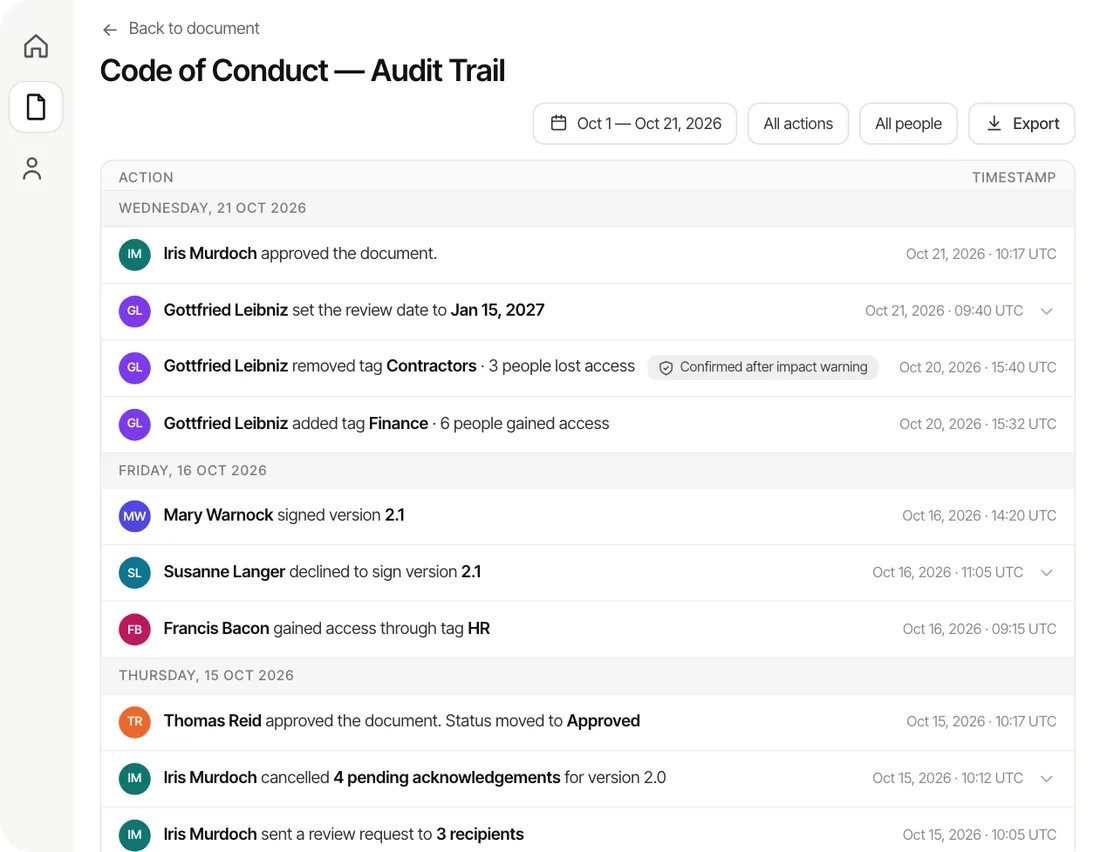
The policy and acknowledgment layer for OSHA written programs.
Write each policy, send it through approval, and send it to the people it covers. Each acknowledgment is recorded by name, with the version, the date and the time.
When a policy changes, the new version is approved, its Editor sends it out again, and everyone it applies to is asked again. Export the record as a PDF or CSV, or give a reviewer Viewer access to the documents their tags allow.
Approved before it goes outUp to four steps, with any or all approvers.
Acknowledged by nameName, email, date, time and version on every record.
Asked again on every changeEach new version goes out again to everyone it applies to.
The record on requestA PDF or CSV export, or Viewer access to the documents their tags allow.
Your region’s laws, the standards your customers ask for, and your own house rules. Write each one as a policy, approve it, and send it to the people it covers.
Does every employer need a written emergency action plan?
Only when another OSHA standard requires one. Where it is required, the plan is written, kept at the workplace and available to employees, although employers with ten or fewer employees may communicate it orally.
Do the 2024 hazard communication changes require an updated written program?
Yes. As amended in January 2026, employers have until November 20, 2026 to update the written program, alternative labeling and training for newly identified substance hazards, and until May 19, 2028 for mixtures.
Is an employee's acknowledgment of a written program the same as a training record?
The two are separate records. Standards such as lockout/tagout and bloodborne pathogens define their own training records with names and dates, and bloodborne pathogens adds content, trainer and job title details.
Which construction standards carry their own written program duties?
Construction hazard communication at 1926.59 is identical to 1910.1200, and 1926.35 requires a written emergency action plan when a construction standard calls for one. The respirable crystalline silica standard adds a written exposure control plan reviewed at least annually.
Which written programs draw the most citations?
OSHA's preliminary FY2026 list ranks hazard communication second, lockout/tagout third and respiratory protection sixth. Fall protection in construction remains first.