Every procedure controlled, and every operator on the current version.

For quality and operations teams who own the quality manual, the procedures and the work instructions. Each one approved, sent to the lines and teams that use it, and on record by person and by version.

30-day trialUnlimited free viewersNo credit card required

Nonconforming Product ProcedureVersion 4.2Owned by Quality & Operations
Drafted
Quality team
Charles Peirce, Quality manager
Clearer hold and release steps, a new disposition form
30 Sep 2026
Step 1 · Operations
David Hume
Operations director
Approved2 Oct 2026
Step 2 · Leadership
Simone de Beauvoir
Chief executive
Approved5 Oct 2026
Sent to everyone
Lines 1 to 3 and Quality, 96 people
95 of 96

acknowledged version 4.2

The documents you own

A quality system is many documents, each controlled, each reaching the people who use it.

Quality policy

Set by top management and understood by everyone, from the line to the office.

Quality manual and procedures

The documented system, each procedure approved and on its own review cycle.

Work instructions

Line-side instructions approved like procedures, so no shift runs on last month’s sheet.

Nonconforming product and corrective action

How product is held, reviewed and released, for everyone who touches it.

Calibration and equipment

The procedure versioned, with calibration certificates kept beside it.

Supplier requirements

Your supplier quality manual, sent to suppliers and acknowledged by them.

Who asks to see them

Wherever you operate, registrars, customers and regulators ask the same question: is this the approved version, and is it the one in use.

ISO 9001, clauses 7.5, 5.2.2

Documented information

Documents approved before use, changes controlled, the current version available where it is used, and the quality policy communicated and understood.

  • Each document approved, versioned and reviewed
  • Only the current version reaches the floor
  • Each person’s acknowledgment, by version

ISO 13485, clause 4.2.4; 21 CFR 820

Medical device document control

Since 2 February 2026, FDA’s quality system rule brings in ISO 13485: documents reviewed and approved before issue, changes approved, obsolete versions kept out of use.

  • Approval before issue, on record
  • Every earlier version kept in history
  • The current version at the point of use

IATF 16949, clause 4.3.2

Customer-specific requirements

Each customer’s requirements are evaluated and built into the system, and the people they affect are told when they change.

  • Customer requirements held as approved documents
  • Sent to the lines that build for that customer
  • Each change approved, then sent again

Wherever you make and ship

Customer and local requirements

Customers, sectors and countries add their own rules to the standard. Each gets its own document beside the core system.

  • A document for each customer or market
  • Sent only to the teams it applies to
  • Each change goes out again

Bring your own rules

Your region’s laws, the standards your customers ask for, and your own house rules. Write each one as a policy, approve it, and send it to the people it covers.
  • Laws of every country and state you work in
  • Standards and certifications
  • Customer and contract requirements
  • Your own policies and procedures
Check what your laws requirePolicy and Compliance lists the documents a business has to have in writing, by country and business type.Check your laws (opens in a new tab)

How it helps quality and operations

Built for quality managers who show document control to registrars, customers and regulators, across every line and shift.

The right version at the point of use

People see the current version only. Earlier ones stay in history, out of circulation.

New hires covered from day one

Invite an operator with their line tag and their procedures are waiting.

No seat cost for the floor

Operators and other viewers are unlimited and free. You pay for the people who write.

Every change goes out again

A revised procedure is approved, then everyone it covers is asked again, automatically.

Evidence kept with the document

Attach calibration certificates and training records to the procedure they belong to.

Proof on request

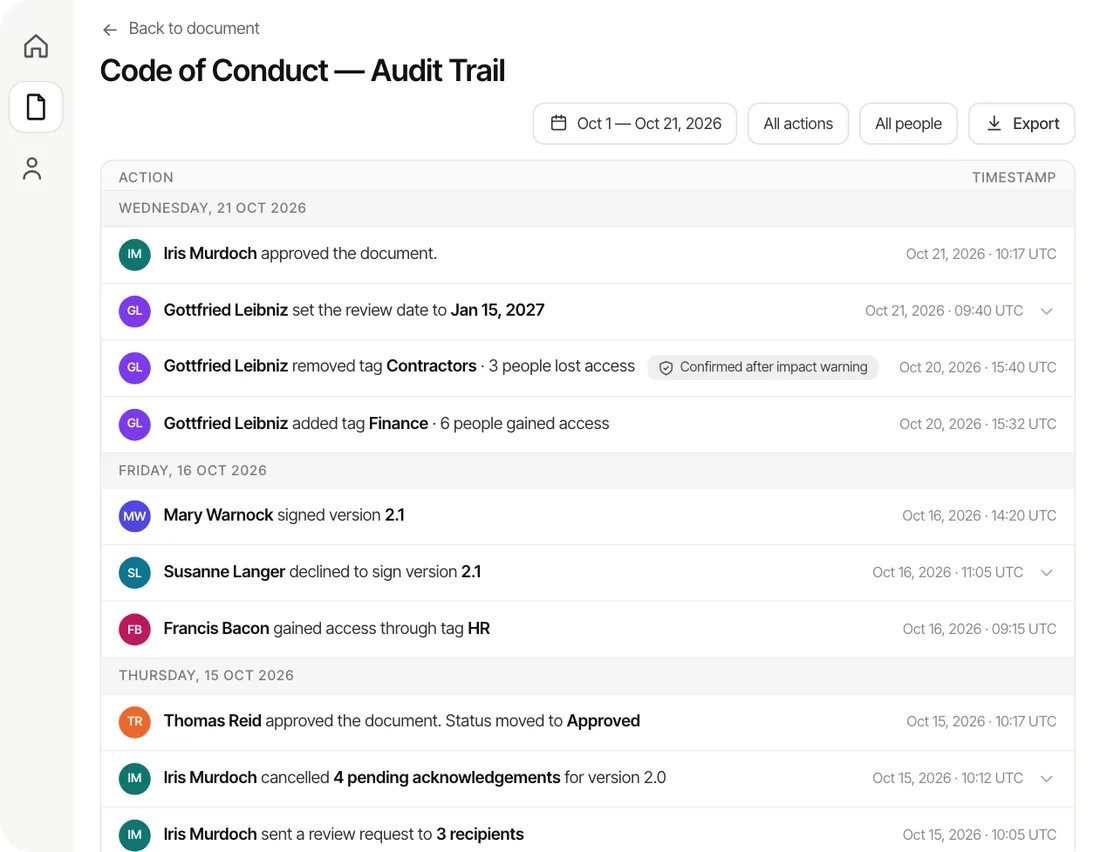
Filter the record by date, person or document and export a PDF or CSV.

Each line gets its own procedures

Tag people by site, line and role. Each procedure reaches only the people who use it, and new hires get theirs on day one.

A record for every operator

Show the auditor who has acknowledged which version, with the time and the statement they agreed to.

Working with the rest of the company

Quality writes the procedure. Operations approves it, and every line works to it.

Operations approves first

Add the operations director as the first approval step. The procedure waits for them.

Top management signs off

The quality policy and manual approved by leadership, on record with the person and the date.

Engineering reviews its part

Bring engineering in as approvers on changes that touch the product or the process.

Each department keeps its own

Quality edits quality’s documents. HR, IT and Safety edit theirs, side by side in one place.

Suppliers, inside the loop

Invite suppliers as external users to receive and acknowledge your supplier manual.

Your consultant, inside the process

Bring in your quality consultant as an external user to draft and review.

Ready for whoever asks.

Registrars, customers and regulators ask the same thing in different words: the current procedure, who approved it and who has it.

Export the record as a PDF or CSV, or let an auditor open the document directly.

  • RegistrarsControlled documents, with approvals and review history
  • CustomersTheir requirements, and proof each change reached the line
  • RegulatorsApproval before issue, and every earlier version kept
  • SuppliersYour supplier manual, with each supplier’s acknowledgment

Built around your quality team

Sites and linesTags such as Line 3, Quality or Dublin send each procedure only to the people who use it.
ApproversAdd operations and leadership as approvers, one step after another.
ConsultantsBring in your quality consultant as an external user to write and review.
AuditorsGive a registrar or customer auditor one document with a one-time code.

Need help writing the policies? Find a consultant for your standard.

Questions

Do operators need a paid seat?

No. They read, acknowledge and sign as viewers, free of charge.

Acknowledgment or signature?

Both are available. Choose for each policy when you send it. e-sign is an add-on on the Scale plan.

What happens when a policy changes?

The new version is approved, then sent to everyone it applies to, who are asked again.

Can an auditor see a document without an account?

Yes. Add them as a one-time viewer and they open that document with a one-time code.

Does everyone have to acknowledge again every year?

Only when a policy changes or expires. If nothing changed at review, the date moves and no one is asked again.

Can Quality keep its policies separate from other departments?

Yes. Each department edits its own policies, and tags decide who reads them.

What happens to someone’s record when they leave?

Their completed acknowledgments stay on record.

Try AllyMatter free for 30 days

  • No credit card needed
  • 30-day money-back guarantee
  • Free migration on yearly plans