
Human Resources · 9 min read
Employee Handbook Acknowledgment Form: Wording and Template
An employee handbook acknowledgment is a dated statement, signed or recorded, that an employee received the handbook, knows where the current version is kept, and understands they are responsible for following it. It is a receipt. It does not turn the handbook into a contract, and it does not prove anyone read page 40. Its whole job is to settle one question later: did this person have this version?
This page gives you the form in two versions, explains what each clause is doing, and then covers the part most guides skip: what the record has to show when an auditor, a surveyor or a lawyer asks for it.
The form, in two versions
Use version A when you want a receipt and nothing more. It confirms the employee got the handbook and accepts the duty to read it, without claiming they have read every page. Use version B when your counsel wants the employee to confirm they have read the handbook and agree to follow it. Both carry the same version line, the same not-a-contract line and the same placeholder for status wording.
[Company name]
Employee Handbook Acknowledgment
Handbook version: [version or effective date]
Version A: Receipt and responsibility

I acknowledge that I have received a copy of the [Company name] Employee Handbook, version [version or effective date], or have been told where the current version is kept and how to open it.

I understand that it is my responsibility to read the handbook, to ask my manager or Human Resources about anything I do not understand, and to follow the policies it contains.

I understand that [Company name] may change the handbook, that the current version always replaces earlier ones, and that I will be asked to acknowledge the new version when it changes.

I understand that the handbook is a guide to policies and practices and is not a contract of employment or a promise of employment for any length of time.

[Where applicable, add the at-will or employment-status wording your employment counsel provides for your state or country.]

Employee name: ____________________
Signature: _________________________   Date: ______________
[Company name]
Employee Handbook Acknowledgment
Handbook version: [version or effective date]
Version B: Read and agree

I confirm that I have read the [Company name] Employee Handbook, version [version or effective date], and that I understand the policies it contains.

I agree to follow these policies and understand that not following them may lead to action under the handbook's procedures.

I understand that [Company name] may change the handbook, that the current version always replaces earlier ones, and that I will be asked to acknowledge the new version when it changes.

I understand that the handbook is a guide to policies and practices and is not a contract of employment or a promise of employment for any length of time.

[Where applicable, add the at-will or employment-status wording your employment counsel provides for your state or country.]

Employee name: ____________________
Signature: _________________________   Date: ______________
Download both versions as one file: Word (.docx) or PDF. No email needed. Fill in the company name and the version, and have the bracketed status line reviewed before you use it.
What each clause does
| Clause | What it says | Why it is there |
|---|---|---|
| Receipt | Says the employee got the handbook, or was shown where the current one lives. | This is the sentence every later question comes back to: did they have it? |
| Where it lives | Names the place the current version is kept. | Stops the argument about which copy was current. |
| Duty to read and ask | Makes reading and asking questions the employee's job. | The company cannot prove someone read every page; it can prove they were told to. |
| Changes and re-acknowledgment | The handbook will change, the current version replaces older ones, and a new acknowledgment will be asked for. | Sets the expectation now, so the next request is routine, not a surprise. |
| Not a contract | The handbook is a guide to policies, not an employment contract. | Keeps the handbook from being read as a promise it was never meant to be. |
| Employment status | A placeholder for the at-will or status wording your counsel wants. | This clause is a legal call that changes by state and country; it is the one line to have reviewed. |
| Version and date | The version or effective date being acknowledged, and the date of the acknowledgment. | An acknowledgment of the 2024 handbook says nothing about the policy you added in 2026. |
| Name and signature | The employee's name and signature, or the recorded identity behind a digital acknowledgment. | Ties the record to one person. |
Keep it to one page. A two-page acknowledgment is a sign that policy text has leaked into the receipt. The policies belong in the handbook; the acknowledgment only points at them.
When to collect it, and why every change asks again
Twice. Once at hire, before or during the first week, and again every time the handbook changes. The second half is where most programs quietly fail. The acknowledgment names a version. When the handbook moves from version 3 to version 4, every acknowledgment on file still proves receipt of version 3 and says nothing about the new leave policy in version 4.
At the last company I started, we had five different versions of the NDA, depending on when people joined. The handbook drifts the same way, just more slowly, and nobody notices until the day someone asks which version a particular employee acknowledged.
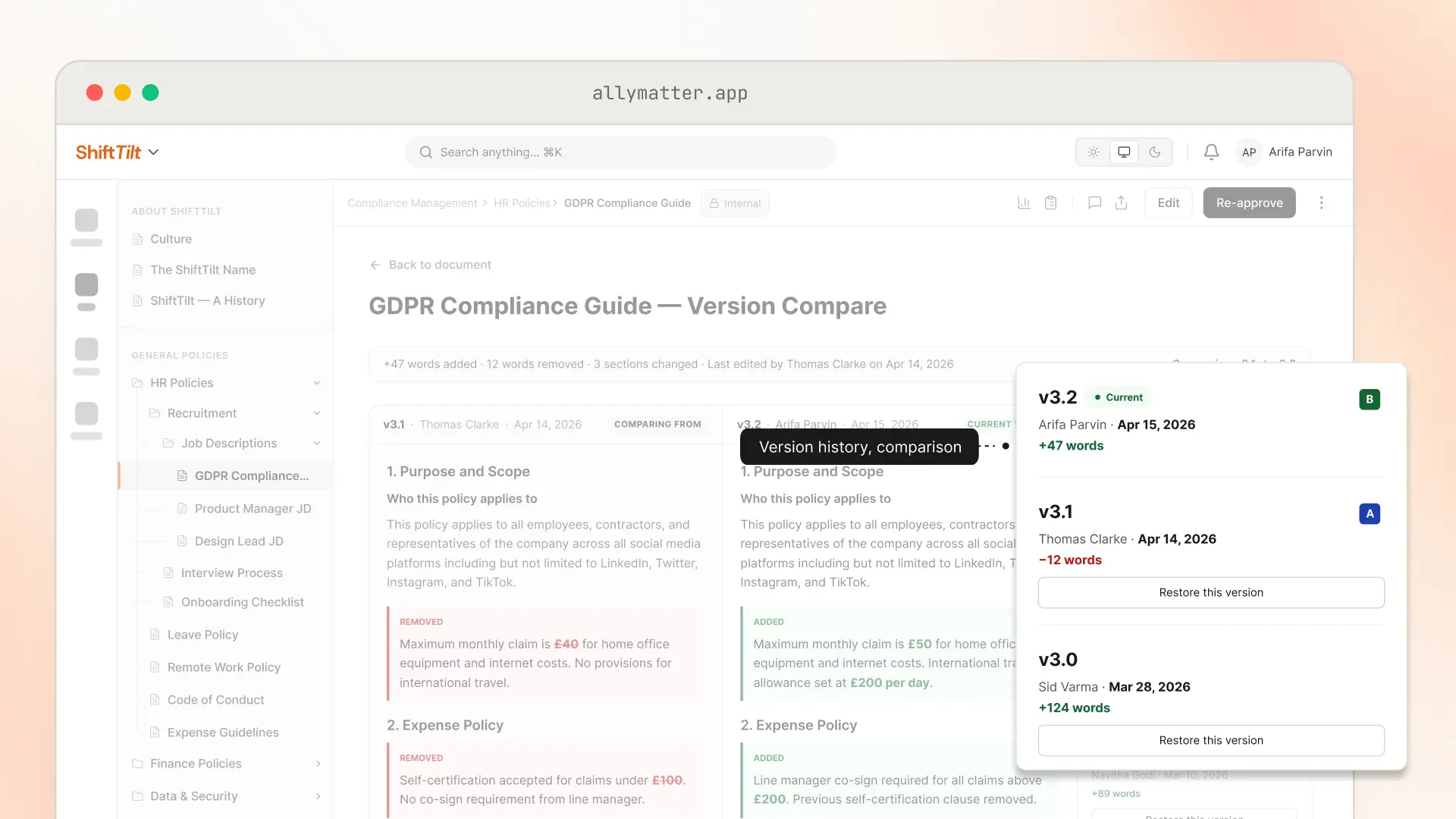
We built AllyMatter so that this is not a judgment call. When a document changes, everyone it applies to is asked to acknowledge the new version. There is no minor-edit exception that an owner can invoke, because a changed comma can change a clause. The objection is reading fatigue, and the answer is tooling rather than skipping the request: Version Compare shows the two versions word by word with a count of what changed, so a handbook update asks for minutes, not an hour.
What counts as proof
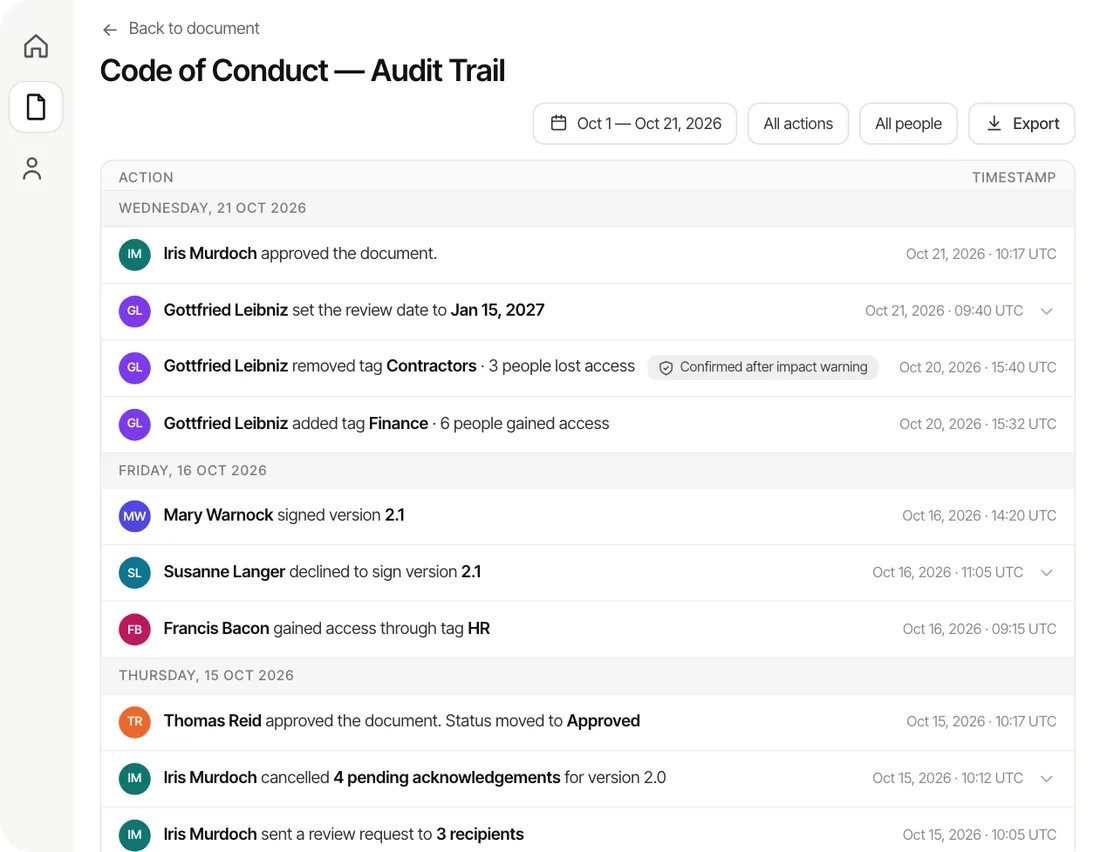
A signature on a page proves one thing: that someone signed. The record an auditor can accept has five parts: who acknowledged (name and the verified email behind it), when (date and time), which version of the handbook, the statement they were shown, and the fact that the request reached everyone it should have. A spreadsheet can assert all five. It cannot evidence any of them.
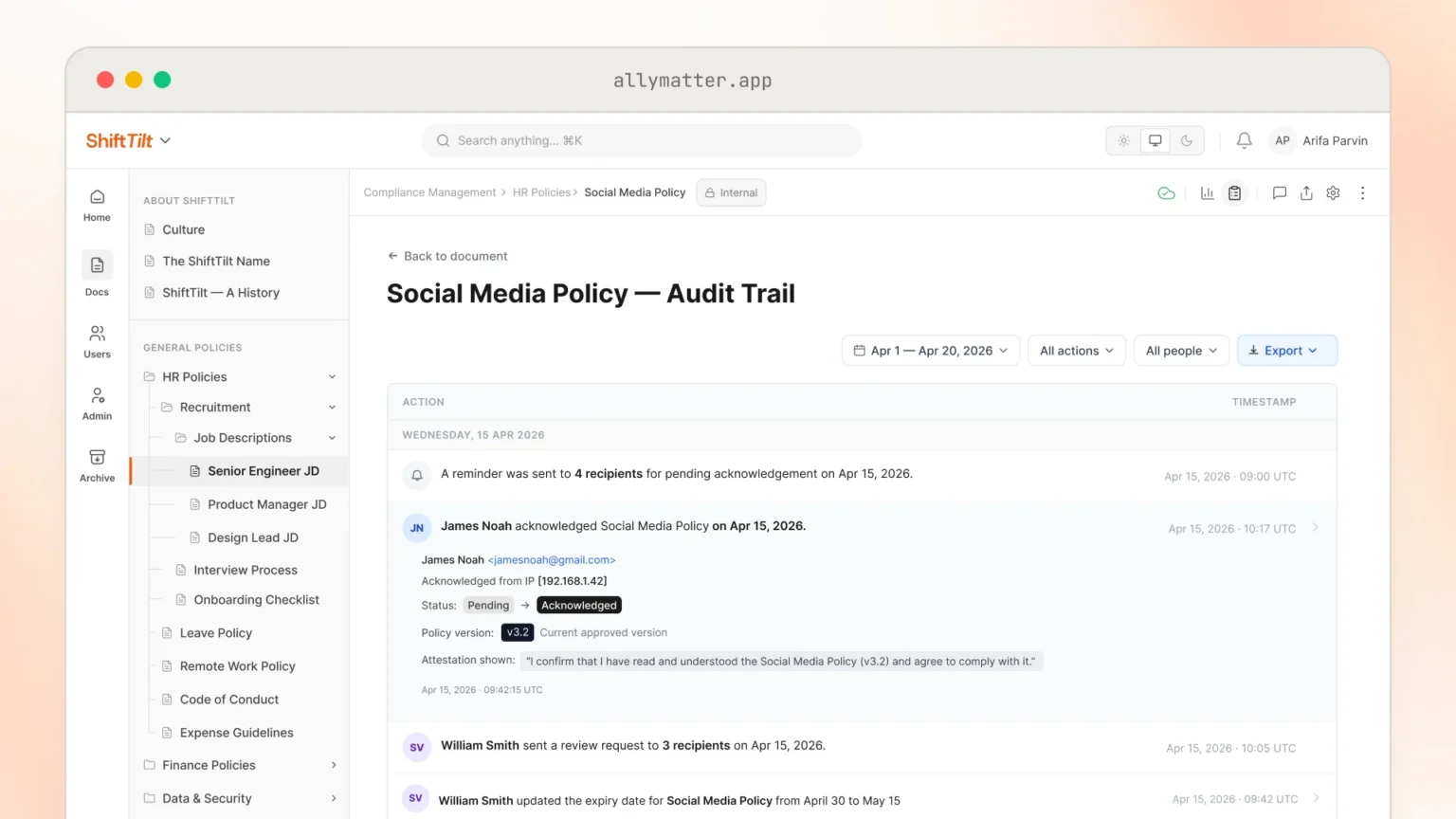
This is what the question "prove everyone acknowledged version 3" looks like when the record was built to be asked. In AllyMatter each acknowledgment is recorded against the person's email identity, the date and time, and the version, with the statement they confirmed stored alongside it. The document's log can be exported as a PDF or a CSV, so the answer to the auditor is a file, not a reconstruction. You can also see who has acknowledged and who has not, which is the list you actually work from.
Digital or paper
Paper works at ten people and fails as filing: the one signed page that matters is the one missing from the drawer, and a page proves nothing about which version was attached. Under the federal ESIGN Act and the state UETA laws, a record is not denied legal effect only because it is electronic, so the real question is not validity but completeness.
Two details make a digital acknowledgment hold. First, the person confirms while signed in, not by clicking a link in an email that anyone with the inbox could click. In AllyMatter the Acknowledge button sits on the document itself and nothing completes from the email. Second, the statement they confirmed is kept with the record, so nobody has to reconstruct a checkbox's wording years later.
If your handbook is a PDF a lawyer wrote and you do not want to rebuild it, you do not have to. Upload it and get it acknowledged by name, with the same record behind it.
When someone refuses to sign
Record the refusal: who, when, and what they were shown. Policies apply whether or not the acknowledgment is signed, because the acknowledgment is a receipt, not consent, and a documented refusal is itself evidence that the policy was communicated. A refusal that comes with a reason is worth a conversation, and sometimes a call to counsel, but it does not create a gap in the record if the refusal is written down.
How long to keep it
At least for as long as the version it covers could be questioned. In practice that means the employee's whole tenure and the retention period your record policy sets after they leave, since disputes arrive late. Counsel can give you the number for your state; what this page can settle is that the record should be kept with the version, not in a folder that outlives the handbook it refers to.
How AllyMatter runs handbook acknowledgment
The audience is a tag, so nobody is missed. Everyone in scope gets the handbook through the tag they hold, and a new hire who is given the tag receives the handbook and the acknowledgment request with it.
Reminders run on their own. When you distribute the handbook for acknowledgment, you choose the reminder cadence in the same step, and the system sends the reminders and logs each one. The HR job becomes reading the list of who has not acknowledged, not maintaining it.
Only approved versions go out, and every change re-collects. Nothing reaches employees unapproved, and a new version asks everyone again, with Version Compare keeping the re-read short.
The proof is a file. The document's log, with every acknowledgment against its version, exports as a PDF or a CSV when someone asks.
Start your 30-day free trial of AllyMatter. No credit card to start, and a 30-day money-back guarantee if you subscribe and change your mind. Free migration on yearly plans.
Questions people ask about handbook acknowledgment
Is an employee handbook acknowledgment legally required?
In general no law requires the acknowledgment itself, but some policies inside the handbook carry their own notice rules, and surveyors, insurers and client auditors often ask for proof that policies were communicated. The acknowledgment is how that proof is kept. Rules vary by state and industry, so ask your employment counsel.
Do employees have to sign the handbook?
An employer can ask for it and can record a refusal. The policies in the handbook apply to employees whether or not they sign, because the acknowledgment is a receipt, not consent. What matters is that the refusal is written down with the date and what the person was shown.
What should the acknowledgment say?
That the employee received the handbook or knows where it lives, that reading it and following it is their responsibility, that it will change and will need acknowledging again, that it is not a contract, plus any employment-status wording your counsel wants. The two versions above cover it.
Does emailing the handbook count as acknowledgment?
Sending proves you sent it. Acknowledgment needs the employee's own recorded confirmation. A reply to an email is a weak version of one: it names no version, keeps no statement, and takes an afternoon to assemble when someone asks.
How often should employees acknowledge the handbook again?
Every time it changes. The acknowledgment covers the version it names and nothing after it. Many companies also run a yearly cycle so the record is never older than a year, but the change is what creates the need.
Is a digital acknowledgment as good as a signed page?
Under the federal ESIGN Act and the state UETA laws, a record or signature is not denied legal effect only because it is electronic. In practice a good digital record is stronger than a scanned page, because it binds the person's identity, the statement shown, the version and the time in one place.
The handbook acknowledgment is the cheapest insurance in HR: one page, collected once per version, that settles arguments before they start. The only expensive ones are the missing one and the one that names the wrong version.
Start your 30-day free trial of AllyMatter. No credit card to start, and a 30-day money-back guarantee if you subscribe and change your mind. Free migration on yearly plans.