Checked against primary sources on 18 October 2026.
Who it applies to
Providers that choose CARF accreditation for programs such as behavioral health and aging services, and then must show conformance to the applicable manual throughout the accreditation term.
Who checks
CARF survey teams of industry peers, who review documentation, observe services and interview leadership, personnel, persons served and other stakeholders
How often
Three-Year Accreditation is the highest outcome for most programs (Five-Year for CCRCs only); Quality Improvement Plan within 90 days of the decision; annual reporting during the term
Current edition
2026 standards manuals, for surveys from July 1, 2026 through June 30, 2027, 2026-07-01. Paid standard (2026 Behavioral Health Standards Manual, printed copy US$214.00 at the CARF online store).
Dates to know
Dates for CARF
Date
What happens
Status
2026-07-01
2026 CARF standards manuals take effect for surveys
Done
2026-07-01
New sobering center standards apply to behavioral health surveys
Done
2027-07-01
2026 standards period ends and the 2027 manuals take over for surveys
Expected
What CARF asks you to write down
Each one needs an owner, an approval, and proof it reached the people it covers.
ASPIRE 1.A Leadership (1.A.6, 1.A.7)
Ethical code of conduct and corporate compliance
Written ethical codes of conduct with procedures for alleged violations and, for U.S. organizations receiving federal funds, a corporate compliance policy, exclusion procedures and a documented compliance officer.
Code version and leadership adoption
Designated compliance officer
Exclusion screening procedures
ASPIRE 1.G Risk Management (1.G.1, 1.G.4)
Risk management plan and technology policies
A risk management plan identifying and analyzing loss exposures and actions to reduce them, reviewed at least annually, plus policies on the use of technology and data.
Loss exposures and reduction actions
Annual review date
Technology and data policy version
ASPIRE 1.H Health and Safety (1.H.4, 1.H.5, 1.H.7)
Health and safety procedures and training
Written emergency and evacuation procedures with written evidence of unannounced tests, and documented competency-based health and safety training at orientation and at least annually.
Training date and competency for each person
Unannounced test results and analysis
ASPIRE 1.I Workforce Development and Management (1.I.4 to 1.I.8, 1.I.13)
Workforce policies and personnel records
Written job descriptions, workforce policies and procedures, orientation covering key plans and policies, documented competency assessments, and documented cybersecurity and technology training.
Orientation topics covered per person
Competency assessments and timeframes
Cybersecurity training dates
ASPIRE 1.J Rights of Persons Served (1.J.1, 1.J.3, 1.J.4)
Rights of persons served and complaints
Policies on the rights of persons served and a written formal complaint procedure, with complaints received documented and analyzed.
Rights policy version
Each formal complaint and its resolution
Documented complaint analysis
ASPIRE 1.K Accessibility (1.K.2)
Accessibility plan
An accessibility plan reflecting the diversity of persons served, personnel and stakeholders, with actions and timelines for identified barriers, reviewed at least annually.
Barriers, actions and timelines
Annual review of progress
Citations are to the standard or regulation; wording is ours. Standard numbers are from CARF's ASPIRE standards as printed in its 2026 manual for continuing care retirement communities. Confirm them against the manual for your program.
What gets asked for on the day
What reviewers sample about these documents and the people they cover.
Documents uploaded before the survey
CARF asks organizations to upload nonconfidential documents, including written policies, plans, procedures and performance analyses, so the survey team can access them the day before the survey starts.
Evidence across the full term
On a resurvey the organization shows conformance since its last survey; on an original survey, any activity required at a set interval, such as annually, must have occurred at least once beforehand.
Personnel and training records
Records that substantiate conformance are assembled in one room or opened electronically for surveyors, such as documented orientation, competency assessments and annual health and safety training.
Interviews alongside the documents
The team interviews leadership, personnel, persons served and at least one representative of a major purchaser, and observes services in addition to reviewing documentation.
The policy and acknowledgment layer for CARF.
Write each policy, send it through approval, and send it to the people it covers. Each acknowledgment is recorded by name, with the version, the date and the time.
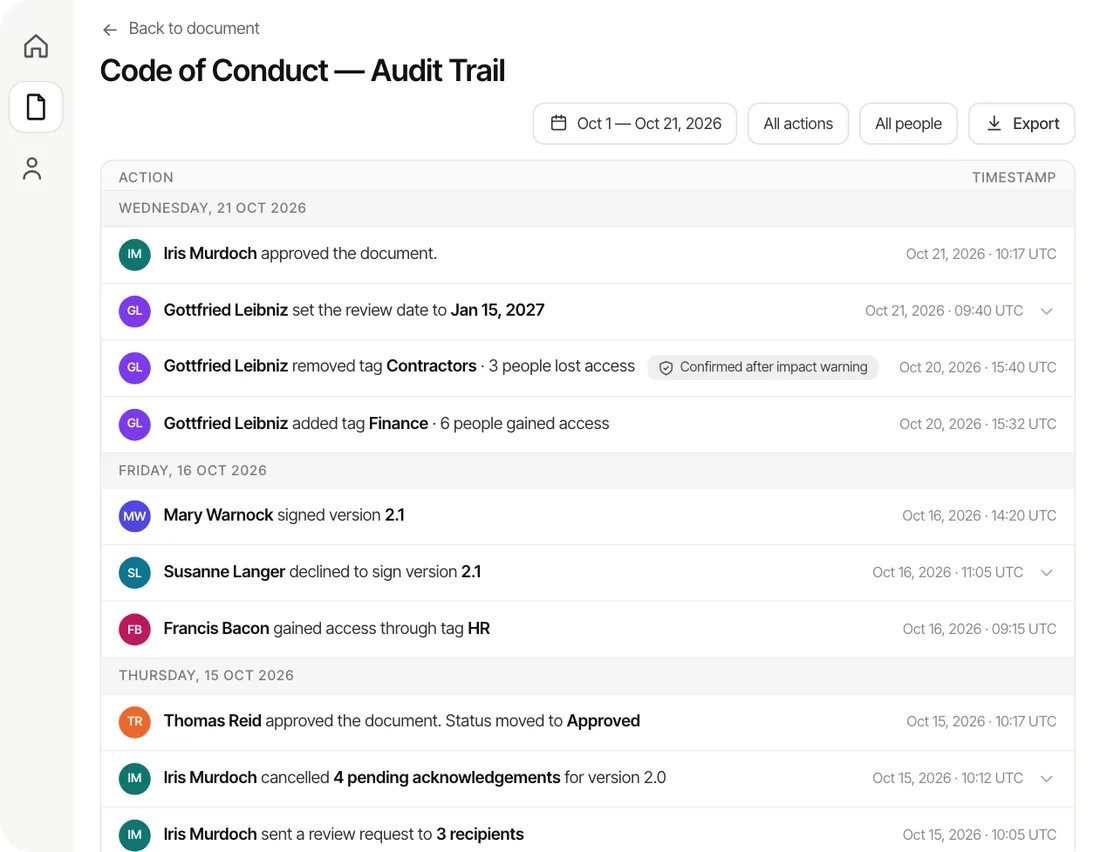
When a policy changes, the new version is approved, its Editor sends it out again, and everyone it applies to is asked again. Export the record as a PDF or CSV, or give a reviewer Viewer access to the documents their tags allow.
Approved before it goes outUp to four steps, with any or all approvers.
Acknowledged by nameName, email, date, time and version on every record.
Asked again on every changeEach new version goes out again to everyone it applies to.
The record on requestA PDF or CSV export, or Viewer access to the documents their tags allow.
Your region’s laws, the standards your customers ask for, and your own house rules. Write each one as a policy, approve it, and send it to the people it covers.
Which standards explicitly require written evidence?
CARF treats the terms policy, plan, documented, documentation and written as always calling for written evidence. Each 2026 manual lists those standards in an appendix on required written documentation, which works as a survey preparation checklist.
What changed in Section 1 for 2026?
The 2026 manuals add a standard on policies and written procedures for artificial or augmented intelligence, fold the technology subsection into risk management and workforce standards, and move diversity into the accessibility plan. Later subsections were re-lettered, so cross-references from 2025 need updating.
How often are the risk management and accessibility plans reviewed?
Both plans are reviewed at least annually for relevance and updated as needed. The accessibility plan review also covers progress in removing identified barriers.
What happens after the survey?
CARF issues a written report about six to eight weeks after the survey, and the organization submits a Quality Improvement Plan within 90 days of notification. At resurvey it is held accountable for following up on those recommendations.
When do the 2026 standards apply?
The 2026 manuals apply to surveys from July 1, 2026 through June 30, 2027. New standards, such as sobering center standards within the behavioral health crisis programs, took effect on July 1, 2026.