ISO/IEC 17025: lab policies, procedures and competence records kept current
For quality managers at accredited testing and calibration laboratories. What the standard asks the laboratory to document, and what the accreditation assessor samples.
Checked against primary sources on 18 October 2026.
Who it applies to
Testing and calibration laboratories that seek accreditation, often because regulators, customers or contracts require accredited results.
Who checks
Accreditation bodies such as A2LA, ANAB, PJLA and IAS in the US, recognized through the international arrangement now run by Global ACI
How often
Initial accreditation assessment, then surveillance, annual review and renewal assessments on the accreditation body's cycle; A2LA asks for proficiency testing evidence at each
Current edition
ISO/IEC 17025:2017 (Edition 3), confirmed at systematic review in 2023, 2017-11-29. Paid standard (CHF 179 for English PDF + ePub or paper; CHF 215 with redline, per iso.org).
Dates to know
Dates for ISO/IEC 17025
Date
What happens
Status
2026-01-01
IAF and ILAC roles pass to Global Accreditation Cooperation Incorporated (Global ACI)
Done
What ISO/IEC 17025 asks you to write down
Each one needs an owner, an approval, and proof it reached the people it covers.
Clause 8.2 (Option A)
Management system policies and objectives
Laboratory management documents policies and objectives covering competence, impartiality and consistent operation, and ensures they are acknowledged and implemented at all levels.
Policies on competence, impartiality and consistent operation
Evidence staff acknowledged them
Management approval and review date
Clause 4.1
Impartiality commitment and risk record
Management commits to impartiality, the laboratory identifies risks to impartiality on an ongoing basis, and it can show how each risk is eliminated or minimized.
Signed management commitment to impartiality
Impartiality risks with mitigation and owner
Clause 6.2.2
Competence requirements by function
Competence requirements for each function influencing results are documented, covering education, qualification, training, technical knowledge, skills and experience.
Requirements for each position
Controlled and versioned like other documents
Clause 6.2.5
Personnel procedures and records
The laboratory keeps procedures and records for determining competence requirements and for selecting, training, supervising, authorizing and monitoring the competence of personnel.
Training and supervision record per person
Authorization date and scope
Ongoing competence monitoring results
Clause 8.3 (Option A)
Control of management system documents
Internal and external documents are approved before issue, periodically reviewed, uniquely identified, available at points of use, and protected from use once obsolete.
Approver and issue date
Current revision status and change identification
Obsolete versions marked if retained
Clause 8.4 (Option A)
Control of records
Legible records show fulfillment of the standard, with controls for identification, storage, protection, back-up, archive, retrieval, retention time and disposal.
Retention period consistent with contracts
Access consistent with confidentiality commitments
Citations are to the standard or regulation; wording is ours.
What gets asked for on the day
What reviewers sample about these documents and the people they cover.
Personnel files for sampled staff
Assessors pick staff from the scope and check competence requirements, training, supervision, authorization and monitoring records; A2LA reports clause 6.2 among its ten most cited areas.
Documents at points of use
Assessors compare documents in use at the bench with the controlled versions, checking approval, revision status and that obsolete documents are identified or removed.
Impartiality risk review
Assessors ask how risks to impartiality are identified, including relationships of personnel, and look for the record of how each identified risk was eliminated or minimized.
Policies acknowledged at all levels
Assessors look for evidence that policies and objectives were communicated and acknowledged across the laboratory, and ask staff where to find the parts relevant to their work.
The policy and acknowledgment layer for ISO/IEC 17025.
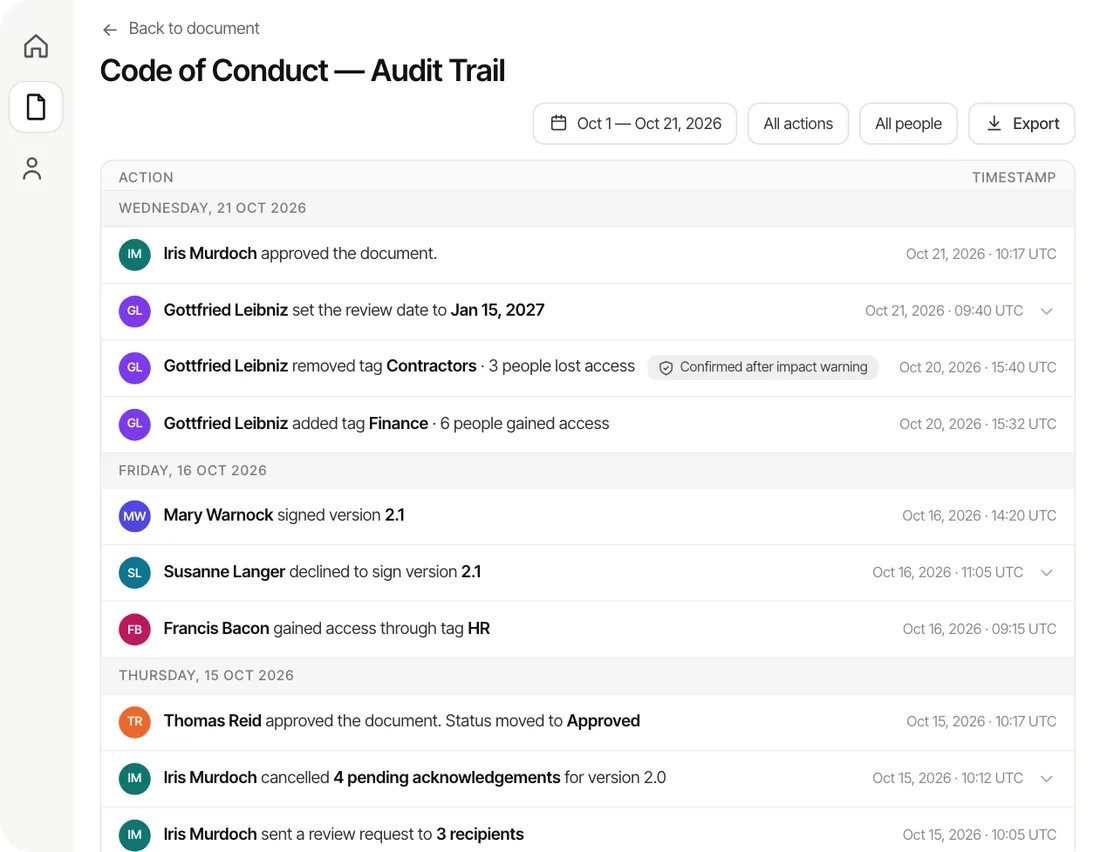
Write each policy, send it through approval, and send it to the people it covers. Each acknowledgment is recorded by name, with the version, the date and the time.
When a policy changes, the new version is approved, its Editor sends it out again, and everyone it applies to is asked again. Export the record as a PDF or CSV, or give a reviewer Viewer access to the documents their tags allow.
Approved before it goes outUp to four steps, with any or all approvers.
Acknowledged by nameName, email, date, time and version on every record.
Asked again on every changeEach new version goes out again to everyone it applies to.
The record on requestA PDF or CSV export, or Viewer access to the documents their tags allow.
Your region’s laws, the standards your customers ask for, and your own house rules. Write each one as a policy, approve it, and send it to the people it covers.
Option A means the management system addresses clauses 8.2 to 8.9 directly. Option B applies where the laboratory runs an ISO 9001 management system that supports clauses 4 to 7 and meets at least the intent of 8.2 to 8.9.
Is ISO/IEC 17025:2017 still the current edition?
Yes. iso.org shows ISO/IEC 17025:2017 as confirmed at its systematic review on 18 August 2023, and no revision project is listed. The English text was not changed by the 2018 corrected version, which applied to French and Spanish only.
How much needs to be written as procedures?
Clause 5.5 c) asks the laboratory to document procedures to the extent needed for consistent application and valid results. Clause 6.2.5 is more specific, requiring procedures and records for six personnel activities, which A2LA notes can be covered in one procedure or several.
How long must records be kept?
Clause 8.4 asks for retention controls and a retention period consistent with contractual obligations. Accreditation body rules, sector schemes and regulations may set longer periods.
What changed for international recognition in 2026?
IAF ceased operations on 1 January 2026, and Global Accreditation Cooperation Incorporated (Global ACI) took over the roles of IAF and ILAC. Laboratory accreditation continues through the national accreditation body.