
Human Resources · 6 min read
Stop Calling It a Handbook: Make HR Content a Living System
Somewhere in your company’s shared drive is a file named something like Employee_Handbook_2025_FINAL.pdf. It was a project once: weeks of writing, a legal review, an all-staff email, a burst of signatures. Then it started aging, the way books do. The leave policy changed in March and the PDF did not. A new state, a new benefits provider, a new security requirement, and by autumn the handbook is a historical document that new hires are still signing.
The problem is the format, not the effort. A handbook is not a book. It is a binding: forty-odd policies with different owners, different stakes, different change rates, and different legal weight, stapled together because paper made that convenient in 1985. Treat it as one artifact and you inherit the book’s failure modes: it is only ever current all at once, and only ever updateable as a project. The full handbook playbook, from legal weight to tracking at scale, lives in the handbook acknowledgment guide.
Four signs the one-PDF model has already failed at your company:
- A policy changed this year and the handbook PDF did not, so people are acknowledging text you know is stale.
- New hires sign the current book while everyone hired earlier signed older ones, and nobody can say who agreed to what.
- A revision went out and re-collecting signatures meant a spreadsheet and a chase, so it quietly didn’t happen.
- Contract-weight language (arbitration, confidentiality, IP) sits inside the same receipt signature as the dress code.
Key takeaways
- A handbook is forty policies with different owners, change rates, and legal weight; one PDF forces them to share one lifecycle, and that is the root failure.
- The fix keeps the handbook as an experience (one curated reading list) and retires it as an artifact: per-policy owners, versions, and acknowledgment.
- Obligations should match content: culture notes publish quietly, policies collect version-bound acknowledgment, and true agreements take e-signatures.
What is inside the staple
Unbind the PDF mentally and look at the parts:
- Policies that change often and matter operationally: leave, expenses, remote work.
- Policies that rarely change but carry compliance weight: code of conduct, anti-harassment, safety.
- Content that is not policy at all: culture notes, benefits summaries, office logistics.
- And, in the worst handbooks, things that should never live behind a receipt signature: arbitration terms, confidentiality obligations, IP language. Courts have repeatedly refused to enforce contract-weight clauses buried in acknowledged handbooks, and the case law is brutal reading for anyone running the one-PDF model.
One artifact, four different kinds of content, one signature covering all of it. That is the format error.
The living system, in four moves
Unbundle. Each policy becomes its own document with its own owner, its own review date, and its own audience. The “handbook” survives as the curated collection, what a new hire experiences as one reading list, without forcing forty documents to share one lifecycle.
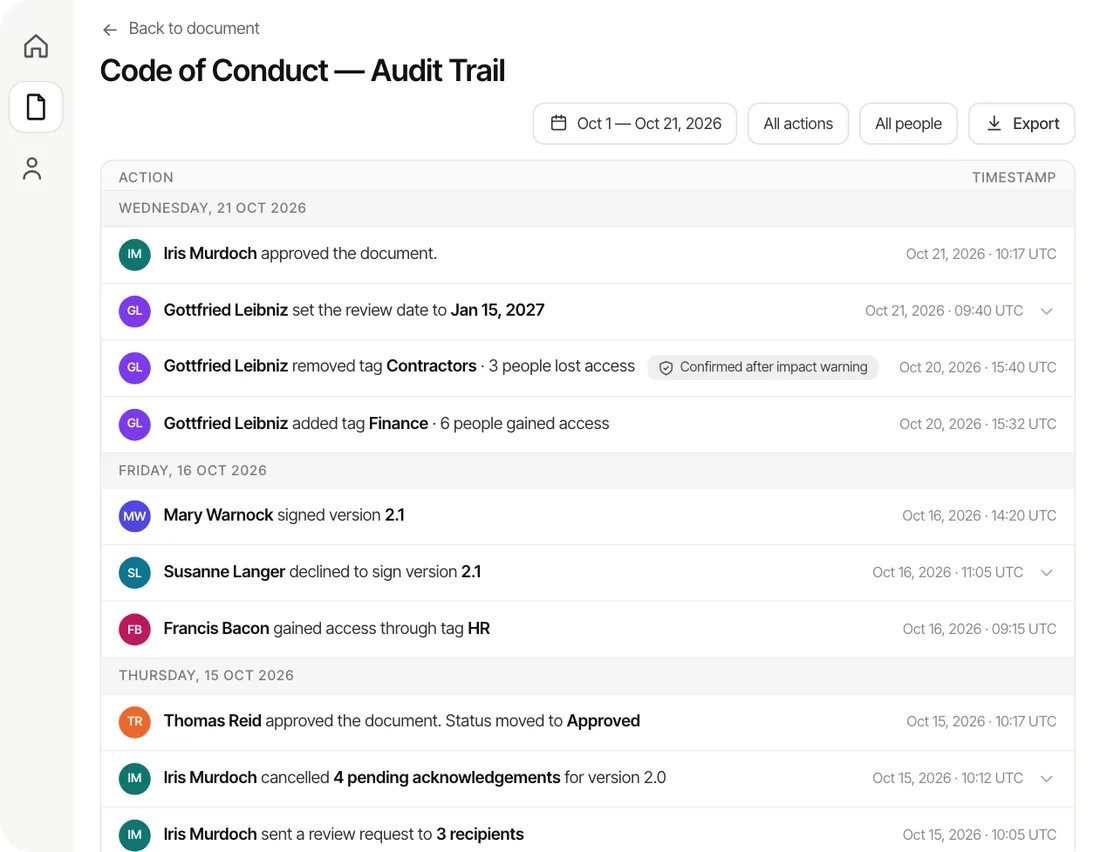
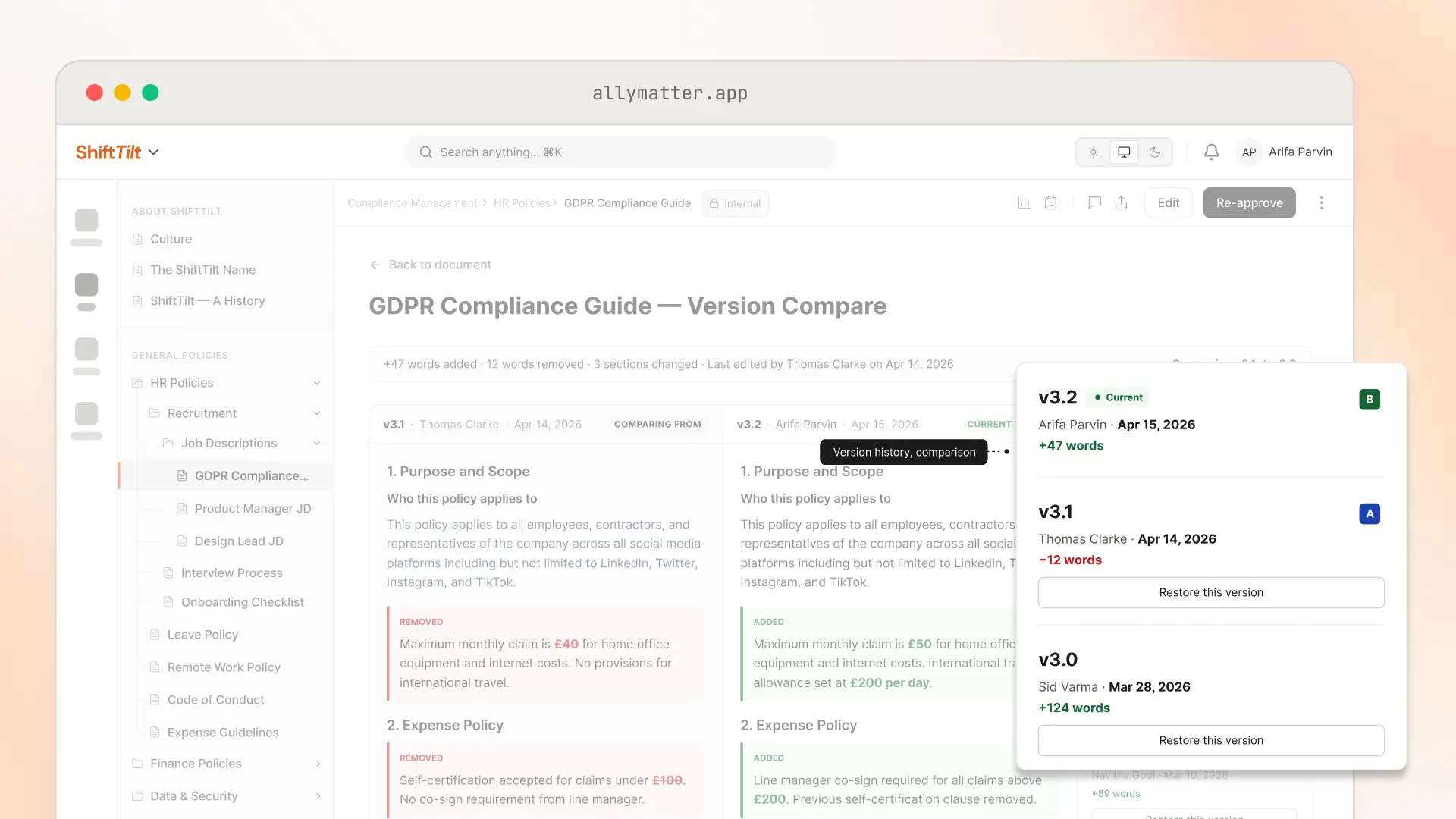
Version everything, separately. When the leave policy changes, the leave policy changes: it re-runs its approval, its audience re-acknowledges with a word-by-word diff in front of them, and the code of conduct sits untouched. No more choosing between shipping one policy change and reprinting the book.
Match the obligation to the content. Culture notes publish with no ask. Operational policies collect acknowledgment, bound to the exact version and text. The documents that are really agreements, NDAs, IP assignments, stand alone and take an e-signature. One bundle, three obligation types, each provable on its own terms.
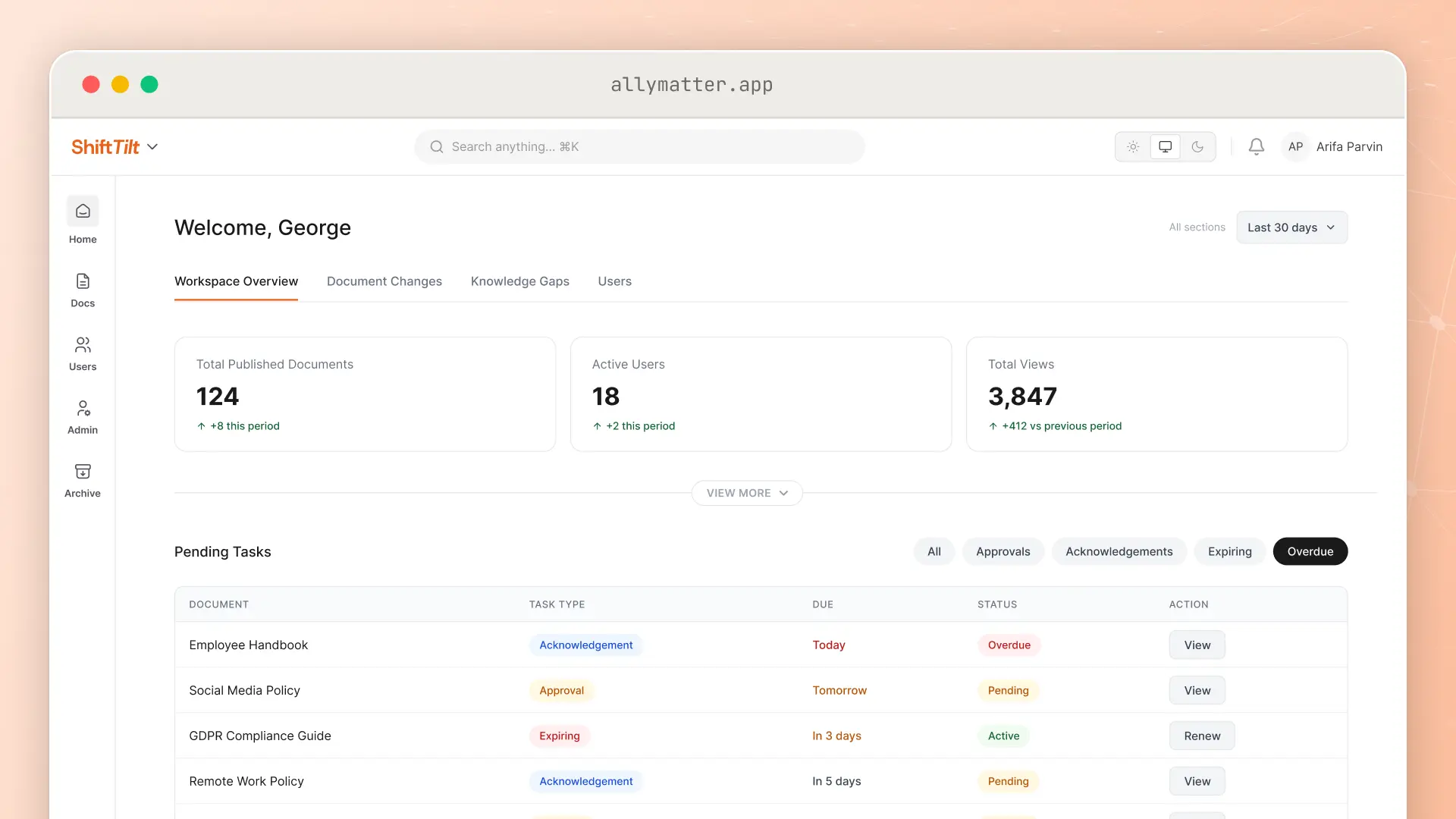
Put the cycle on rails. Tags decide which documents each new hire receives, with deadlines and reminders. The policies that need annual re-confirmation get it on a schedule, whether or not the text changed.
“But everyone signs one handbook”
The objection is always continuity: auditors expect a handbook, new hires expect a handbook, counsel wrote a handbook. Nothing about the living system removes the handbook as an experience; it removes it as a single point of failure. The new hire still reads one organized collection. What changed is underneath: each piece is current, each acknowledgment names its policy and version, and the record can answer the question the one-PDF model never can: which version of which policy did this person confirm, and when?
That question is exactly where the PDF model dies in practice: the March hire signed the January book, the June revision invalidated everyone’s signatures and nobody re-collected, and the person handling the September dispute is now doing archaeology. And when someone declines to sign at all, a living system records the refusal with its reason instead of losing it in an inbox.
What this looks like in AllyMatter
The handbook becomes a collection of governed documents: each policy owned, versioned, approved before distribution, and targeted by tags. Acknowledgments bind to the exact text and version each person saw and survive turnover permanently. Changes re-run approval and re-collect acknowledgment automatically, with the diff shown, so a two-line edit costs the audience two minutes, not a re-read. The agreements stand alone with e-signatures. And the whole record, who has confirmed what, who is outstanding, what is due for review, is tracked for each policy and exports the day someone asks. Building the underlying structure is its own guide.
Stop calling it a handbook. Keep the reading experience, retire the book, and let each policy be exactly as current, as acknowledged, and as provable as it needs to be.
Three scenarios
If you are under about 30 people, one honest PDF refreshed annually is survivable: keep a change log, date the signatures, and revisit when the first mid-year policy change arrives.
If you are 30 to 500 people, the four signs at the top of this post are probably familiar already, and every new state, client, and hire widens the gap between what people signed and what is true. This is the company we built AllyMatter for.
If you are regulated or client-audited, per-policy, version-bound acknowledgment is what the examiner samples: the one-PDF model fails the sample by construction, however diligent the person running it. We’d start with AllyMatter, and the pre-audit scramble is the week this replaces.
Questions people ask about unbundling the handbook
Do we lose the handbook as a single document for new hires?
No. The collection is the handbook: one ordered reading experience, assigned automatically on day one. What disappears is the single artifact forcing forty policies to share one lifecycle and one signature.
Do employees have to re-sign everything every time anything changes?
The opposite. Only the changed policy re-collects, with the diff in front of each person, while everything else stays untouched. The one-PDF model is what forces all-or-nothing.
What about the arbitration clause and IP language counsel put in the handbook?
Pull them out and treat them as what they are: agreements. They stand alone and take a real e-signature, which is both stronger evidence and cleaner law than a receipt signature on a bundle. Your counsel will recognize the case law behind that instinct.
Start your 30-day free trial. No credit card to start, and a 30-day money-back guarantee if you convert and change your mind.
Not ready for a trial? On annual plans, migration is on us: we’ll move your docs from SharePoint, Google Drive, Confluence, or Notion, usually within a week and often sooner.