CLIA: a director-approved procedure manual and competency records on file
For laboratory directors and quality leads running nonwaived testing under a CLIA certificate of compliance or accreditation. What Part 493 asks for in writing, and what surveyors review.
Checked against primary sources on 18 October 2026.
Who it applies to
US laboratories testing human specimens for health assessment or to diagnose, prevent or treat disease need a CLIA certificate; the written quality system rules apply to nonwaived testing.
Who checks
State Survey Agencies for CMS at certificate of compliance laboratories; CMS-approved accreditation organizations at certificate of accreditation laboratories
How often
Certificates and fees run on two-year cycles; certificate of compliance laboratories are surveyed every two years, and accreditation organizations inspect accredited laboratories once every two years
Current edition
42 CFR Part 493, current eCFR text (up to date as of 2026-10-15), 2025-01-01. Free to read.
Dates to know
Dates for CLIA
Date
What happens
Status
2026-03-01
CLIA moves to paperless certificates and fee coupons; paper checks no longer accepted
Done
What CLIA asks you to write down
Each one needs an owner, an approval, and proof it reached the people it covers.
42 CFR 493.1251
Procedure manual
A written procedure manual covers every test the laboratory performs, and each procedure and change is approved, signed and dated by the current laboratory director before use.
Director signature and date before use
Dates of initial use and discontinuance
Copy kept two years after retirement
42 CFR 493.1200
Quality system policies and procedures
Laboratories doing nonwaived testing keep written policies and procedures that implement and monitor a quality system across preanalytic, analytic and postanalytic phases and general laboratory systems.
Policies for each phase of testing
Quality assessment component with ongoing monitoring
42 CFR 493.1235
Competency assessment policy
The laboratory establishes and follows written policies and procedures to assess the competency of employees and, where applicable, consultants.
Assessment methods used per test system
Assessor, employee and assessment date
Semiannual first year, annual after for high complexity
42 CFR 493.1239
General laboratory systems quality assessment
Written policies set an ongoing mechanism to monitor, assess and correct problems, including review of corrective action, policy revision and discussion with staff.
Problems found and corrective actions taken
Policy revisions made to prevent recurrence
Record of review discussed with staff
42 CFR 493.1105
Record retention
Requisitions, QC and patient test records, proficiency testing and quality assessment records are kept at least two years, with longer periods for pathology reports and slides.
Retired procedures two years after discontinuance
Pathology reports at least ten years
Plan for records if the laboratory closes
Citations are to the standard or regulation; wording is ours.
What gets asked for on the day
What reviewers sample about these documents and the people they cover.
Procedure manual at the bench
Surveyors compare the procedures in use with practice and check that each procedure and change carries the current director's approval signature and date, with dates of initial use and discontinuance.
Competency records for testing personnel
Surveyors sample testing personnel and look for documented competency assessments covering direct observation, result recording, QC review, maintenance checks, blind or PT samples and problem solving.
Quality assessment evidence
Surveyors ask for documentation of ongoing quality assessment, including how problems were identified, corrective actions reviewed for effectiveness and results discussed with staff.
Retained records
Surveyors request QC, proficiency testing and patient test records for at least the prior two years, and retired procedures with their discontinuance dates.
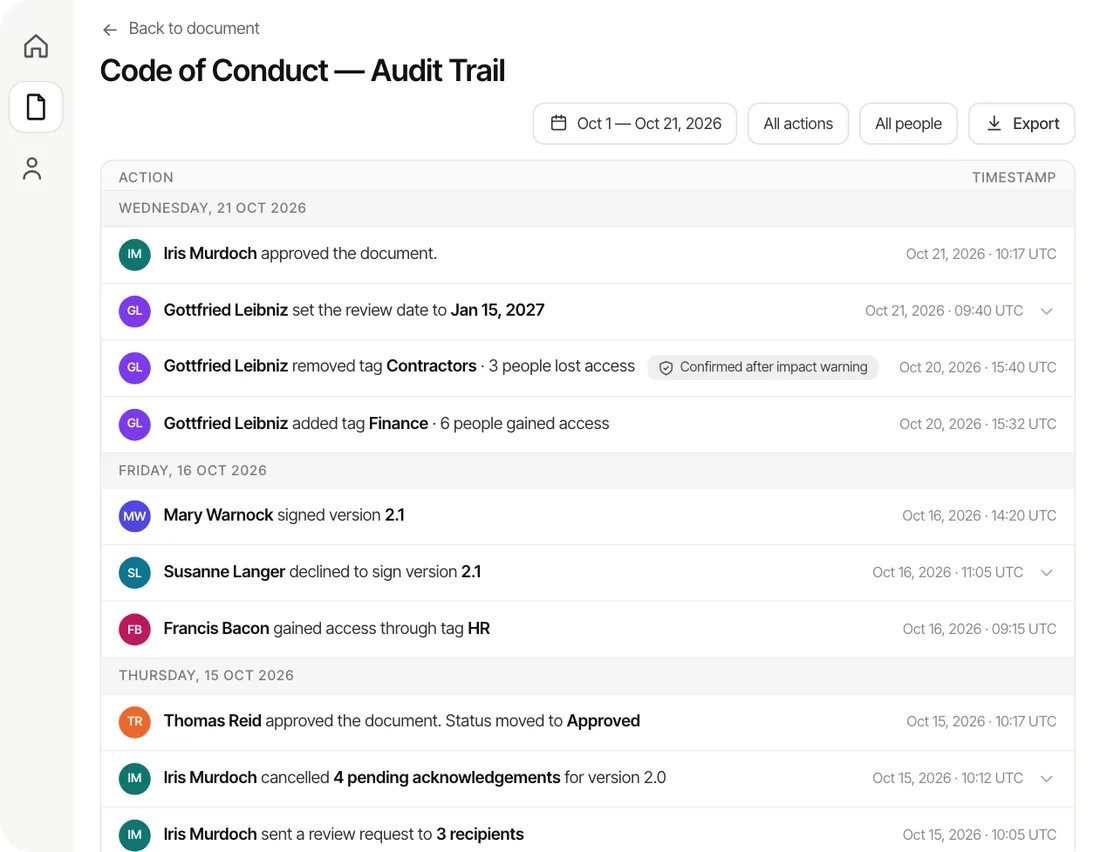
The policy and acknowledgment layer for CLIA.
Write each policy, send it through approval, and send it to the people it covers. Each acknowledgment is recorded by name, with the version, the date and the time.
When a policy changes, the new version is approved, its Editor sends it out again, and everyone it applies to is asked again. Export the record as a PDF or CSV, or give a reviewer Viewer access to the documents their tags allow.
Approved before it goes outUp to four steps, with any or all approvers.
Acknowledged by nameName, email, date, time and version on every record.
Asked again on every changeEach new version goes out again to everyone it applies to.
The record on requestA PDF or CSV export, or Viewer access to the documents their tags allow.
Your region’s laws, the standards your customers ask for, and your own house rules. Write each one as a policy, approve it, and send it to the people it covers.
What happens to the procedure manual when the laboratory director changes?
Section 493.1251(d) requires procedures and changes in procedures to be approved, signed and dated by the current laboratory director before use. Because approval is tied to the current director, laboratories confirm with their State Agency or accreditation organization how a new director's review is documented.
Can manufacturer instructions serve as procedures?
Yes, for the items in 493.1251(b)(1) through (b)(12) where applicable. Anything the manufacturer does not provide must be added by the laboratory, and textbooks may supplement but cannot replace written procedures.
How often must competency be assessed?
For high complexity testing, 493.1451(b)(9) requires evaluation at least semiannually during an individual's first year of patient testing and at least annually after that. A change in methodology or instrumentation requires evaluation before patient results are reported on it.
How long must retired procedures be kept?
Section 493.1105(a)(2) requires a copy of each test procedure for at least two years after it is discontinued. Each procedure must show its dates of initial use and discontinuance.
Does accreditation change the inspection cycle?
Laboratories with a certificate of accreditation are inspected by their CMS-approved accreditation organization once every two years, against that organization's standards. Certificate of compliance laboratories are surveyed every two years by the State Agency for CMS.