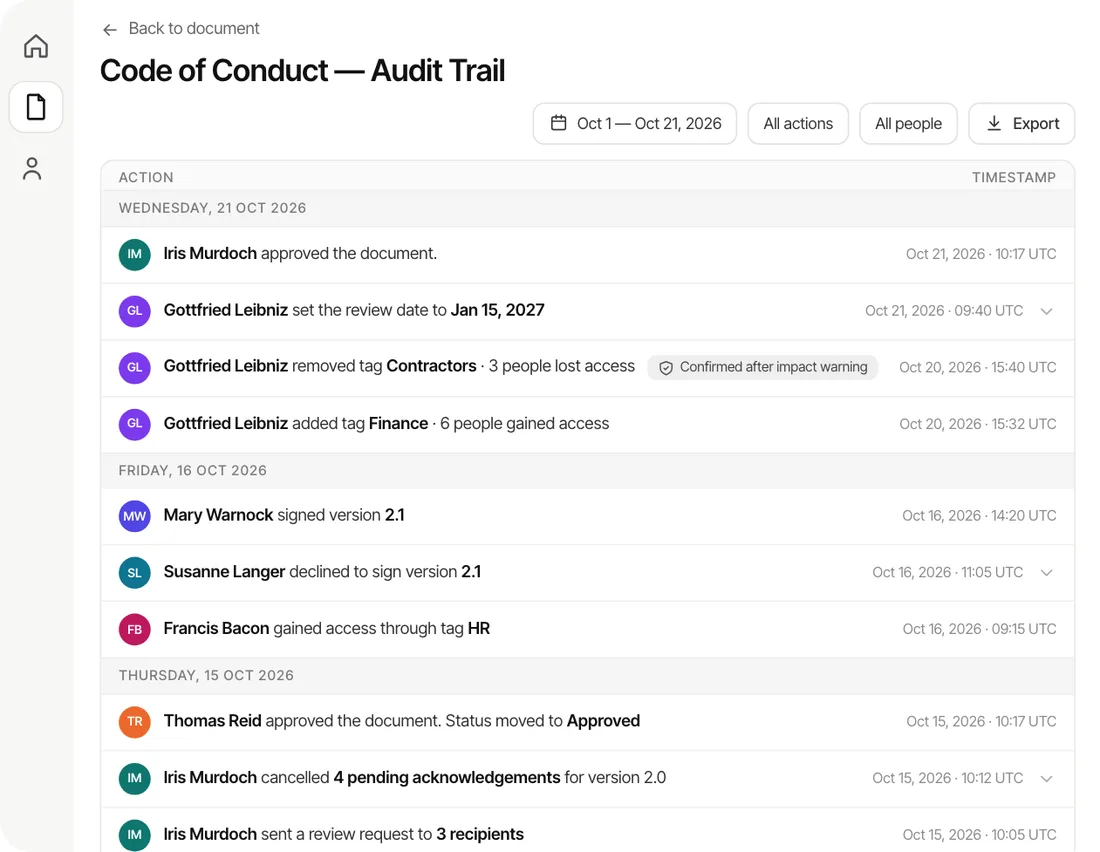
Every employee on the current handbook, and the record to show it.
For HR and People teams who own the handbook, the code of conduct and every people policy. Each one approved, sent to the teams it covers, and on record by person and by version.
The handbook is the start. HR keeps a whole set current, and each one reaches a different group of people.
Employee handbook
Where the notices the law requires reach people. Its acknowledgment is your proof of delivery when a claim or a hearing asks.
Code of conduct
One standard for everyone, and the document customers’ auditors sample first.
Harassment prevention
Local rules set what it says and how it is delivered, and it is your main defense when a complaint arrives.
Leave and time off
Leave, sick pay and attendance rules, kept in step as each country and state changes them.
Remote work
Rights follow the employee to where they live. A policy with local supplements, each sent to the people it covers.
Hiring, background checks and pay
Background checks, fair hiring and pay disclosure rules, current for every recruiter and hiring manager.
Who asks to see them
Wherever you operate, regulators, auditors and counsel ask the same question: which version did this person receive, and when.
2 CCR 11023, NY Labor Law 201-g
Harassment prevention policy
Many places expect a written policy given to every employee, with proof of receipt. California and New York spell out how, down to the language it is written in.
Sent to everyone it covers through their tags
A receipt by person and version
Language versions kept current together
29 CFR 825.300(a)(3)
FMLA general notice
If you have a handbook, the general notice belongs in it. Otherwise it goes to each new employee at hire, and electronic distribution counts.
The notice inside the current handbook
New hires receive it on day one
Delivery on record by person and version
SOC 2, Trust Services Criteria CC1.1
Code of conduct acknowledgment
When customers ask for your SOC 2 report, the auditor usually samples new hires and checks that each one acknowledged the code of conduct.
Every new hire asked on day one
Each acknowledgment with its date and version
The sample exported in seconds
Wherever you employ people
Local employment laws
Leave, working time, pay and conduct rules differ by country and by state. Each place gets its own supplement beside the company-wide handbook.
A supplement for each country or state
Sent only to the people who work there
Each change goes out again
Bring your own rules
Your region’s laws, the standards your customers ask for, and your own house rules. Write each one as a policy, approve it, and send it to the people it covers.