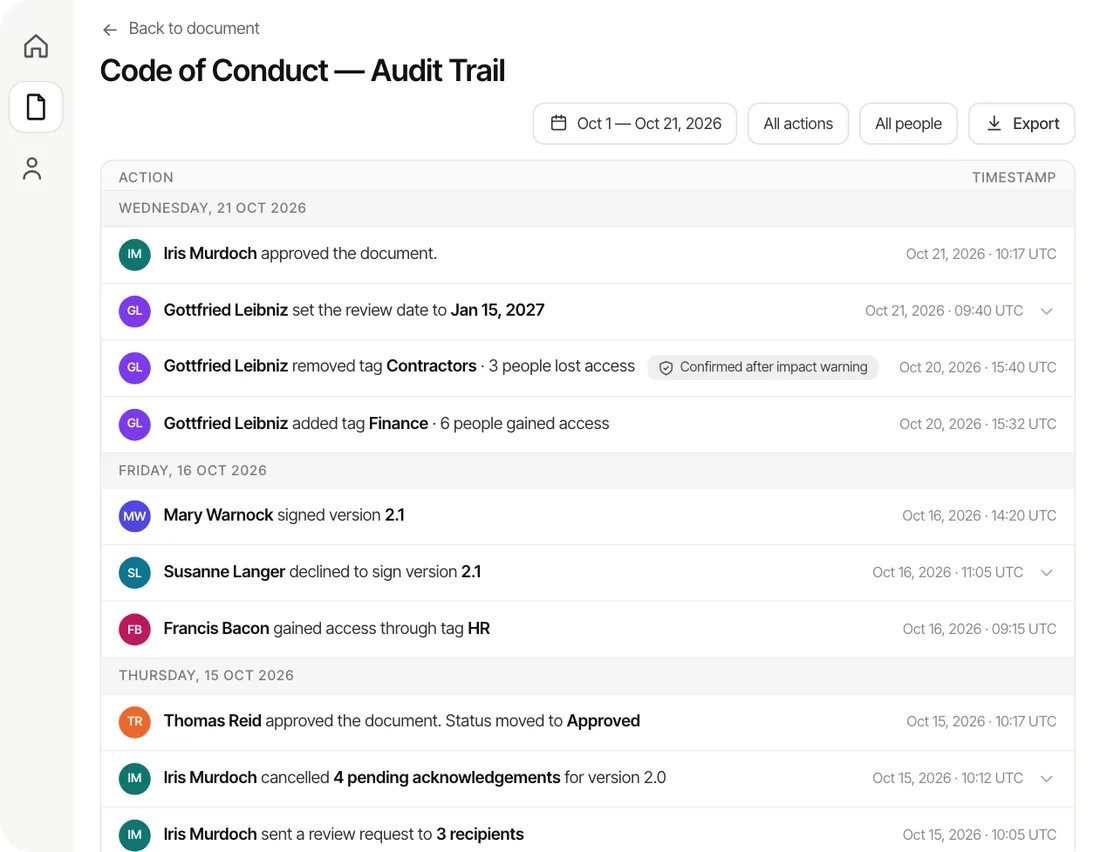
The code of conduct, communicated to everyone, and the record to show it.
For compliance and legal teams who own the code of conduct, the speak-up policy and the rules behind them. Each one approved, sent to the people it covers, and on record by person and by version.
Code of ConductVersion 4.2Owned by Compliance & Legal
Drafted
Compliance team
Philippa Foot, Chief compliance officer
Updated gifts and hospitality limits, a new AI section
28 Sep 2026
Step 1 · Legal
Karl Popper
General counsel
Approved1 Oct 2026
Step 2 · Board
Mary Midgley
Audit committee chair
Approved8 Oct 2026
Sent to everyone
All staff, 162 people
160 of 162
acknowledged version 4.2
The policies you own
The code sets the standard. The policies behind it each reach the people whose work they govern.
Code of conduct
One standard for everyone, and the document every investigator, auditor and partner reads first.
Speak-up and whistleblowing
How to raise a concern and how it is handled, where every employee can find it.
Anti-bribery and corruption
Gifts, hospitality and third-party payments, for the people who meet customers and agents.
Conflicts of interest
What to disclose and to whom, for directors, managers and buyers.
Sanctions and trade
Screening rules for the teams that sell, ship and pay across borders.
Data protection and records
What is kept, for how long, and how it is released, in step with the law.
Who asks to see them
Wherever you operate, prosecutors, regulators and partners ask the same question: was the policy communicated, and can you show it.
US DOJ, Evaluation of Corporate Compliance Programs
Communication of policies
Prosecutors ask how policies were communicated to all employees and relevant third parties, and whether there are language barriers to access.
Every policy sent to the people it covers
Third parties included as external users
Language versions kept current together
UK Bribery Act 2010, s. 7
Adequate procedures
The defence to failing to prevent bribery is adequate procedures, and the guidance names communication, including training, as one of its six principles.
The anti-bribery policy approved and current
Sent to every person who acts for you
Each acknowledgment by person and version
EU Directive 2019/1937, Articles 8 and 9
Internal reporting channels
Companies with 50 or more workers set up internal reporting channels, with clear, easily accessible information on how to report.
The speak-up policy where everyone can find it
Each language version kept current
Every change sent out again
Wherever you do business
Local laws
Each country adds its own rules on bribery, reporting, privacy and records. Each gets its own supplement beside the code.
A supplement for each country
Sent only to the people it applies to
Each change goes out again
Bring your own rules
Your region’s laws, the standards your customers ask for, and your own house rules. Write each one as a policy, approve it, and send it to the people it covers.