ISO 9001: documented information that is approved, current and acknowledged
For quality managers running an ISO 9001 system through the move to the 2026 edition. What the standard expects in writing, and what the certification auditor samples.
Checked against primary sources on 18 October 2026.
Who it applies to
Any organization that chooses to run a quality management system and seek accredited certification, often because customers or sector schemes ask for the certificate.
Who checks
Accredited certification bodies, overseen by accreditation bodies that sign the Global ACI arrangement (formerly IAF)
How often
Two-stage initial certification audit, surveillance audits each year, recertification every three years; transition to the 2026 edition through a scheduled or special audit by 30 September 2029
Current edition
ISO 9001:2026 (Edition 6), replacing ISO 9001:2015 and Amd 1:2024, 2026-09-16. Paid standard (CHF 196 for English PDF + ePub or paper; CHF 235 with redline, per iso.org).
Dates to know
Dates for ISO 9001
Date
What happens
Status
2026-09-04
Global ACI issues mandatory transition requirements for ISO 9001:2026 (Global ACI-TECH-3-TR)
Done
2026-09-16
ISO 9001:2026 published (Edition 6)
Done
2027-03-31
Accreditation bodies ready to assess certification bodies to ISO 9001:2026
Scheduled
2028-03-31
New and initial accredited certifications issued only to ISO 9001:2026
Scheduled
2029-09-30
End of transition: ISO 9001:2015 certificates must be moved to ISO 9001:2026
Scheduled
What ISO 9001 asks you to write down
Each one needs an owner, an approval, and proof it reached the people it covers.
Clause 4.3
Scope of the quality management system
The scope is kept as documented information, naming the products and services covered and justifying any requirement the organization treats as not applicable.
Products, services and sites covered
Justification for each requirement not applied
Current approved version
Clause 5.2
Quality policy
Top management sets a quality policy suited to the organization's context and strategy, keeps it as documented information, and communicates it internally and to relevant interested parties.
Top management approval and effective date
Where staff and interested parties can read it
Evidence it was communicated and understood
Clause 6.2
Quality objectives and plans
Quality objectives are set for relevant functions and levels, kept as documented information, and planned with responsibilities, resources, timing and how results are evaluated.
Each objective with owner and target date
How results are measured and reviewed
Clause 7.2
Competence records
The organization defines the competence needed for work affecting quality, acts to close gaps, and retains documented information as evidence of competence.
Competence requirements for each role
Training, education or experience per person
Check that training actions worked
Clause 7.3
Awareness, including quality culture and ethical behavior
People working under the organization's control are made aware of the quality policy, relevant objectives and their contribution, and in the 2026 edition of quality culture and ethical behavior.
Who was briefed, on which version
Date of briefing or acknowledgment
Clause 7.5
Control of documented information
Documents the system needs are identified, reviewed and approved, version controlled, available where used and protected, with obsolete versions kept from unintended use.
Identifier, version and approver for each document
Change history and distribution
Retention period and disposal for records
Citations are to the standard or regulation; wording is ours. Sub-clause numbers inside clause 7.5 of the 2026 edition are not cited because the text sits behind ISO's paywall.
What gets asked for on the day
What reviewers sample about these documents and the people they cover.
Documents at the point of use
Auditors pick working documents where the work happens and compare them with the controlled master, checking approval, revision status and that superseded copies are withdrawn or marked.
Quality policy in practice
Staff are asked where the quality policy is and what it means for their job, then the auditor looks for the record of how it was communicated.
Competence and awareness for sampled roles
For a sample of roles, auditors compare defined competence requirements with training and qualification records and ask how awareness of quality culture and ethical behavior is achieved.
Transition audit to the 2026 edition
The transition audit reviews how the organization addressed the changed requirements, including the reorganized risks and opportunities clause, planning of changes, leadership on quality culture and the new awareness item.
The policy and acknowledgment layer for ISO 9001.
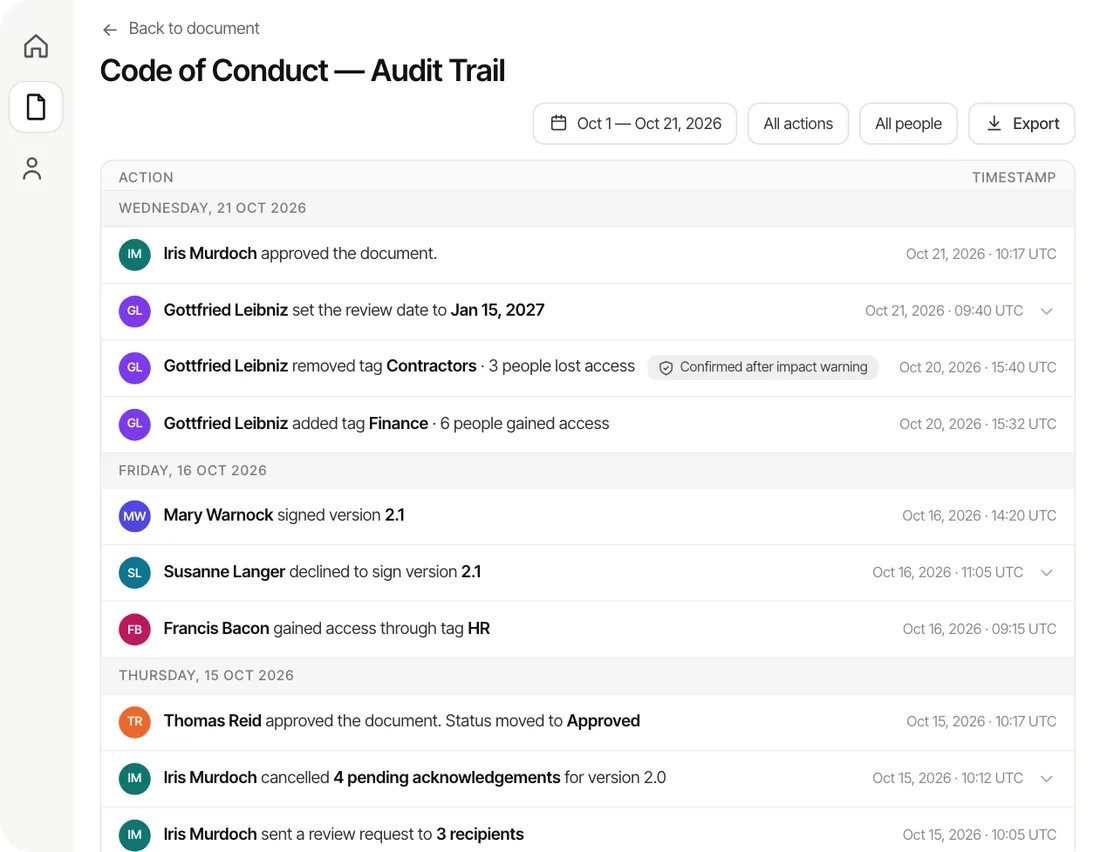
Write each policy, send it through approval, and send it to the people it covers. Each acknowledgment is recorded by name, with the version, the date and the time.
When a policy changes, the new version is approved, its Editor sends it out again, and everyone it applies to is asked again. Export the record as a PDF or CSV, or give a reviewer Viewer access to the documents their tags allow.
Approved before it goes outUp to four steps, with any or all approvers.
Acknowledged by nameName, email, date, time and version on every record.
Asked again on every changeEach new version goes out again to everyone it applies to.
The record on requestA PDF or CSV export, or Viewer access to the documents their tags allow.
Your region’s laws, the standards your customers ask for, and your own house rules. Write each one as a policy, approve it, and send it to the people it covers.
How large are the documentation changes in ISO 9001:2026?
Global ACI describes the overall changes as minimal, with new wording on documented information and a clarified statement that documented information shall be available. SGS reports that clause 7 was restructured with few substantive changes. A gap review of the current document set against the 2026 text is still the expected first step.
When does an ISO 9001:2015 certificate need to move to the 2026 edition?
Under Global ACI-TECH-3-TR, certification bodies must transition existing clients by 30 September 2029, at a surveillance, recertification or special transition audit. From 31 March 2028, new and initial certifications are issued only to ISO 9001:2026.
Does ISO 9001 require each employee to sign the quality policy?
The standard asks that the quality policy be communicated, understood and applied, and that people be aware of it. It does not prescribe the form of evidence, so organizations choose records such as dated acknowledgments, briefing logs or training records.
What do quality culture and ethical behavior add?
Leadership commitment in clause 5.1.1 now includes promoting quality culture and ethical behavior, and clause 7.3 adds awareness of them. A new note explains that they show up in the organization's shared values, attitudes and established practices.
Who sets the transition rules now that IAF has closed?
IAF ceased operations on 1 January 2026 and Global Accreditation Cooperation Incorporated (Global ACI) took over its role. Global ACI issued the mandatory ISO 9001:2026 transition document on 4 September 2026, and each certification body schedules audits within it.