
Every time. In AllyMatter, any change to a distributed policy re-runs approval and then re-collects acknowledgment from everyone the policy covers, and there is no minor-edit exception where an owner decides a change does not count. That is the short answer, and I know it sits at the strict end of the spectrum, because most of the advice you will find online says the opposite. The rest of this page is the why: the best argument I have ever heard against our rule, the audit that shaped how I operate, and the two design choices that keep the strict version humane.
What does everyone else say?
The prevailing advice, including from handbook software vendors, is some version of minor/major gating: wording tweaks, reorganized sections, and administrative changes do not need new signatures; save the re-signing ceremony for major changes. It is popular advice because it responds to a real pressure, which is signature fatigue.
The trouble is what the employment lawyers say when an actual dispute lands: a signature on an old version does not automatically bind anyone to the new text. Those two positions cannot both be safe. The gap between them is a quiet one, because the version in force and the version people signed drift apart without anyone noticing, and the drift only matters on the worst possible day, in front of exactly the person you least want reading your records. The court record on acknowledgments that could not name their text is not comfortable reading. [LINK WHEN LIVE: The court cases where click-through acknowledgments failed]
What is the best argument for skipping re-acknowledgment?
The strongest case I ever heard was not from a vendor. It was from a head of sales I worked with when I ran marketing at a previous company. The document in question was the sales commission policy, and his proposal was genuinely thoughtful: collect the minor edits through the quarter, and if a new version had to exist early because a new salesperson joined, fine, give it to the new joiner now and roll the accumulated version out to everyone else at quarter-end, signatures in one batch.
It is efficient. It respects everyone’s time. And notice it is the same instinct as the minor/major advice above, just stated honestly: signatures are expensive, so collect them less often. If you have ever run a commission plan through a real quarter, you know exactly why he wanted this.
Why is the answer still “always”?
Because of what that batching quietly creates: for the length of a quarter, two versions of the policy are simultaneously live, with the new joiner on one text and everyone else on another, and the company’s own records showing it knew. A commission dispute does not wait politely for quarter-end. The week it lands, “which version did she agree to” has date arithmetic in it, and date arithmetic is where defensibility goes to die.
Underneath that is the principle the whole rule rests on. An acknowledgment is an attestation to specific words. A signature that floats over changing text is not evidence of anything; it is a formality wearing evidence’s clothes. A comma can change what a clause means, so the system never guesses which edits matter, and it never hands that guess to an owner working under deadline pressure either.
In AllyMatter, this is structural rather than disciplinary: the change goes back through approval, the approved version re-collects from its whole audience, and every prior version keeps its own records permanently.
What does an auditor actually check?
Here is the moment that made this personal. In one audit I sat through, the auditor asked to see the NDAs of three employees picked at random, checking that all three had signed IP assignment agreements. One of the three had joined a week earlier. He had not signed. We took it as a minor rectification and got through the audit, and from that day we made every new employee sign everything on day one, no exceptions.
Notice what the sampling did: it checked a person-version pair, and it deliberately reached for the awkward person, the one-week joiner, the hire from May. Auditors sample the edges because the edges are where coverage fails. A minor-edit exception manufactures edges: every gated change creates a population whose signatures point at text that is no longer in force. In AllyMatter, the day-one lesson is automated now, since new hires inherit every obligation through their tags the morning they start, and the re-collection rule keeps the rest of the company on the version that is actually live.
Where is the batching instinct actually right?
At the edit level, and this is the answer I wish I had given that head of sales. We run it ourselves: we leave typos alone if fixing them means shipping a new version. If a change is not significant enough to be worth its own acknowledgment cycle, it is not significant enough to ship, and the small fixes ride along the next real change, folded in and acknowledged once.
Batch the edits, never the signatures. You get everything the quarter-end proposal wanted, fewer interruptions, tidier cycles, without the thing that made it dangerous: at every moment, there is one text in force, and everyone’s acknowledgment points at it.
Doesn’t “always” exhaust people?
Less than you would think, and I say that from the signing side. A company I worked for once had everyone re-sign NDAs because a new investor wanted four or five lines added. Nobody grumbled, me included. The change was real, it affected us, and re-signing took minutes. What people resent is not re-signing; it is being handed fourteen pages to re-read for a two-line change, and being asked to re-confirm things that did not need to change at all.
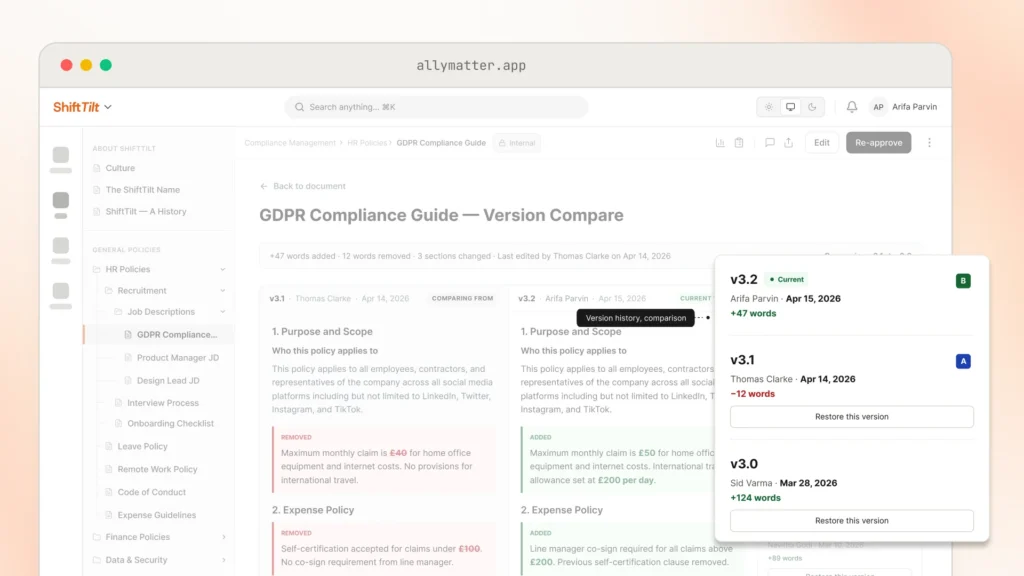
Both of those have mechanical answers. The second is the edit discipline above: changes that do not matter do not ship. The first is Version Compare: when a revision goes out for re-acknowledgment, each person sees the word-by-word difference between what they signed and what is in front of them, with a count of changed words, so confirming a real five-line change costs about a minute. The reminder cadence does the chasing in the background, and nobody’s afternoon is spent on it.
So, when does a policy update require re-acknowledgment? Whenever the text people agreed to changes. Which is to say: always, by design, because the version that quietly nobody signed is the version that ends up in front of a lawyer.
Start your 30-day free trial. No credit card to start, and a 30-day money-back guarantee if you convert and change your mind.
Not ready for a trial? On annual plans, migration is on us: we’ll move your docs from SharePoint, Google Drive, Confluence, or Notion and have you running in about a week.
Related reading
- 5 practical fixes for sales commission documentation mess
- The approval that’s stuck in someone’s inbox

Founder of AllyMatter I’m founder of AllyMatter, an operations-first knowledge base for growing companies. Before AllyMatter, I co-founded Syren Cloud and helped scale it into a 300-person organization across two countries, leading marketing, operations, and HR. We moved fast, served demanding customers, and learned the hard way that internal knowledge systems built for help docs or IT don’t solve day-to-day operations. AllyMatter is my answer—tools that turn tribal knowledge into trusted, searchable processes. This blog shares the playbooks, checklists, and lessons I wish I’d had while scaling.