ISO 15189: medical lab policies, documents and authorizations kept current
For quality managers and laboratory directors at medical laboratories accredited to ISO 15189:2022. What the standard asks to be documented, and what assessors sample.
Checked against primary sources on 18 October 2026.
Who it applies to
Medical laboratories, including point-of-care testing, that choose accreditation to show quality and competence to clinicians, patients, payers and regulators.
Who checks
Accreditation bodies; in the US the CAP 15189 program, among others; a CLIA certificate is still required for US patient testing
How often
Initial accreditation assessment, then periodic surveillance and reassessment; CAP 15189 runs a three-year accreditation cycle with remote and on-site assessments
Current edition
ISO 15189:2022 (Edition 4), replacing ISO 15189:2012 and ISO 22870:2016, 2022-12-06. Paid standard (CHF 225 for English PDF + ePub or paper, per iso.org).
Dates to know
Dates for ISO 15189
Date
What happens
Status
2025-12-06
End of the three-year transition from ISO 15189:2012 to ISO 15189:2022 (ILAC Resolution GA 26.08)
Done
2026-01-01
IAF and ILAC roles pass to Global Accreditation Cooperation Incorporated (Global ACI)
Done
What ISO 15189 asks you to write down
Each one needs an owner, an approval, and proof it reached the people it covers.
Clause 8.2
Objectives and policies
Laboratory management documents objectives and policies addressing competence, quality and consistent operation, and ensures they are acknowledged and implemented at all levels.
Policies on competence, quality and consistent operation
Evidence of acknowledgment across the laboratory
Management approval and review date
Clause 4.1
Impartiality safeguards
The laboratory is structured and managed to safeguard impartiality, monitors threats including personnel relationships, and can show how each threat is removed or minimized.
Management commitment to impartiality
Threat register with mitigations and owners
Clause 6.2.2
Competence requirements
Competence requirements are specified for each function influencing results, including education, qualification, training, retraining, technical knowledge, skills and experience.
Requirements per position
Retraining triggers and intervals
Clause 6.2.3
Authorization of personnel
Personnel are authorized for specific activities such as method selection, development, verification and validation, and the review, release and reporting of results.
Named person and authorized activities
Authorizing manager and date
Clause 8.3
Control of documents
The laboratory controls internal and external documents relating to the standard, so each is uniquely identified, approved, periodically reviewed and current at points of use.
Unique identifier and revision status
Approver and review date
Obsolete copies marked, one copy retained
Clause 8.4
Control of records
Legible records demonstrate fulfillment of the standard, are created when each quality-affecting activity is performed, and amendments stay traceable to the original entries.
Record created at the time of activity
Amendment date and link to original
Defined retention period
Citations are to the standard or regulation; wording is ours.
What gets asked for on the day
What reviewers sample about these documents and the people they cover.
Authorizations for result review and release
Assessors check that only authorized staff select and verify methods and review, release and report results, and ask to see the authorization record for named individuals.
Personnel records for sampled staff
For sampled staff, assessors review competence requirements, position descriptions, training and retraining, authorization and competence monitoring records.
Document control at points of use
Assessors compare documents at workstations and in point-of-care settings with the controlled versions and check approval, review dates and removal of obsolete copies.
Impartiality and policy acknowledgment
Assessors ask how threats to impartiality are monitored, and look for evidence that objectives and policies are acknowledged and implemented at all levels.
The policy and acknowledgment layer for ISO 15189.
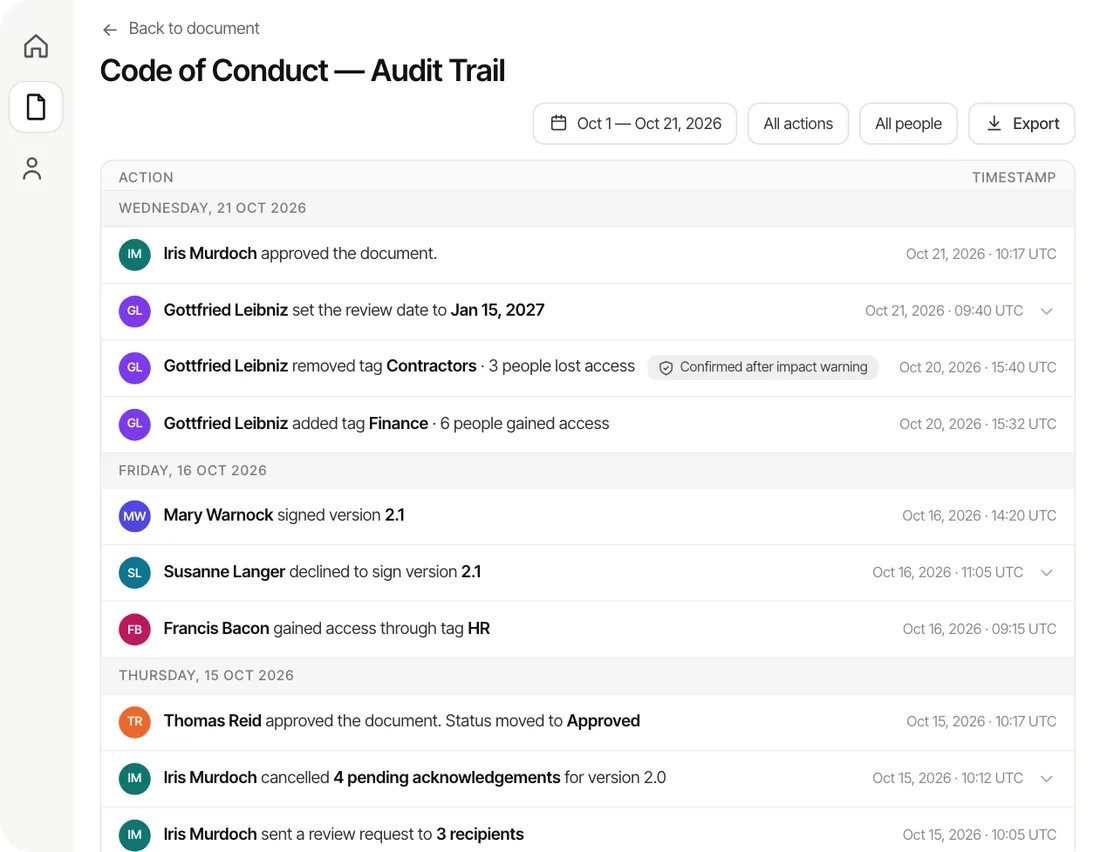
Write each policy, send it through approval, and send it to the people it covers. Each acknowledgment is recorded by name, with the version, the date and the time.
When a policy changes, the new version is approved, its Editor sends it out again, and everyone it applies to is asked again. Export the record as a PDF or CSV, or give a reviewer Viewer access to the documents their tags allow.
Approved before it goes outUp to four steps, with any or all approvers.
Acknowledged by nameName, email, date, time and version on every record.
Asked again on every changeEach new version goes out again to everyone it applies to.
The record on requestA PDF or CSV export, or Viewer access to the documents their tags allow.
Your region’s laws, the standards your customers ask for, and your own house rules. Write each one as a policy, approve it, and send it to the people it covers.
ILAC Resolution GA 26.08 set a three-year transition from publication, which ended in December 2025. After that, accreditation to the 2012 edition is no longer recognized under the international arrangement.
Does ISO 15189:2022 cover point-of-care testing?
Yes. The 2022 edition applies to point-of-care testing and replaced ISO 22870:2016, which iso.org lists as withdrawn.
How does ISO 15189 relate to CLIA in the US?
CMS regulates US laboratory testing on human specimens through CLIA, and laboratories need a CLIA certificate to test patient specimens. ISO 15189 accreditation, such as through CAP 15189, is an additional quality and competence program.
What does 'acknowledged at all levels' ask for?
Clause 8.2 asks management to ensure objectives and policies are acknowledged and implemented at all levels of the laboratory. The standard leaves the evidence to the laboratory, and assessors typically look at communication and training records alongside staff interviews.
How is risk handled in the 2022 edition?
CAP notes that risk management has greater emphasis throughout the 2022 edition, with particular focus on risk to patients. The management system clauses also include actions to address risks and opportunities.