Marketing leaders know the pattern. Your team produces strong work, but too much energy goes into finding assets, aligning on processes, and making sure everyone is on the latest version of the rules. When the information lives across shared drives, email threads, agency portals, and Slack DMs, the work slows down in ways nobody quite tracks.
Growing companies feel this acutely. The informal systems that held when marketing was four people start cracking at fifteen. The result is inconsistent branding, duplicated effort, and institutional knowledge that walks out the door when team members transition.
An internal knowledge base addresses these specific failures. Below are seven marketing tasks that get materially easier with a centralized, searchable hub.
One quick distinction before going further. A knowledge base is for written knowledge: brand voice, messaging frameworks, campaign briefs, playbooks, vendor docs, process SOPs. Binary assets like logo files, raw photography, video files, and ad creative belong in a digital asset manager (DAM) or a clean Drive folder. The two systems sit side by side. This post is about the first one.
Brand guidelines management
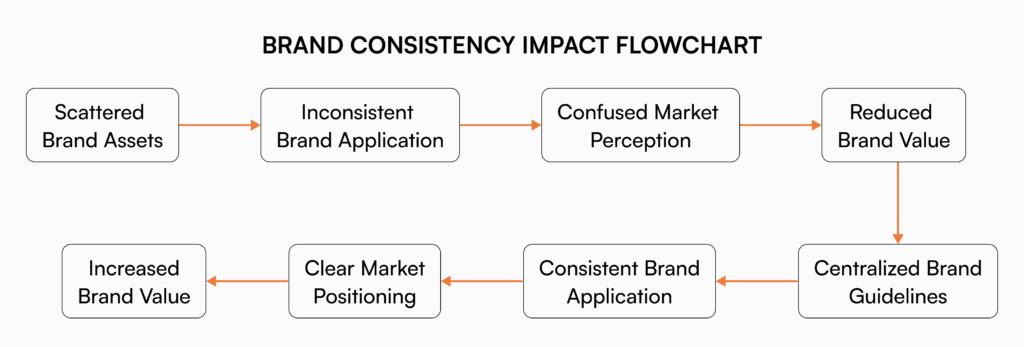
“Has anyone seen the latest logo file?” This question runs through marketing departments everywhere, usually followed by frantic searching or a Slack ping that interrupts someone else’s flow.
When brand assets live in multiple places, inconsistency follows:
- Designers use outdated logos in new materials
- Content creators write messaging that doesn’t match current positioning
- Regional teams interpret brand standards differently, creating market confusion
A centralized KB creates a single source of truth. You tag critical brand elements for fast retrieval, keep version control as guidelines evolve, and assign clear ownership of every brand doc. When the visual identity updates, every team member, including agencies, sees the new standard the next time they open the file.
Campaign documentation and marketing asset library
Your marketing team runs a successful campaign. Everyone celebrates the result, then moves on. Six months later, you’re planning a similar initiative, and the insight, assets, and learnings from the previous campaign are scattered across personal notes, analytics tools, and the project management board nobody opens anymore.
A Content Marketing Institute survey found that 65% of the most successful content marketers have a documented content strategy, compared to just 14% of the least successful. Documentation is the differentiator.
A real KB changes campaign management:
- Standardized templates for documenting campaign strategy and results
- Assets, messaging, and performance metrics preserved in one searchable place
- Post-campaign analysis linked directly to the campaign materials
- Institutional memory that survives turnover
When planning the next campaign, the team references what worked and what didn’t last time, building on previous wins instead of starting over.
Marketing asset organization and searchable resources
“I know we made something like this before.” Without organized resources, the patterns are predictable:
- More time spent searching for assets than using them
- Recreating materials that already exist but can’t be found
- Outdated versions in circulation because the current ones are hard to find
- Inconsistent naming and folder organization across people
A checklist for asset organization:
- Consistent naming conventions for every asset
- A tagging system that reflects how your team actually works
- Clear categories for different material types
- Regular audits to archive outdated material
- The organization system documented so new hires can navigate it
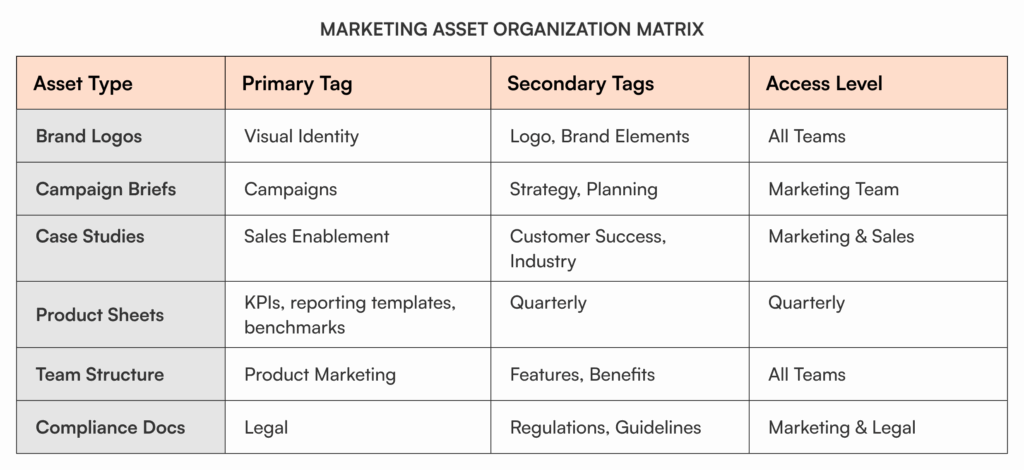
A KB with smart tagging lets marketers find exactly what they need. The system has to adapt to how your team thinks about content, not force them into a rigid scheme that doesn’t match their workflow.
Team collaboration tools and cross-functional alignment
Marketing rarely operates alone. Campaigns need input from sales, product, legal, and others. These collaborations are also where the friction lives:
“Legal hasn’t approved the landing page copy yet.” “Sales is using messaging from the last campaign.” “Product changed a feature, but nobody updated the materials.”
Aberdeen Group research found that companies with optimized sales and marketing alignment grow 32% faster. The alignment is built on shared information.
A centralized marketing KB bridges these divides:
- Workflows that are visible to every stakeholder, not buried in one team’s project tool
- Clear approval paths for cross-departmental content
- Shared access to the relevant information across team boundaries
- Documented collaboration protocols so the handoffs don’t get reinvented every quarter
When sales and marketing work from the same KB, both teams hold the same understanding of messaging, campaign timing, and available resources.
Onboarding and process standardization
Your marketing team is growing. Each new hire spends weeks piecing together how things work, interrupting senior team members with basic questions, discovering processes through trial and error, and sometimes developing habits that drift from team standards.
Gallup research found that only 12% of employees strongly agree their organization does a great job onboarding new hires. For marketing, where brand voice, processes, and campaign knowledge all matter, the gap shows up immediately.
A KB transforms onboarding through self-service access:
- New hires explore documented processes at their own pace
- Marketing SOPs cover the routine tasks
- Examples of previous work show what good looks like
- Brand guidelines and messaging frameworks set clear boundaries
The result: faster productivity from new team members, less time spent by senior staff answering the same questions.
Compliance tracking and management
For marketing teams in regulated industries (finance, healthcare, legal, anything with mandated disclosures), compliance adds another layer. Tracking approvals, maintaining records, and proving adherence to regulations eats resources. When the compliance documentation is scattered, audit prep becomes a fire drill.
A KB simplifies compliance through:
- Documented approval workflows with a clear audit trail
- Version control tracking changes to regulated content
- Centralized storage of compliance requirements and guidelines
- A documented sign-off process for legal review
Three quick checks before publishing:
- Is the content subject to regulatory review? If yes, route it through the documented approval workflow. If no, standard marketing review.
- Does it make claims about product performance? If yes, the supporting evidence has to be documented and approved.
- Is it going to an external audience? If yes, current legal disclaimer language needs to be in place.
With this structure in place, the team spends less time worrying about regulatory issues and more time creating marketing materials within established guidelines.
Marketing workflow standardization
As marketing teams grow, inconsistent processes create inefficiency and quality control problems:
- Team members approach the same task differently
- Project handoffs create confusion about expectations
- New initiatives lack clear templates or starting points
- Workload distribution gets harder without standard procedures
A KB enables standardization through:
- Documented SOPs for the routine work
- Templates for the common projects
- Workflow documentation that removes confusion
- Approval paths that prevent bottlenecks
When the processes are documented and easy to access, new initiatives launch faster because the foundation is already built.
Why AllyMatter
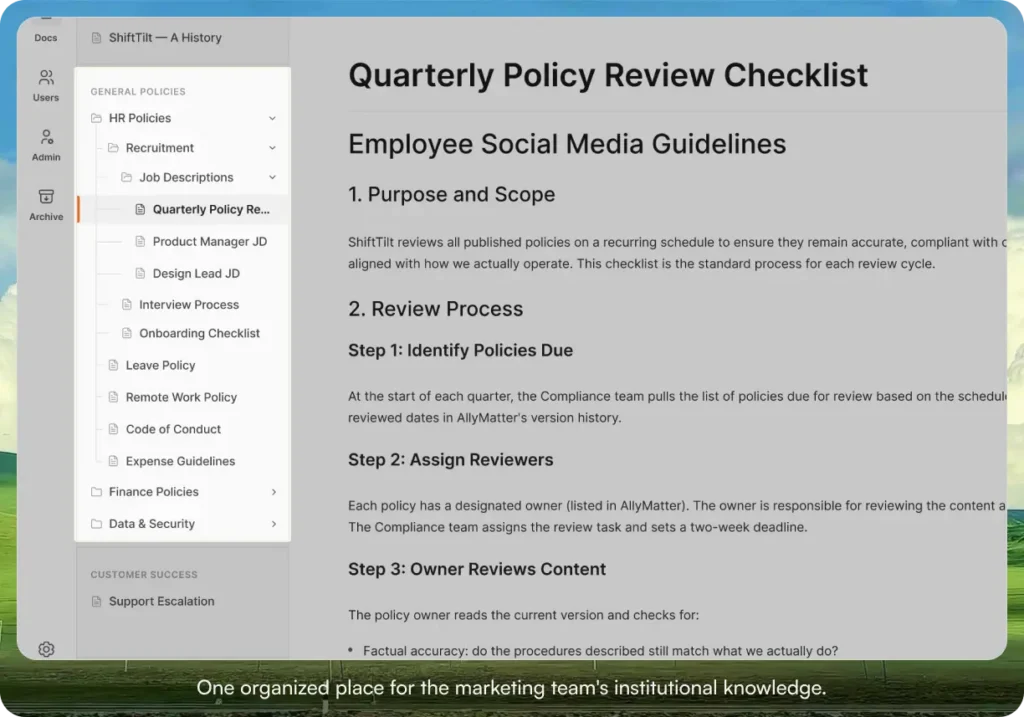
AllyMatter is built for what comes after the doc is written. Most tools (Notion, Google Docs, Confluence) are built for the creation phase, where two people draft a doc together. AllyMatter is built for the phase that matters more for marketing: making sure the brand voice doc, the campaign playbook, and the agency briefing template are findable, governed, and trusted as the team grows.
Search that actually finds the doc. Type a few words and the right doc surfaces in under a second. No more sending a Slack message to ask where something lives.
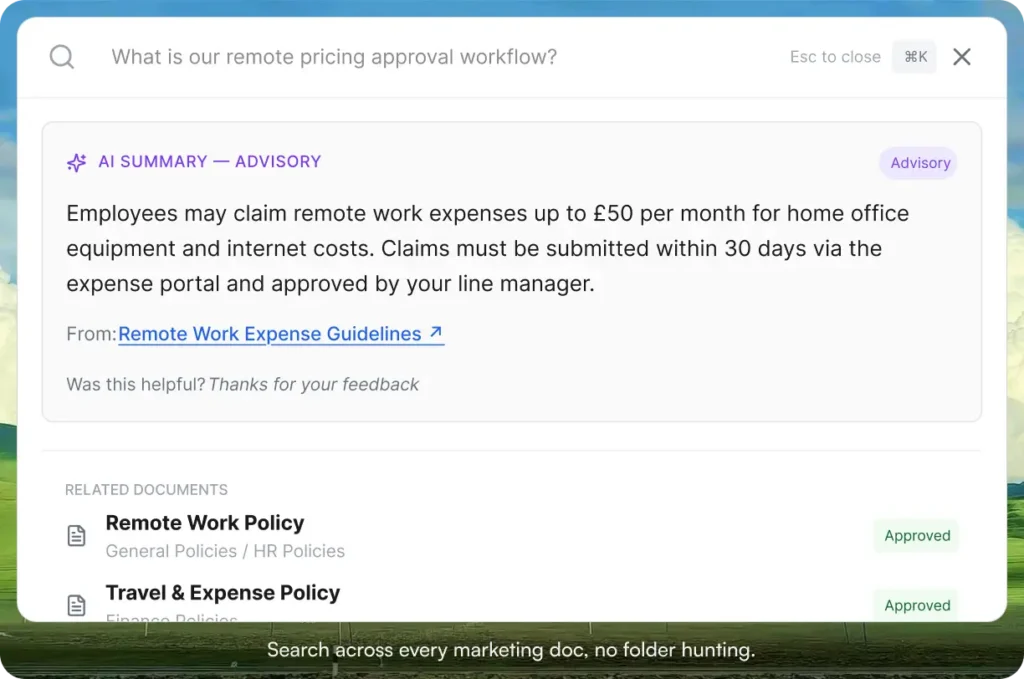
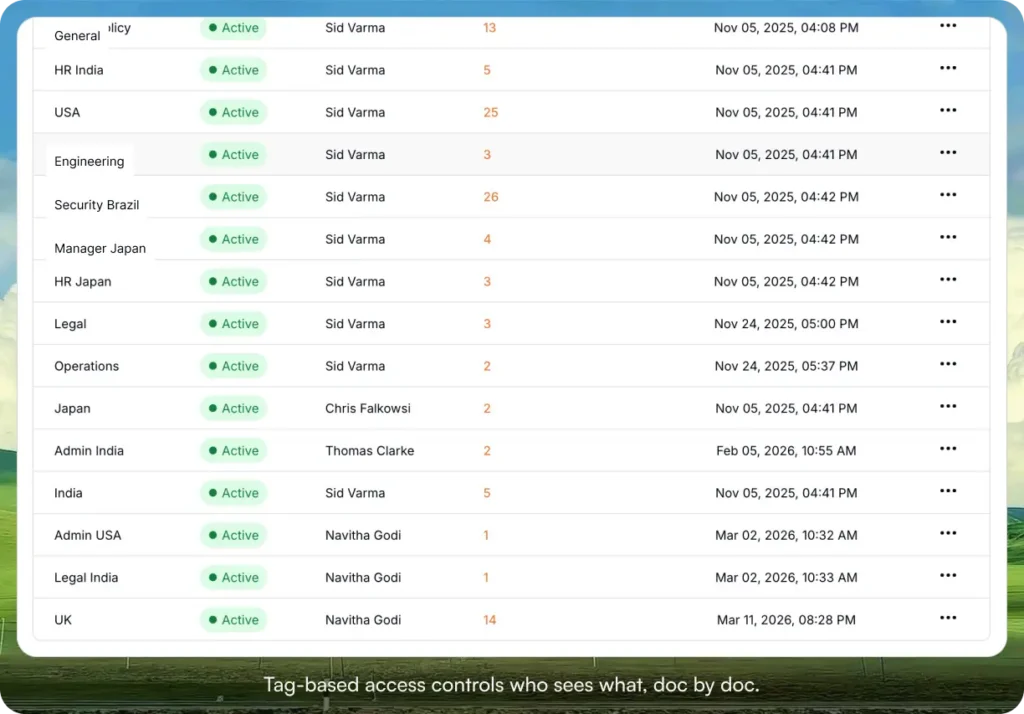
Smart tagging and document categorization. Your full brand guidelines visible to everyone in the company. Your unannounced product launch messaging visible only to people tagged on the launch team. No nested folder permissions to maintain every time a doc changes hands.
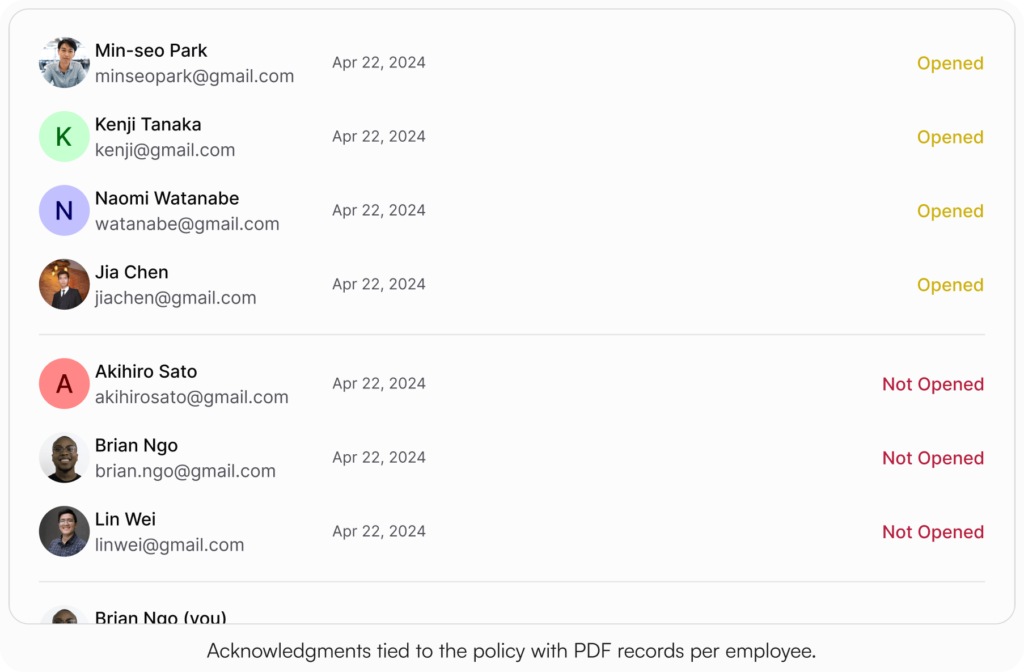
Acknowledgment tracking. When you ship a brand refresh or a new messaging framework, you can see who has read and acknowledged it, with a PDF record per person. No more wondering whether the agency actually saw the new tone guidance.
Approval workflows. Route content to the right reviewers in sequence, with a complete audit trail of who approved what and when. Useful for regulated content, anything legal needs to sign off on, and any brand asset that involves more than one stakeholder.
Version Compare. When the brand guidelines change, you can see exactly what’s different between this version and the last. Useful when a freelancer asks “did the rules change between when we briefed this and when we delivered it?”
Inline images for brand guidelines. Drop logos, color swatches, type samples, and example layouts directly into the doc so the brand guidelines read the way they should.
External sharing. Share a doc with an agency or freelancer through a link, without giving them a full seat. They get a clean read-only view, you keep control.
Where your team already works. Native Slack and Microsoft Teams integration, so updates and reminders show up in the channels marketers already use.
Start your 30-day free trial. No credit card to start, and a 30-day money-back guarantee if you convert and change your mind.
Three scenarios
An honest read on when to put a marketing KB in place:
If your marketing team is under five people inside a smaller company, you probably don’t need a dedicated KB yet. A clean Notion workspace or Drive structure with strict naming rules will hold for a while.
If your marketing team is between five and thirty inside a company that’s growing, the cracks are already showing. Brand voice drift, campaign briefs disappearing, three different people answering the same agency question. This is the moment. AllyMatter is what we built for it.
If you’re 30+ marketing people, or you’re in a regulated industry where compliance documentation has to be audit-ready on demand, a KB is no longer optional. You need search, access control, governance, and acknowledgments. AllyMatter or another purpose-built KB platform makes sense here. We’d start with AllyMatter.
Key takeaways
An effective internal knowledge base changes how marketing teams work:
- Brand assets and guidelines stay consistent across every initiative
- Campaign insight and institutional knowledge survive turnover
- Less time spent hunting for assets and answers
- Cleaner cross-functional collaboration, especially between marketing and sales
- Faster onboarding through self-service access to the things new hires actually need
What feels optional at four people becomes infrastructure at twenty. Get it in place before the cracks start showing, not after.
Start your 30-day free trial. No credit card to start, and a 30-day money-back guarantee if you convert and change your mind.
Not ready for a trial? Migration from Confluence or Notion is on us when you decide. We’ll move your existing marketing docs over and have you up and running in about a week.
Frequently asked questions
How does an internal knowledge base differ from shared folders or drives?
A shared folder stores files. A real knowledge base adds the things that make those files useful: search across content, tagging, version control with the ability to compare versions, approval workflows, audit trails, and granular access controls. The difference shows up the moment someone asks “where is the latest version” or “who approved this” and you need an answer in under thirty seconds.
What features should marketing teams look for in a knowledge base?
Fast search, flexible organization through tags, version control with a compare view, approval workflows for content review, granular access permissions for sensitive material, audit trails for compliance, and integration with Slack or Microsoft Teams. The interface needs to be easy enough that the marketing team doesn’t have to be trained for two days before they can use it.
How do we measure the ROI of a marketing knowledge base?
Track time spent searching for assets, the number of duplicate documents that get created, onboarding time to full productivity, approval cycle length, and brand consistency issues per quarter. Most teams that implement a working KB recover several hours per person per week that previously went to administrative friction.
How do we get a marketing team to actually use a new knowledge base?
Start with a structure that mirrors how the team already thinks about its work. Involve the people who will use it in the setup. Document the most-requested content first so the KB earns trust by being the fastest path to an answer. Make it the default link in onboarding, meeting notes, and Slack threads. Leadership uses it visibly. The team mirrors what leadership does.
Related reading
- Internal Knowledge Base 101
- Top 10 Internal Knowledge Base Use Cases for Marketing Teams
- Everything You Need to Know About Building a Knowledge Base for HR

Vikas is a B2B marketing professional with over 14 years of experience in content strategy, messaging, and demand generation. He specializes in turning complex business challenges into clear, actionable stories to connect meaningfully with audiences.