
Think about the person on your team everyone goes to. The ops lead who knows how vendor contracts move. The HR manager who’s the only one who understands the full onboarding sequence. The CS lead who handles escalations entirely from memory.
Now think about how many times a week someone interrupts them with a question.
This is one of the quieter productivity problems at growing companies. Your most experienced people carry institutional knowledge that nobody has written down. So every time a new hire joins, every time a process gets handed off, every time someone hits an edge case, the question goes to the same person. And that person answers it. Again.
According to Panopto’s Workplace Knowledge and Productivity Report, 42% of institutional knowledge is unique to individual employees and isn’t documented anywhere else. For a growing company, that’s not just an information problem. It’s a daily tax on your best people.
The interruption nobody talks about
The knowledge gap in most growing teams isn’t obvious at first. When you’re 30 people, it barely registers. The person who knows the process is usually nearby, usually available, and usually happy to help.
By the time you’re 80 or 120 people, the math changes. That same person is now fielding variations of the same question from four different team members, two new hires, and a manager who needs to brief a client. They’re not complaining. But they’re also not doing the work you need them to do.
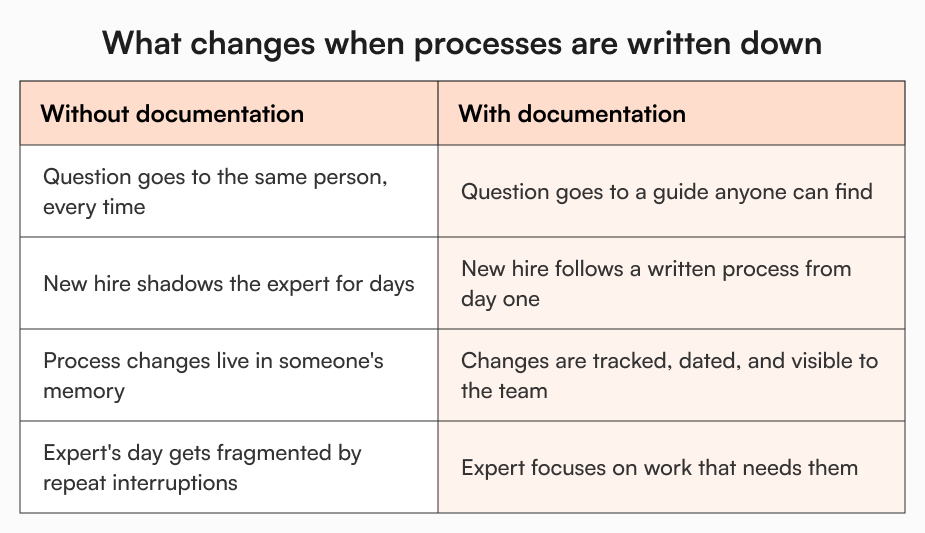
When I was building my previous startup, our best ops person was also our most interrupted one. Every new hire, every process question, every edge case landed with her first. She handled it all. What we never stopped to ask was what it was costing her, and us, that none of it was written down.
The fix wasn’t complicated. It was just never prioritized.
What it means to write it down
Here’s where most teams go wrong. They treat “writing it down” as moving a Word document into a shared Google Drive folder, and nobody opens it again. That’s not documentation. That’s a filing cabinet with a search bar.
Useful process documentation is specific enough that someone unfamiliar with the work can follow it without a single clarifying question. “Check in with the vendor” is not a process. “If no response by end of day two, send the follow-up template in the Procurement folder and copy the finance lead” is.
It also needs to match the type of work it describes. Some processes are fixed and sequential: the same steps, every time, in the same order. Others require judgment at multiple points. Getting those two confused produces documentation that’s either too rigid or too vague to be useful.
The distinction matters because it changes what you write. A standard operating procedure suits fixed, sequential work: IT onboarding setup, monthly finance close, offboarding checklist. A playbook suits processes where the right action depends on the situation: how your support team decides when a ticket escalates, how your sales team handles a prospect who’s gone quiet. The SOP specifies steps. The playbook captures the reasoning behind them.
A quick test: could someone unfamiliar with this process follow the document without asking a single question? If yes, write an SOP. If they’d need to make judgment calls, write a playbook.
Why people don’t write it down even when they know they should
It’s not laziness. People skip creating process documentation because converting what they know into something a stranger can follow is genuinely hard work. And if the tool they’re supposed to use requires formatting decisions, breaks on different screens, or produces something that looks different depending on who opens it, the effort feels even higher than it is.
This is where the writing experience matters more than most teams give it credit for. A WYSIWYG editor removes the formatting overhead entirely. The person capturing the process thinks about content, not whether the heading hierarchy is right or whether the table will render correctly on mobile. They drop in a screenshot to show exactly what a step looks like, add a decision tree where text alone would be unclear, and it renders correctly for everyone.
When writing a guide feels about as effortful as writing a message to a colleague, people do it. When it feels like a publishing project, they put it off until something breaks.
What this looks like in practice
Take a 150-person HR tech company. Their finance team had a clean month-end close process, but it existed entirely in the head of their finance manager, Marcus. New team members either shadowed him or figured things out by asking at the wrong moment.
When Marcus moved into a regional director role, nothing transferred with him. The close took longer. Steps got missed. Two team members were running parallel versions of the same process without realizing it.
Before transitioning, Marcus spent two focused sessions documenting the sequence: which reports pulled first, who reviewed what, where exceptions went, and what a clean close looked like at each stage. Built in a WYSIWYG editor with embedded screenshots from the finance system, it took an afternoon.
That one document stopped four recurring questions cold. The process hadn’t changed at all. It was just finally written down. The harder question for most teams isn’t whether to document. It’s having the right place to do it.
How AllyMatter helps
The infrastructure problem at most growing teams isn’t a lack of willingness to document. It’s that the tools are fragmented. A Notion page here, a Google Doc there, a PDF someone emailed months ago that may or may not still be accurate. Knowledge ends up scattered, and scattered knowledge gets ignored.
AllyMatter gives growing companies one place to create, organize, and maintain internal documentation. The WYSIWYG editor means anyone on the team can build a well-structured SOP or playbook without touching formatting. Images, charts, and embedded visuals work natively, so a guide can show the actual steps, not just describe them. Someone writing a process document can drop in screenshots, annotate steps visually, and publish something a new hire can follow on day one.
Once the documentation exists, finding it is the next problem. AllyMatter’s search works on the actual content of documents, not just titles. If someone types a keyword that appears anywhere inside a document, that document surfaces in results. If the title alone doesn’t match but the content does, it still shows up.
That means a team member mid-task can type a plain description of what they’re trying to do and find the relevant guide without navigating folder structures or asking a colleague where something was saved. The knowledge Marcus spent an afternoon writing down is just as findable on day one for someone who wasn’t in the room when it was created.
The goal is simple: when someone has a process question, the answer should be in a document, not in someone’s head.
Getting started without overhauling everything
The point isn’t to build a complete documentation library overnight. It’s to identify which person on your team is fielding the most repeat questions, and start there.
What’s the one process that generates the most interruptions? Write that one down first. Decide the format: fixed-sequence tasks go into SOPs, judgment-heavy processes go into playbooks. Assign a named owner. Set a review date tied to how often the process changes.
Then move to the next one.
Teams that do this consistently don’t overhaul everything at once. They start with whatever’s costing the most, document it properly, and watch the repeat questions slow down. The knowledge base that results reflects how the team works, which is exactly why people use it.
If you want to see what that looks like in practice, try AllyMatter’s sandbox. It comes pre-loaded with sample documentation so you can explore a structured knowledge base before building your own.
Frequently asked questions
Why do growing teams struggle most with process documentation?
Because informal knowledge sharing works fine when teams are small and people sit near each other. Once teams grow past a certain size, that system breaks down. Processes that everyone “just knew” become things only one or two people know, and every question goes to the same person. The problem isn’t awareness. It’s that nobody has built the habit of writing things down before they’re needed.
What’s the difference between an SOP and a playbook?
An SOP is for fixed, sequential processes where steps don’t change based on context: IT onboarding, finance close, offboarding checklists. A playbook is for processes that involve judgment, where the right action depends on the situation: escalation logic, deal handling, exception management. Picking the wrong format produces something too rigid or too vague to follow.
How do you get your best people to actually write things down?
Reduce the friction first. If creating a guide feels like a publishing task, it won’t happen. Give people a writing tool that doesn’t require formatting decisions, assign clear document ownership, and make documentation part of completing a process rather than a separate task done afterward. Start with whoever is fielding the most repeat questions.
How often should process documentation be reviewed?
As often as the underlying process changes. High-traffic documents like onboarding SOPs or escalation playbooks warrant quarterly reviews. Lower-priority reference documents can go longer. What matters more than cadence is ownership: every document needs one person responsible for keeping it current.
What makes process documentation findable once it exists?
Structure and search. Documents need to live somewhere logical, organized the way teams think about their work. Search needs to work on the content inside documents, not just titles, so people can find what they need mid-task with a plain keyword, without navigating folder levels or interrupting a colleague.

Founder of AllyMatter I’m founder of AllyMatter, an operations-first knowledge base for growing companies. Before AllyMatter, I co-founded Syren Cloud and helped scale it into a 300-person organization across two countries, leading marketing, operations, and HR. We moved fast, served demanding customers, and learned the hard way that internal knowledge systems built for help docs or IT don’t solve day-to-day operations. AllyMatter is my answer—tools that turn tribal knowledge into trusted, searchable processes. This blog shares the playbooks, checklists, and lessons I wish I’d had while scaling.