
Policy Basics · 3 min read
How to Migrate from Confluence to AllyMatter
Confluence migrations rarely start because Confluence broke. They start because the wiki grew into something it was never asked to be: the place where the security policy, the SOPs, and the handbook quietly live, with no approval gate, no acknowledgment record, and no answer to “which version was in force in March.” If your spaces hold obligations, not just notes, this guide is the move, step by step.
Confluence works fine until the wiki becomes the place your policies live: the security policy, the SOPs, the handbook, with no approval gate, no acknowledgment record, and no answer to “which version was in force in March.” That is when a migration starts.
Decide what moves
Start with a split, not an export. Confluence content falls into three piles:
- Obligations: policies, procedures, anything people must follow and someone may audit. These move first and get the full treatment.
- Reference: how-tos, team notes, project pages people merely read. Move what is alive; archive what is not. A migration is the best pruning opportunity you will ever get.
- The graveyard: the 2019 offsite page, the abandoned project spaces. Nobody moves the graveyard. Export it for cold storage and leave it behind.
The 15 to 20 documents your next audit would sample are the spine of the migration. Everything else follows at its own pace.
Map the concepts, because they do not map one-to-one
Spaces become tags. Confluence organizes by container: the HR space, the engineering space. AllyMatter organizes by audience: documents targeted by department, location, and role tags, so access and distribution run on the tags. Plan the tag scheme before moving anything in; it is the single highest-leverage hour of the project.
Pages become governed documents. Each policy you bring in gets what Confluence never asked of it: an Editor, a document type (notify, acknowledgment required, or e-signature), a review date, and an approval workflow. This is also the moment to consolidate the three near-duplicate versions of the expense policy into one.
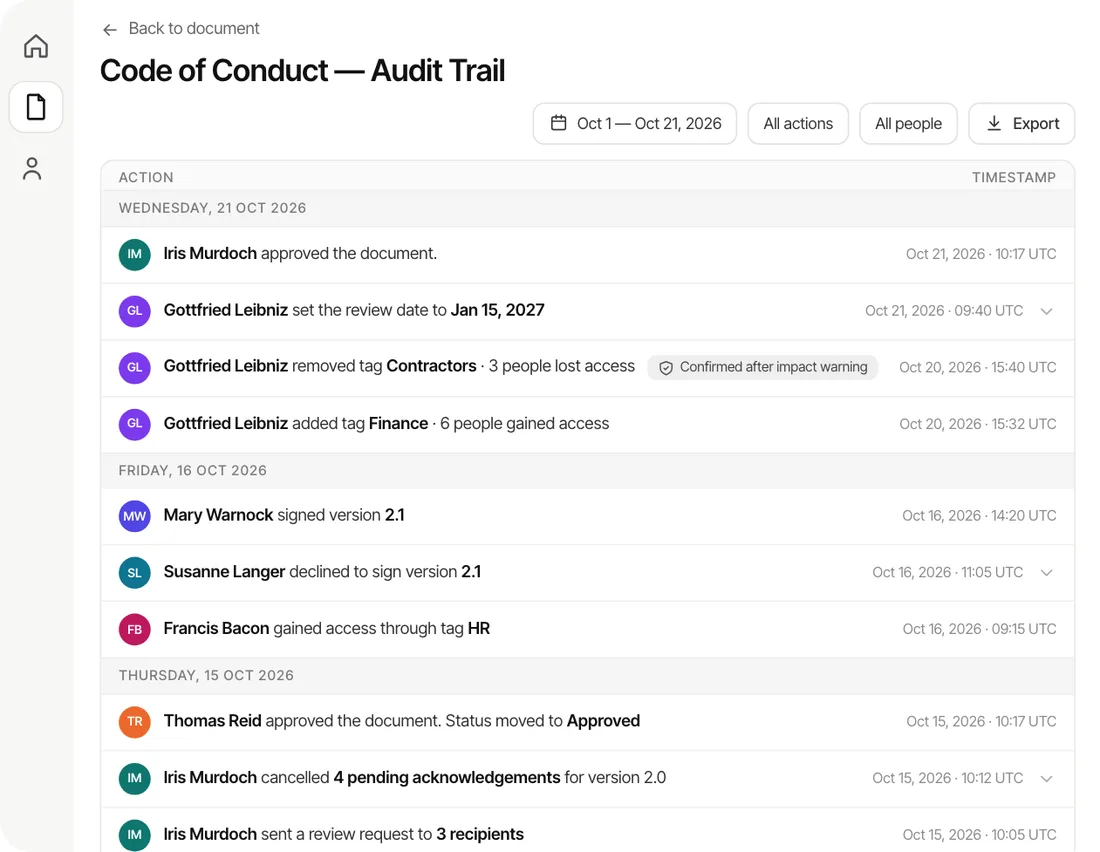
Page history does not become version history. Your Confluence edit history is a record of typing, not of governance: no approvals attach to it, no acknowledgments bind to it. Bring the current text; treat the past as archive. The governed version history starts at version one, on migration day, with its first real approval.
There is no acknowledgment to migrate, and that is the point. Confluence never collected any. Your first acknowledgment round in AllyMatter is the moment the library becomes provable, and it doubles as forcing everyone to see where the policies now live.
Run the move
Yearly plans include free migration help and chat handholding while you set up. Documents come in by paste or by uploading PDF, Word, or image files, so Confluence’s standard exports work well for the self-serve route.
The sequence that works: bring in the obligation set → apply tags and Editors → route each document through its first approval (a real review, not a rubber stamp; you will catch stale content here) → run the first acknowledgment round → then move the reference layer at leisure. Keep Confluence read-only for a defined overlap period, with a banner pointing at the new home, and retire it on a date, not “eventually.” The migration that fails is the one where the old wiki stays half-alive as the real system for another year.
What you gain and what you lose, honestly
You lose Confluence’s sprawl of macros, plugins, and freeform page-building; if your wiki is primarily a collaborative scratchpad, keep it for that. What you gain is the obligation layer Confluence structurally lacks: approval before publication, version-bound acknowledgment, re-collection on every change, and exports an auditor accepts. Teams often keep a small Confluence for project notes and move the governed layer here, and that split is legitimate: scratchpads and systems of record are different tools.
Start your 30-day free trial. No credit card to start, and a 30-day money-back guarantee if you convert and change your mind.
Not ready for a trial? Yearly plans include free migration help and chat handholding while you set up, whether your docs live in SharePoint, Google Drive, Confluence, or Notion.