
You don’t have to rebuild everything from scratch. Here’s how to migrate from Google Drive to AllyMatter in a few days.
If you just signed up for AllyMatter and you are staring at years of Google Drive folders wondering where to begin, the answer is not “migrate everything.” It is “migrate what matters, and do it right.”
One thing up front: you may not have to do any of this yourself. Migration is on us. Send us your Drive export and we move it into AllyMatter for you at no cost, structure and tags included. If you would rather run it yourself, this guide is the clean way to do it. Either way, the principle is the same. Most teams that struggle with this move make it harder than it needs to be, recreating their entire Drive structure on day one or exporting everything without reviewing what is worth keeping, and the result is a new platform that looks exactly like the old mess.
If you want to see how Google Drive and AllyMatter compare side by side first, that is covered separately. Otherwise, here is how to make the move.
Step 1: Audit what’s worth migrating (and what to leave behind)
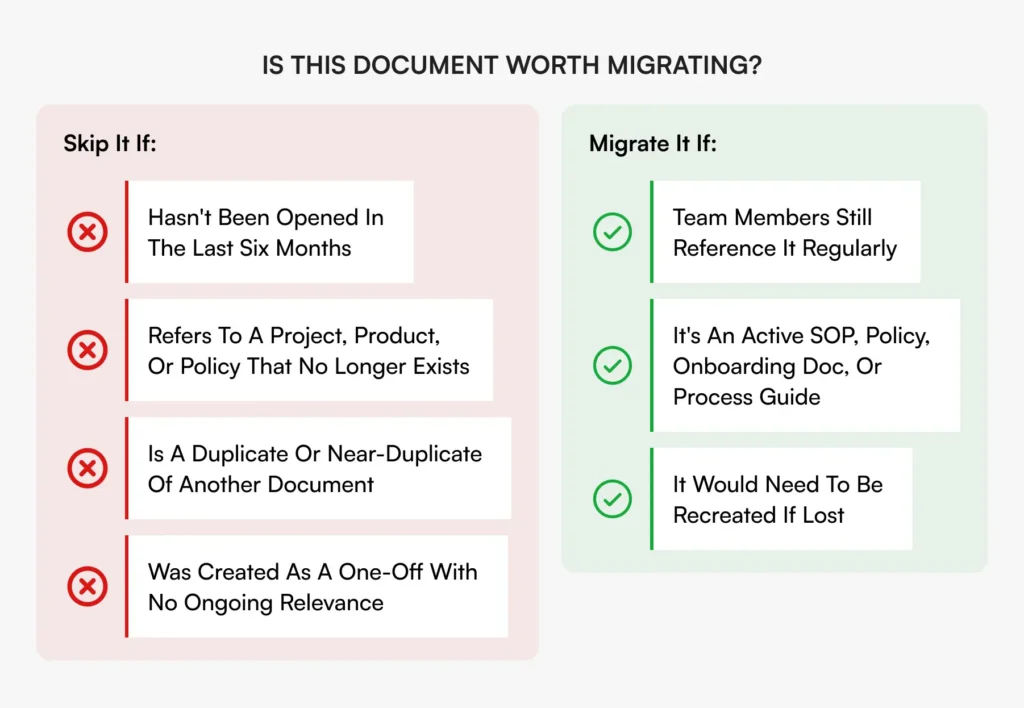
Before you export a single file, spend time in Google Drive answering one question for each document: is this still useful?
Skip it if it has not been opened in the last six months, refers to a project, product, or policy that no longer exists, duplicates another document, or was a one-off with no ongoing relevance. Carry over your active, reusable knowledge: SOPs, onboarding materials, HR policies, process guides, finance workflows, anything people still reference or should be.
A quick audit spreadsheet keeps this honest. One row per document, with columns for the document name, last modified date, whether it is still relevant, the owner, and a simple migrate yes or no. It takes a few hours and saves days of cleanup later. It is also your chance to surface things that live only in someone’s head and get them written down before you move.
If you are still weighing the decision, read why Google Drive falls short as a knowledge base first.
Step 2: Export your Google Docs
Once you know what you are moving, exporting is straightforward. Google’s built-in Takeout tool downloads your Drive contents in bulk. A few things to keep in mind: export documents as .docx and spreadsheets as .xlsx for the cleanest import, resolve any open comments or suggestions first so you do not carry over noise, and remember that shared drives require the owner or an admin to export, so loop in the right people early. Export folder by folder, matching the structure you plan to use in AllyMatter, which you will set up next.
Step 3: Plan your AllyMatter structure before you import
This is where most migrations go sideways. People import first and organize later, and end up with a flat, unsorted pile they spend weeks untangling.
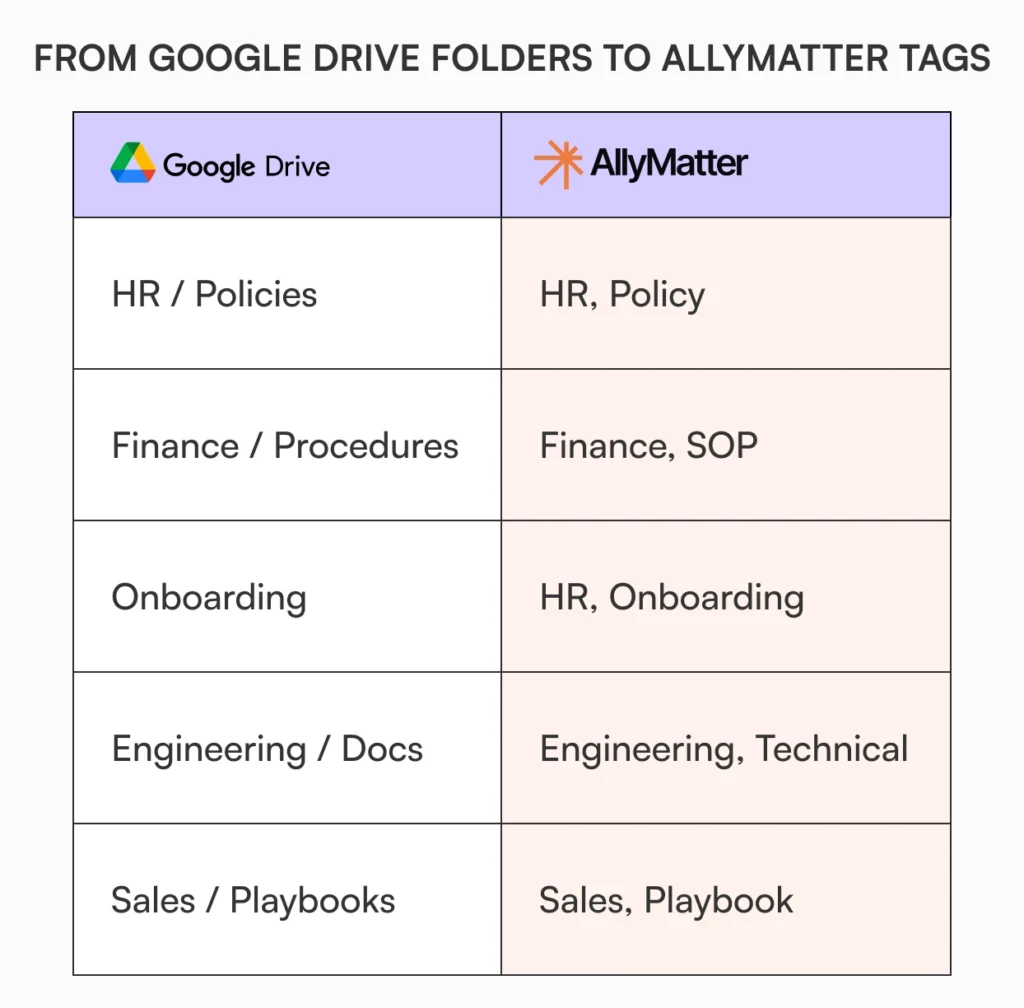
AllyMatter organizes documents with a combination of folders, tags, and metadata. You can recreate a folder hierarchy if that is what your team is used to, but the tag system is where you gain flexibility Drive cannot match. A single document can carry several tags across department, document type, audience, geography, and status, so it surfaces in any relevant search regardless of where it sits. Instead of thinking in folders (HR > Policies > Leave > 2024), think in attributes you can assign to any document. A leave policy might carry HR, Policy, Active, and All Staff, so it turns up in a search for any of those.
Before you import, map your top-level Drive folders to AllyMatter tags on paper or in a spreadsheet. It takes about 30 minutes and prevents a lot of cleanup later.
Step 4: Import and tag your documents
With your structure mapped and files exported, bring content in and apply your pre-planned tags as you go. Do not import everything and tag later. Tag each document at the point of upload. It is slightly slower upfront and avoids the “I’ll sort this later” trap that derails most migrations. As you upload, also assign a responsible editor who keeps the document current, an access level for who can see or edit it, and a status for whether it is live, a draft, or pending approval. AllyMatter tracks every change through version control from the moment a document enters the platform, so your team starts clean with full history going forward.
Step 5: Set up access using AllyMatter tags
One of the clearest wins in leaving Drive is leaving behind the permission sprawl that builds up in shared folders, where access gets inherited in ways nobody planned and revoking it when someone leaves is rarely clean.
In AllyMatter, access is managed at the document level. Documents default to internal-only and can be opened deliberately to the whole organization, named external people, or fully public. Beyond visibility, you assign access by role, department, or tag, so the right documents reach the right people without manual management every time someone joins or changes teams. Use this step to review access deliberately rather than replicating Drive, and tighten anything that has drifted over time. For the full picture, the AllyMatter knowledge base features are worth exploring once your documents are in.
Step 6: Redirect your team
A clean migration means nothing if people keep going back to Drive out of habit. A few things help: send a short announcement explaining the switch, where to find things, and why; pin a note on the most-used Drive folders pointing to AllyMatter; have one person available for the first two weeks to help teammates locate documents; and add a “this has moved to AllyMatter” note to high-traffic Drive files rather than deleting them immediately. Habit beats mandate. Make AllyMatter the obvious place to go and people will.
A realistic timeline
If you run it yourself, a team of 10 to 50 people with a reasonably organized Drive can audit, migrate, and redirect in about two weeks. Week one is preparation: run the document audit, decide what migrates, map folders to AllyMatter tags, and export from Drive. Week two is the move: import documents, apply tags and permissions, set up access, notify the team, and watch Drive usage. Larger teams or messier Drives should budget three to four weeks, and the estimate assumes someone is dedicating a few focused hours a day rather than doing it alongside a full workload. If that is not realistic, hand it to us and it is off your plate.
What to do with old Google Drive files
Do not delete Drive immediately. Give it 30 days as read-only: no new documents, no edits. If someone goes looking in Drive and cannot find the AllyMatter version, that is useful signal: either the document was missed and should be migrated, or the person has not learned where it lives yet. After 30 days, review what is still being accessed, migrate anything missed, then archive Drive or restrict it to a small group of admins as a backup. Keeping Drive alive indefinitely as a parallel system is the one thing that undermines most migrations. Once AllyMatter is your source of truth, make it the only source of truth.
Ready to move?
Start with the audit. Open Drive, pull up a spreadsheet, and spend an hour deciding what is worth bringing over. Everything else follows from that.
Start your 30-day free trial. No credit card to start, and a 30-day money-back guarantee if you convert and change your mind. Start free or explore the sandbox demo. Prefer to hand it over? Contact us and we will run the migration for you at no cost.
Frequently asked questions
How long does it take to migrate from Google Drive to AllyMatter?
If you do it yourself, plan for about two weeks for a team of 10 to 50, with most of that time in the audit and planning rather than the import. Larger or more complex Drives should budget three to four weeks. Or hand it to us and we do the migration for you at no cost.
What format should I export Google Docs in?
Export Docs as .docx and spreadsheets as .xlsx for the cleanest import, and resolve any open comments or suggestions first to keep the imported version clean.
Do I need to recreate my Google Drive folder structure in AllyMatter?
No. AllyMatter supports folders, tags, and metadata, so you can recreate a familiar structure if you want, but mapping your Drive folders to tags gives you more flexible search and access control than a folder hierarchy alone.
What happens to documents that were publicly shared in Google Drive?
You can set any document to fully public in AllyMatter, accessible to anyone with the link. For documents previously shared with specific external people, reshare them from AllyMatter and set the access accordingly.
Can someone migrate it for us?
Yes. Migration is included at no cost. Send us your Drive export and our team moves it into your AllyMatter account, structure and tags included.

Founder of AllyMatter I’m founder of AllyMatter, an operations-first knowledge base for growing companies. Before AllyMatter, I co-founded Syren Cloud and helped scale it into a 300-person organization across two countries, leading marketing, operations, and HR. We moved fast, served demanding customers, and learned the hard way that internal knowledge systems built for help docs or IT don’t solve day-to-day operations. AllyMatter is my answer—tools that turn tribal knowledge into trusted, searchable processes. This blog shares the playbooks, checklists, and lessons I wish I’d had while scaling.