
Policy Software · 5 min read
How Growing Companies Turn Policy Chaos Into Clear Docs
You’ve just closed your Series A, and suddenly everything’s moving at hyperspeed. New team members are joining weekly, and everyone’s excited about the growth ahead. But beneath the surface, a critical challenge is emerging – your internal policies aren’t keeping pace with your expansion. Documents are scattered across drives, approvals are lost in email threads, and new hires are struggling to find the information they need.
This post is part of our guide to policy management software for small and growing businesses, which covers what a policy center does, what it costs and how to choose one.
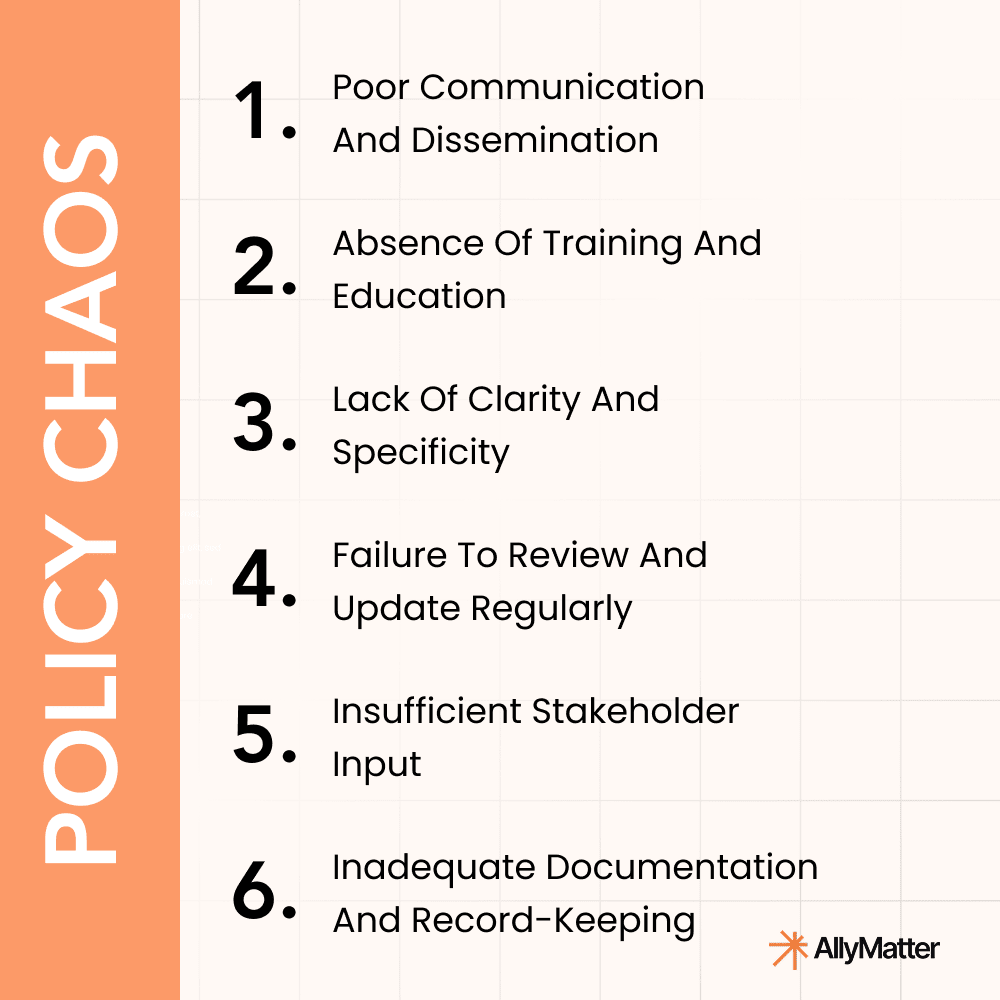
You’re not alone. While clear, well-managed internal policies are the foundation of successful scaling, many fast-growing companies stumble when it comes to policy management. In this post, we’ll explore seven common pitfalls that can derail your growth and show you how AllyMatter’s purpose-built platform helps you avoid them.
Pitfall 1: Lack of Clarity and Specificity
When policies are vague or ambiguous, confusion reigns. Consider a common “work from home” policy that simply states “employees may work remotely when appropriate.” Without clear guidelines on what constitutes “appropriate,” you’ll face inconsistent interpretation across teams and inevitable conflicts.
This lack of specificity doesn’t just frustrate employees – it creates ripple effects across your organization, from decreased productivity to potential compliance risks. The challenge intensifies as you scale, with each new hire adding their own interpretation to unclear policies.
Pitfall 2: Insufficient Stakeholder Input
Creating policies in isolation is a recipe for failure. Imagine your IT team implementing new security protocols without consulting client-facing teams. The result? A policy that looks perfect on paper but creates significant friction in daily operations, potentially hampering client relationships and team productivity.
As organizations grow, the gap between policy creators and those affected by the policies often widens, leading to guidelines that don’t reflect operational realities or address real-world challenges.
Pitfall 3: Poor Communication and Dissemination
Even the most well-crafted policies fail if they don’t reach the right people at the right time. In fast-growing companies, critical updates often get buried in overflowing inboxes or lost in chat threads. When your sales team can’t quickly find the latest pricing policy, or your support team is working from outdated customer service guidelines, the impact on your business is immediate and costly.
Pitfall 4: Absence of Training and Education
Distribution isn’t enough – employees need to understand how policies apply to their specific roles. Without proper training, even straightforward policies can lead to confusion and mistakes. This is particularly crucial for compliance-related policies where misunderstandings can have serious legal implications.
Pitfall 5: Failure to Review and Update Regularly
As your company evolves, your policies must keep pace. Yet many organizations treat policy creation as a one-time event rather than an ongoing process. When your hybrid work policy still reflects pre-pandemic thinking, or your security guidelines haven’t caught up with new threats, you’re exposing your organization to unnecessary risks.
Pitfall 6: Inadequate Documentation and Record-Keeping
Poor documentation isn’t just an administrative headache – it’s a legal liability waiting to happen. Without clear records of policy acknowledgments and updates, you’re vulnerable during audits and potential disputes. This risk multiplies as your organization grows and regulatory requirements become more complex.
How AllyMatter Solves These Policy Management Challenges
AllyMatter wasn’t built just to store documents – it’s designed specifically to help fast-growing companies overcome these common policy management pitfalls. Here’s exactly how our platform addresses each challenge:
Clarity and Specificity
• WYSIWYG Editor: Our intuitive editor lets Editors write policies directly in AllyMatter. If your team already has its own templates, bring them in before you use them, so every policy starts from a consistent structure.
• Version Control with Change Tracking: Every publish creates a new version, and compare shows additions and deletions, making it easy to see how policies evolve and ensuring clarity about what’s changed.
• Smart Document Organization: Build structured, hierarchical documentation with clear categories and tags, making it easy for employees to find exactly what they need.
Stakeholder Input and Collaboration
• Collaborative Review Workflows: Create custom approval flows involving multiple stakeholders, ensuring all relevant perspectives are captured before policies are finalized.
• Comment and Feedback System: Admins, Editors, and approvers can comment directly within documents, and mark each comment resolved once the question or concern is addressed.
• Tag-Based Access Control: Tags decide who can see each document, so the right people are involved at the right stages of policy development.
Effective Communication and Dissemination
• Distribution Notifications: When you distribute a policy, the people it applies to are notified by email and in the app, and you can ask them to acknowledge it or e-sign it.
• Centralized Access: A single source of truth for all policies, accessible through an intuitive interface that works on any device.
• Powerful Search: Tags and keyword search help employees find relevant policies quickly.
Training and Education
• Built-in Acknowledgment System: Track who has viewed and acknowledged each policy, with automated reminders for those who haven’t.
Regular Reviews and Updates
• Automated Review Reminders: Set review schedules for policies, with automatic notifications when updates are due.
• Change Management Tools: Structured processes for updating policies, including approval workflows and automatic notification of affected employees.
Documentation and Record-Keeping
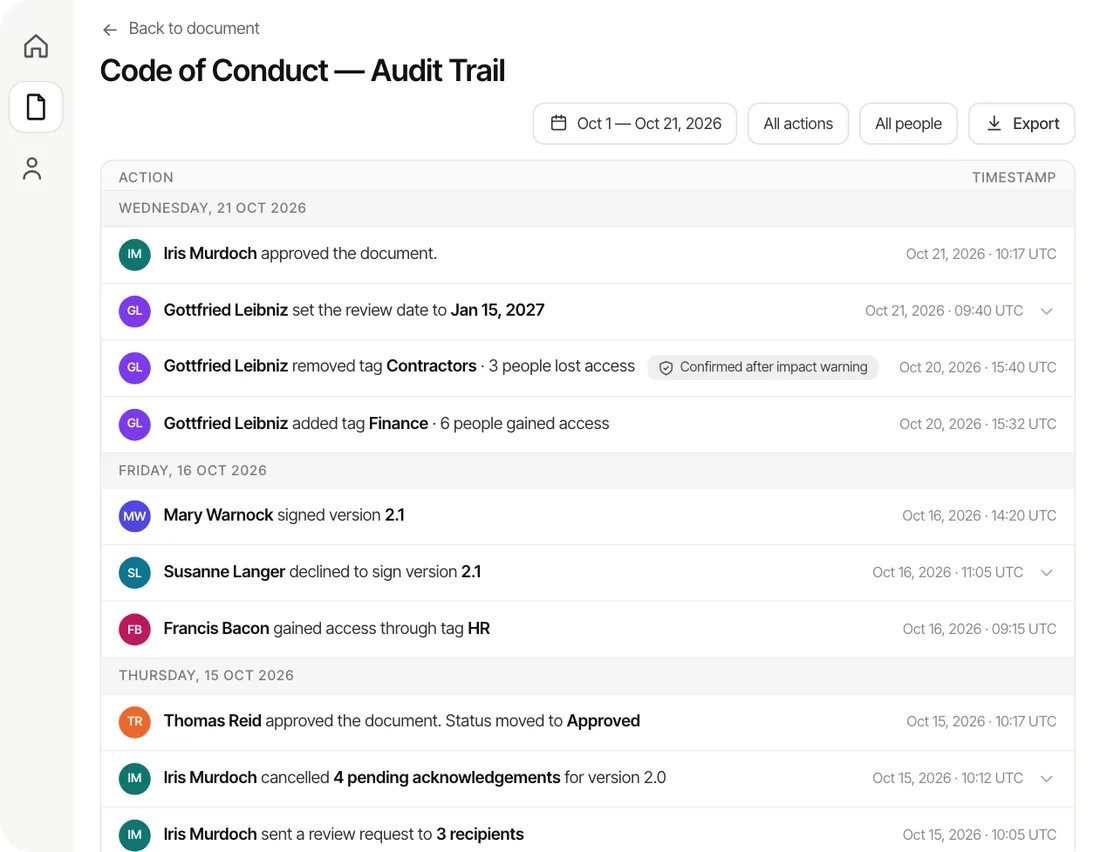
• Comprehensive Audit Trail: Every approval, distribution, and acknowledgment is logged with the person and time.
• Native E-Signature: Signatures built into AllyMatter for policies that require formal sign-off, available as an add-on on the Scale plan.
Beyond Features: The AllyMatter Difference
While individual features are important, AllyMatter’s real value comes from how these capabilities work together to create a seamless policy management experience. Our platform is built for growing companies, with the flexibility to adapt as your needs evolve and the simplicity to get started quickly.
We understand that policy management isn’t just about documents – it’s about creating a foundation for sustainable growth. That’s why we’ve designed AllyMatter to be more than just a repository. It’s a dynamic system that helps you build and maintain the structure your growing organization needs.
Making the Transition
Ready to transform your policy management? Getting started with AllyMatter is straightforward, and we’re here to help every step of the way:
- Bring your existing policies in, with free migration help and chat handholding on yearly plans
- Set up your organizational structure and user roles
- Configure your approval workflows and review dates
- Start managing policies more effectively immediately
Don’t let poor policy management hold back your growth. Schedule a demo today to see how AllyMatter can help your organization scale with confidence.