
Knowledge Base · 6 min read
The 4 Critical Pillars of Internal Knowledge Management
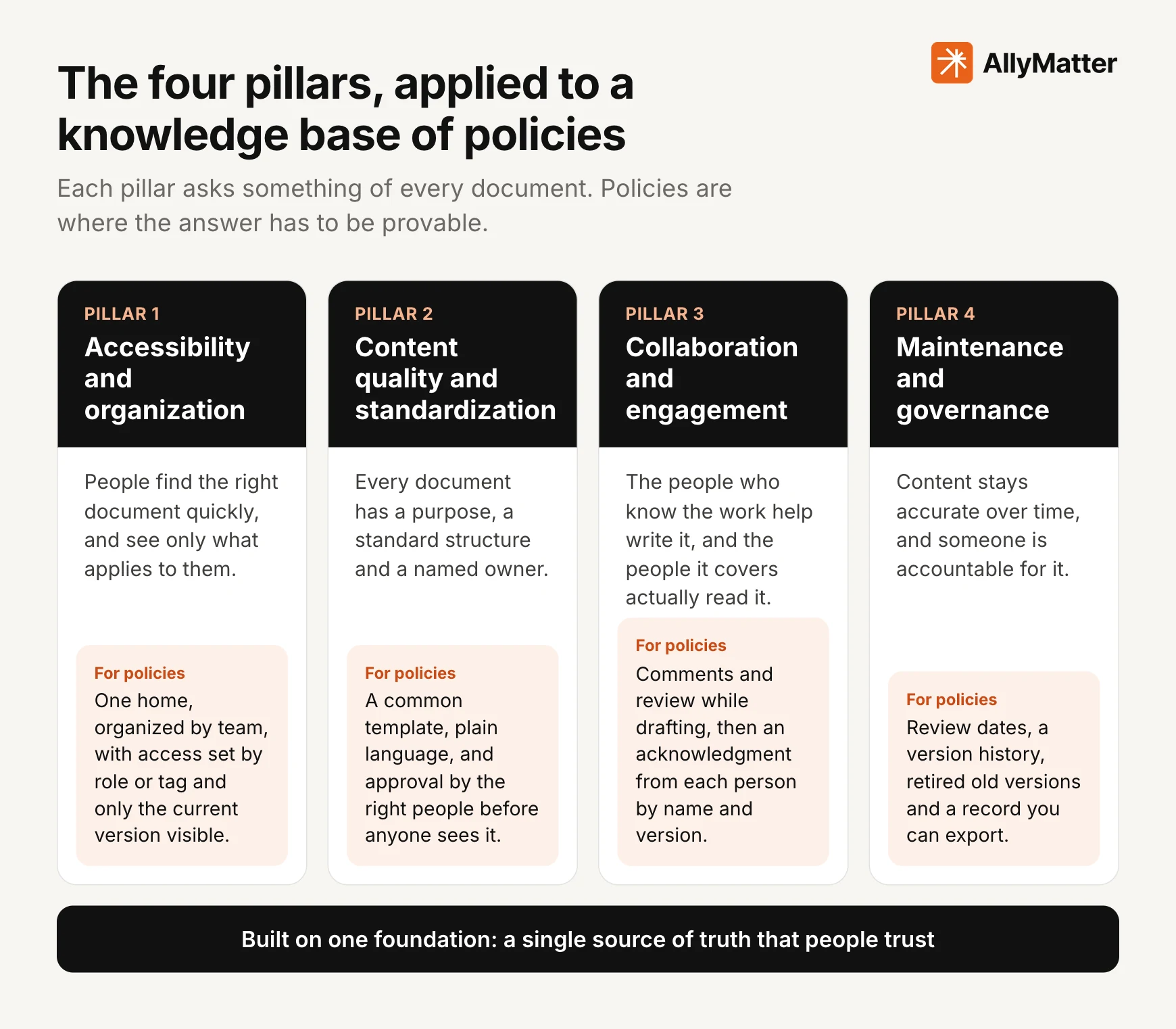
The four pillars of internal knowledge management are accessibility and organization, content quality and standardization, collaboration and engagement, and maintenance and governance. Together they decide whether people can find what they need, trust what they find, help keep it right, and rely on it staying right. For a company of 50 to 500 people, the documents that test all four hardest are policies, because those are the ones people are expected to follow and the ones someone eventually asks you to prove.
If the documents your team relies on include policies that people must read, follow and acknowledge, our guide to policy management software for small and growing businesses covers what a policy center does, what it costs and how to choose one.
What are the four pillars of knowledge management?
Different authors name the pillars differently. Michael Stankosky’s widely cited model uses leadership, organization, technology and learning, and many practitioners use people, process, technology and content. This guide uses four practical pillars that map onto the work a growing company actually does with its documents.
| Pillar | The question it answers | What it means for policies |
|---|---|---|
| Accessibility and organization | Can people find the right document quickly? | One home, organized by team, with only the current version in view |
| Content quality and standardization | Can people trust what they find? | A standard structure, a named owner and approval before publishing |
| Collaboration and engagement | Do the right people help write it, and do the rest read it? | Review while drafting, and acknowledgment by name and version |
| Maintenance and governance | Will it still be right next year, and who is accountable? | Review dates, version history and an exportable record |
First Pillar: Accessibility & Organization
Accessibility means the right person finds the right document quickly, and organization means it is where they expect it to be. The usual failure is not a missing document but too many copies of it. I have spent more time than I would like in meetings where the first twenty minutes went on working out which version of the document everyone was looking at.
For policies, the fix is structural. Keep each document in one place, organize folders the way the business runs, and control access by role or team so people see what applies to them. Most importantly, make sure readers can only open the current approved version, with earlier versions kept in the history rather than in circulation.
Second Pillar: Content Quality & Standardization
People trust a knowledge base when its documents look and behave the same way. A standard structure tells readers where to find the scope, the rule and the owner, and it tells writers what a finished document needs.
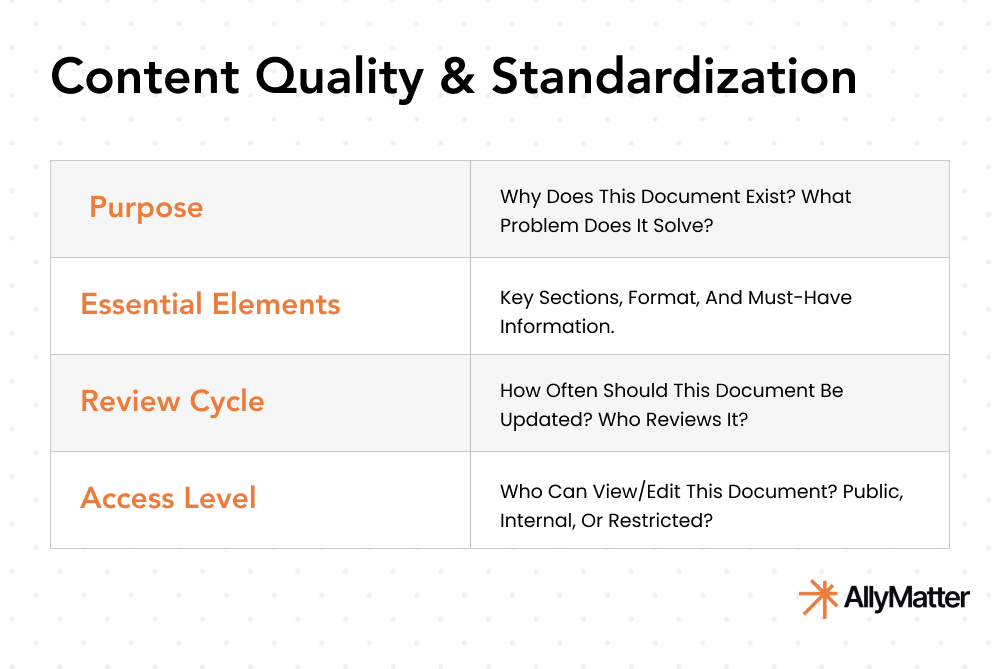
For policies, quality has one more requirement: approval. A policy is only official once the right person has signed off on that exact version, and nobody should be reading a draft. Our guide to writing a policy on policies sets out a standard structure and who approves what.
Third Pillar: Collaboration & Engagement
Collaboration is how the people who know the work help write it down. Engagement is whether the people a document is for actually read it. Most knowledge bases do the first reasonably well and leave the second to chance.
For policies, engagement has to be recorded. While a policy is being drafted, reviewers comment and the approval flow collects sign-off in order. Once it is published, each person it covers acknowledges it, and the record shows their name, the version and the time. When the policy changes, everyone is asked again. Our guide to acknowledgment tracking covers what that record needs to hold.
Fourth Pillar: Maintenance & Governance
A knowledge base starts decaying the day it is finished. Maintenance is the routine that keeps it accurate, and governance is the set of rules that decides who is accountable for each part of it.
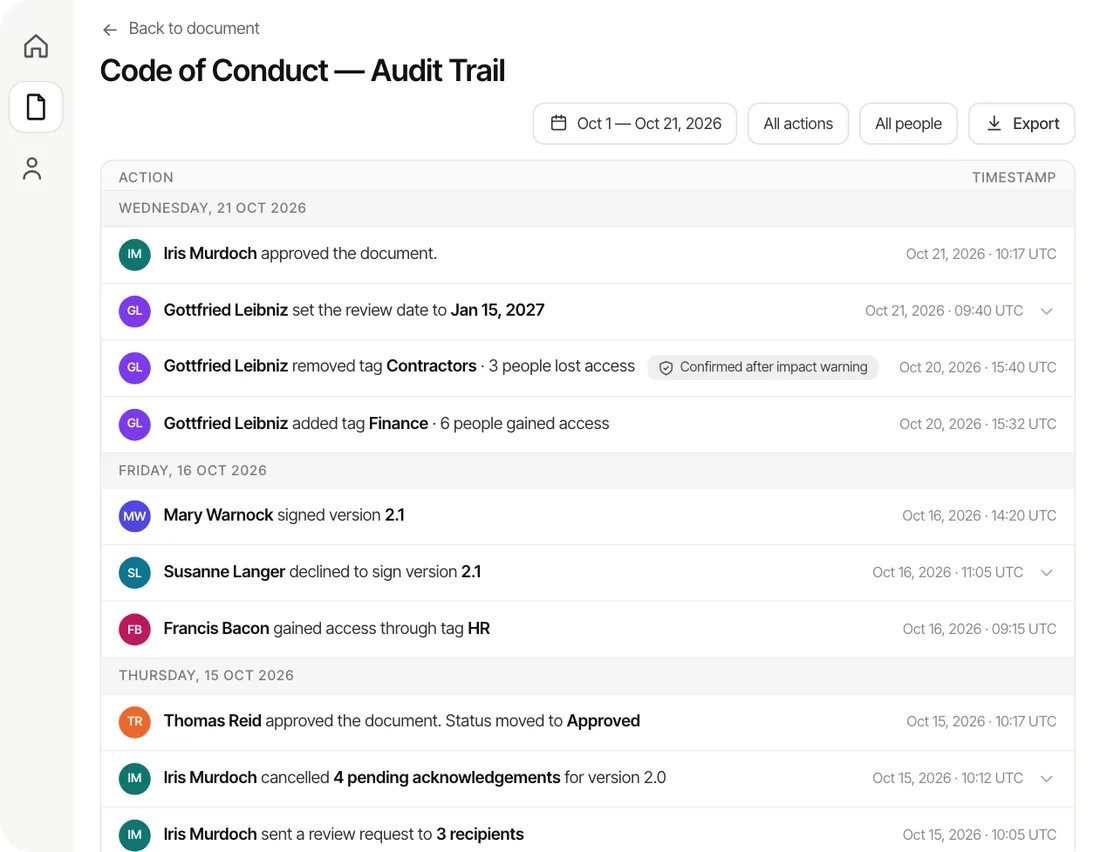
For policies, governance means a named owner for every document, a review date that reminds that owner to check it, a version history that shows what changed and when, and a clear way to retire documents that no longer apply. It also means being able to answer, from the record, who approved each version and who has read it. Our guide to policy governance goes deeper on owners, reviews and approvals.
Implementation Strategy
- Start with the documents people must follow. List your policies and core procedures first, since they carry the most risk if they are wrong.
- Name an owner for each. One person per document, responsible for keeping it current.
- Organize and set access. Folders by team, access by role, one copy of each document.
- Standardize and approve. Move each policy into a common structure and route it through approval before publishing.
- Collect acknowledgments. Send each policy to the people it covers and record who has read which version.
- Set review dates and keep the record. Put every policy on a review cycle and keep the history of approvals and acknowledgments ready to export.
How AllyMatter supports the four pillars
We built AllyMatter as policy management software, and it works as a knowledge base of policies. Folders and tags handle accessibility and organization, and readers only ever see the approved version. Mandatory approval flows, with up to four steps in order, handle quality. Inline comments while drafting and acknowledgments by name and version after publishing handle collaboration and engagement, with reminders on the cadence you set and a view of who has acknowledged and who has not. Review dates, version history with side-by-side comparison, and an audit trail that exports as a PDF or CSV handle maintenance and governance.
Frequently Asked Questions
What are the four pillars of knowledge management?
In this guide they are accessibility and organization, content quality and standardization, collaboration and engagement, and maintenance and governance. Other frameworks name people, process, technology and content, or leadership, organization, technology and learning. They cover the same ground from different angles.
What are the four components of knowledge management?
People often use components and pillars to mean the same thing. A common version is people, process, technology and content: the people who hold and use knowledge, the processes that capture and share it, the tools that store it, and the content itself.
Which pillar matters most for policies?
Maintenance and governance. A policy that is easy to find but out of date, or current but never read, causes more trouble than a missing one, because people act on it. Review dates, version history and acknowledgments are what keep policies trustworthy.
How do you measure whether knowledge management is working?
For policies, look at three numbers: how many documents are past their review date, what share of people have acknowledged the current version of each policy, and how long it takes to answer a question like who approved this and who has read it.
Do the pillars apply to a small company?
Yes, and they are cheaper to set up early. A company of 20 can start with one owner per document, one folder per team, approval before publishing and a review date on every policy.
Start your 30-day free trial of AllyMatter. No credit card to start, and a 30-day money-back guarantee if you subscribe and change your mind. Free migration.