
Policy Governance · 23 min read
Company Policy Examples for Small Businesses, With Sample Wording
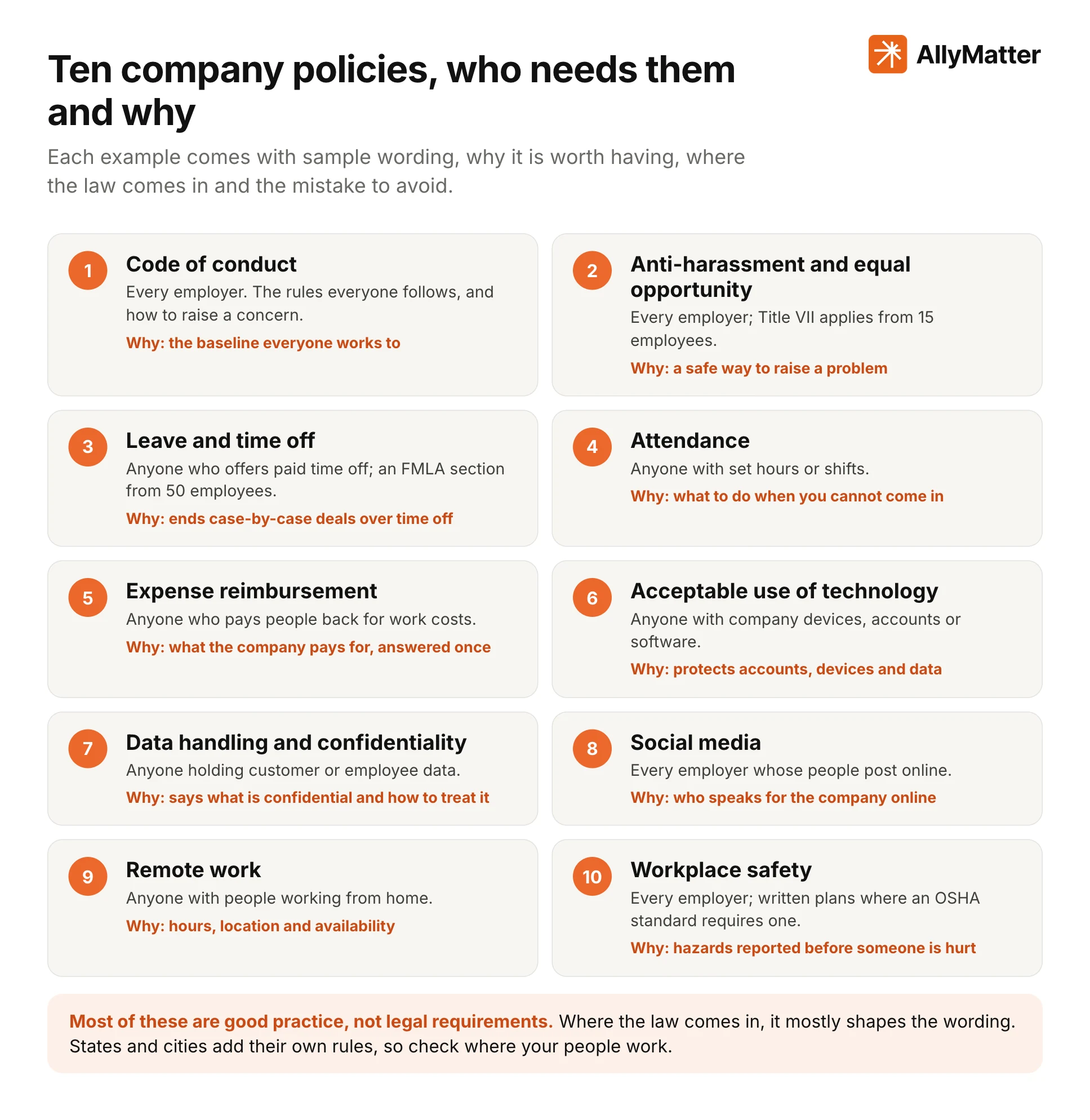
Here are ten company policy examples a small or growing US business can adapt today: a code of conduct, anti-harassment and equal opportunity, leave and time off, attendance, expense reimbursement, acceptable use of technology, data handling and confidentiality, social media, remote work and workplace safety. Each one is short, written for a sample company, and followed by why it is worth having, where the law comes in and the mistake to avoid.
This post is part of our guide to policy governance, which covers who writes, approves, owns and reviews each policy as a company grows.
Written policies matter because people cannot follow rules they have never been told. Gallup found that only 47% of employees strongly agree they know what is expected of them at work. If you want the definition first, our guide to what a policy is covers it, along with the ten parts every good policy has. Governance is easier to keep up when the policies themselves live in policy management software rather than a shared drive.
Source: Gallup, employee engagement strategies, 2026 (2025 data)
How to use these policy examples
Each example is written for ShiftTilt Inc, a sample company, and starts with a header line that names the version, effective date, owner, approver and next review date. Those five details are what turn a page of rules into a policy you can prove was in force. After each example, three short notes explain why the policy is worth having, where the law comes in and the mistake to avoid.
Most of these policies are not required by any law. You write a social media, expense or remote work policy because it is good practice: it sets expectations before there is a problem and gives every manager the same answer to apply. Where the law comes in, it mostly shapes the wording, not whether you need the policy.
These are starting points for a US company, written to federal law. States and cities add their own rules, especially on leave, pay, reimbursement and privacy, so check the rules where your people work and have counsel review anything that touches pay, leave or discipline.
Code of conduct example
A code of conduct sets the rules that apply to everyone and tells people how to raise a concern. For a small company it should fit on a page, with the detail in the policies it points to.
| Policy | Code of Conduct, version 2.0, effective January 1, 2027. Owner: Head of People. Approved by: CEO. Next review: January 2028. |
| Purpose and scope | Sets out how everyone at ShiftTilt Inc is expected to act. It applies to employees, and to contractors where their contract says so. |
| The rules | Act honestly and within the law. Protect company property and the confidential information described in our Data Handling Policy. Tell People Operations about any conflict of interest before it affects a decision. Do not give or accept gifts worth more than a token amount from anyone we buy from or sell to. |
| Raising a concern | Tell your manager, People Operations or the CEO, whichever you prefer. We will not retaliate against anyone who raises a concern in good faith. |
| Acknowledgment | “I have read the Code of Conduct, version 2.0, and will follow it.” |
Why have it. It sets the baseline everyone works to, so the first employee and the fiftieth start from the same expectations, and it gives you something fair to point to when someone crosses a line. The concern route goes around the manager on purpose, because a concern about a manager needs somewhere else to go.
Where the law comes in. No law requires a code of conduct. The federal sentencing guidelines do count written standards of conduct as the first element of an effective compliance program, and Section 7 of the National Labor Relations Act limits how broadly you can restrict what employees say about their work.
The common mistake. Copying a 40-page enterprise code, or adding blanket rules such as “be respectful at all times” or “never say anything negative about the company”. Broad civility and loyalty rules are the ones most likely to conflict with employees’ right to discuss their working conditions.
Anti-harassment and equal opportunity policy example
This is the policy that tells people what to do when something is wrong at work, and the one you will be asked for first if a complaint ever reaches a lawyer. Write it from the first hire.
| Policy | Anti-Harassment and Equal Opportunity Policy, version 1.4, effective January 1, 2027. Owner: Head of People. Approved by: CEO. Next review: January 2028. |
| Our commitment | We make decisions about hiring, pay, promotion and every other part of work without regard to race, color, religion, sex (including pregnancy), national origin, age, disability, genetic information or any other characteristic protected by law. |
| What is not allowed | Harassment based on any of those characteristics, including unwelcome comments, jokes, images or contact, whether in person, in messages or at work events. |
| How to report | Tell your manager, Epictetus Freed in People Operations, or the CEO. You do not have to report to anyone involved, and you do not have to go through your manager. |
| What happens next | We investigate promptly and impartially, keep reports as confidential as we can while we do, and take corrective action where it is needed. Nobody will be retaliated against for reporting or for taking part in an investigation. |
Why have it. People need a safe way to raise a problem, and you need to hear about it while it is still small enough to fix. More than one reporting route matters because the usual route, the manager, fails exactly when the manager is the problem.
Where the law comes in. Title VII applies from 15 employees. In Faragher v. City of Boca Raton and Burlington Industries v. Ellerth (1998), the Supreme Court gave employers a defense against some harassment claims if they took reasonable care to prevent and promptly correct harassment, and the employee unreasonably failed to use the complaint routes offered. A written policy with more than one route and a promise of no retaliation is the evidence for that defense. The EEOC took in 88,201 new charges of discrimination in its 2025 fiscal year.
The common mistake. Promising complete confidentiality, which no investigation can keep. Also check any settlement or employment agreement: since the Speak Out Act of 2022, nondisclosure and nondisparagement clauses signed before a dispute cannot be enforced in court for sexual harassment and sexual assault disputes.
Sources: 42 U.S.C. 2000e(b), Faragher v. City of Boca Raton, 524 U.S. 775 (1998), Burlington Industries v. Ellerth, 524 U.S. 742 (1998), 42 U.S.C. 19403, EEOC, fiscal year 2025 results, April 2026
Leave and time off policy example
Time off is the question people ask most, so answer it once, in writing. No federal law requires paid vacation or paid holidays; the Department of Labor treats them as a matter of agreement between you and your employees. Most employers offer them anyway: in March 2026, 80% of private-industry workers had paid vacation and 81% had paid sick leave, according to the Bureau of Labor Statistics.
| Policy | Time Off Policy, version 3.1, effective January 1, 2027. Owner: Head of People. Approved by: CEO. Next review: January 2028. |
| Who it covers | All regular employees, from their first day. |
| Paid time off | Full-time employees earn paid time off each pay period, as set out in the accrual table, and part-time employees earn it in proportion to their hours. Up to five unused days carry over to the next year. |
| How to request it | Ask your manager in the leave system at least two weeks ahead for planned time off, and as soon as you can for anything unplanned. Your manager approves or declines within three working days. |
| Leaving the company | Unused paid time off is handled as required by law where you work, and otherwise as this policy states. |
| Family and medical leave | Eligible employees can take unpaid, job-protected leave under the Family and Medical Leave Act. Accrued paid time off runs at the same time as that leave. Our FMLA notice is attached to this policy. |
Why have it. Without written rules, time off runs on case-by-case deals, and different deals for different people are where resentment starts. A written policy answers how much, how to ask and what happens to unused days, once, for everyone.
Where the law comes in. No federal law requires paid vacation. The Family and Medical Leave Act applies to private employers with 50 or more employees, and gives eligible employees (12 months of service, 1,250 hours in the last year, and 50 employees within 75 miles) up to 12 weeks of job-protected leave. A covered employer that has a handbook or written leave policy must include the FMLA general notice in it, which is why the example attaches it.
The common mistake. Saying nothing about carryover or what happens to unused time when someone leaves, which is where most disputes start. The second is a company that has grown past 50 employees and never added the FMLA section.
Sources: US Department of Labor, vacation leave, DOL Fact Sheet #28, FMLA, 29 CFR 825.300(a)(3), Bureau of Labor Statistics, Employee Benefits in the United States, March 2026
Attendance policy example
An attendance policy tells people how to report an absence and what happens if absences become a problem. The part that needs the most care is what it does not count.
| Policy | Attendance and Timekeeping Policy, version 1.2, effective January 1, 2027. Owner: Operations Manager. Approved by: Head of People. Next review: January 2028. |
| Your hours | Your manager agrees your working hours with you. If you are paid by the hour, record all the time you work, including time before and after your shift. |
| If you are absent or late | Tell your manager before your start time, by phone or message, and say when you expect to be back. |
| Absences that do not count | Leave protected by law, such as FMLA leave, military leave and time off agreed as a disability accommodation, never counts against you under this policy. |
| If attendance is a problem | Your manager will talk with you first, then put concerns in writing, before any further step. |
Why have it. It tells people exactly what to do on the morning they cannot come in, and gives managers one fair way to handle absences instead of a different answer for each person.
Where the law comes in. FMLA rules forbid using FMLA leave as a negative factor in employment decisions, so protected leave cannot count under a points system, and the EEOC’s guidance on leave and the Americans with Disabilities Act says extra leave can be a reasonable accommodation. For hourly staff, federal wage rules say a written rule against unrecorded work is not enough; managers have to stop work they do not want done.
The common mistake. A no-fault points system that counts every absence, including protected ones. The other is “no overtime without approval” written into the policy while managers quietly accept the extra hours.
Sources: 29 CFR 825.220(c), EEOC, Employer-Provided Leave and the Americans with Disabilities Act (2016), 29 CFR 785.13
Expense reimbursement policy example
An expense policy decides what the company pays back, how quickly people claim and who approves. The timing in the example is not arbitrary.
| Policy | Expense Reimbursement Policy, version 2.0, effective January 1, 2027. Owner: Finance Lead. Approved by: CEO. Next review: January 2028. |
| What we pay back | Reasonable costs you pay while doing your job, such as travel, client meals and equipment your manager has approved in advance. |
| How to claim | Submit each claim within 60 days of the cost, with an itemized receipt showing the amount, date, place and business purpose. Return any advance you did not spend within 120 days. |
| Who approves | Your manager approves your claims. Nobody approves their own claim, and the Finance Lead’s claims go to the CEO. |
| When you are paid | Approved claims are paid with the next payroll. |
Why have it. It answers what the company pays for once, so nobody has to ask before every trip and nobody is surprised when a claim is turned down. Clear deadlines also keep the books current.
Where the law comes in. Under the IRS accountable plan rules, reimbursements stay out of taxable wages when the cost has a business connection, is backed by receipts within a reasonable time and any excess is returned. The rules’ safe harbor is 60 days to substantiate and 120 days to return excess, which is where the example’s deadlines come from. Separately, work costs you require hourly staff to cover cannot push their pay below the minimum wage or overtime due.
The common mistake. A flat monthly allowance with no receipts, which the IRS treats as wages. The other is letting the person who approves claims approve their own. Some states add their own reimbursement rules, so check where your people work.
Sources: 26 CFR 1.62-2(c), (d), (e), (f) and (g), 29 CFR 531.35
Acceptable use of technology policy example
An acceptable use policy covers the company’s devices, accounts and software, and any personal device used for work. It is usually the first policy a customer’s security questionnaire asks for.
| Policy | Acceptable Use of Technology Policy, version 2.3, effective January 1, 2027. Owner: IT Lead. Approved by: CEO. Next review: July 2027. |
| What it covers | Company laptops and phones, company accounts and software, our network, and any personal device you use for work. |
| Accounts and passwords | Use multi-factor sign-in on every company account. Never share your password or let someone else use your account. |
| Software and AI tools | Install only software from the approved list, and follow our AI Use Policy before putting company information into any AI tool. |
| Reporting | Report a lost or stolen device, or a message you think is phishing, to the IT Lead within one hour. |
| Monitoring | Company systems may be monitored for security. Reasonable personal use is allowed, but it is not private. |
| Before you get access | You acknowledge this policy before your accounts are switched on. |
Why have it. Company accounts, laptops and software are how most work gets done, and most security problems start with one of them: a shared password, an unapproved app, a lost laptop nobody reported. The policy sets the few rules that prevent most of that. AI tools belong here too: SHRM’s 2026 research found that only 36% of small organizations that have adopted AI have a policy on how employees use it, and our guide to an AI acceptable use policy covers that one.
Where the law comes in. Most companies are not required to have one. The NIST Cybersecurity Framework 2.0 still puts policy at the center of its Govern function, and NIST SP 800-171, which binds contractors handling controlled unclassified information, asks for rules of behavior acknowledged before access. Customers’ security questionnaires usually ask for it too.
The common mistake. Asking for a signature once at hiring and never again, so the acknowledgment on file is for a version from years ago. The other is a separate device policy, security policy and acceptable use policy that contradict each other.
Sources: NIST Cybersecurity Framework 2.0 (CSWP 29), Govern function, GV.PO, NIST SP 800-171 Rev. 3, 03.15.03, SHRM, Navigating AI in the Workplace, 2026
Data handling and confidentiality policy example
This policy defines what is confidential and how to handle it. The last row of the example is the one most small-business policies leave out.
| Policy | Data Handling and Confidentiality Policy, version 1.5, effective January 1, 2027. Owner: IT Lead. Approved by: CEO. Next review: July 2027. |
| What is confidential | Customer data, our source code and product plans, pricing and contracts not yet public, and other people’s personal data you can see because of your job, such as payroll and medical records. |
| How to handle it | Keep confidential information in approved company systems only, share it only with people who need it for their work, and never send it to a personal email account or device. |
| Keeping and disposing | Keep records for as long as our Records Retention Schedule says, then delete or shred them. |
| What this policy does not limit | Nothing in it stops you discussing your own pay or working conditions, or reporting a possible violation of law to a government agency. Under 18 U.S.C. 1833(b), you are immune from trade secret liability for confidential disclosures to a government official or an attorney made only to report or investigate a suspected violation of law. |
Why have it. People handle customer data, contracts and payroll every day, and most leaks are accidents by someone who did not know the rule. The policy says what counts as confidential and how to treat it, so nobody has to guess. The FTC’s guide for businesses sums up the handling rules in five principles: take stock, scale down, lock it, pitch it and plan ahead.
Where the law comes in. The Defend Trade Secrets Act requires an employer to tell employees, contractors and consultants about whistleblower immunity in any agreement that governs confidential information, and pointing to a policy that sets out the reporting route counts. Without it, the employer loses exemplary damages and attorney fees against that person. The carve-out for discussing pay and working conditions is there because Section 7 of the National Labor Relations Act protects that discussion.
The common mistake. Defining confidential information so broadly that it includes employees’ own pay and working conditions, and leaving out the trade secret notice. If you are a financial institution under the FTC’s definition, such as a tax preparer or mortgage broker, the Safeguards Rule also requires a written information security program.
Sources: 18 U.S.C. 1833(b), 29 U.S.C. 157, FTC, Protecting Personal Information: A Guide for Business, 16 CFR Part 314
Social media policy example
A social media policy should be short and narrow. Most of the risk in this policy comes from what it tries to forbid.
| Policy | Social Media Policy, version 1.1, effective January 1, 2027. Owner: Marketing Lead. Approved by: CEO. Next review: January 2028. |
| Speaking for the company | Only people the Marketing Lead has authorized post on company accounts or speak for ShiftTilt Inc online. |
| Your own accounts | If you post about our products or services, say that you work here. Do not share confidential information as defined in our Data Handling Policy, and do not harass colleagues, customers or anyone else online. |
| Your rights | This policy does not restrict your right to discuss pay, working conditions or other terms of employment with colleagues or anyone else. |
Why have it. Your people post about their work, and that is mostly a good thing. The policy settles the two questions that matter: who speaks for the company, and what stays confidential.
Where the law comes in. Section 7 of the National Labor Relations Act protects most non-supervisory employees, union or not, when they discuss pay and working conditions, including online. As of November 2026, the NLRB judges work rules under the standard it set in Stericycle in 2023: a rule employees could reasonably read as discouraging that activity is presumed unlawful unless a narrower rule could not protect the employer’s interest. Its General Counsel has asked the Board to replace that standard, so keep rules narrow under either test. The disclosure line comes from the FTC’s endorsement rules.
The common mistake. Banning negative or disparaging posts about the company or its managers, or requiring approval before anyone mentions the company at all.
Sources: 29 U.S.C. 157, Stericycle, Inc., 372 NLRB No. 113 (2023), 16 CFR 255.5
Remote work policy example
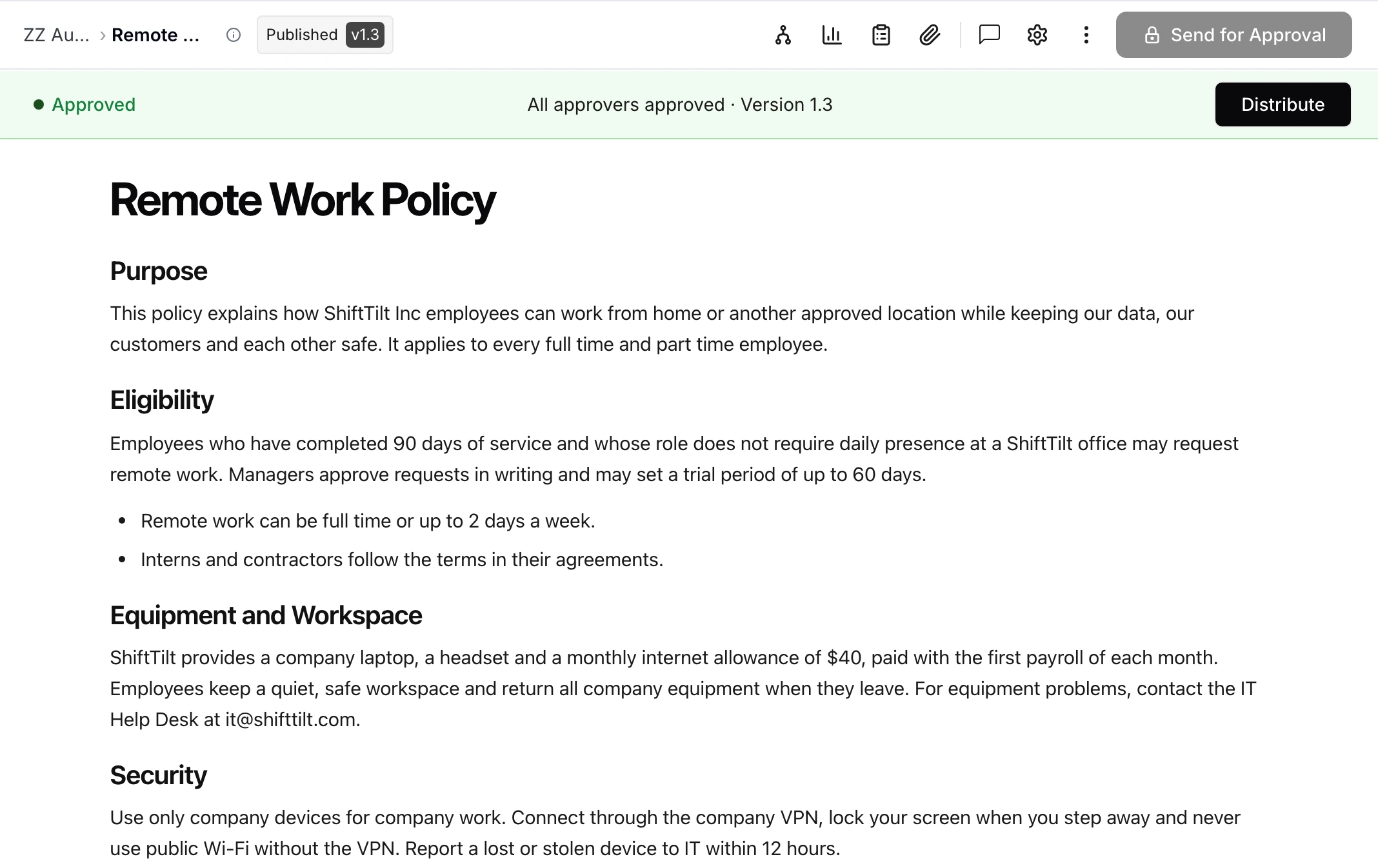
Our guide to what a policy is includes a complete remote work policy as its worked example, so this one shows only the section most remote policies get wrong: hours for hourly employees. In March 2026, 22.6% of US workers teleworked or worked at home for pay, according to the Bureau of Labor Statistics.
| Policy | Remote Work Policy (hours section), version 1.3. Owner: Head of Operations. |
| Hours for hourly employees | If you are paid by the hour, record every minute you work remotely, including calls, messages answered outside your schedule and short meetings. Your manager will not ask you to work time you do not record. |
| Where you work | Remote work is from a location in the United States that your manager has approved. |
Why have it. Remote work runs on clear expectations: when people are available, where they can work from and how hours are recorded. For hourly employees, the hours part is the one most often left vague.
Where the law comes in. The Department of Labor’s telework guidance says hourly employees working remotely must be paid for all hours worked, under the same break rules as in the office, and that for FMLA purposes a remote employee’s worksite is the office they report to, not their home.
The common mistake. Treating short calls and messages outside the schedule as free time for hourly staff, and leaving remote employees out when counting toward the FMLA’s 50-employee test.
Sources: US Department of Labor, Field Assistance Bulletin 2023-1, 29 CFR 785.13, Bureau of Labor Statistics, The Economics Daily, April 2026
Workplace safety policy example
Safety starts on the first day: people need to know how to report a hazard and what to do in an emergency. Every employer has safety duties, whatever its size, and the Bureau of Labor Statistics counted 5,070 fatal work injuries in the United States in 2024.
| Policy | Workplace Safety Policy, version 1.0, effective January 1, 2027. Owner: Operations Manager. Approved by: CEO. Next review: January 2028. |
| Our commitment | Everyone who works here should go home uninjured. The CEO signs this policy and we review it every year. |
| Reporting hazards and injuries | Report any hazard, near miss or injury to your supervisor or the Operations Manager the same day. Nobody will be retaliated against for reporting. |
| Emergencies | Follow the emergency procedures posted in each location and covered in your first-week training: how to raise the alarm, where to exit and where to meet. |
| Training | Everyone completes safety training in their first week, and again whenever their work or equipment changes. |
Why have it. People need to know how to report a hazard and what to do in an emergency before the day they need it. A blame-free reporting route gets hazards fixed before someone is hurt.
Where the law comes in. The Occupational Safety and Health Act’s general duty clause requires every employer to keep the workplace free of recognized hazards likely to cause death or serious harm. Where an OSHA standard requires an emergency action plan, it must be written and kept at the workplace, though an employer with 10 or fewer employees may communicate it orally. OSHA’s recommended practices start with a written safety policy signed by top management, which is why the example says the CEO signs it.
The common mistake. Assuming small size means no OSHA duties. Companies with 10 or fewer employees are partly exempt from keeping injury logs, but they must still report a work-related fatality, inpatient hospitalization, amputation or loss of an eye.
Sources: 29 U.S.C. 654(a), 29 CFR 1910.38, 29 CFR 1904.1 and 1904.39, OSHA, Recommended Practices for Safety and Health Programs, Bureau of Labor Statistics, Census of Fatal Occupational Injuries, 2024
Two more policies most companies add
Conflict of interest. Anyone who buys, hires or signs contracts should disclose outside interests that could affect a decision. Our guide to the conflict of interest policy has the full structure and a disclosure process.
AI use. Which AI tools people may use, what information can go into them and who checks the output. Our AI acceptable use policy guide covers what to include and how to roll it out.
Wording that gets policies into trouble
Most policy problems start with one sentence that says more than the company meant. These are the patterns to look for in any example you adapt, including ours.
| Risky wording | Safer wording | Why |
|---|---|---|
| “Employees must not discuss their pay.” | “Do not share other people’s payroll data you can see because of your job. This does not limit discussing your own pay.” | NLRA Section 7 protects discussing pay and conditions, with or without a union |
| “Do not post anything negative about the company or its managers.” | “Do not post confidential information or harass anyone online.” | Broad bans on criticism are the rules the NLRB most often finds unlawful |
| “Get approval before mentioning the company online.” | “Only authorized people speak for the company. If you mention our products, say you work here.” | Narrower rule, and matches the FTC endorsement rules |
| “Report harassment to your manager.” | “Report it to your manager, People Operations or the CEO, whichever you prefer.” | A route around the manager is part of the Faragher defense |
| “All complaints are completely confidential.” | “We keep reports as confidential as we can while we investigate.” | An investigation needs to talk to people; do not promise what you cannot keep |
| “Every absence earns a point.” | “Leave protected by law never counts against you.” | FMLA leave cannot be a negative factor, 29 CFR 825.220(c) |
| “Everyone gets a flat monthly expense allowance.” | “Submit receipts within 60 days; return unspent advances within 120 days.” | Without substantiation, the IRS treats the allowance as wages |
| “All company information is confidential.” | A defined list, plus “nothing here stops you reporting a possible violation of law to a government agency.” | Section 7, the trade secret notice and agency reporting rights |
Turning an example into your policy
An example becomes your policy when it describes what your company actually does and when you can show it was approved and communicated.
- Adapt it to your real practice, your headcount and the states where your people work.
- Name an owner who keeps it current. Our guide to policy owners covers how to choose one.
- Get it approved by the people your policy on policies names, and record who approved which version.
- Send it to everyone it covers and collect an acknowledgment of that version from each person.
- Set a review date, and change it through the same steps when the law or the business changes. Our guide to how often policies should be reviewed has review cycles by risk.
How AllyMatter helps
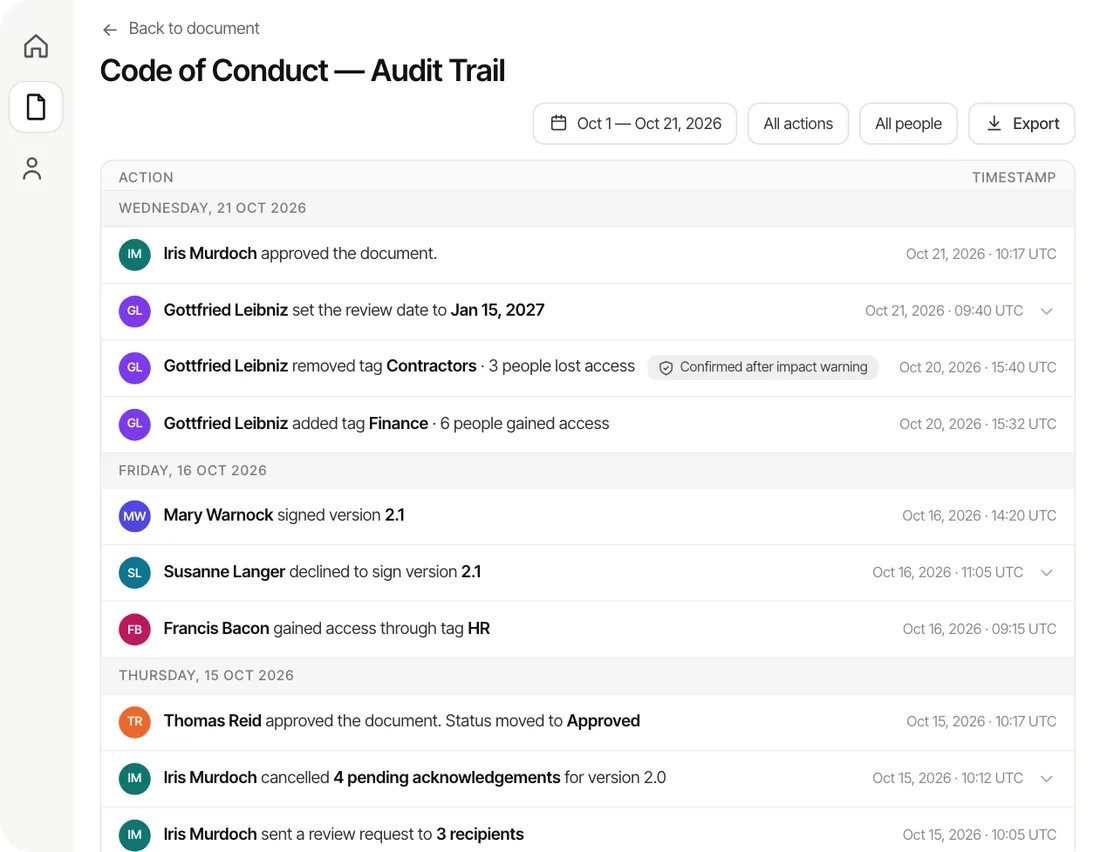
We built AllyMatter so that a small team can run the whole life of a policy in one place. Every policy goes through an approval flow before anyone sees it, and each approved change becomes a new version with the history kept. When it is ready, you choose how it goes out: notify people, or ask them to acknowledge or e-sign it. Reminders follow on the cadence you set, review dates remind each owner when a policy is due, and the record of approvals, versions and acknowledgments exports as a PDF or CSV when someone asks.
Not ready for software yet? Start with our free Policy Acknowledgment and Signature Tracker for Google Sheets or Excel.
Questions about company policy examples
What are some examples of company policies?
The ten most small businesses start with are a code of conduct, an anti-harassment and equal opportunity policy, a leave and time off policy, an attendance policy, an expense reimbursement policy, an acceptable use of technology policy, a data handling and confidentiality policy, a social media policy, a remote work policy and a workplace safety policy. This guide gives sample wording for each.
Which policies should a small business write first?
Start with anti-harassment and equal opportunity, pay and timekeeping, safety and the code of conduct, because they apply from the first hire and protect you in the disputes that happen most. Add the others as you grow; our guide to small business compliance shows which laws apply at 15, 20, 50 and 100 employees.
Can I copy a policy example word for word?
Use it as a starting point, not a finished policy. Change it to match what your company actually does, check the rules in the states where your people work, and have counsel review anything that touches pay, leave or discipline. A policy that describes a practice you do not follow is worse than no policy.
How long should a company policy be?
As short as it can be while still answering who it covers, what the rule is, what the exceptions are and who to ask. Most of the examples here fit on one page. Put the step-by-step detail in a procedure that the policy links to.
Do employees have to sign company policies?
No federal law requires a signature on most policies, but an acknowledgment by name, version and date is your proof that each person was told. Our guide to policy acknowledgment tracking covers what that record should hold.
Can a company policy stop employees from discussing pay?
Not for most private-sector employees. Section 7 of the National Labor Relations Act protects employees who discuss pay and working conditions, with or without a union. A policy can still stop people from sharing payroll records they can see because of their job.
Do company policies apply to contractors?
Only where the contract says so. Conduct, confidentiality, data handling and acceptable use policies often should apply, so name them in the contract and collect the contractor’s acknowledgment the same way you do for employees.
What is the difference between a policy example and a policy template?
An example shows a finished policy for a sample company, so you can see the wording. A template leaves blanks for your own details. Our free policy and procedure template gives you the blank structure for any policy.
Start your 30-day free trial of AllyMatter. No credit card to start, and a 30-day money-back guarantee if you subscribe and change your mind. Free migration.