
A policy system earns its keep in the gap between publishing and knowing: the document went out, and someone has to make sure it actually reached people, got read, and got confirmed. In most companies a human fills that gap with reminder emails. In AllyMatter, the gap is the notification system’s whole job, and this is what it actually does.
Where notifications come from
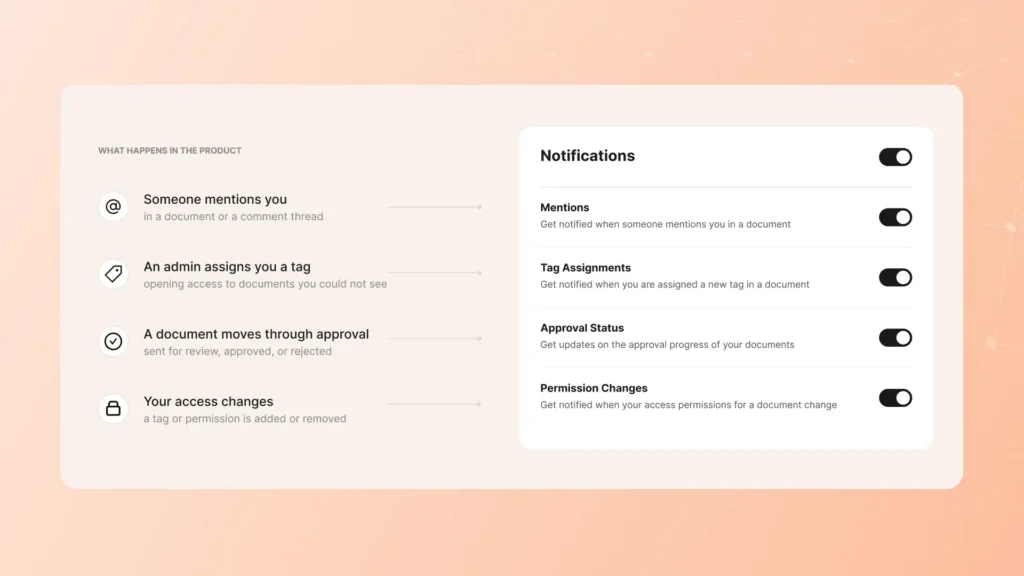
The document’s type, set at creation, decides what its audience will be asked to do and how they will be reminded.
Notifications are driven by the document’s type and its audience, not by broadcast lists. A notify document tells its tag-matched audience it exists, once, and asks nothing. An acknowledgment required document opens an obligation per person, and the system carries it: the request, the visible due date, and automatic reminders on a cadence until each person confirms. An e-signature document runs the same pattern with a signing ceremony at the end. Audiences are tags (department, location, role), so the June reorg updates who gets notified without anyone editing a distribution list, and a new hire’s obligations arrive with their tags on day one.
Where notifications arrive
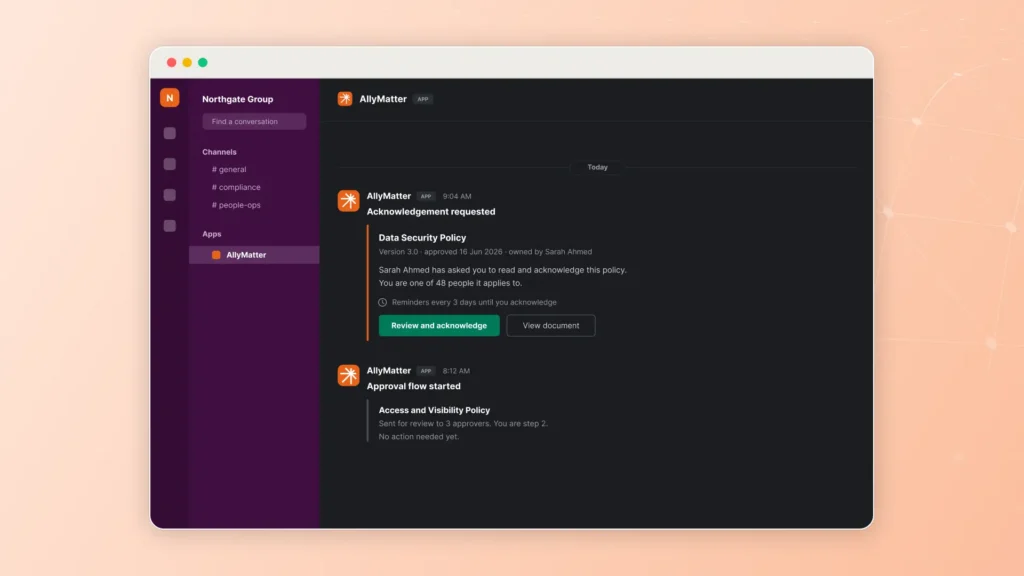
Where people actually see it: the request lands in Slack with the deadline attached, no new inbox to check.
Email, Slack, and Microsoft Teams (coming soon): the places people already look, which is most of the battle. The engineer who lives in Slack confirms the updated security policy through the link in Slack; the floor supervisor gets an email.
The two kinds of chasing
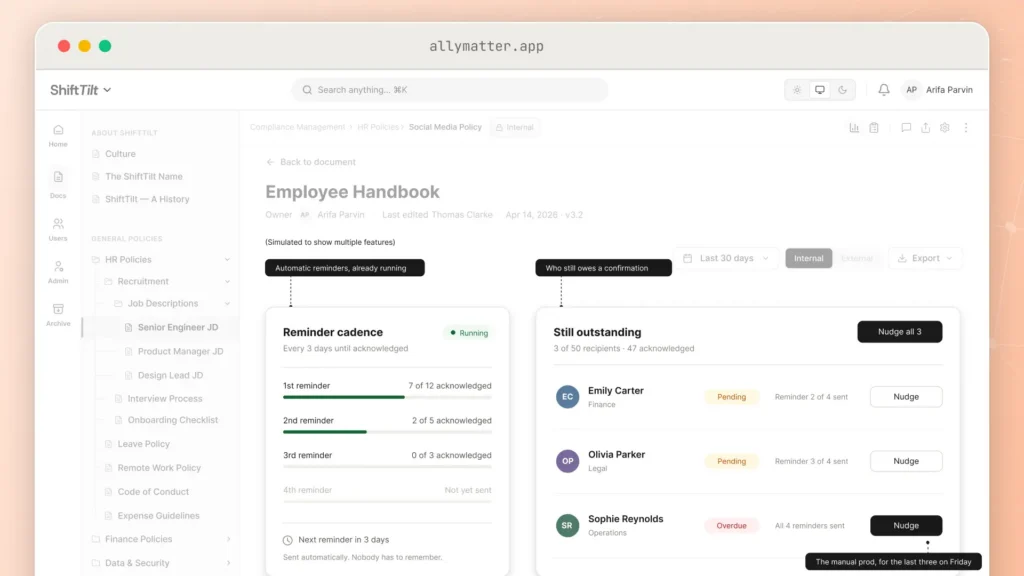
The owner’s whole job on one screen: the outstanding list, the reminders already chasing it, and the nudge for stragglers.
Automatic cadence handles the routine: reminders keep going to whoever is outstanding, without the owner remembering anyone.
Manual nudge handles the exception: the deadline is Friday, three names remain, and the owner sends a direct prod without restarting the request. The division of labor matters because it is the difference between a system that chases and a person who chases with software.
Both kinds land on the record: who was reminded and who confirmed is part of the document’s log, which is how “we told everyone” becomes a statement with evidence behind it.
Keeping notifications worth reading
The features prevent silence; discipline prevents noise, and noise is how notification systems die. Three practices we recommend to every team:
- Reserve the obligation types for obligations. If everything requires acknowledgment, nothing does. Reference material publishes quietly; the security policy demands a response. The document type is where that judgment lives.
- Scope audiences honestly. Tags exist so the California addendum reaches California, not everyone. The narrower the audience, the more each notification means.
- Say what changed. When a revision goes out, recipients see the word-by-word diff, so the notification leads to a one-minute confirmation instead of a re-read. Owners who add one line of context (“mileage rate updated, section 4”) get faster completion still.
Run it that way and the reminder system stays credible for the moment it matters: the policy that genuinely must be confirmed by Friday, by everyone, provably.
What this replaces
The spreadsheet of who-has-not-replied, the “friendly reminder” email with forty names in BCC, and the pre-audit discovery that a third of the company never saw the update. The chasing still happens; it just stops being anyone’s job.
Start your 30-day free trial. No credit card to start, and a 30-day money-back guarantee if you convert and change your mind.
Not ready for a trial? On annual plans, migration is on us: we’ll move your docs from SharePoint, Google Drive, Confluence, or Notion and have you running in about a week.

Vikas is a B2B marketing professional with over 14 years of experience in content strategy, messaging, and demand generation. He specializes in turning complex business challenges into clear, actionable stories to connect meaningfully with audiences.