
Policy Governance · 16 min read
How to Change a Company Policy: Notice, Approval and Re-Acknowledgment
To change a company policy, write the change as a new version, have it approved by the people who approved the old one, announce it with an effective date and a short note of what changed, and ask everyone it covers to acknowledge the new version. Keep the old version, because sooner or later someone will ask which rule applied on a given day.
This post is part of our guide to policy governance, which covers who writes, approves, owns and reviews each policy as a company grows.
Most policy changes are routine. A process changed, a tool was replaced, a rule turned out to be unclear, or the company simply grew. The hard part is rarely the new wording; it is making sure the change reaches everyone it affects, because a change in policy that people do not hear about does not change what they do. A few situations, such as a union contract or a benefit plan, set the terms for you. This guide covers the steps to make a change, who should approve it, how much notice to give, what the notice should say, what to keep afterwards and when the law takes the decision out of your hands. Governance is easier to keep up when the policies themselves live in policy management software rather than a shared drive.
Can you change a company policy without notice?
Legally, for most workplace policies at an at-will US employer, yes. Practically, give notice anyway. People can only follow the rule they know about, and a rule that changes without warning feels arbitrary to the people it affects, which costs more goodwill than the change is worth. Notice also gives managers time to answer questions before the change starts, not after.
The legal default is simple. Federal wage law, for example, has no scheduling rules, and the Department of Labor says an employer may change work hours without prior notice unless an agreement says otherwise. These are the situations where something other than your own judgment sets the terms.
| If this applies to you | What sets the terms of the change |
|---|---|
| The policy is part of a contract, an offer letter or a written promise | The terms you agreed to. In some states, specific promises in a handbook can be treated as an implied contract, so a change may need more than an announcement. |
| A union represents any of your employees | Changes to pay, hours and other terms of employment usually have to be bargained with the union first. Changing them on your own can be an unfair labor practice. |
| The policy describes a benefit plan | The plan rules set the clock. A summary of a material change goes to participants within 210 days after the end of the plan year, a material cut to group health benefits within 60 days, and a change to the Summary of Benefits and Coverage at least 60 days before it takes effect. |
| You are a HIPAA covered entity or business associate | Document the change before it takes effect, train the people whose work it affects within a reasonable time, and keep the records for six years. |
| You are a registered investment adviser | Review your compliance policies at least once a year, and keep every version that was in force in the last five years. |
| You hold ISO 9001 or ISO 27001 certification | Changes are planned and documents are controlled, so the auditor will expect to see who approved each version and how it reached the people who use it. |
Sources: US Department of Labor, FLSA FAQ on changing scheduled hours, Cornell LII, employment-at-will doctrine, NLRB v. Katz, 369 U.S. 736 (1962), 29 CFR 2520.104b-3, 29 CFR 2590.715-2715(b), 45 CFR 164.530(b), (i) and (j), 17 CFR 275.206(4)-7 and 275.204-2(a)(17), ISO 9001, clauses 6.3 and 7.5.3
Some states and cities add their own notice rules for specific topics such as pay, scheduling and leave, so check the rules where your people work.
One more check applies whether or not you have a union. Section 7 of the National Labor Relations Act protects most non-supervisory employees when they talk with each other about pay and working conditions, so a new or changed rule on conduct, confidentiality, social media or recording at work can be unlawful if employees could reasonably read it as discouraging that. As of November 2026, the NLRB still applies the standard it set in Stericycle in 2023, though its General Counsel has asked the Board to replace it. Have counsel read any rule that touches how employees communicate.
What counts as a change in policy?
Any edit to a policy that has already gone out is a change, whether it adds a rule or moves a comma. A comma can change what a sentence requires, and once you start deciding which edits are too small to count, the record of what people agreed to stops matching the text. We treat every change as a new version, and our post on when a policy update requires re-acknowledgment sets out why.
Two things are not changes. An exception lets one person or team depart from the policy for a reason and a period, and the policy itself stays the same; our guide to policy exceptions covers how to record one. A review that finds nothing to change is also not a change, though it should still be recorded, as our guide to how often policies should be reviewed explains.
How to change a company policy, step by step
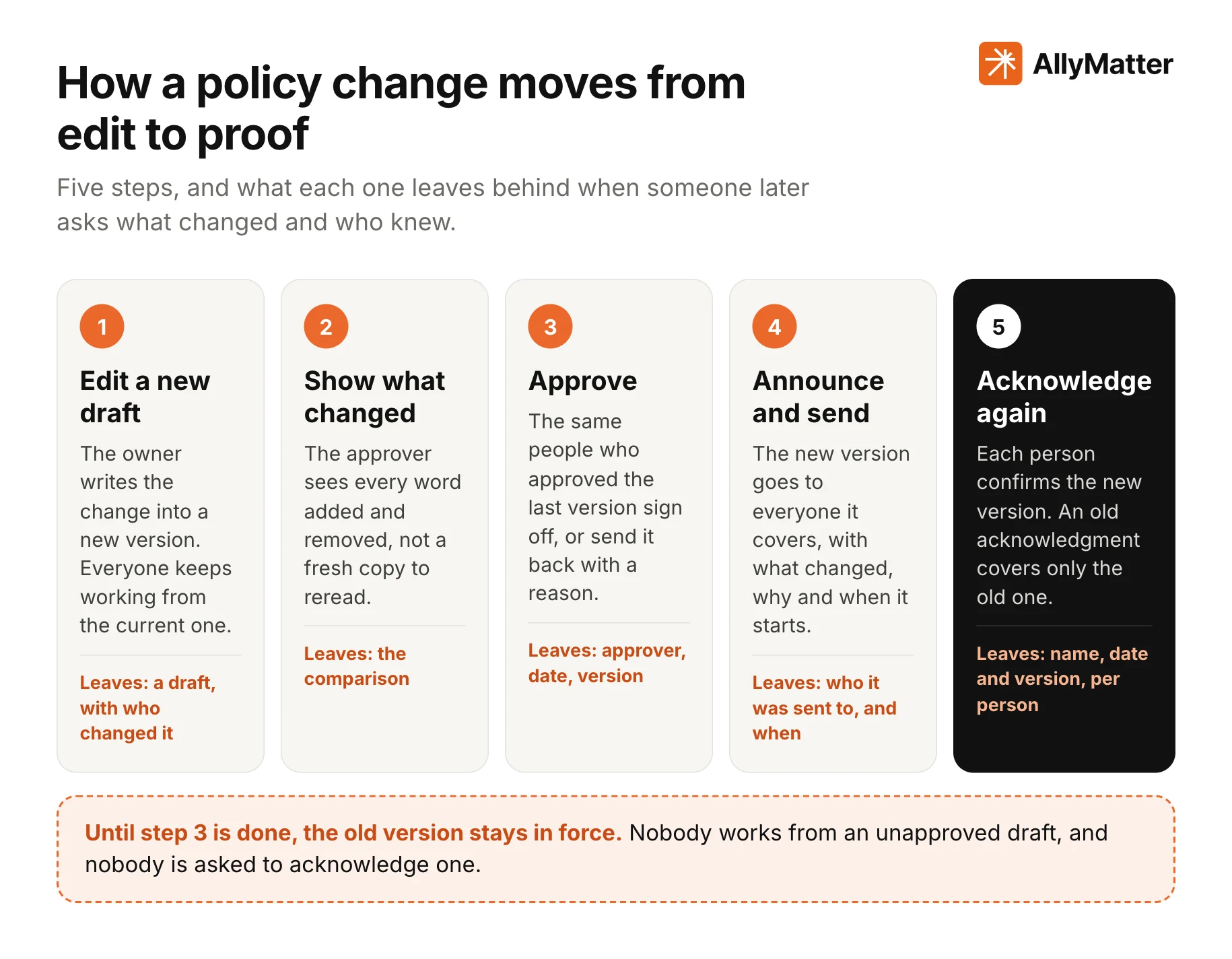
The same steps work for a one-word fix and a full rewrite. Using one process for both means nobody has to decide how to handle each change.
- Write down why it is changing and who owns the change. A new law, an audit finding, an incident or a change in how the business runs. The trigger becomes the “why” in your notice, and the policy owner carries the change through.
- Draft the change as a new version, not over the live one. Everyone keeps working from the current version until the new one is approved. Add a short note at the top of the draft that says what changed and why, in a sentence or two.
- Check whether the law sets the terms. Run through the table above, and ask counsel to read anything that touches pay, earned time off, benefits, leave or how employees talk about their work.
- Get it approved. Send it to the people who approved the last version, or the people your policy on policies names, and show them exactly what changed rather than a fresh copy to reread. Record who approved which version, and when.
- Set the effective date. Decide when the new version starts and how much notice people get before then (see the table further down).
- Brief managers, then send the notice. Managers hear first so they can answer questions, and then everyone the policy covers gets a short notice with one link to the full text.
- Ask everyone it covers to acknowledge the new version. An acknowledgment of the old version proves someone read text that is no longer in force.
- Retire the old version, and keep it. Nobody should be able to work from it, but you need to be able to show what it said and when it applied.
- Update everything that points at the old version. Onboarding packs, training slides, the handbook, and any procedure or form that repeats the old rule.
I have watched a team spend an entire afternoon rebuilding a policy from memory because well-meant edits had made it worse and nobody had a clean copy of the version before. Step two is there for that afternoon.
Who should approve a policy change?
The simplest rule is that a change goes to the people who approved the version in force. If your policy on policies names approvers by type of policy, follow it. If you have neither, this is a common pattern for a company of 10 to 500 people.
| Kind of policy | Who usually approves a change |
|---|---|
| HR and conduct policies, such as leave, remote work, conduct and discipline | The HR lead and a member of the leadership team, with employment counsel for anything touching pay, leave or discipline |
| Information security and privacy policies | The security or IT owner and a member of management, since ISO 27002 guidance expects management to approve these policies |
| Quality and operational procedures | The process owner and the quality lead |
| Compliance policies in a regulated firm | The compliance officer, and for investment advisers the chief compliance officer who administers the program |
| Benefits policies | The HR lead with your benefits broker or counsel, because plan rules apply |
Whoever approves should see what changed, word by word, rather than a fresh copy of the policy to reread. Approvers who have to find the change themselves either miss it or put the policy at the bottom of their pile. Our guide to document approval workflows covers how to set up the steps so the record builds itself.
How much notice should you give before a policy change?
Outside the rules in the first table, the notice period is your call. This is what we would give, by kind of change.
| Kind of change | Notice we would give |
|---|---|
| A correction or clarification that does not change what anyone does | None in advance. It takes effect when it is approved, and people still acknowledge the new version. |
| A new or changed rule about conduct, process, tools or security | Two to four weeks, so managers can brief their teams and people can ask questions |
| A change to pay, schedules, earned time off or benefits | At least 30 days, after counsel has reviewed it, and only for time not yet worked |
| A change to a benefit plan | Whatever the plan rules require, which can be 60 days before the change |
| A change forced by a new law | As much as the law’s start date allows, with the reason stated plainly |
Whatever you choose, write the effective date into the notice, and say which version applies until then. People who read a notice on Monday about a change starting in three weeks need to know the old rule still stands this week.
How to communicate policy changes to employees
Your people are absorbing more change than ever. Gartner research published in Harvard Business Review found the average employee went through ten planned enterprise changes in 2022, up from two in 2016. In Gallup’s 2024 survey of more than 79,000 US workers, only 46% strongly agreed that they know what is expected of them at work. A policy change that arrives as one more long email adds to both problems.
- Tell managers first. Prosci’s change management research finds that employees want to hear how a change affects them from their direct manager, and why it is happening from senior leaders.
- Lead with what changes for the reader, in one or two sentences, and say what stays the same.
- Link to the full policy instead of pasting it into the message or attaching a file that will be out of date by next year.
- Batch small changes into a regular update, such as once a month, unless a change is urgent.
- Repeat it where people already are, in team meetings and in the channels they read.
- Answer questions in one place, so the answer one person gets is the answer everyone gets.
Do not expect the full policy to be read just because it was sent. In a 2020 XpertHR survey of 619 US employers, 66% said getting employees to read the handbook was a challenge. The notice has to carry the change on its own, and the acknowledgment has to point at the full text.
Sources: Harvard Business Review, “Employees Are Losing Patience with Change Initiatives”, May 2023, citing Gartner, Gallup, “U.S. Employee Engagement Sinks to 10-Year Low”, January 2025, Prosci, change management communication research, XpertHR 2020 Survey on Employee Handbooks
What should a notice of policy change include?
A good notice of policy change answers, in under a page, the eight questions people would otherwise ask you one at a time.
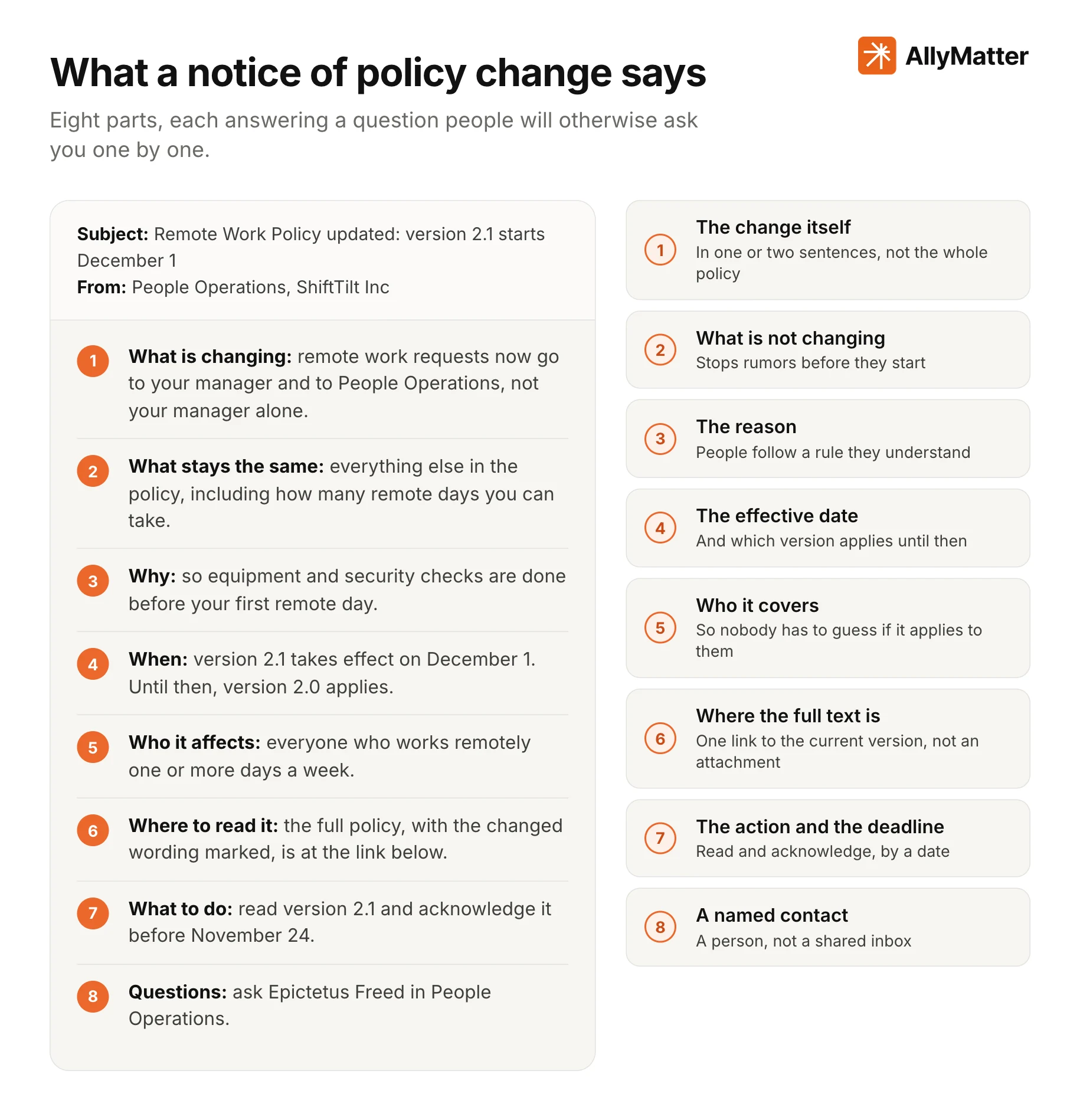
Here is the same notice as text you can adapt for a policy change email or letter to employees.
| Subject | Policy update: Remote Work Policy, version 2.1, effective December 1 |
| What is changing | Requests to work remotely now go to your manager and to People Operations, instead of your manager alone (section 3). |
| What stays the same | Everything else in the policy, including how many remote days you can take. |
| Why | So equipment and security checks are done before your first remote day. |
| When | Version 2.1 takes effect on December 1. Until then, version 2.0 applies. |
| Who it affects | Everyone who works remotely one or more days a week. |
| What to do | Read version 2.1 at the link below and acknowledge it before November 24. |
| Questions | Ask Epictetus Freed in People Operations. |
For regulated teams, add who approved the change and on what date. It costs one line, and it answers the first question an auditor asks about any change.
Do employees need to acknowledge a changed policy again?
Yes. An acknowledgment records that a person read a specific version, so once the policy changes, the old acknowledgment proves knowledge of text that is no longer in force. ISO 27002 guidance for control 5.1 calls for policies to be communicated to and acknowledged by the people they cover, and SOC 2 auditors commonly ask for evidence that people received the current policies. Our guide to policy acknowledgment tracking covers what each record should hold.
Pay attention to the people who join while a change is in progress. In one audit I went through, the auditor’s sample landed on an employee who had never signed our NDA, because they joined while it was being rewritten. Nobody had left them out on purpose; the old version had been withdrawn and the new one had not gone out yet. Send new joiners the version in force on their first day, and the new one when it is approved.
What to keep when a policy changes
The change is done when you can show it happened. Keep these for every change.
| Keep | Why it matters |
|---|---|
| The old version and the new version | Shows exactly which rule applied on any given date |
| What changed between them | Answers “what was different?” without anyone comparing two files by eye |
| Who approved the new version, and when | Shows the change carried the right authority |
| The effective date | Ties incidents and decisions to the version in force at the time |
| The notice, who it went to and when | Shows people were told, and how much notice they had |
| Who acknowledged the new version, and when | Shows each person knew the new rule, by name |
Keep them for as long as someone might reasonably ask what the rule was, and longer where a rule says so. HIPAA documentation is kept for six years, investment advisers keep compliance policies that were in force at any time in the last five years, and ISO 9001 expects obsolete documents to be kept under control for as long as you retain them. Our guide to version control for HR policies covers how to keep the history without a folder full of files named “final v3”.
Common mistakes
Announcing before the change is approved. If an approver then sends it back, you have told everyone about a rule that does not exist yet.
Editing the live policy in place. People read half-finished wording, and there is no clean record of what the policy said before.
A summary with no link to the full text. People act on the summary, and the summary is never the whole rule.
No effective date. Without one, nobody can say which rule applied to something that happened in the week of the change.
Old copies left behind. The handbook PDF, the onboarding deck and the shared drive still show the old rule, and new joiners read those first.
How AllyMatter handles a policy change
We built AllyMatter around this loop. The policy’s Editor, who is its owner, writes the change as a new version, and everyone the policy covers keeps seeing the last approved version until the new one is approved. Every change goes through approval, however small, and there is no minor-edit exception. Approvers see every word added and removed, and a rejection goes back to the Editor with a mandatory reason.
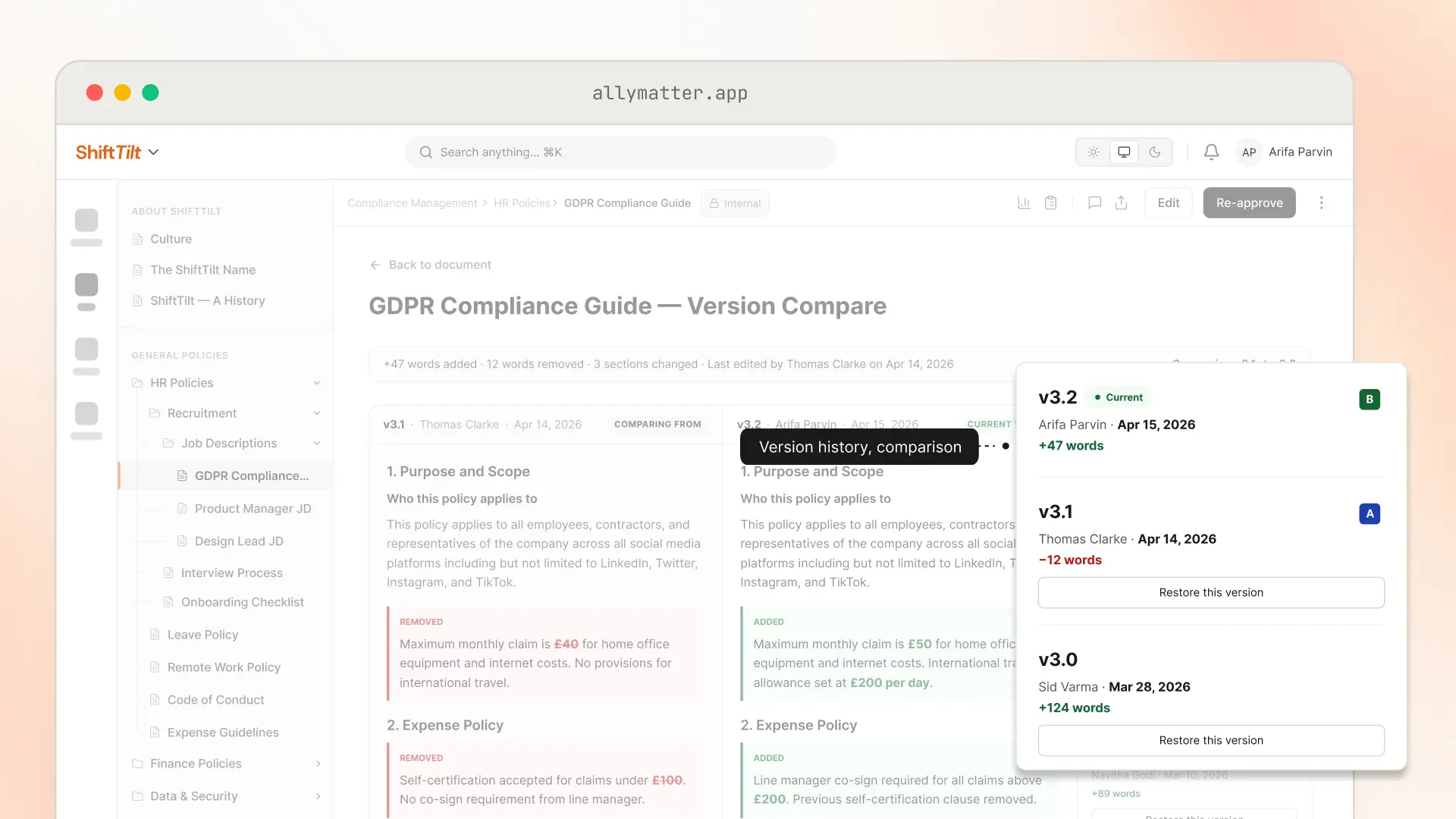
The approval date is the effective date, so approve the change on the day you want it to start. Once it is approved, nothing goes out on its own. The Editor presses Distribute and chooses whether to inform people, ask them to acknowledge it or, where e-signature applies, ask them to sign. Anyone with a pending request on the old version only has to acknowledge the new one, because their old request is replaced. The people acknowledging can see what changed between versions, automatic reminders follow up at the interval you choose, and each acknowledgment records the person, the date and time, and the version.
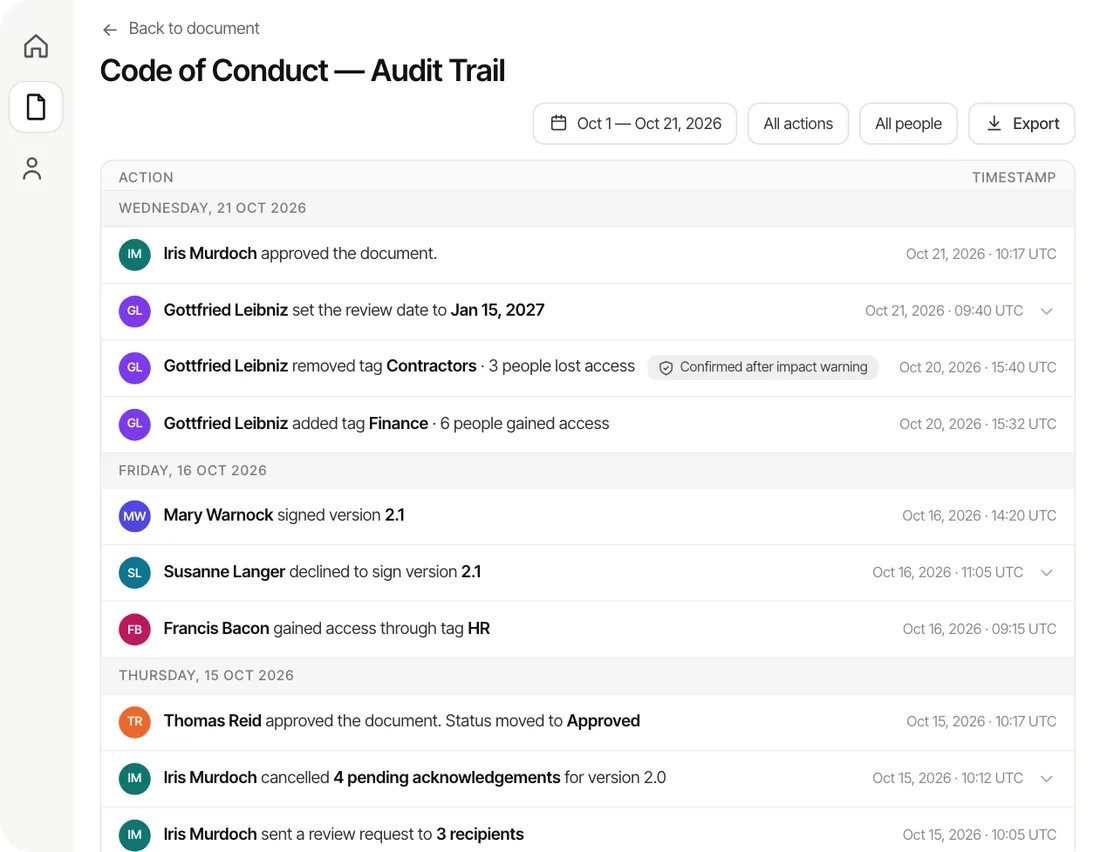
Every earlier version stays in the version history, and the audit trail keeps the approvals, distributions and acknowledgments for each one. When someone asks what the policy said last March and who had acknowledged it, the record exports as a PDF or CSV.
Questions about changing a company policy
Can an employer change a policy without telling employees?
Legally, most policy changes at an at-will US employer need no advance notice, but contracts, union agreements, benefit plans, some regulated programs and some state and local laws change that. In practice, a rule nobody was told about is very hard to enforce, so announce every change and ask people to acknowledge it.
How much notice do you have to give before changing a company policy?
No general federal rule sets a notice period for a policy change. Benefit plans have their own clocks, such as 60 days before a change to the Summary of Benefits and Coverage. As a practice, give two to four weeks for a changed rule and at least 30 days for anything that touches pay, schedules, earned time off or benefits.
Do employees have to agree to a policy change?
Usually not, for an at-will employee and an ordinary workplace policy. Agreement can matter when the policy is part of a contract, a union agreement or a benefit plan, or when the change affects pay or benefits already earned, so check those with counsel. What you do need is proof that each person was told, which is what an acknowledgment gives you.
Do employees need to sign the updated policy again?
Yes. An acknowledgment records the version a person saw, so after a change it points at text that is no longer in force. Our view is that every change, however small, should be acknowledged again, and our post on when a policy update requires re-acknowledgment explains why.
Who should approve changes to a company policy?
The same people who approved the version in force, or whoever your policy on policies names for that kind of policy, with counsel for changes that touch pay, leave, benefits or discipline. Our guide to document approval workflows covers how to set the steps up.
What should a policy change letter to employees include?
What is changing, what stays the same, why, the effective date and version, who it affects, one link to the full policy, what to do and by when, and a named person to ask. The sample in this guide shows all eight in under a page.
What changes if a union represents some of our employees?
Changes to pay, hours and other terms of employment for those employees usually have to be bargained with the union before they take effect. Talk to labor counsel before you send anything.
How long should we keep the old version of a policy?
Keep it for as long as your retention schedule says, and at least as long as any rule that applies to you: six years for HIPAA documentation and five years for an investment adviser’s compliance policies. Our records retention schedule guide covers how to set the periods.
Start your 30-day free trial of AllyMatter. No credit card to start, and a 30-day money-back guarantee if you subscribe and change your mind. Free migration.