
Audits and Evidence · 14 min read
CARF Accreditation: How to Keep Your Policies and Procedures Survey-Ready
CARF accreditation is the result of a peer survey by CARF International which finds that a provider’s programs conform to CARF’s published standards for health and human services, and for most behavioral health, IDD and community services providers it is earned or lost in the gap between what the policy binder says and what staff do every day. This guide covers how the process works, what the standards ask of your written policies and procedures, and how to keep them survey-ready all year rather than in the last three months. It belongs with our guide to the document audit trail, because a CARF survey is, among other things, a test of whether your records can show what happened.
Key takeaways
- CARF publishes a preparation timeline that starts about 12 months before the survey, and most of the policy work belongs in the first six of those months.
- Section 1 of every CARF standards manual covers business practices, from leadership and risk management to workforce, rights and accessibility, and much of it is evidenced through written policies, plans and procedures.
- Surveyors observe, interview and review documents, so a policy staff can’t find or explain counts for little.
- The strongest evidence is a named approval, a review date and a staff acknowledgment for every policy, kept as the work happens.
What CARF accreditation is
CARF International is an independent, nonprofit accreditor of health and human services, and its accreditation is a finding, after an on-site survey, that a provider’s programs meet CARF’s international consensus standards. CARF describes its survey as a consultative peer review rather than an inspection, carried out by surveyors who work in the same field and are matched to the programs being surveyed.
CARF publishes separate standards manuals for behavioral health, opioid treatment programs, child and youth services, employment and community services, aging services, medical rehabilitation and vision rehabilitation, and a provider seeks accreditation for specific programs at specific locations rather than for the whole organization in one go. Many providers pursue it because a state funder, a payer or a referral partner asks for it, and others because it gives the board and the families they serve an outside view of quality.
Sources: carf.org, accreditation overview, carf.org, our standards
How CARF accreditation works, step by step
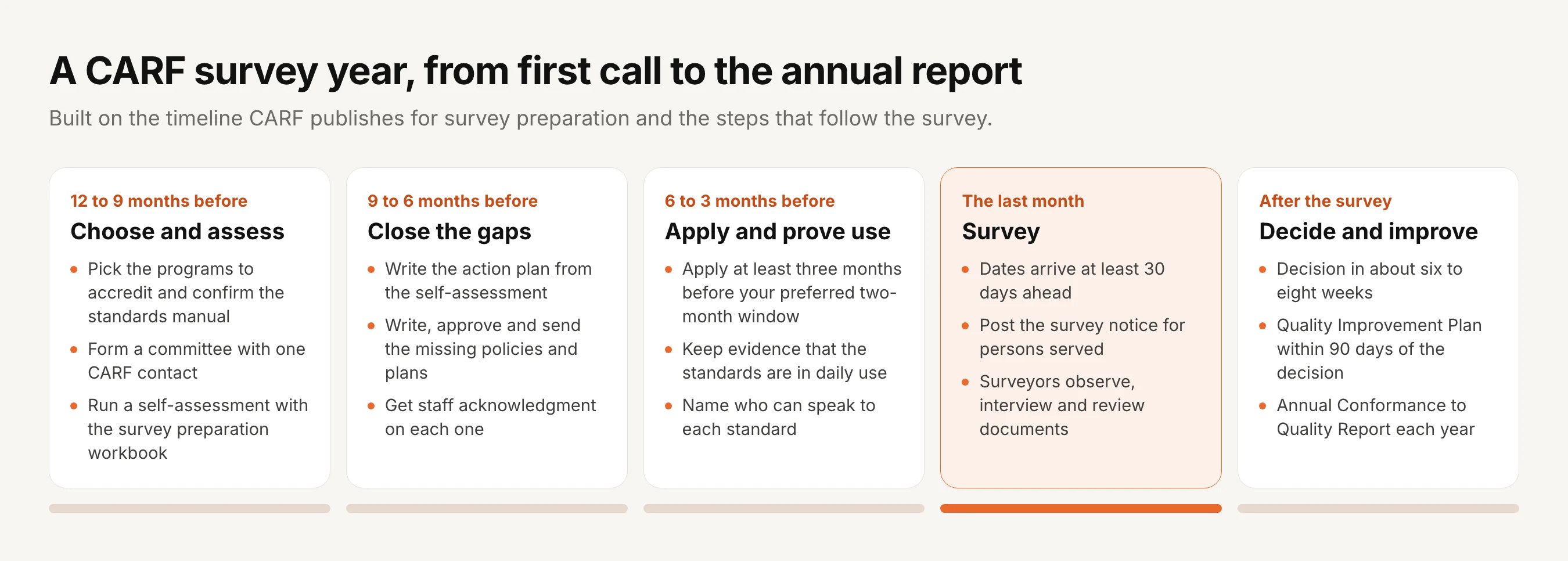
CARF lays out its process in a short sequence, and the dates matter because they decide when your policy work has to be finished.
Contact CARF. After a new organization questionnaire, CARF assigns a resource specialist, opens an account in its Customer Connect portal and confirms which standards manual applies to your programs.
Evaluate yourself. CARF recommends a self-study of your conformance to the standards and notes that preparation may take a year or more, which is why its own timeline starts 12 months before the survey and puts a self-assessment with the survey preparation workbook at about nine months out.
Apply. The survey application names your leadership, programs and locations and a preferred two-month window for the survey, and CARF asks for it at least three months before that window.
Schedule and survey. CARF invoices the survey fee, which depends on the number of surveyors and days, picks the team, and sends written notice of the dates at least 30 days ahead, after which you display a survey notice so persons served and others can give input. During the survey the team observes services, interviews persons served and other stakeholders, reviews documentation and consults with staff.
Decide and improve. CARF notifies you of the decision about six to eight weeks after the survey with a written report, sends the certificate within 60 days of the decision, and expects a Quality Improvement Plan within 90 days of the decision describing what you have done or will do about each recommendation. Once accredited, you complete an Annual Conformance to Quality Report every year until the next survey.
Sources: carf.org, steps to accreditation, carf.org, preparing for an accreditation survey
One date is easy to miss. CARF expects programs to show that they have been using its standards before the survey, and a CARF presentation to North Dakota providers puts that at a minimum of six months for each program seeking accreditation, which means a policy written the month before the survey has no history to show.
Source: North Dakota HHS, CARF provider presentation, November 2024
CARF accreditation decisions
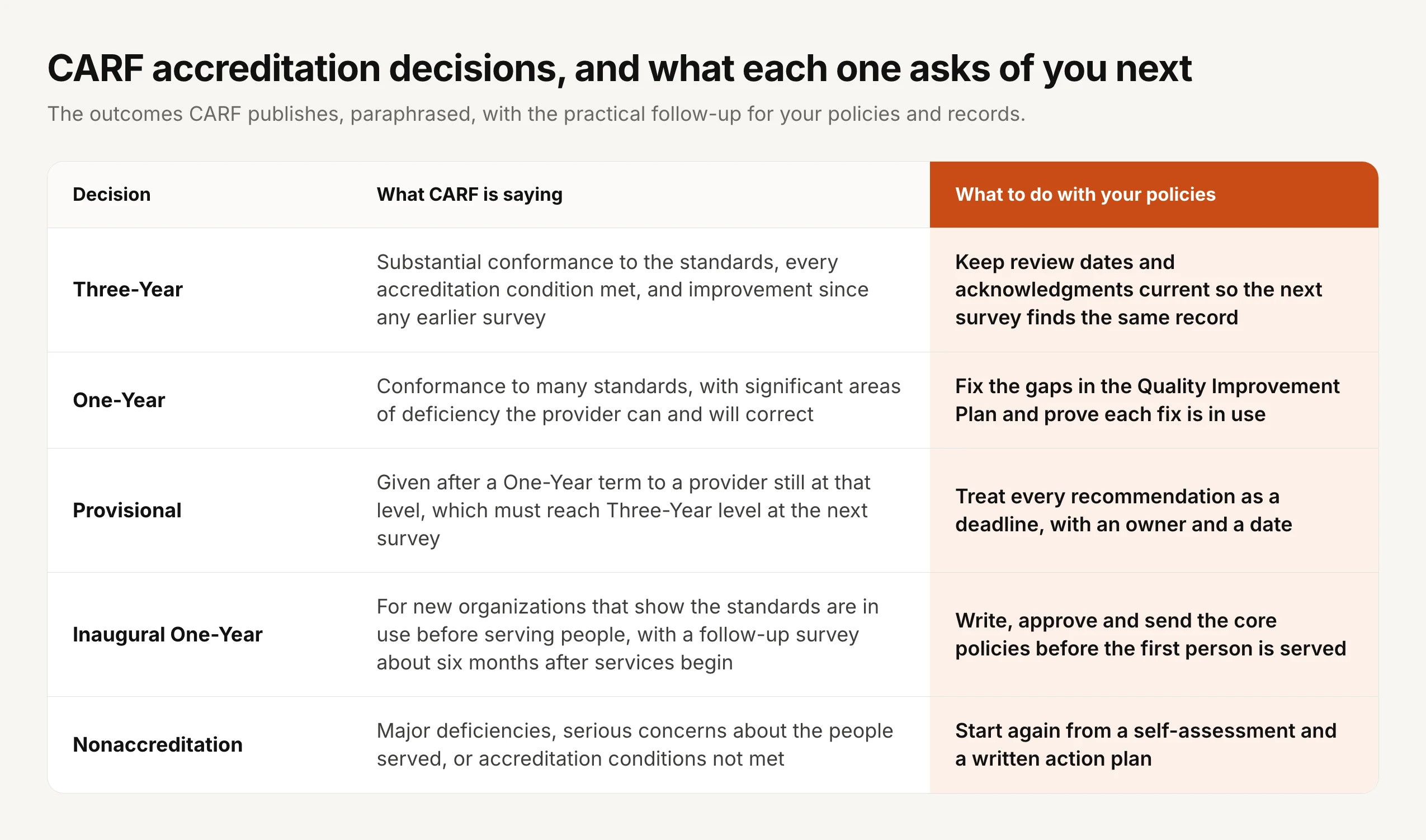
CARF publishes the outcomes it can award, and each one sets a different agenda for the months that follow.
Source: carf.org, accreditation decisions
The pattern is that the policy record which earns a Three-Year Accreditation is the same one that carries a One-Year or Provisional provider to the next level, because every recommendation that touches a written policy ends in the same three steps: change it, approve it and make sure the staff it covers have received it.
What CARF standards cover
Every CARF standards manual opens with Section 1, which CARF calls ASPIRE to Excellence, a framework for business practices and quality improvement that runs through six steps: assess the environment, set strategy, obtain input from persons served and other stakeholders, implement the plan, review results and effect change. The later sections cover the specific programs and services you are seeking accreditation for, such as outpatient treatment, residential services or community integration.
CARF’s standards say what a program must achieve rather than exactly how, so there is more than one way to show conformance, and the precise wording of each standard sits in the manual CARF sells for each program area. Our sister site, Policy and Compliance, explains what common standards ask for in plain language.
Source: carf.org, our standards (ASPIRE to Excellence)
Section 1 is where most providers feel the weight of written policies, because its business practice areas are usually evidenced by plans and procedures that someone has to write, approve, keep current and put in front of staff. The table below shows the kind of documents providers commonly keep ready in each area, as a starting point to check against your own manual rather than a list of CARF requirements.
| Business practice area | Written documents providers commonly keep ready | Who usually owns them |
|---|---|---|
| Leadership and governance | Code of ethics, conflict of interest policy, board and leadership roles | Executive director |
| Legal requirements | How the organization tracks and meets its legal and regulatory obligations | Compliance lead |
| Financial planning | Budgeting, billing and fiscal controls | Finance lead |
| Risk management | Risk management plan, incident reporting and review | Compliance or quality lead |
| Health and safety | Emergency procedures, infection control, inspections and drills | Operations or safety lead |
| Workforce | Hiring, orientation, supervision and performance review procedures | HR lead |
| Technology | Technology and system use, privacy and security, backups | IT lead |
| Rights of persons served | Rights, grievances, confidentiality and informed consent | Clinical director |
| Accessibility | How barriers to services are identified and removed | Operations lead |
| Performance measurement and improvement | How data is collected, reviewed and used to improve services | Quality lead |
Where policies and procedures fit in a CARF survey
A CARF surveyor reads your policies, but the reading is only the start, because the same surveyor then interviews staff and persons served, watches services and samples records to see whether the policy is what actually happens. A policy that sits in a binder nobody opens tends to show itself in the first interview, when a staff member describes a process that differs from the one on paper or can’t say where the current version lives.
That gives every written policy five questions to answer, and only the first can be answered by the document itself.
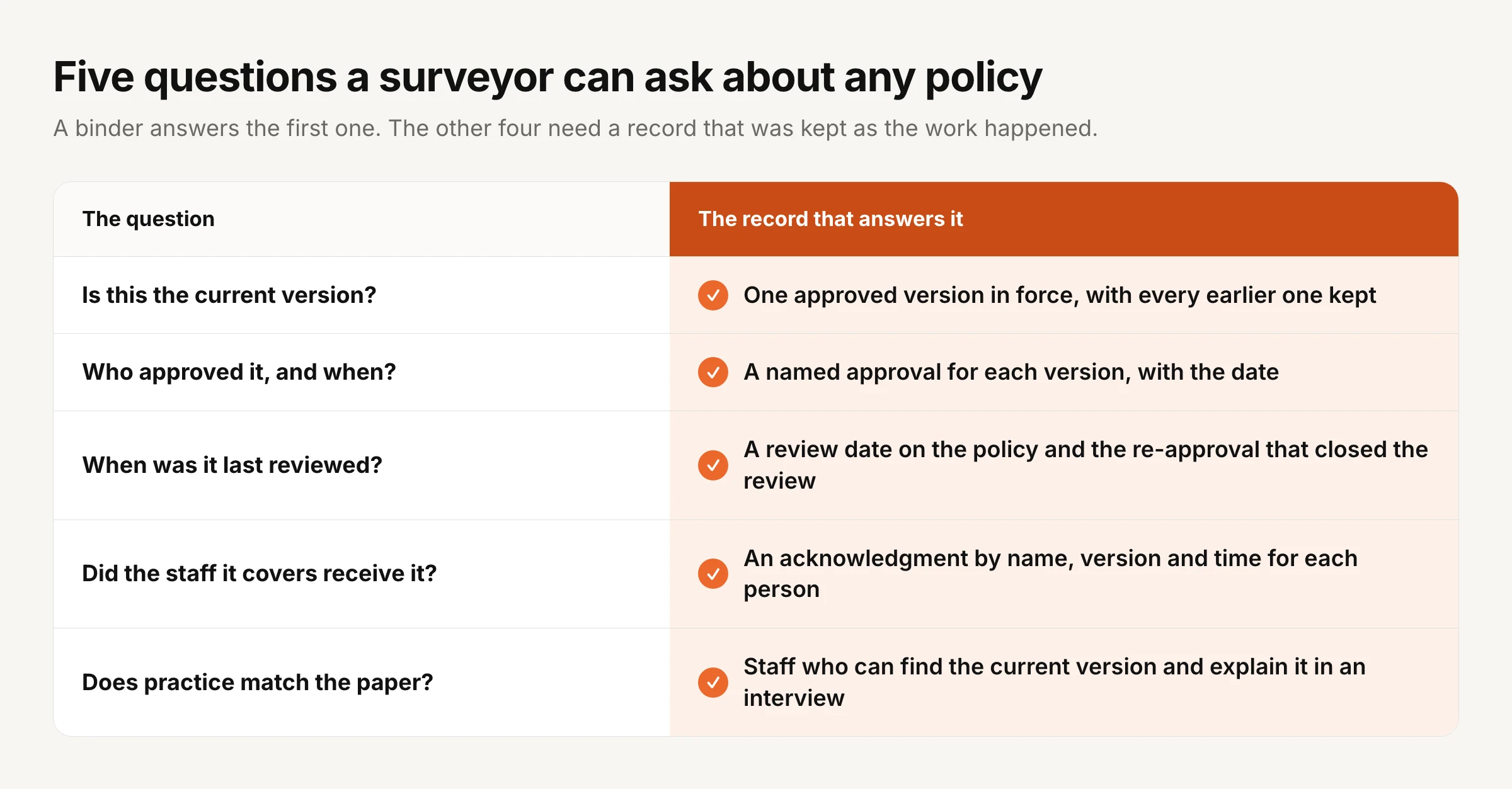
The fifth question is about people rather than paper, and it is the one that most often separates providers in a survey. It gets easier when the current version of every policy is in one place staff can search, when each person has confirmed the policies for their program, and when a changed procedure goes back out to the people it affects instead of waiting for the next training day.
Keeping policies survey-ready all year
Providers who come through a survey well tend to treat the policy record as part of running the program rather than a project that starts when the application goes in. The habits are simple to describe and harder to keep, which is why most of them come down to giving each job a name, a date and a record.
Give every policy an owner. Each policy and plan needs one person accountable for keeping it current, usually the leader of the area it covers, and our guide to the policy owner role covers how to assign them across a small or mid-sized provider. In AllyMatter the owner is the policy’s Editor, the one person who updates it and sends it for approval.
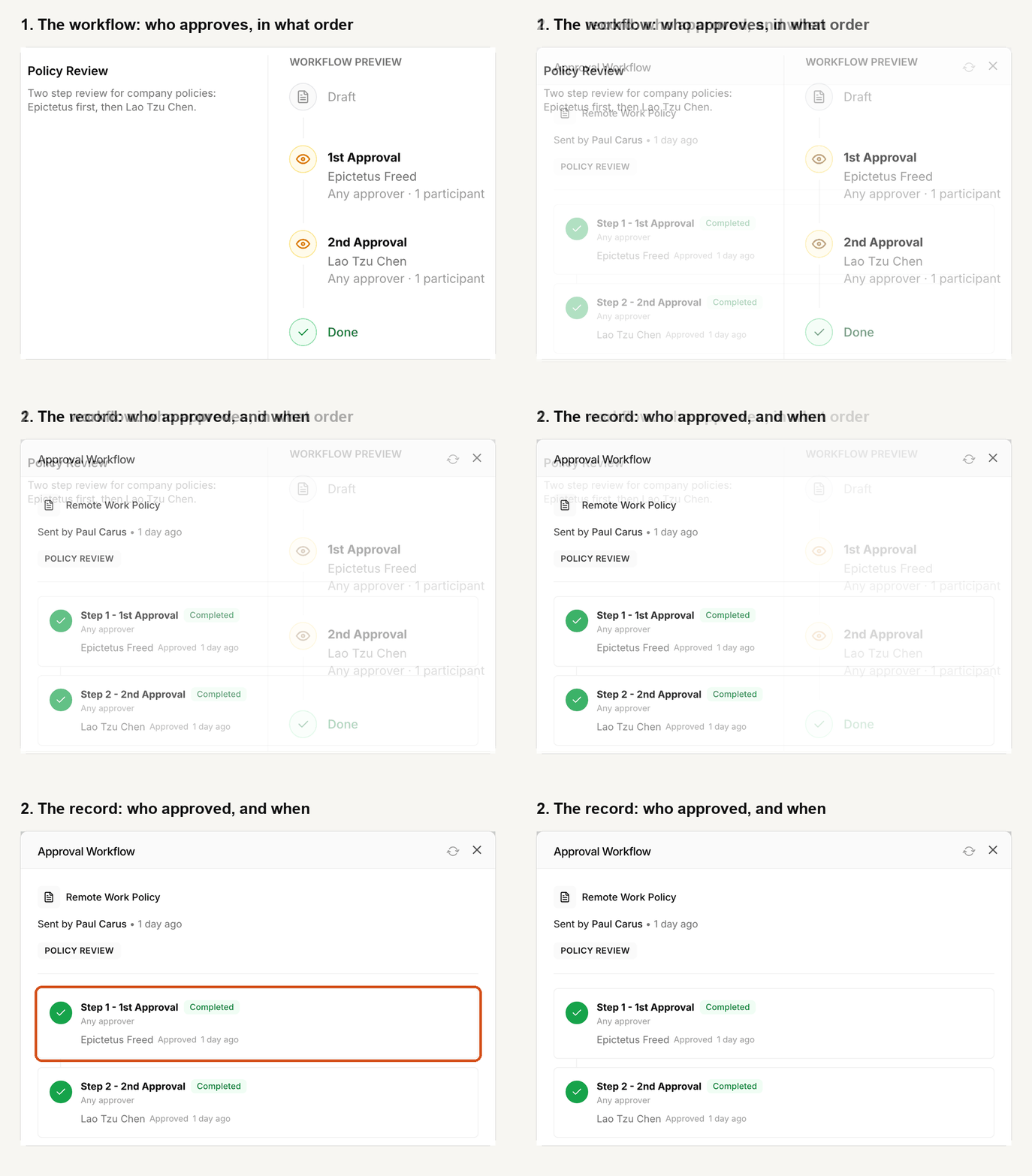
Approve before anyone sees it. A surveyor will ask who approved a policy and when, so the approval has to be recorded rather than remembered. In AllyMatter every policy runs through its approval workflow before it can be sent, a rejection has to come with a reason that stays on file, and only approved versions ever reach staff.
Put a review date on everything. Your manual sets specific review expectations for particular plans, and a review date on each policy turns those expectations into a schedule. In AllyMatter each policy carries its own review date, fixed or repeating every twelve months, and a review alert appears on the policy until it is re-approved. A policy that needs no changes is still re-approved, which is the record that someone reviewed it and judged it still valid, and that approved version can then go to anyone who has joined since.
Send each policy to the staff it covers. Programs, locations and roles differ, so the residential team should receive residential procedures and the outpatient team theirs. In AllyMatter tags for programs, sites and roles decide who receives each policy, and each person acknowledges it while signed in, with automatic reminders for anyone who hasn’t.
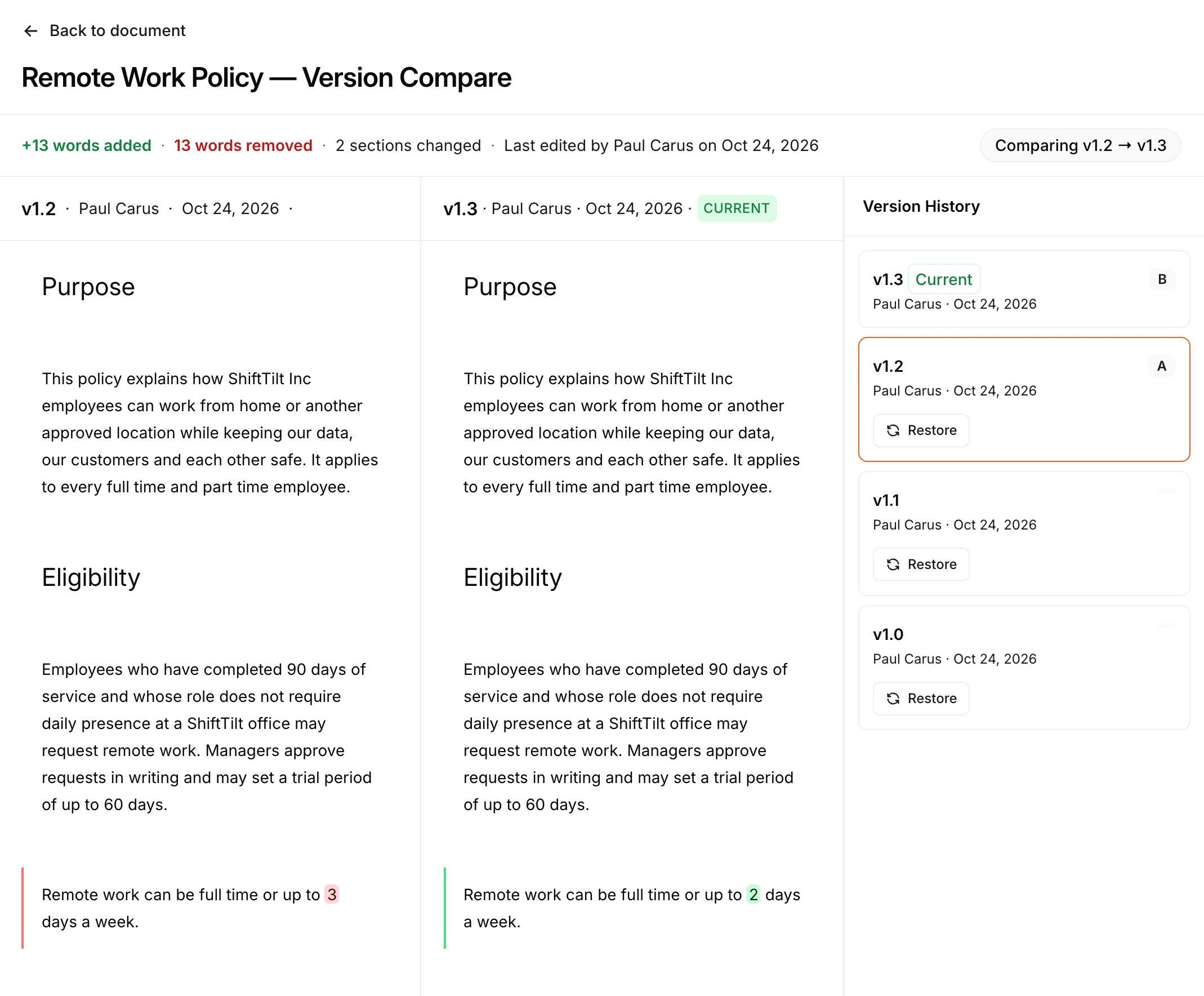
Send changes back out. When a procedure changes after an incident, a new regulation or a recommendation from the last survey, the new version should go back through approval and out for acknowledgment, with no exception for small edits. AllyMatter shows every word removed and added between versions, so staff can see what changed instead of rereading the whole procedure.
Keep new hires in the loop. Orientation is where many providers lose the thread, because a new direct support professional starts on a busy week and the core policies never reach them. When access follows tags, a new hire who is given the program’s tag can see that program’s current policies straight away, and when each policy comes up for review and is re-approved, the approved version can go to everyone who has joined since.
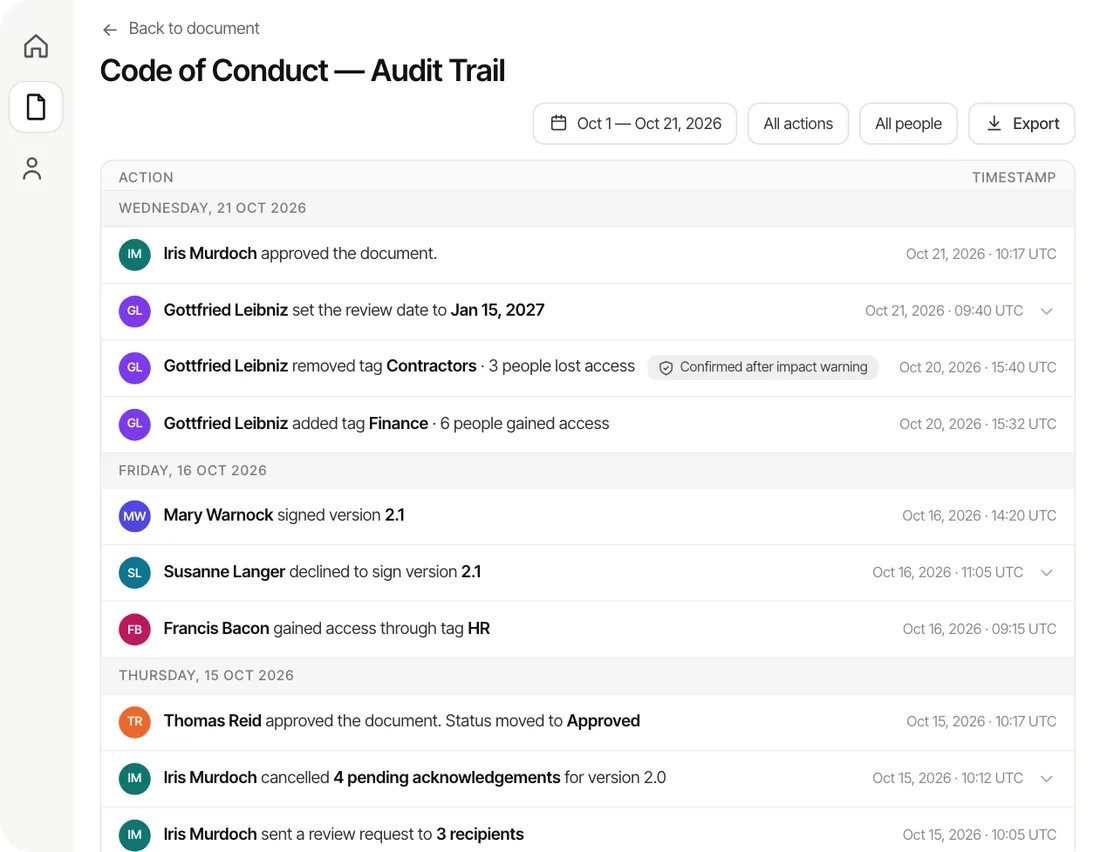
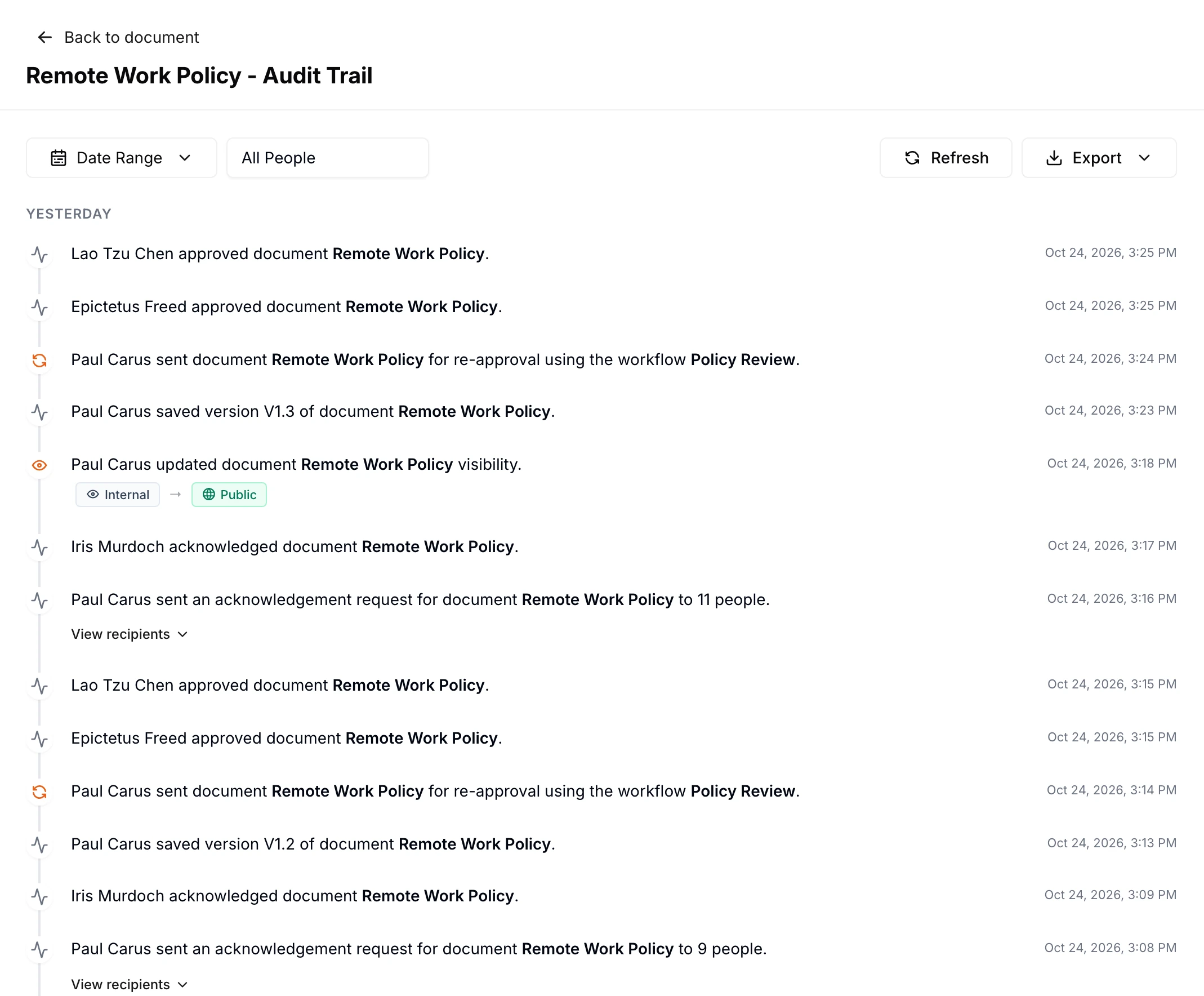
Keep the record exportable. When the survey team asks for proof, the answer should be a file rather than a week of assembly. In AllyMatter each policy’s audit trail records its approvals, versions, sends and acknowledgments by name, can be filtered by date and person, and exports as a PDF or CSV.
A survey-readiness checklist for policies and procedures
This checklist follows CARF’s own timeline and covers only the policy side of the work, which sits alongside the clinical records, personnel files and health and safety preparation that your manual also asks for.
| When | What to do with your policies and procedures | What it leaves on record |
|---|---|---|
| 12 months out | List every written policy, plan and procedure your standards manual asks for, and give each one a named owner | A register of policies with an owner for each |
| 9 months out | Run the self-assessment against the survey preparation workbook and mark each policy as current, out of date or missing | A gap list that becomes your action plan |
| 9 to 6 months out | Write or update the missing ones, route each through approval, and send it to the staff it covers for acknowledgment | Named approvals and acknowledgments, dated well before the survey |
| 6 to 3 months out | Set a review date on every policy and plan, and check that new hires receive the core policies in their first week | Proof that the system keeps running without a push |
| The last month | Chase any open acknowledgments, check every policy is the approved version, and export the record for each program | A file per program that answers the five questions |
| After the decision | Turn each recommendation that touches a policy into a change, an approval and a new acknowledgment round | Evidence for the Quality Improvement Plan and the annual report |
The last row matters as much as the first, because the Quality Improvement Plan and the Annual Conformance to Quality Report both ask you to show what you did about each recommendation, and a recommendation that changed a policy is easiest to evidence with the approval and acknowledgment of the new version.
CARF and other accreditors
Some providers compare CARF with The Joint Commission, which runs its own accreditation program for behavioral health care and human services, or hold more than one accreditation across different service lines. The surveys differ in method and emphasis, but every accreditor asks the same underlying questions about written policies, so a record of approval, review and acknowledgment serves each of them and spares the team from rebuilding it for each survey.
How AllyMatter helps providers stay survey-ready
We built AllyMatter for organizations whose policies have to be provable, and behavioral health, IDD and community services providers are among the teams it fits best, because their policies change often, their staff are spread across programs and shifts, and their surveys ask for proof by name. Our page for health and care providers covers how they use it.
AllyMatter keeps every policy and procedure in one place with one approved version in force, runs each one through an approval workflow you build once, sends it to the programs and locations it covers for acknowledgment with automatic reminders, puts a review date on every policy, and keeps an audit trail you can export when a surveyor asks. Readers, acknowledgers and approvers are free, so covering every direct support professional doesn’t raise the bill, and on yearly plans we’ll move your policies over from SharePoint, Google Drive, Confluence or Notion, usually within a week.
Start your 30-day free trial of AllyMatter. No credit card to start, and a 30-day money-back guarantee if you subscribe and change your mind. Free migration.
Questions about CARF accreditation
What is CARF accreditation?
CARF accreditation is the result of a survey by CARF International, an independent, nonprofit accreditor of health and human services, which finds that a provider’s programs conform to CARF’s published standards. Providers in behavioral health, opioid treatment, child and youth services, employment and community services, aging services, medical rehabilitation and vision rehabilitation can seek it.
How long does CARF accreditation take?
CARF says preparation can take a year or more, and its own survey preparation timeline starts about 12 months before the survey. You apply at least three months before your preferred two-month survey window, receive the dates at least 30 days ahead, and hear the decision about six to eight weeks after the survey.
How long does CARF accreditation last?
The best outcome for most providers is a Three-Year Accreditation. CARF also awards One-Year and Provisional Accreditation, an Inaugural One-Year Accreditation for new organizations, and Nonaccreditation, while continuing care retirement communities can receive a five-year term.
What do CARF surveyors look at?
CARF surveyors observe services, interview persons served, staff and other stakeholders, review documentation and consult with your team. In practice that means they compare what your written policies and plans say with what people do and with the records that show it happened.
Does CARF require policies to be reviewed every year?
CARF’s standards manuals set specific review expectations for particular plans and documents, so the exact rule for each one is in your manual. Many providers review all of their policies at least once a year anyway, because it keeps them current and gives surveyors a consistent pattern to check.
What happens after the CARF survey?
You receive the decision and a written report about six to eight weeks after the survey, and a certificate within 60 days of the decision. Within 90 days of the decision you submit a Quality Improvement Plan for each recommendation, and once accredited you complete an Annual Conformance to Quality Report every year.
Can software make a program CARF accredited?
No. Accreditation depends on how your programs serve people and whether you conform to the standards, and no tool changes that. What software can do is keep your written policies approved, current and acknowledged, and keep the record that shows it, so the survey spends its time on your services rather than on finding paper.
A CARF survey rewards the provider whose records were kept while the work happened, because the surveyor’s questions about who approved, who reviewed and who received a policy can only be answered by a record that already exists. Building that record a little at a time all year is far easier than building it in the three months before the team arrives.
Start your 30-day free trial of AllyMatter. No credit card to start, and a 30-day money-back guarantee if you subscribe and change your mind. Free migration.