
Comparisons · 34 min read
AI Compliance Software for SMBs: What 165 GRC and Policy Tools Actually Do With AI
Almost every compliance vendor now says its product is powered by AI, and the claims run from “drafts your policies” to “automates 90% of your audit.” I wanted to know what is actually behind them, so we read the websites of 205 GRC, compliance and policy management tools and recorded every AI claim we found. This guide to AI compliance software is the result: what the features do, who has the most of them, what they promise, and where the AI stops and people still have to step in.
One thing became clear early on, and it shapes how I’d read everything below. AI is getting very good at writing policies and reading evidence, but almost none of it touches the part an auditor cares about most, which is proof that the right people approved a policy and that staff actually read it. That gap is exactly what we built AllyMatter to close, so you’ll see us pop up through this guide wherever it matters.
Key takeaways
- 165 of the 205 tools we reviewed claim at least one AI feature, and we recorded 1,902 separate AI claims between them.
- Among tools built for small and mid-sized businesses, Scrut leads with 29 AI claims, all live, followed by ComplySec360, ISMS Copilot, TLM Software and Kertos.
- Enterprise platforms make even more claims, led by SAI360 with 50, but they’re built for large compliance teams.
- 85% of the claims are presented as live, but only about a third say a human reviews what the AI produces.
- 34 tools use AI to draft policies, while only 3 apply AI anywhere near policy acknowledgment, which is where AllyMatter comes in.
How we did the research
Between October 10 and 22, 2026, we read the public websites of 205 GRC, compliance automation, privacy, risk, quality and policy management tools, including product pages, pricing pages and documentation where it was public. For each tool we recorded every feature the vendor described as using AI, along with where the claim appeared, which part of the compliance job it covered, whether the vendor presented it as live, in beta or on the roadmap, whether it promised a measured outcome, and whether it said a person reviews the AI’s output.
We read what vendors say rather than testing the products ourselves, so this is a map of claims and not a lab test, and we’ve paraphrased each vendor’s wording rather than quoting it. Every source is shown as plain text, so you can copy it into a browser if you want to read the original.
If you spot something we got wrong, or a vendor has changed its product since we looked, email corrections to [email protected] and we’ll update this page.
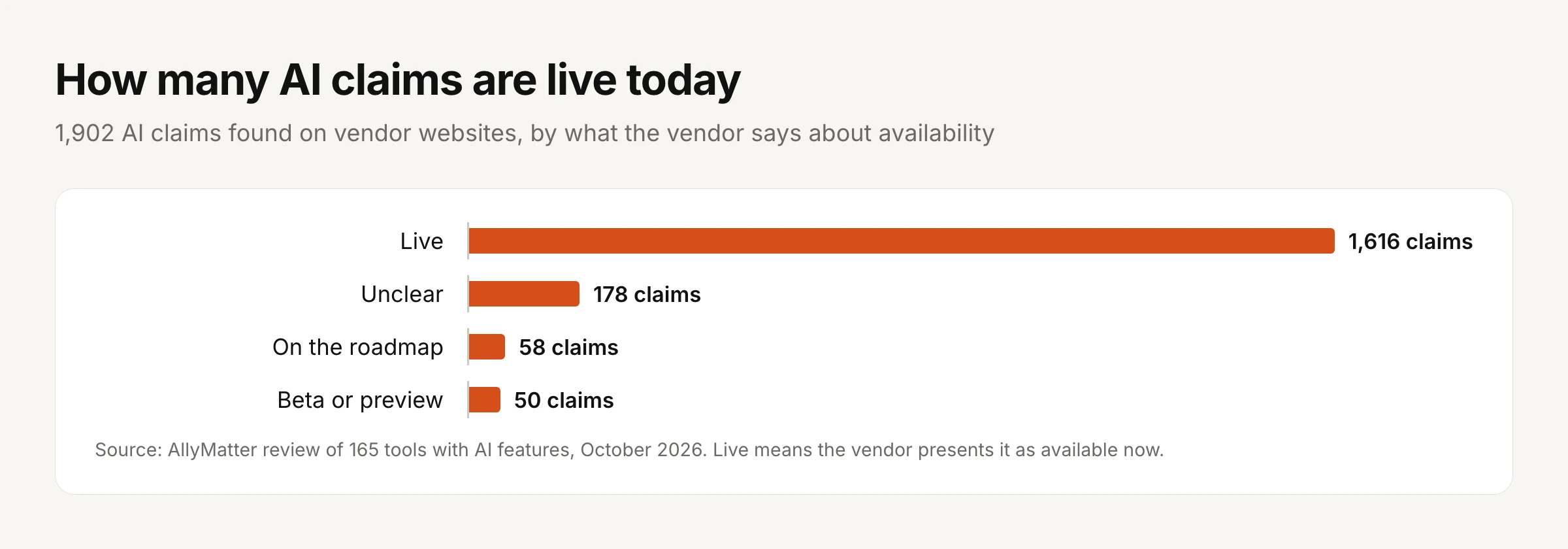
Of the 205 tools, 165 claim AI features, 36 claim none, and 4 had websites we couldn’t read. The 165 tools made 1,902 AI claims between them: 1,616 presented as live, 178 where availability was unclear, 58 on the roadmap and 50 in beta or preview.
What AI does in compliance software
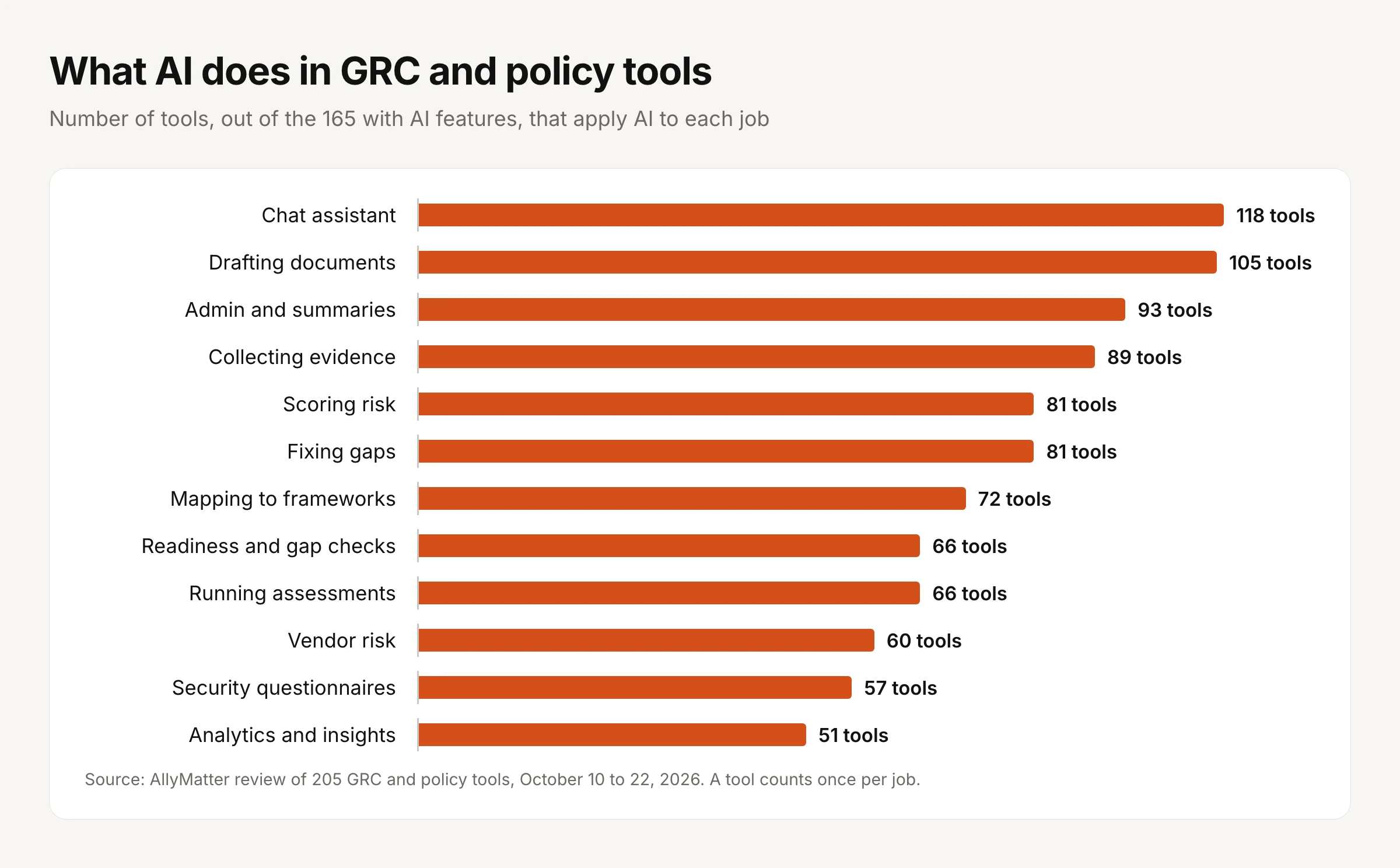
Across the 1,902 claims, AI shows up in about twenty different parts of the compliance job. The chart below shows the most common ones by the number of tools that offer them, and the sections that follow explain how each one works, what it’s meant to save and where it stops.
Drafting policies, procedures and reports
How many tools: 105 tools.
Drafting is the most familiar AI job, because it’s what large language models do best: you describe what you need, or point the tool at a framework such as ISO 27001 or SOC 2, and it produces a first version of a policy, a control statement, an audit report or a security plan. Some tools draft from a blank page, some fill templates, and the more serious ones draft from your own evidence so the text describes what you actually do.
How it’s meant to help: It is meant to remove the blank page, which is where policy work usually stalls, and turn a week of writing into an afternoon of editing.
Where it stops: A draft is not a policy. Someone still has to check it matches how you really work, get it approved, send it to the right people and prove they read it.
Chat assistants that answer questions
How many tools: 118 tools.
The most common AI feature of all is a chat box. You ask a question in plain language, such as which controls cover access reviews or what our travel policy says about upgrades, and the assistant answers from the documents and data in the tool, often with links to its sources.
How it’s meant to help: Assistants are meant to save compliance and HR teams from answering the same questions again and again, and to help employees find guidance without opening a ticket.
Where it stops: An answer is only as good as the documents behind it, so an assistant reading an out-of-date or unapproved policy will confidently give the wrong answer.
Collecting and checking evidence
How many tools: 89 tools.
For security frameworks, much of the work is gathering proof that controls work, such as screenshots, settings exports and logs. AI evidence features pull that proof from connected systems, check whether it actually satisfies the control, and flag what is missing or stale.
How it’s meant to help: The promise is that audit preparation stops being a scramble, because evidence is collected and checked continuously instead of the month before the auditor arrives.
Where it stops: This is mostly about technical controls in cloud systems, and it does little for the human side of compliance, such as whether staff read and accepted a policy.
Scoring and prioritising risk
How many tools: 81 tools.
Risk features read incidents, indicators, vendor data and threat feeds, connect related records, and score or rank risks so a team knows where to look first. Some go further and scan millions of outside documents every day for emerging risks.
How it’s meant to help: They are meant to replace a risk register that nobody updates with one that keeps itself current and tells you what changed.
Where it stops: A score is a model’s opinion, and most vendors don’t say how it is calculated or who checks it, so treat it as a prompt for judgement rather than a judgement.
Recommending and fixing gaps
How many tools: 81 tools.
Once a gap is found, remediation features suggest what to do about it, from a recommended action to a ready-made fix for a cloud setting, and some open the task and assign it automatically.
How it’s meant to help: The point is to shorten the distance between finding a problem and fixing it.
Where it stops: Automatic fixes in production systems need careful limits, and a recommendation still needs an owner who decides whether it is right.
Mapping controls to frameworks
How many tools: 72 tools.
Mapping features read the requirements of one or more frameworks and match them to your existing controls and policies, showing where one control satisfies several frameworks and where nothing covers a requirement.
How it’s meant to help: This is meant to save the slow, error-prone work of building and maintaining a control matrix by hand, especially when a company holds several certifications.
Where it stops: Mappings are suggestions, and an auditor will still ask a person to stand behind them.
Vendor risk and security questionnaires
How many tools: 60 and 57 tools.
Vendor risk features read a supplier’s SOC 2 report or questionnaire, summarise it and flag weaknesses, while questionnaire features work the other way round, answering the long security questionnaires your customers send you by drawing on your own policies and past answers.
How it’s meant to help: Both are meant to cut days of reading and copying down to hours, and these are the features with the boldest measured promises.
Where it stops: An AI answer to a customer’s security questionnaire is a statement your company makes, so someone has to own every answer that goes out.
Tracking regulatory change
How many tools: 35 tools.
Regulatory change features read new laws and guidance across chosen jurisdictions, decide what is relevant to you, extract the obligations and point to the policies and controls they affect.
How it’s meant to help: They are meant to replace a manual watch on regulators’ websites with an alert that arrives already sorted.
Where it stops: Relevance is a judgement call, and a missed obligation is a real risk, so legal review still matters.
Notice what’s missing from that list. AI drafts the policy, maps it, answers questions about it and checks it for gaps, but almost no vendor uses AI, or anything else, to show that the policy was approved before it went live and that each person read the version in force. In AllyMatter, that is the whole point: every policy goes through an approval workflow before anyone sees it, and every acknowledgment is recorded by name and version.
The five AI tools built for small and mid-sized businesses
These are the five tools with the most AI claims among those built for small and mid-sized businesses, ranked by the number of claims and, where two tools tie, by how many of their claims are live today. To decide who is built for smaller companies, we read each vendor’s own site for who it serves, how it prices and who it names as customers.
We’ve left out platforms built for large enterprises, such as SAI360, Riskonnect, Archer, Zania and Ethena, even though several of them made more AI claims, because they’re designed for big compliance teams and enterprise budgets rather than small and mid-sized businesses. They still appear in the full ranking further down.
| Tool | AI claims | Live | Built for | Price on its website |
|---|---|---|---|---|
| Scrut Automation | 29 | 29 | Startups and growth companies, with a separate enterprise plan | Not published |
| ComplySec360 | 27 | 27 | Small and medium enterprises | Not published |
| ISMS Copilot | 27 | 26 | Compliance leads and consultants, from a free plan | From $24 a month |
| TLM Software | 21 | 20 | Small and growing manufacturers, about 10 to 200 people | Set by company size |
| Kertos | 21 | 19 | Startups and mid-sized European companies | Not on the pages we read |
1. Scrut Automation
Scrut is a compliance automation platform for frameworks such as SOC 2 and ISO 27001, with plans for startups and growth-stage companies as well as an enterprise tier, and it says it has more than 2,500 customers. It made 29 AI claims, every one of them presented as live, which is the most of any tool built for smaller companies.
Its AI is organised as a team of named agents it calls Teammates, and each one takes a slice of the compliance job.
Policies. A Policy Architect drafts audit-ready policies from the data already in your account, ready for review and publishing, and then keeps checking those policies against what actually happens, flagging gaps and drift. Teammates can also read the policies you upload and suggest which controls each one satisfies, and it flags content gaps between your policies and your controls before an auditor does.
Onboarding and mapping. An Onboarding Analyst maps your existing policy library and risk register to controls with confidence scores, and drafts your statement of applicability and SOC 2 system description from live data. Scrut also says a unified control framework lets you reuse up to 80% of your existing controls across frameworks.
Evidence and audits. An Evidence Collector pulls evidence from more than 150 integrations such as AWS, GitHub and Okta, checks it is fresh and flags gaps, while an Internal Auditor runs continuous readiness checks and produces findings ranked by severity with steps to fix them.
Vendors, risk and security. AI tailors vendor questionnaires to each vendor’s risk, scores their answers, checks them for completeness, watches for breach news and suggests mitigation tasks. A Security Analyst runs agent-driven penetration testing with people verifying every finding, and when a cloud test fails, Teammates can write the infrastructure fix.
Questionnaires and trust. Security questionnaires from prospects are filled in from your answer library, documents and policies, a trust portal can be drafted from your data, and visitors to it can ask questions of an AI. A Compliance Concierge lets AI tools such as Claude, ChatGPT and Cursor read and act on your Scrut data.
How it’s meant to help. The promise is that a small security or compliance team gets a set of specialists that never sleep, so audits, vendor reviews and questionnaires stop eating whole weeks. Scrut even says its AI recommends training by role from your HR data and follows up after someone acknowledges a policy.
What to keep in mind. Scrut states human review on 8 of its 29 claims, mostly where it matters, such as policy drafts, questionnaire answers and penetration test findings, and it doesn’t publish prices.
Verdict: the right pick for a startup or growth company working towards SOC 2 or ISO 27001 that wants AI across evidence, vendors and security policies. The wrong pick if your main job is HR and operational policies that every employee must read and acknowledge, which is where AllyMatter sits, alongside a security tool like Scrut or on its own.
Sources: scrut.io, scrut.io/platform/scrut-teammates, help.scrut.io/docs/getting-started-with-scrut-teammates
2. ComplySec360
ComplySec360 is the compliance platform from Engaiz, aimed at small and medium enterprises and covering frameworks such as SOC 2, ISO 27001, ISO 42001, HIPAA, PCI DSS and CMMC. It’s sold with audit support and ties compliance to cyber insurance, which is unusual in this market, and all 27 of its AI claims are presented as live.
Policies and documents. A supervising agent called ComplyGenie drafts policies, maps controls, collects evidence, scores readiness and coordinates internal and external audits, and an Intelligent Policies Builder produces draft SOC 2 or ISO 27001 policies at the click of a button. A Discovery agent maps your technology and writes your system description, and for CMMC, agents read your environment, trace where controlled information flows and draft your system security plan.
Evidence, readiness and risk. Evidence and Integration agents gather and sort proof from your systems, a Readiness agent simulates an audit and flags gaps, a Risk agent scores risks and recommends fixes, and a Vulnerability Assessor looks for weaknesses.
Vendors, training and questionnaires. A Third Party Vendor agent onboards and assesses suppliers, a Training agent runs phishing simulations and awareness sessions, and a Questionnaire agent drafts answers to customer questionnaires grounded in your policies and evidence.
Cyber insurance. A separate CyberInsureGenie scores how insurable you are, checks warranty eligibility, helps with insurer questionnaires and prepares submissions for brokers, with further agents that help underwriters and brokers price risk.
How it’s meant to help. The pitch is a small company getting compliance, audit support and better cyber insurance terms from one platform, with agents doing the legwork a security team would otherwise need.
What to keep in mind. ComplySec360 states human review on only 3 of its 27 claims, most of its agent descriptions are playful rather than precise, and it doesn’t publish prices.
Verdict: the right pick for a small company that wants compliance and cyber insurance readiness in one package, with support included. The wrong pick if you need tight control over how policies are worded, approved and acknowledged by staff, which is the part AllyMatter takes on.
Sources: engaiz.com, engaiz.com/agents/, engaiz.com/complysec360/
3. ISMS Copilot
ISMS Copilot is a specialist AI assistant for information security compliance, covering ISO 27001, SOC 2, NIS 2, DORA and more than 130 other frameworks. It has a free plan, paid plans from $24 a month and an unlimited plan at $1,000 a month, and it’s also sold as an API, an MCP server and a widget other products can embed. 26 of its 27 claims are presented as live.
Drafting. It drafts policies with traceability from each policy to the controls it covers, drafts risk assessments, treatment plans and statements of applicability, and plans SOC 2 evidence by mapping each criterion to the evidence an auditor expects. It is unusually clear that you stay responsible: it drafts, and you tailor, approve and sign.
Checking. It walks through all 93 ISO 27001 controls to produce a gap analysis, says what an auditor would question in your ISMS and why, compares your records with what actually happens, fact-checks audit reports, reviews supplier data processing agreements, and flags documents that need updating when a policy changes.
Scoping. It works out whether NIS 2 applies to you and how, and walks through whether an AI system is prohibited, high-risk, limited-risk or minimal-risk under the EU AI Act.
How it’s meant to help. ISMS Copilot says it cuts internal audit preparation from weeks to days, and that new junior auditors produce client-ready work in weeks rather than months, which is why consultants use it as much as in-house teams.
What to keep in mind. It states human review on 12 of its 27 claims, the most careful in this group, and one feature, agent tasks, wasn’t generally available when we looked. It’s an assistant rather than a system of record, so the documents it drafts still need a home.
Verdict: the right pick for an ISO 27001 or SOC 2 lead, or a consultant, who wants an expert AI to draft and check documents at a low price. The wrong pick as the place where policies are approved, sent and proven, which is exactly what you’d pair it with AllyMatter to do.
Sources: ismscopilot.com, ismscopilot.com/pricing
4. TLM Software
TLM is a quality management system for small and growing manufacturers that are setting up their first real QMS or outgrowing an old one, typically between ten and two hundred people, and it says plainly that it isn’t built for enterprises. Prices are set by company size and locked in. Its AI is built on Anthropic’s Claude, and 20 of its 21 claims are presented as live.
Answers and reports. Ask Claude answers plain-English questions from your controlled documents with links to the source, Claude Data answers questions about your live quality data, such as which suppliers lapsed re-approval, and Claude Reporting builds a report from a description, while Claude Digest sends scheduled summaries of where the quality system stands.
Reviewing and fixing documents. Claude Review reads any document against the standards it’s linked to and returns every gap, its severity and a fix, each with a citation, and a Full QMS Review checks the whole system in one go. Claude Edit then revises the document itself and routes it into a change order, and a change impact check shows what a proposed change affects, what needs re-approval and what training it triggers.
Audits, CAPA and training. Claude drafts audit checklists mapped to the documents that cover each clause, drafts responses to audit findings for your auditor to review, reviews corrective actions for root cause and effectiveness before you close them, and turns a released procedure into a competence quiz that your expert approves.
Management review. Claude combines the system review with metrics, corrective actions, deviations, training and customer feedback to draft the management review.
How it’s meant to help. The idea is that a small manufacturer gets the quality expertise of a much larger team, with AI doing the reading, checking and drafting and people making the decisions.
What to keep in mind. TLM states human review on 6 of its 21 claims, mainly where Claude edits documents or drafts audit responses, and it’s built for manufacturing quality rather than company-wide policies.
Verdict: the right pick for a small manufacturer building an ISO 9001-style quality system. The wrong pick for HR, IT and company policies that every employee must acknowledge, which AllyMatter handles across the whole company.
Sources: tlm-software.com, tlm-software.com/ai-powered-qms/
5. Kertos
Kertos is a German compliance platform for startups, scale-ups and mid-sized European companies, covering ISO 27001, GDPR, NIS2, SOC 2, TISAX and the EU AI Act, and it pairs its software with certified compliance experts. 19 of its 21 AI claims are presented as live.
Policies. Its AI, called KAIA, includes a Policy Co-Pilot that uses your company context to produce complete, framework-aligned policy drafts in minutes for you to review, edit and approve, and it links policies to the controls they support.
Evidence and readiness. When you upload a document as evidence, KAIA reads it and checks it against the control’s requirements, it monitors controls and evidence continuously, and it helps check readiness before an audit.
Privacy, risk and vendors. KAIA helps build and maintain the GDPR record of processing activities, supports the risk register, fills in vendor and system records automatically, and drafts answers to security and vendor questionnaires from your compliance data.
Assistant and access. KAIA answers questions about ISO 27001 and other standards in plain language, searches across all your compliance data, guides setup, and gives outside AI tools read access through MCP. Kertos also sells tools for governing your own AI, such as an AI inventory and AI risk assessments.
How it’s meant to help. The pitch is European compliance done faster than with consultants, and Kertos says a certified expert reviews what KAIA prepares before it reaches you.
What to keep in mind. Human review is stated on 6 of its 21 claims, largely through that expert service, and two of its broader AI claims don’t say whether they’re available yet.
Verdict: the right pick for a European SME juggling GDPR, ISO 27001 and NIS2 that wants AI backed by human experts. The wrong pick if what you need is HR and operational policies approved and acknowledged across a US team, which is AllyMatter’s home ground.
Sources: kertos.io/en, kertos.io/en/plans, kertos.io/en/platform/kaia
All five use AI to draft policies, and none of them makes the acknowledgment by each employee the centre of its AI story. Whichever of them writes your policies, AllyMatter is where those policies get approved, reach the right people and are confirmed by name and version.
The enterprise platforms with the most AI
Across all 205 tools, the most AI claims came from platforms built for large organisations, and they’re worth knowing about even though they’re not built for smaller companies.
SAI360 made the most AI claims of any tool, 50, with 49 presented as live, spread across policy, risk, regulatory change, audit, vendor risk, incidents, training and business continuity in more than twenty modules. Its policy module includes an AI assistant that answers employees’ policy questions and AI summaries shown while employees review a policy before they attest to it.
Sources: sai360.com, sai360.com/solutions/grc-compliance-policy-management
Riskonnect made 46 AI claims, every one presented as live, across insurable risk, claims, GRC, business continuity and healthcare risk.
Source: riskonnect.com
Archer made 45 AI claims, but only 15 are presented as live, with the rest unclear or still to come. It’s also the most likely to say a person reviews the AI’s work, on 30 of its claims.
Source: archerirm.com
smartGRC, which governs access in SAP systems, made 41 AI claims and not one is presented as live, with 30 on the roadmap or in preview.
Source: smartgrc.eu
The lesson for any buyer is the same at every size: count the AI you can switch on today, not the AI on the roadmap, and for anything to do with policies, ask what happens after the AI has finished writing.
The 35 GRC and policy tools with the most AI
These are the 35 tools that made the most AI claims in our review, ranked by the number of claims, with ties broken by the number of live claims and then by measured promises. The main AI jobs are the three parts of the compliance job each tool’s AI covers most often, and the website is shown as plain text so you can look the tool up yourself.
| # | Tool | AI claims | Live | Main AI jobs | Measured promises | Human review stated | Website |
|---|---|---|---|---|---|---|---|
| 1 | SAI360 | 50 | 49 | risk scoring, admin and summaries, assessments | 3 | 10 | sai360.com |
| 2 | Riskonnect | 46 | 46 | analytics, risk scoring, assessments | 2 | 3 | riskonnect.com |
| 3 | Archer | 45 | 15 | drafting, admin and summaries, analytics | 8 | 30 | archerirm.com |
| 4 | smartGRC | 41 | 0 | evidence collection, fixing gaps, risk scoring | 7 | 26 | smartgrc.eu |
| 5 | Benchmark Gensuite | 40 | 32 | drafting, risk scoring, chat assistant | 10 | 15 | benchmarkgensuite.com |
| 6 | osapiens | 38 | 37 | evidence collection, admin and summaries, vendor risk | 6 | 27 | osapiens.com |
| 7 | RegScale | 32 | 19 | drafting, fixing gaps, assessments | 8 | 6 | regscale.com |
| 8 | Scrut Automation | 29 | 29 | vendor risk, drafting, readiness checks | 7 | 8 | scrut.io |
| 9 | SecurityScorecard | 29 | 28 | vendor risk, admin and summaries, questionnaires | 8 | 8 | securityscorecard.com |
| 10 | Anecdotes | 28 | 27 | evidence collection, admin and summaries, fixing gaps | 10 | 3 | anecdotes.ai |
| 11 | ComplySec360 | 27 | 27 | drafting, risk scoring, evidence collection | 3 | 3 | engaiz.com |
| 12 | ISMS Copilot | 27 | 26 | assessments, chat assistant, drafting | 4 | 12 | ismscopilot.com |
| 13 | Zania | 26 | 26 | evidence collection, vendor risk, risk scoring | 8 | 12 | zania.ai |
| 14 | Certivo | 26 | 24 | evidence collection, readiness checks, assessments | 8 | 2 | certivo.com |
| 15 | Ketryx | 25 | 24 | drafting, change impact, incidents | 12 | 15 | ketryx.com |
| 16 | Optro (formerly AuditBoard) | 24 | 22 | drafting, evidence collection, framework mapping | 5 | 18 | optro.ai |
| 17 | Ethena | 23 | 21 | drafting, analytics, incidents | 6 | 11 | goethena.com |
| 18 | TrustArc | 22 | 22 | chat assistant, drafting, admin and summaries | 1 | 7 | trustarc.com |
| 19 | ComplianceQuest | 21 | 21 | chat assistant, analytics, drafting | 0 | 0 | compliancequest.com |
| 20 | Bitsight | 21 | 21 | risk scoring, security testing, assessments | 6 | 1 | bitsight.com |
| 21 | TLM Software | 21 | 20 | drafting, admin and summaries, assessments | 4 | 6 | tlm-software.com |
| 22 | Kertos | 21 | 19 | drafting, chat assistant, risk scoring | 7 | 6 | kertos.io |
| 23 | 6clicks | 21 | 19 | framework mapping, evidence collection, admin and summaries | 7 | 15 | 6clicks.com |
| 24 | Scytale | 21 | 16 | evidence collection, framework mapping, chat assistant | 6 | 4 | scytale.ai |
| 25 | Mitratech | 20 | 19 | vendor risk, admin and summaries, analytics | 5 | 6 | mitratech.com |
| 26 | Whistic | 19 | 16 | vendor risk, assessments, evidence collection | 3 | 11 | whistic.com |
| 27 | Ketch | 19 | 3 | data discovery, drafting, fixing gaps | 3 | 8 | ketch.com |
| 28 | TrustCloud | 18 | 18 | evidence collection, admin and summaries, risk scoring | 7 | 7 | trustcloud.ai |
| 29 | DataGrail | 18 | 18 | risk scoring, data discovery, vendor risk | 3 | 5 | datagrail.io |
| 30 | VelocityEHS | 18 | 17 | risk scoring, analytics, document reading | 4 | 4 | ehs.com |
| 31 | Klaay | 18 | 17 | evidence collection, chat assistant, drafting | 3 | 0 | klaay.com |
| 32 | ProcessUnity | 18 | 16 | vendor risk, questionnaires, assessments | 8 | 2 | processunity.com |
| 33 | Strike Graph | 18 | 15 | evidence collection, admin and summaries, assessments | 5 | 6 | strikegraph.com |
| 34 | Effivity | 17 | 17 | admin and summaries, chat assistant, risk scoring | 6 | 7 | effivity.com |
| 35 | Certa | 17 | 17 | vendor risk, questionnaires, evidence collection | 4 | 4 | certa.ai |
Just outside the top 35, Greenlight Guru and Intelex also made 17 AI claims each.
What the leading tools’ AI does
Here is a short summary of the AI story for other leading tools in the ranking, based on what each vendor says on its own website.
Riskonnect. Riskonnect is a large integrated risk platform covering insurable risk and claims, GRC, business continuity and healthcare risk. Its AI, branded Intelligent Risk and delivered partly through Salesforce’s agent technology, summarises records, predicts outcomes from past data and reads documents such as claims and incident reports. Every one of its 46 AI claims is presented as live, which makes it the most complete AI story on this list after SAI360.
Archer. Archer is one of the best-known enterprise GRC platforms, and its Evolv layer adds AI for regulatory change, obligation extraction, control mapping and plain-language questions. It also has the most honest-looking human review language in the dataset, with 30 of its 45 claims saying a person stays in the loop. But only 15 of those 45 claims are presented as live today, so much of the story is still arriving.
smartGRC. smartGRC sells access governance for SAP systems and promises a large family of AI agents for emergency access, segregation of duties and access reviews. Not one of its 41 AI claims is presented as live, with 30 on the roadmap or in preview, so it belongs in this list as a statement of intent rather than something you can use today.
Benchmark Gensuite. Benchmark Gensuite sells environment, health, safety and sustainability software, and its Genny AI layer adds advisors, agents for permits, chemicals and disclosures, and computer vision. It makes 10 measured promises, among the most in the dataset, and 32 of its 40 claims are presented as live.
osapiens. osapiens sells a platform for supplier due diligence, product compliance and sustainability reporting, and its AI is a library of named agents for onboarding, risk response and document handling. It is one of the more careful vendors on human review, stating it on 27 of its 38 claims.
RegScale. RegScale is a continuous controls monitoring platform for frameworks such as FedRAMP, CMMC, SOC 2 and ISO 27001. Its AI engine drafts control statements and security plans, grades them and recommends evidence, and it makes one of the clearest drafting promises in the market.
Scrut Automation. Scrut is a compliance automation platform whose AI teammates draft policies, map controls, check evidence and policies, and handle vendor reviews. All 29 of its AI claims are presented as live, and it is one of only three tools in the dataset whose AI reaches anywhere near policy attestation.
SecurityScorecard. SecurityScorecard is best known for security ratings, and its TITAN AI agents answer and review questionnaires, draft vendor communications and monitor third parties. It pairs its AI with certified human reviewers for questionnaire answers, which it says is how it reaches high accuracy.
Anecdotes. Anecdotes is an enterprise GRC platform that collects evidence from more than 230 integrations and runs AI agents, including a chat assistant and an agent builder. It makes 10 measured promises, though it states human review on only 3 of its 28 claims.
ComplySec360. ComplySec360 from Engaiz is a compliance platform for SOC 2, ISO 27001 and CMMC sold with audit support, and its AI is a family of named agents for policies, evidence, readiness, risk and vendors. All 27 of its claims are presented as live.
ISMS Copilot. ISMS Copilot is a specialist AI assistant for ISO 27001, SOC 2 and more than 130 other frameworks. It drafts policies, risk assessments and statements of applicability, maps controls and prepares audits, and is one of nine tools whose AI reaches across the whole compliance cycle.
Zania. Zania is a GRC platform built around AI agents that collect evidence, test controls, assess vendors and answer security questionnaires, across frameworks including SOC 2, ISO 27001, HIPAA and ISO 42001.
Certivo. Certivo serves manufacturers with product and supplier compliance, and its AI agent collects supplier documents, reads and validates them, and checks them against substance, trade and sustainability rules.
Ketryx. Ketryx manages the regulated product lifecycle for medical device and pharmaceutical teams on top of tools such as Jira and GitHub, and its AI agents draft requirements, risks and documentation. It makes 12 measured promises, the most of any tool we reviewed, and states human review on 15 of its 25 claims.
Optro (formerly AuditBoard). Optro, the new name for AuditBoard, is an enterprise platform for audit, controls, risk and compliance, and its AI covers controls testing, audit fieldwork and drafting, questionnaire answers and regulatory change. It states human review on 18 of its 24 claims.
Ethena. Ethena started as compliance training with an ethics hotline and now presents itself as a set of AI compliance agents for training, policy, disclosures and third-party risk, with AI course building and translation.
TrustArc. TrustArc is a privacy management platform whose Arc Intelligence layer offers an agentic assistant and drafts records and assessments from evidence. All 22 of its AI claims are presented as live.
ComplianceQuest. ComplianceQuest is a quality, safety and supplier platform built on Salesforce, and its CQ.AI agents handle issue intake, investigation, risk and audit work. It makes no measured promises and states human review on none of its 21 claims.
Bitsight. Bitsight sells security ratings and vendor monitoring, and its AI maps vendor documents to frameworks, summarises SOC 2 reports and powers a chat mode for risk questions.
Notice how many of these tools use AI to write and check policies, and how few have anything to say about the moment a policy reaches the people who have to follow it. When you’ve picked the AI that writes your policies, the next question is who proves people saw them, and that’s the question AllyMatter answers.
The outcomes AI vendors promise
115 of the 165 tools promise at least one measured outcome, such as a percentage of time saved, a speed-up or an accuracy rate, and they made 414 such promises between them. Here are some of the boldest, paraphrased from each vendor’s own page.
| Tool | What the vendor promises | Human review stated | Source |
|---|---|---|---|
| Copla | Says its AI assistant and automated evidence gathering get businesses ready for SOC 2 certification up to 10 times faster. | No | https://copla.com/frameworks/soc2-compliance-automation-software/ |
| Klaay | Says its AI automates about 90% of the work of getting ready for SOC 2, and cuts setup time by 95%. | No | https://www.klaay.com/klaay-ai |
| Ketryx | Says AI cuts a medical device documentation cycle from three months to three days. | No | https://www.ketryx.com/capabilities/documentation |
| RegScale | Says its drafting AI starts control statements 80% complete and finishes them with 90% less effort. | Yes | https://regscale.com/ai-driven-compliance-automation-with-regml/ |
| Scytale | Says its AI agent cuts the hours spent on compliance management by 90% for ISO 27001. | No | https://scytale.ai/iso-27001/ |
| GRASP | Says AI and automation reduce manual effort by up to 70% and reach ISO 27001 certification up to 60% faster. | No | https://grasp-grc.com/en/products/isms/iso-27001/ |
| OneTrust | Says its AI answers 76% of risk assessment questions automatically, on average. | No | https://www.onetrust.com/solutions/privacy-teams/ |
| SecurityScorecard | Says its questionnaire answers reach over 92% accuracy by pairing generative AI with certified human reviewers. | Yes | https://securityscorecard.com/product/titan-assess/ |
| Vendict | Describes its GRC assistant as completely free of hallucinations. | No | https://vendict.com/grc-mentor |
| Strike Graph | Says its AI completes security questionnaires within 48 hours with no extra input from your team. | Yes | https://www.strikegraph.com/ai-security-reports-for-vendor-assessments |
| Certa | Says its adjudication agent removes false positives and makes analysts four times more efficient. | Yes | https://www.certa.ai/platform/certa-ai |
| Protecht Group | Says customers save an average of 17 hours per vendor assessment with AI-assisted assessments that take 30 seconds. | Yes | https://www.protechtgroup.com/en-au/solutions/vendor-risk-management |
| 6clicks | Claims an 80% increase in efficiency through AI automation. | No | https://www.6clicks.com/platform/hailey-ai |
| CyberSaint | Says continuously validated controls cut audit preparation time by up to 80%. | No | https://www.cybersaint.io/cybersecurity/continuous-control-monitoring |
Read these with care. Very few of them explain how the number was measured, over how many customers, or compared with what, and a promise of “up to” describes the best case rather than the typical one. The most believable promises in the table are the ones that also say a person reviews the AI’s work, because they describe a process you could check rather than a result you have to take on trust.
The one outcome no AI can promise is an employee’s confirmation that they read a policy, because that has to come from the employee. AllyMatter records it by name and version, so when an auditor asks, you hand over a file instead of a percentage.
Where AI stops in compliance software
Under the headline numbers, the research shows four limits worth knowing before you buy.
Human review is often missing from the story. Only 618 of the 1,902 claims, about a third, say a person reviews what the AI produces. That doesn’t mean the other tools have no review step, but it does mean you have to ask.
Some AI belongs to someone else. 74 claims across 25 tools describe AI provided by a partner, such as a large language model company or a platform like Salesforce, and 86 claims only work through an integration with another product. That matters for where your data goes and who is responsible for the model.
Some AI isn’t here yet. 108 claims are on the roadmap or in preview, and another 178 don’t say whether they are available, so about one claim in seven describes something you may not be able to use today.
AI governs AI too. 61 of the tools now sell features for governing a company’s own use of AI, such as AI inventories and AI risk assessments, often alongside frameworks like ISO 42001 or the EU AI Act, which is a separate market growing quickly inside GRC.
Before you sign, ask every vendor these questions in writing:
- Which of the AI features we saw in the demo are live today, and which are in preview or planned?
- Who reviews the AI’s output before it reaches an auditor, a customer or an employee?
- Whose model does the AI use, and is our data used to train it?
- How was each measured outcome you quote calculated, and can we speak to a customer who achieved it?
- When AI drafts a policy, how does it get approved, sent to the right people and acknowledged, and where is the proof kept?
If the last answer is vague, that’s the gap AllyMatter fills alongside whatever AI you choose.
Start your 30-day free trial of AllyMatter. No credit card to start, and a 30-day money-back guarantee if you subscribe and change your mind. Free migration.
AI in policy management: what it does, and what it leaves to you
Policy management is where AI looks most impressive in a demo, and where the gap after the AI matters most. In our research, 80 tools apply AI to policies in some way, and here is what they do with them.
| What the AI does to policies | Tools that claim it | Examples |
|---|---|---|
| Drafts policies | 34 | 6clicks, Archer, ISMS Copilot, Kertos, Klaay, RegScale, Scrut Automation, Scytale, VComply |
| Maps policies to controls and frameworks | 20 | Anecdotes, Optro, RegScale, SAI360, Sprinto, Strike Graph |
| Answers employees’ policy questions | 19 | Optro, SAI360, Scrut Automation, Scytale, VComply, Zania |
| Reviews or checks policies for gaps | 15 | Anecdotes, Ethena, ISMS Copilot, Kertos, SAI360, Scrut Automation |
| Summarises or translates policies | 3 | Riskonnect, Secfix, Secureframe |
| Touches attestation or acknowledgment | 3 | Compliancy Group, SAI360, Scrut Automation |
The pattern is striking. AI writes policies, maps them and answers questions about them, but only 3 tools apply AI anywhere near attestation or acknowledgment, which is the evidence an auditor actually samples. A policy written in thirty seconds still has to be approved by the right person, reach the people it applies to, be read and confirmed by each of them, and be reviewed before it goes stale, and an auditor will ask you to prove every one of those steps.
That’s the job AllyMatter is built for, and it works with any AI that writes your policies.
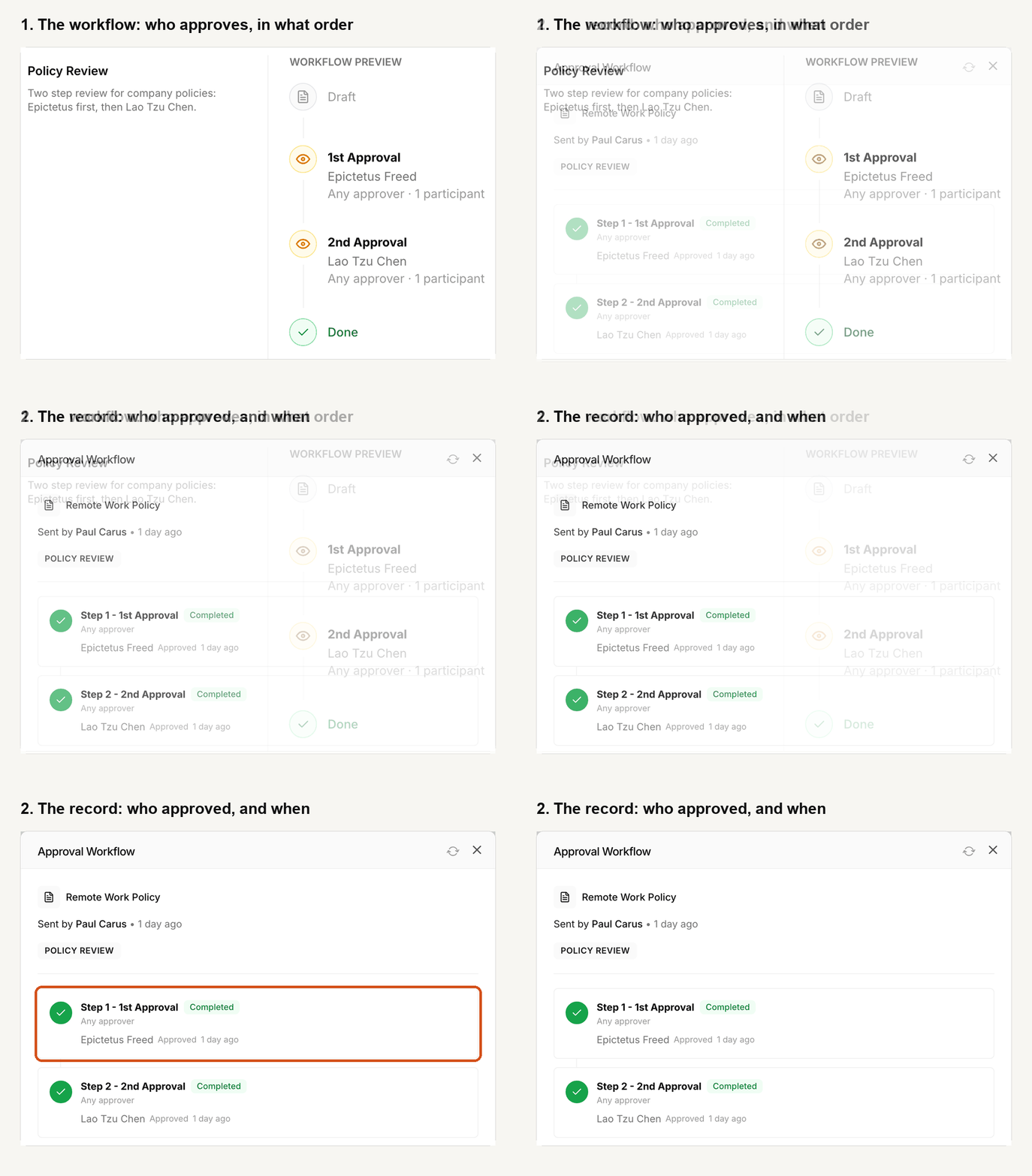
Approval before anyone sees it. Whatever wrote the draft, the policy goes through an approval workflow with up to four ordered steps, it’s locked while under review, and only an approved version can be sent out.
The right people, every time. Tags decide who receives each policy, so it reaches the teams it applies to rather than whoever was on an email list.
Acknowledgment by name and version. Each person acknowledges the policy while signed in, the record shows their name and the version they confirmed, and automatic reminders follow up with anyone who hasn’t. When the policy changes, the new version goes back through approval and out again, so the record always matches what’s in force.
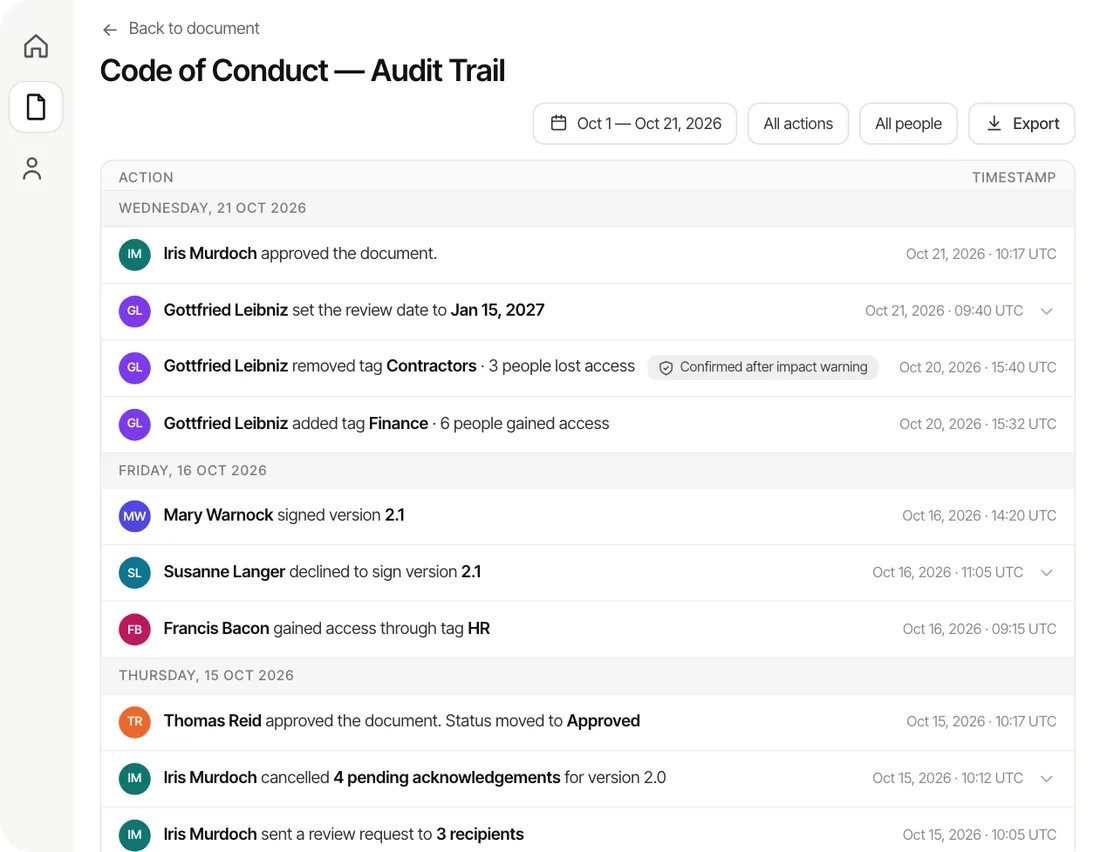
Proof you can hand over. Each policy’s audit trail records its versions, approvals, rejections with their reasons, who it was sent to and every acknowledgment, and you can export it as a PDF or CSV.
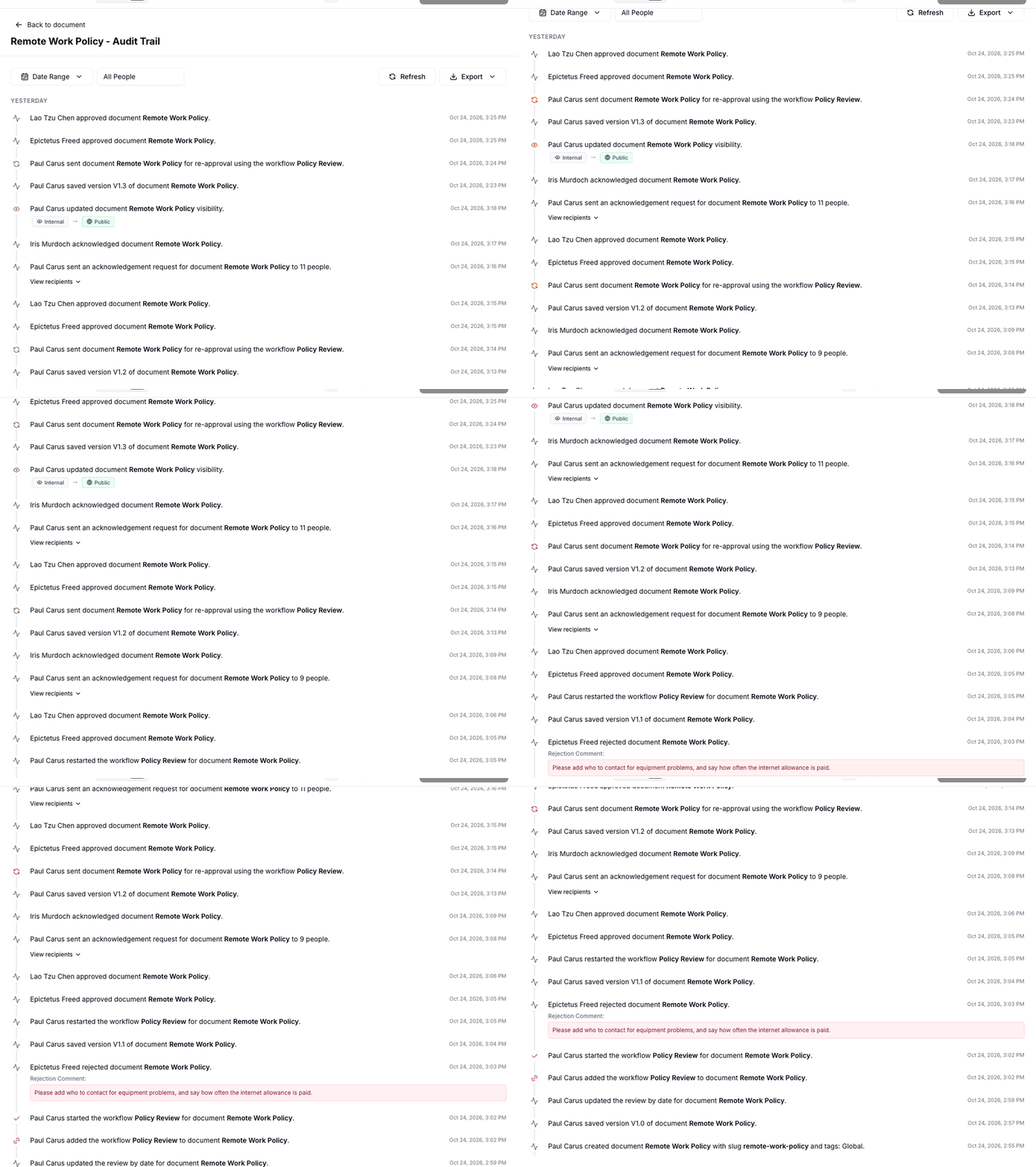
Readers and acknowledgers are free in AllyMatter, so you pay for the people who manage policies rather than for everyone who reads them, and our prices are public on the pricing page. If you’re weighing the wider category, our guide to policy management software covers what to look for.
Start your 30-day free trial of AllyMatter. No credit card to start, and a 30-day money-back guarantee if you subscribe and change your mind. Free migration.
Three scenarios
An honest read on what you need:
If you’re a large organisation running ethics, risk and compliance across many teams, an integrated platform with AI throughout, such as SAI360 or Riskonnect, may be worth the implementation, and AllyMatter can still sit alongside it for the policies every employee has to read.
If you’re a growing company working towards SOC 2 or ISO 27001, a compliance automation tool with good evidence collection and questionnaire AI will save real time, and AllyMatter is where the policies it drafts get approved, acknowledged and proven.
If your main job is keeping policies current, approved and provably read across a company of 30 to 500 people, that is exactly what I built AllyMatter for, and you can use any AI you like to write the drafts.
Questions people ask about AI compliance software
What is AI compliance software?
AI compliance software is GRC, compliance or policy software that uses artificial intelligence for parts of the job, such as drafting policies, answering questions, collecting evidence, scoring risk, mapping controls or answering security questionnaires. In our review, 165 of 205 tools now claim at least one AI feature.
Which GRC tool has the most AI features?
Across all 205 tools, SAI360 made the most AI claims, 50, with 49 presented as live, but it’s an enterprise platform. Among tools built for small and mid-sized businesses, Scrut Automation leads with 29 claims, all live, followed by ComplySec360 and ISMS Copilot with 27 each.
Can AI write our compliance policies?
AI can write a good first draft, and 105 of the tools we reviewed offer some kind of AI drafting. A draft still has to be checked against how you actually work, approved by the right people, sent to the staff it applies to, and acknowledged, which is the part AllyMatter handles.
Are AI compliance features reliable?
They vary. Most claims in our review are presented as live, but only about a third say a human reviews the AI’s output, and measured promises are rarely explained. Ask every vendor how the AI is checked, what data it sees and who is responsible for its output.
Does AI replace a compliance or policy manager?
No. AI takes on reading, drafting and sorting, but someone still decides what a policy says, who approves it and who must follow it, and that person is accountable to the auditor. The useful question is which work AI should take off their plate.
How does AllyMatter fit alongside AI compliance tools?
Use whichever AI you like to draft a policy, then bring it into AllyMatter, where it goes through approval, reaches the right people through tags, is acknowledged by name and version, and leaves an audit trail you can export as a PDF or CSV.
This research reflects vendor websites between October 10 and 22, 2026, and AI features are changing quickly, so we’ll update it as the market moves. Product names belong to their owners, and every claim is paraphrased from the vendor’s own public page. Corrections are welcome at [email protected].
Start your 30-day free trial of AllyMatter. No credit card to start, and a 30-day money-back guarantee if you subscribe and change your mind. Free migration.