
Say it’s the first week of February. A rep is on your calendar with last year’s plan in one hand and this year’s in the other, asking which accelerator applies to the deal she closed in January. Whatever you answer, the next question is the expensive one: can you prove which version she agreed to?
Commission plans are policies with money attached, which makes them the most disputed documents most companies own. They change every year, sometimes mid-year; every rep’s pay depends on the exact wording; and when a dispute lands, it hinges on which version someone saw and what they agreed to. I have watched the same five failures play out at company after company, and each one has a practical fix. Here they are. (Comp plans are also the textbook case of a policy nobody calls a policy; the wider playbook lives in the handbook acknowledgment guide.
Four signs your comp-plan documentation is already costing you:
- Two “final” versions of this year’s plan exist, and finance and revops are not editing the same one.
- At least one rep signed last year’s plan after this year’s took effect.
- A mid-year change went out by email, and nobody re-collected agreement to the new terms.
- A comp dispute took longer to research than to resolve, because the record was an inbox.
Key takeaways
- Comp plans fail as documentation before they fail as math: scattered drafts, email approvals, and unversioned signatures create the disputes.
- The five fixes are one governed draft, an approval chain on rails, questions kept on the document, signatures bound to the exact version, and rep-visible transparency.
- Every fix is the same move: replace a human memory with a system record.
Fix 1: End the drafting scatter
The mess begins before anyone signs anything: the plan drafted across email threads, a deck, and three spreadsheet tabs, with finance and sales revops editing different copies. The fix is one governed draft: a single document, visible only to its editors while it takes shape, with every change tracked to a person. When the plan is ready, there is exactly one candidate text, which sounds small and is the foundation for everything below.

One governed draft: finance and revops edit the same document, and every change carries a name.
Fix 2: Put the approval chain on rails
A comp plan needs sign-off that means something: sales leadership, finance, sometimes legal. Routed by email, that chain stalls in whoever’s inbox is worst, and the stuck approval becomes its own genre of delay. In AllyMatter the plan runs a named approval workflow, up to four steps with everyone-or-any-one rules per step, the document locked while under review, every approval and rejection landing with a name, a timestamp, and comments. “Who authorized this accelerator change” stops being a mystery, and the stalled step is visible instead of silent.
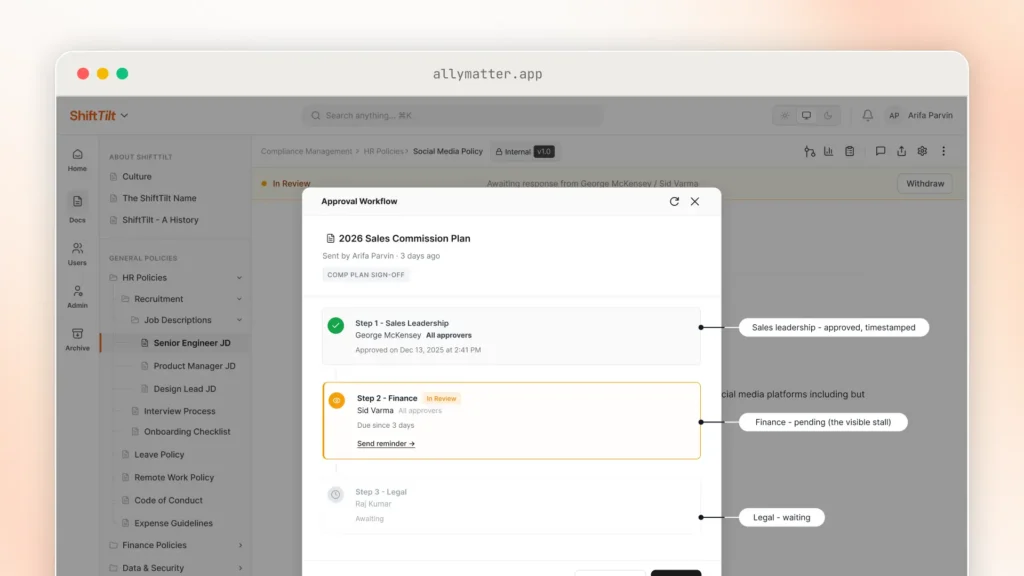
The approval chain on rails: every step named, the stalled one visible instead of buried in an inbox.
Fix 3: Make the questions part of the document
Every comp plan launch generates the same clarifying questions, and email scatters the answers where the next asker cannot find them. Inline comments keep the questions and their resolutions on the document itself, so the answer given to one rep is the answer visible to all of them, and the ambiguity that generated the question is right there as a candidate for the next revision.
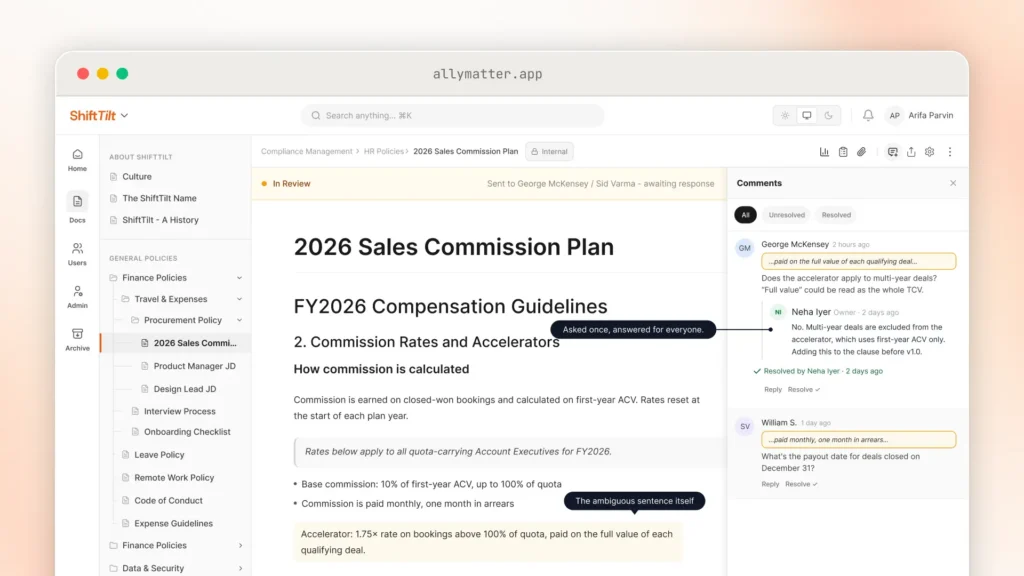
Questions live on the clause that caused them, so one answer serves every rep who wonders next.
Fix 4: Collect real signatures, bound to the real version
This is the fix that ends the January argument about the March plan. Each rep’s plan goes out for e-signature: their own signed record, bound to the exact version they signed, with a completion certificate filed automatically. When the plan changes mid-year, the revision goes back through approval and everyone signs the new version, with the word-by-word diff showing precisely what moved; nobody’s old signature can be quietly read as agreement to new terms. And the records are permanent: the rep who leaves in November keeps no hold over the paperwork, because the signed history survives their departure. (Whether a document needs a signature or an acknowledgment is its own decision.l
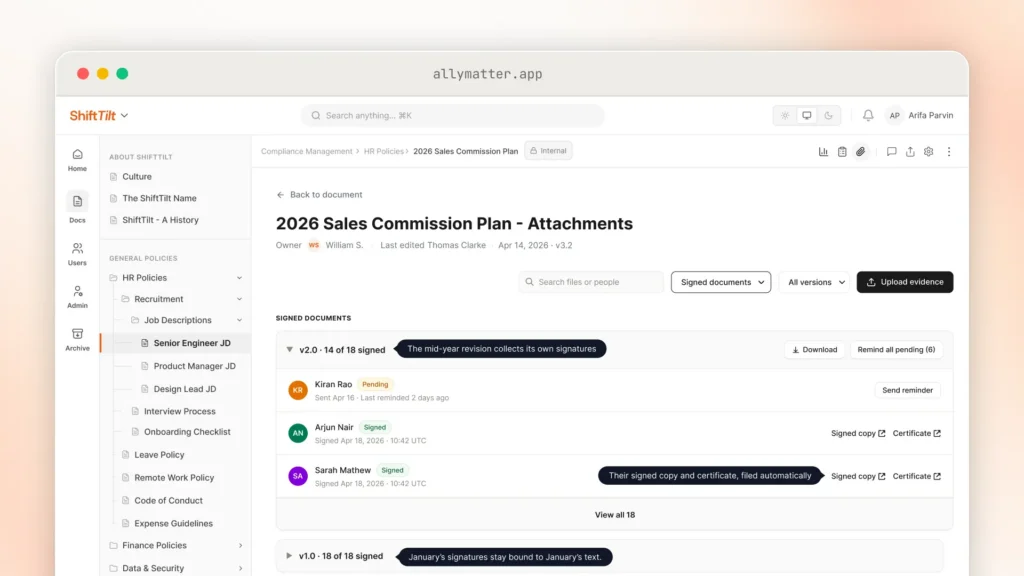
Signatures grouped by version: the March plan cannot borrow January’s agreement.

Before anyone re-signs, the diff shows precisely what moved, so re-signing a two-line change takes a minute.
Fix 5: Let transparency do the retention work
The human cost of comp-plan chaos is real even if I will not invent numbers for it: a rep who cannot say with certainty what their own plan says, or whether the version they signed is the version in force, carries that uncertainty into every deal and every one-on-one. The fix is structural transparency: each rep sees their current plan (and only theirs, tag-scoped), knows it is the approved version because no other kind can reach them, and holds their own signed copy. Uncertainty is the tax; a provable record is the refund.
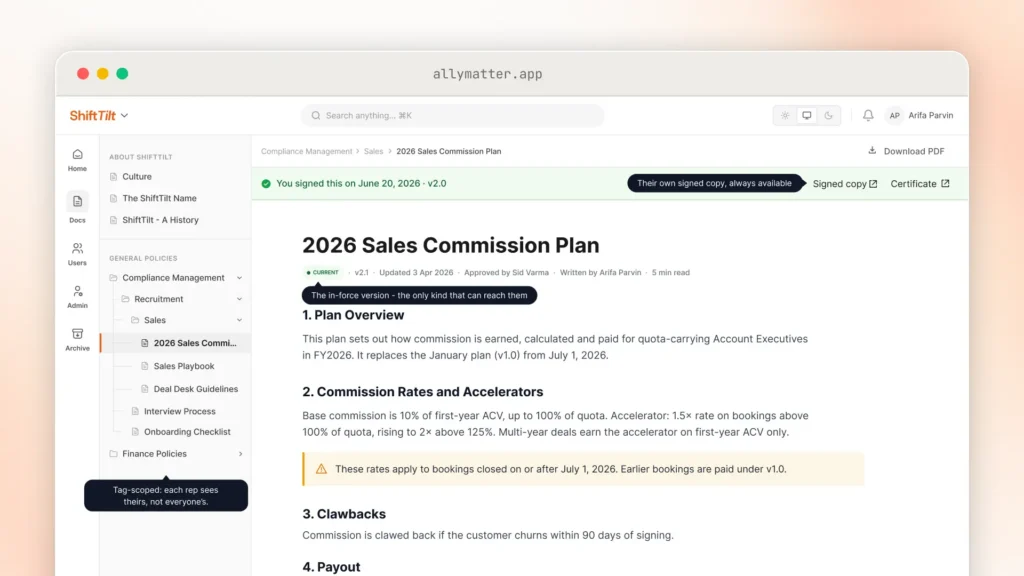
What the rep sees: their current plan, verifiably the approved version, with their own signed copy a click away.
The pattern under all five
Every fix is the same move: replace a human memory with a system record. One draft instead of a scatter, a workflow instead of a chase, comments instead of an inbox, version-bound signatures instead of “I think she signed something,” visibility instead of rumor. The whole history stays inspectable afterward in the document’s audit trail, which is what makes February’s question a lookup instead of an argument. Comp plans will always be contentious in the way anything tied to pay is contentious. The documentation just should not be contributing.
Three scenarios
If you have a handful of reps on one simple plan, a well-named PDF and a dated signature folder will hold for now; just never edit the plan without re-collecting.
If you are 30 to 500 people with a real sales team, comp plans change mid-year and disputes are a matter of when. The five fixes above are the system we built AllyMatter around, and comp plans are one of its sharpest uses.
If your plans face audits or legal review (public-company adjacent, PE-owned, or litigation-prone markets), version-bound signatures with surviving records are table stakes, and email cannot produce them. We’d start with AllyMatter.
Questions people ask about commission plan documentation
Do commission plans really need e-signatures rather than acknowledgments?
Usually yes. A comp plan defines pay, which makes it an agreement, not a notice: the legal weight sits in the exact wording each rep accepted. Signature, bound to the version, is the right instrument.
What happens when the plan changes mid-year?
The revision re-runs approval, then every rep signs the new version with the diff in front of them. January’s signatures stay attached to January’s text permanently, so neither side can blur the two.
What about the rep who left in November?
Their signed records survive their departure, by design. The dispute that arrives in March is settled by the record, not by whoever remembers.
Start your 30-day free trial. No credit card to start, and a 30-day money-back guarantee if you convert and change your mind.
Not ready for a trial? On annual plans, migration is on us: we’ll move your docs from SharePoint, Google Drive, Confluence, or Notion and have you running in about a week.

Founder of AllyMatter I’m founder of AllyMatter, an operations-first knowledge base for growing companies. Before AllyMatter, I co-founded Syren Cloud and helped scale it into a 300-person organization across two countries, leading marketing, operations, and HR. We moved fast, served demanding customers, and learned the hard way that internal knowledge systems built for help docs or IT don’t solve day-to-day operations. AllyMatter is my answer—tools that turn tribal knowledge into trusted, searchable processes. This blog shares the playbooks, checklists, and lessons I wish I’d had while scaling.