See for yourself in the live sandbox. No login or signup.

Write, approve, acknowledge, track, prove. The whole policy lifecycle in one place.

Every document you have to stand behind (policies, SOPs, the handbook) runs one governed lifecycle here, and every step writes to the same permanent record. That is what makes the proof exportable at the end: nothing lives in a side spreadsheet.

Author documents that are built to be governed

A real editor underneath, and a record-keeping system around it. Every document gets an owner, a type, and a version history from its first save.

Editor

A real editor with an owner and a type chosen at creation. The type drives everything downstream: what the audience must do, and what the record captures.

Versions

Every version is kept with timestamps and author attribution. Restore any previous version in one click. Version Compare shows any two versions word by word, down to a counter of how many words changed, so a reviewer sees exactly what moved between v4 and v5 instead of rereading thirty pages.

Organization

Folders with drag-and-drop reorganization. When a parent folder moves, child documents move with it and inherit the destination's permissions, so a reorg never silently strands access. Flat, role-based tags keep the structure from turning into a maze.

Access

Access is tag-based: admins create tags for departments, locations, roles, or any combination, and both documents and people carry them. Match the tags and you see the document; miss them and it does not exist for you. Tags can be applied per document or cascade through folders. Search respects the same permissions, so people find what they are allowed to find.

Embeds

SOPs work better when the diagram, the walkthrough, and the tracker live inside the document. AllyMatter embeds: YouTube, Vimeo, Loom, Google Docs, Google Sheets, Google Slides, Excel Online, Figma, Canva, Lucidchart, Draw.io, Google Forms, Typeform, Calendly, CodePen. One scope rule, stated plainly: embeds are for SOPs and working documents. A document that collects acknowledgment or e-signature stays self-contained, because live embedded content can change after people sign.

Approvals with real rules, not a thumbs-up emoji

Route any document through the sign-off it deserves: one approver for the parking memo, four structured steps for the information security policy.

Workflows

Build an approval workflow from one step up to four. Each step holds up to six approvers, and a single workflow can involve up to twelve people in total. Or keep it simple: one person, one click. Sending a document into approval takes one action from the document itself.

Step Rules

Each step carries its own rule: everyone in the step must approve, or any one person in the step approves and the document advances. Mix rules across steps in the same workflow: step one might need any one legal reviewer, step two all three department heads. Approvers can approve with comments attached, or reject with comments, which sends the document back with the reasoning on the record.

While In Review

The document auto-locks during active approval: no mid-review edits, so what the final step approves is exactly what step one saw. And only approved versions can be distributed for acknowledgment or signature. Nobody ever signs a draft.

Reusable

Name and save any approval workflow and apply it across documents. The quality team's 3-step review, the HR policy chain, the fast one-person path for low-stakes updates: build each once.

On the Record

Every approval decision is captured permanently: who approved, when, under which rule, including shapes like "sent to three, any could approve, this person did." When an auditor asks who signed off on the version in force, it is a lookup, not an investigation.

The right people, the right obligation, and a record that holds

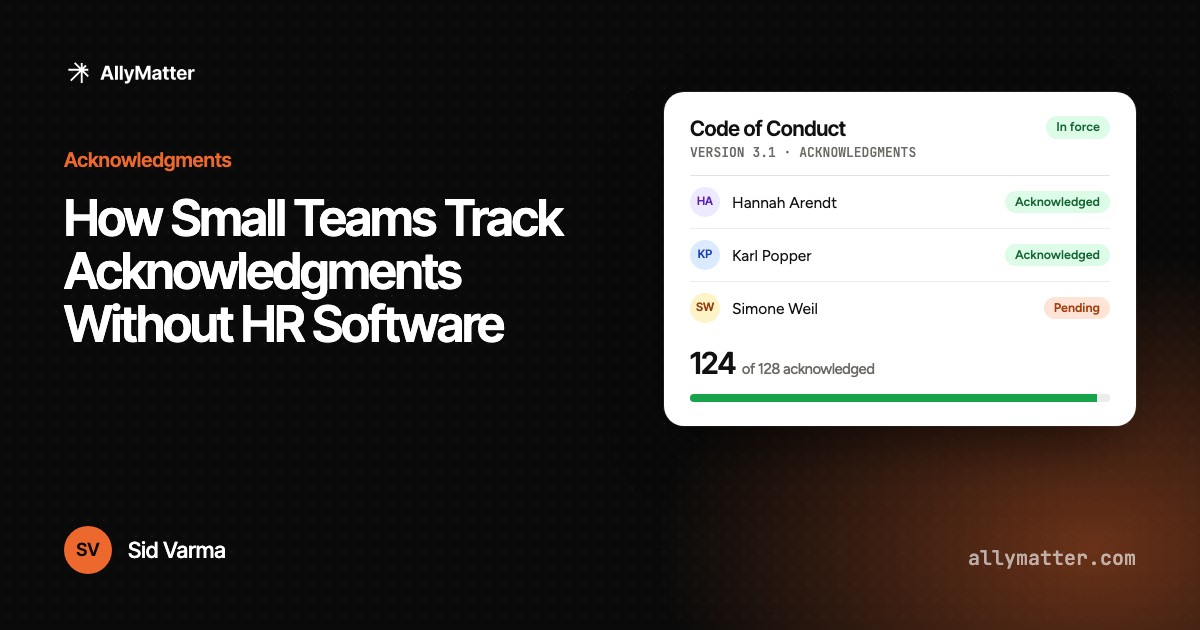
An acknowledgment here is an evidence record, not a read receipt. Every one binds a person to an exact version and the exact statement they agreed to.

Policies age. The system notices before your auditor does

Two mutually exclusive freshness mechanisms per document, chosen by the owner, plus one rule with no exceptions.

The audit ends with an export, not a scramble

Everything the other sections do lands on one per-document record. This section is where it comes back out.

The audit ends with an export, not a scramble

Everything the other sections do lands on one per-document record. This section is where it comes back out.

Run it for the whole company without running an IT project

Everything in AllyMatter

The full toolkit, grouped the way the lifecycle runs.

01

Real editor

Rich text with an owner and a type from the first save.

02

Version history

Every version kept, with timestamps and attribution.

03

Version compare

Word-level diff between any two versions.

04

Document types

Notify, acknowledgment, or e-signature — set at creation.

05

Tag-based access

People see only what their tags allow.

06

Organization

Move freely; child documents inherit permissions.

07

Embeds

15 providers render inside SOPs.

01

Multi-step workflows

Route reviews through 1 to 4 structured approval steps

02

Flexible approvers

Add up to 6 approvers per step and 12 per workflow.

03

All-or-any rules

Require every approver or any one approver at each step.

04

Decisions with context

Approve or reject with comments; every decision stays captured.

05

Review lock

Documents lock automatically while an approval is in progress.

06

Approved-only distribution

Only the approved version can reach the document’s audience.

07

Reusable workflows

Save named approval flows and apply them across documents.

01

Distribution types

Choose notification, acknowledgment, or e-signature for each document.

02

Tag-based audiences

Send policies to the right roles, teams, sites, or groups.

03

Automatic assignment

New hires inherit every document associated with their tags.

04

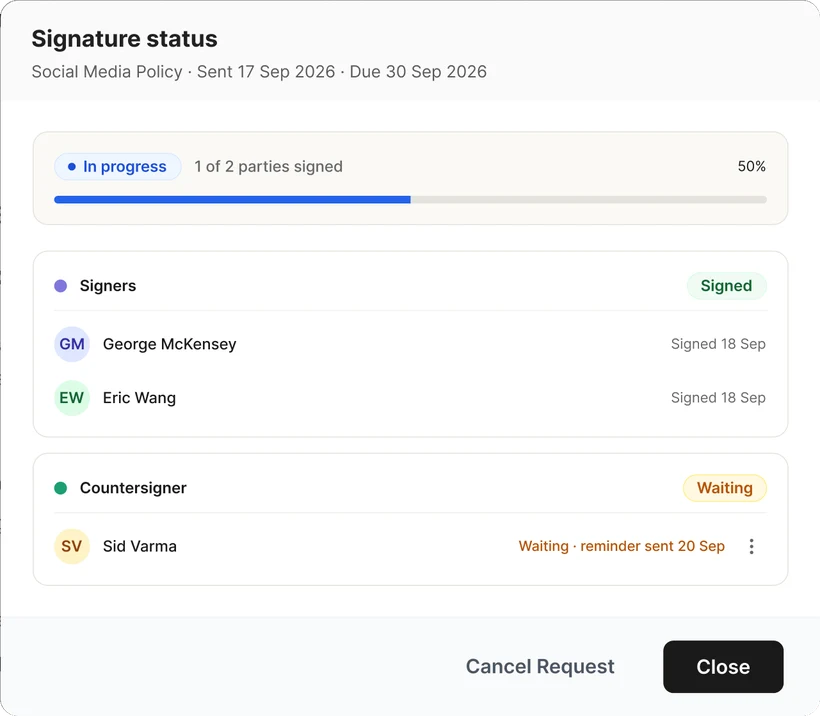
Deadlines and reminders

Set due dates and automate reminders through email, Slack, and Teams

05

Nudges and exceptions

Manually nudge people or record declines and exclusions with reasons.

06

Permanent acknowledgment records

Keep identity, version, attestation text, and timestamp—even after user deletion.

07

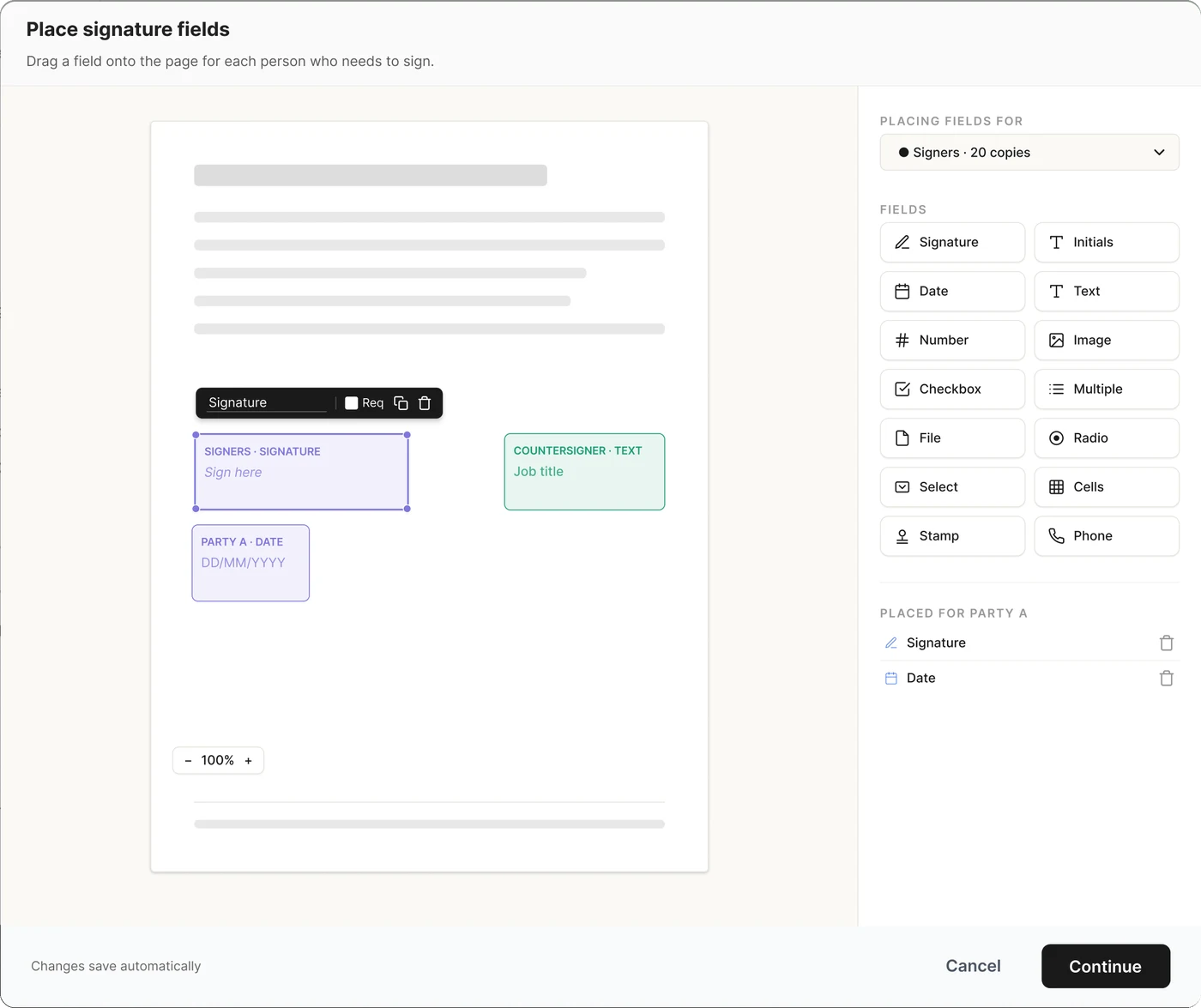
E-signatures

Use DocuSign, Adobe Sign, SignNow, or built-in signing with identity verification.

08

Packaged guides

Bundle documents into ordered reading and acknowledgment experiences.

01

In-force dashboard

See which documents are active, due for review, or lapsed.

02

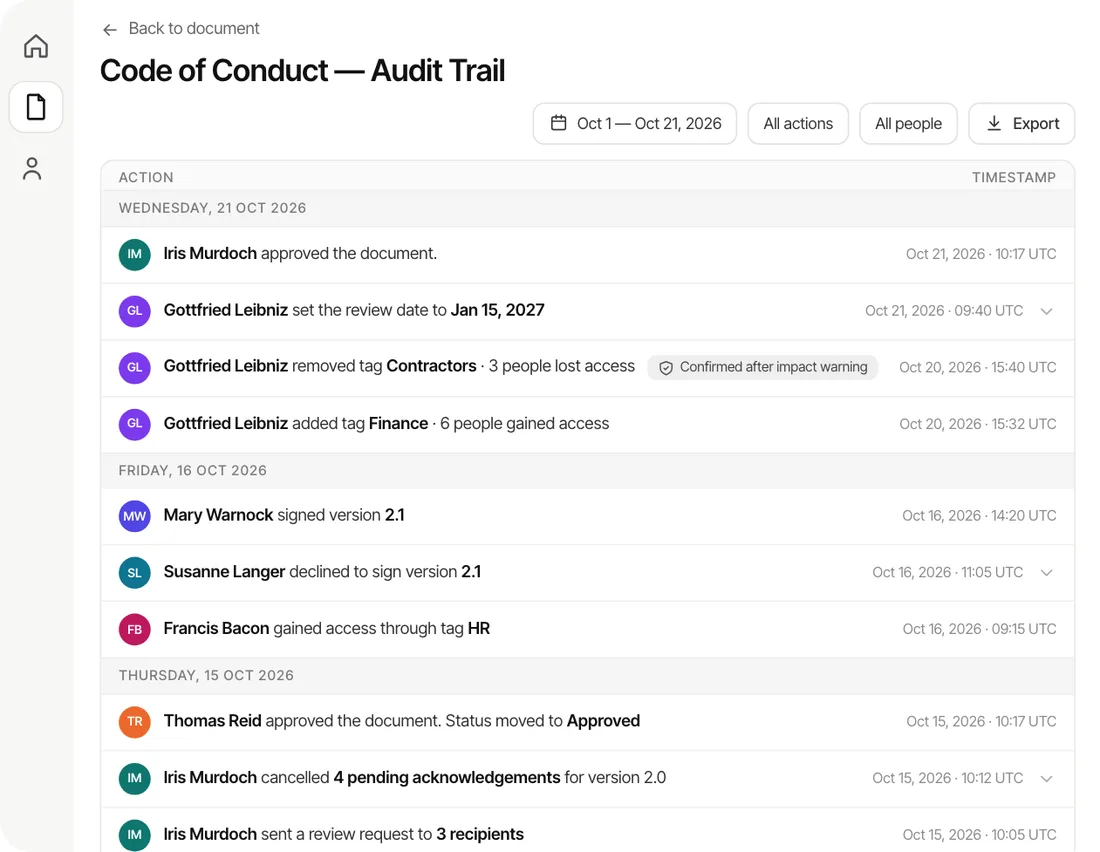
Complete audit trail

Track document activity, access changes, and append-only admin events.

03

Point-in-time snapshots

Reconstruct the policy record exactly as it existed on a selected date.

04

Audit evidence packs

Package policies, records, and requirement references for review.

05

Document analytics

See 30-day activity, visible reading time, and access attempts.

06

Tamper-evident exports

Export verifiable PDF records, CSV files, or logs in bulk.

07

One-click document PDF

Download a clean PDF of any document whenever it is needed.

01

User console

Manage every user, invitation, status, and workspace relationship.

02

Roles and SSO

Control permissions and sign-in through Azure AD or Google Workspace.

03

Retention policies

Define how long documents and records must remain available.

04

Legal hold

Preserve required records without normal deletion or retention changes.

05

Logged lifecycle actions

Keep deletion and archiving activity visible in the administrative record.

06

Full data export

Take your documents and records with you whenever required.

07

Controlled publishing

Create public pages or share documents through controlled external links.

Standards & controls mapping

Map your policies to any standard's requirements, and see coverage at a glance.

Start your 30-day trial

Set up your policy management center this week. Pricing is public, and your data exports whenever you want it.

30-day money-back guarantee · Free migration

Scroll to Top