
Your HRIS probably collects a handbook signature at onboarding, and it probably does it well. If that is the whole of your policy obligation, you do not need another tool, and we would rather say that plainly than pretend otherwise.
The gap appears after onboarding, and it shows up in four specific places. They are the pattern we keep meeting in this space, and they are the four this post covers. For the full picture of handbook obligations from day one onward, the handbook acknowledgment guide is the place to start.
Four signs the gap is already open at your company:
- A policy changed this year, and the only signatures on file predate the change.
- IT, operations, or finance owns a policy that HR has never seen and could not produce on request.
- A contractor or board member carries real obligations, and the evidence is an email thread.
- Nobody can say who approved the version currently in force, only who signed something once.
Key takeaways
- An HRIS handles the onboarding signature well; the gap opens afterward, when policies change mid-cycle and nothing re-collects against the new version.
- Obligations that live outside HR (security policies, SOPs, expense rules) and people who are not employees usually fall between systems.
- The fix is not replacing the HRIS. It is pairing it with a system built for the policy lifecycle, and letting each do its job.
Gap one: what happens when a policy changes mid-cycle?
The HRIS captured a signature on the handbook as it existed on each person’s start date. Then the leave policy changes in June. Now what? The January signatures cover the January text; in most setups nothing re-opens the obligation, re-collects against the new version, and keeps both records straight. The mid-cycle change is where “everyone signed the handbook” quietly becomes “everyone signed some handbook,” and where point-in-time questions (“what had she agreed to on the date of the dispute?”) stop being answerable.
In a policy system, the June change re-runs approval, re-collects acknowledgment from everyone covered, shows each person the word-by-word diff, and keeps January’s records attached to January’s version permanently. The as-of-date question gets a screen instead of a shrug.
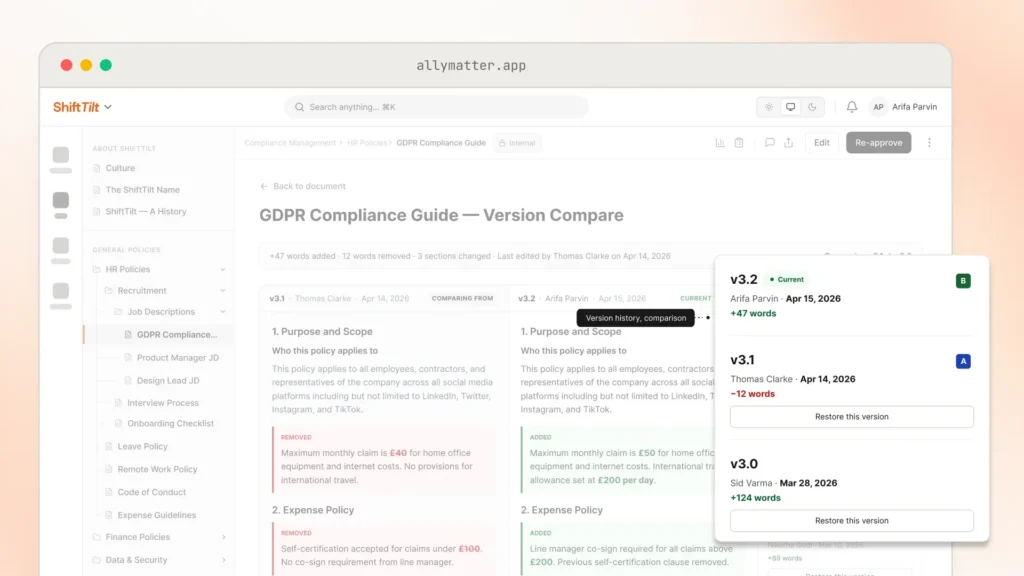
Closing the HRIS gap on mid-cycle changes: each person re-acknowledges with the word-by-word diff in front of them.
Gap two: who governs the policies HR does not own?
The HRIS is HR’s system, and the obligation problem is not HR-shaped. The security policy belongs to IT, the SOPs to operations, the expense policy to finance, and none of those owners live in the HRIS or want to. So companies end up with one governed obligation (the handbook, at onboarding) and a long tail of ungoverned ones, each tracked in whatever spreadsheet its owner improvised. That split between departments is where audit findings come from, and the pre-audit scramble is where everyone finds out.
A policy system is horizontal on purpose: every team keeps its documents and its ownership, and the approval, distribution, and acknowledgment machinery is identical everywhere, with the records in one place.
Gap three: what about people who are not employees?
Contractors, agency staff, board members, the client’s auditor: people your policies genuinely cover but who sit outside the employee records an HRIS is organized around. The NDA a contractor should sign and the security policy they should acknowledge tend to fall into the space between systems, tracked by email if they are tracked at all.
Here, anyone with an email address can carry an obligation: acknowledgments and e-signatures run on verified email identity, no employee record required, and the evidence lands in the same records as everyone else’s.
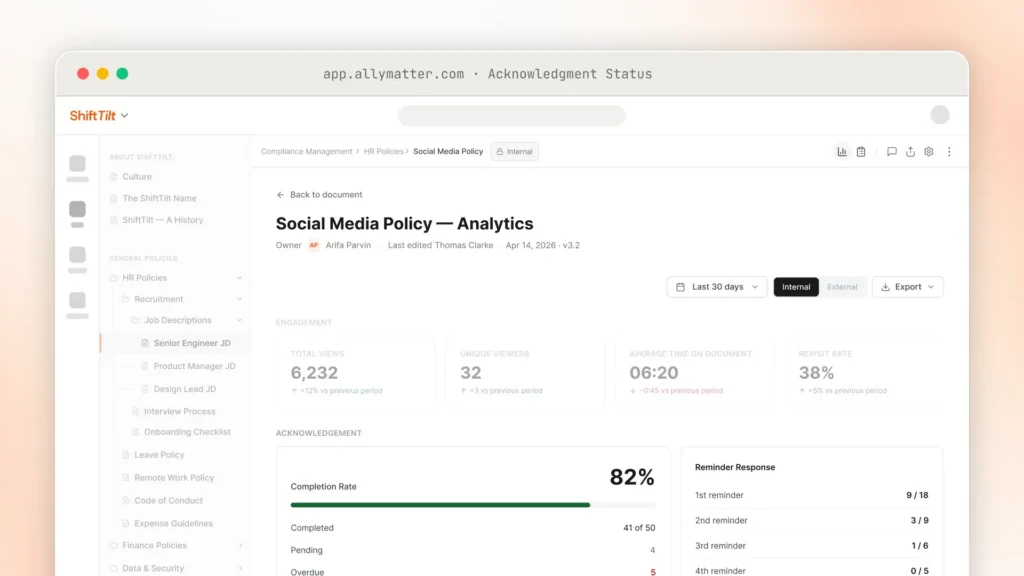
The record that closes gap three: identity, exact version, timestamp, and the attestation text, for employees and non-employees alike.
Gap four: what happened before the signature?
An HRIS meets a policy at the end of its life: finished text, please sign. It has no opinion on how the text got there, which is precisely what an auditor asks about: who wrote it, who approved it, which version is in force. Authoring, structured approval, version history, and the only-approved-versions-distribute rule are the upstream half of the job, and they are the half that makes the downstream signature mean something. The audit trail records that whole upstream story per document.
So do you replace the HRIS?
No, and this is not a rip-out argument. Keep the HRIS doing what it does well: employment records, payroll, the onboarding packet’s employment forms. Put the policy lifecycle, all four gaps of it, in a system built for obligations: one that re-collects on change, covers every team and every kind of person, and can answer the as-of-date question years later. The two meet politely at onboarding, where the HRIS handles the employment paperwork and the policy packet arrives from the policy system, tracked to completion.
Three scenarios
If you are under about 30 people and your only signed document is the handbook at onboarding, your HRIS is enough. Spend nothing more; revisit when the first client questionnaire or audit notice arrives.
If you are 30 to 500 people and any of the four gaps above is already familiar (a policy changed mid-year and nobody re-signed, or IT’s security policy lives in a spreadsheet), this is the moment. We built AllyMatter for exactly this pairing: the HRIS keeps employment, we keep obligations.
If you are regulated or client-audited, the four gaps are where findings land, because examiners sample across departments, versions, and people your HRIS does not cover. One evidence layer across all of them closes the surprise. We’d start with AllyMatter.
Questions people ask about the HRIS gap
Should we replace our HRIS with policy management software?
No. They do different jobs. The HRIS owns employment records and payroll; a policy system owns the document lifecycle and its evidence. Most companies that need the second keep the first exactly as it is.
Our HRIS re-sends the handbook annually. Doesn’t that cover gap one?
An annual re-send covers the calendar, not the change. If the policy changed in June and the re-send happens in January, there are six months where nobody agreed to the current text. Re-collection tied to the change itself is what closes the gap.
Can’t we track contractor signatures in the HRIS too?
Some HRIS products can hold non-employee records, and if yours does it well for signatures, use it. The test is whether the record binds identity, the exact version, and the attestation text, and whether it survives the contractor leaving. If it is a checkbox against a PDF, it is gap three wearing a checkmark.
Start your 30-day free trial. No credit card to start, and a 30-day money-back guarantee if you convert and change your mind.
Not ready for a trial? On annual plans, migration is on us: we’ll move your docs from SharePoint, Google Drive, Confluence, or Notion and have you running in about a week.
Related reading

Vikas is a B2B marketing professional with over 14 years of experience in content strategy, messaging, and demand generation. He specializes in turning complex business challenges into clear, actionable stories to connect meaningfully with audiences.