

Think about the last person your company hired. Somewhere between their offer letter and their first Friday, they were supposed to receive, read, and confirm a stack of documents: the handbook, the code of conduct, the security policy, the expense policy, an NDA, maybe a state-specific addendum or a safety procedure. Now the harder question: can you list which documents that specific person actually confirmed, which versions, and when?
At most companies the honest answer is a folder, an email thread, and a hope. Onboarding paperwork is where policy programs quietly fail, because it happens at the busiest possible moment, is owned by whoever is least busy that week, and is checked by nobody until an audit or a dispute checks it for you. (The handbook side of this story, from legal weight to tracking at scale, lives in the handbook acknowledgment guide.
The fix is a packet: one ordered bundle of everything a new hire owes, assembled automatically, tracked to completion. Here is how it works and what belongs in it.
Four signs your day-one paperwork is already failing:
- Someone hired this year has a signature on a policy version that was already superseded on their start date.
- The onboarding checklist lives in one person’s head, and it changed the last time they went on leave.
- Nobody can say which of the last five hires finished their packet, without opening five folders.
- The NDA and the handbook get the same treatment: one signature ceremony, no distinction between agreement and acknowledgment.
Key takeaways
- The packet should be a consequence of your org structure, not a checklist someone maintains: tags decide what each hire owes, automatically.
- Order and deadlines make it onboarding instead of homework; reminders make completion nobody’s manual job.
- Agreements (NDA, IP assignment) run as e-signatures inside the same packet, so the hire has one experience and the record has the right instrument per document.
How does the packet assemble itself?
The packet starts with a decision you make once, not per hire. Every policy in your system is targeted by tags: department, location, role, any combination. Marketing policies reach marketing; the California addendum reaches California; the safety procedure reaches the floor crew.
When a new hire is tagged into their team on day one, they inherit every document those tags carry, automatically, along with every acknowledgment obligation attached. Nobody assembles anything, which means nobody forgets anything: the packet is a consequence of the org structure, not a checklist someone maintains. The hire in Austin operations gets exactly what Austin operations owes, including the policy that changed last Tuesday, in its current approved version.

The day-one policy packet starts here: tags decide what each new hire owes, before anyone thinks about it.
How does it read like onboarding instead of homework?
A pile of fourteen simultaneous documents is homework, not onboarding. Packaged guides fix the experience: the packet presents as one sequence, handbook first, then the code of conduct, then role-specific policies, each acknowledged as the hire moves through. Automatic reminders chase whatever is still open, by email or Slack, so the hiring manager never plays collections.
The handbook piece deserves its own note: the packet works best when the handbook is not one monolithic PDF but a collection of owned, versioned policies, each confirmed on its own record.
Read: Stop calling it a handbook
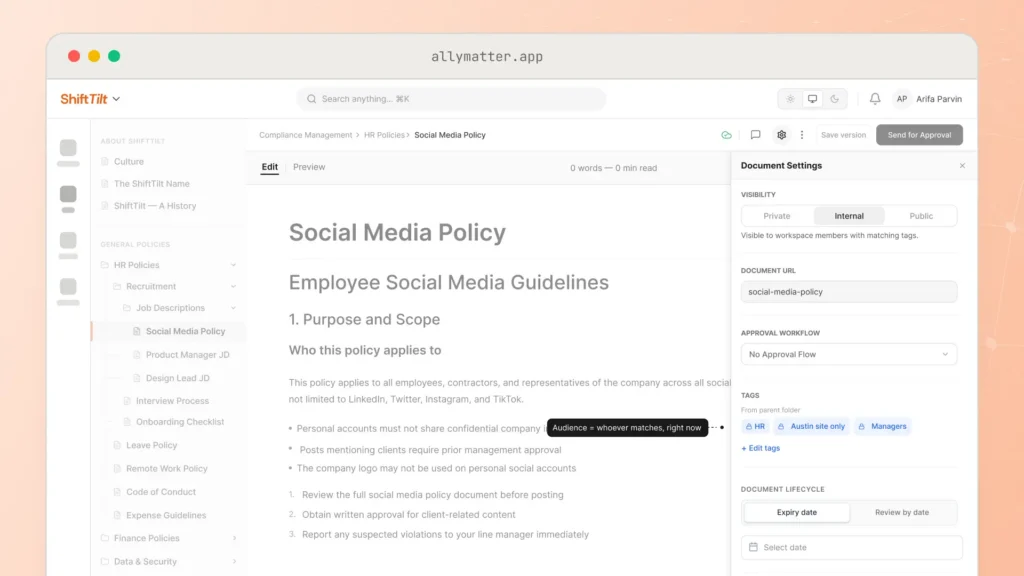
The new-hire policy packet as the hire sees it: one ordered path, each step tracked to completion.
Where do signatures belong?
Some of what a new hire signs is not a policy acknowledgment. The NDA and the IP assignment are agreements, and inside the packet they run as e-signatures: standalone documents, signed against the exact version, completion certificate filed to the document’s record automatically. Same packet experience for the hire, correct legal instrument per document, and no more discovering at year three that half the team signed a different NDA generation than the other half.
What does the record show on Friday?
By the end of week one, the packet has produced the thing the paper stack never does: a record. Per person: every document received, the version, the attestation text they confirmed, the timestamp, and anything still outstanding with reminders already running. Per document: coverage across the whole cohort. And it holds up over time: when a policy changes in March, the January hires re-acknowledge the new version like everyone else, and every record survives departures permanently.
If someone declines to sign something, that lands on the record too, with their reason, so HR follows up on a documented conversation instead of a rumor.
What belongs in the packet?
A starting checklist, tuned by tags per role and state:
- The handbook collection: code of conduct, core people policies
- Security basics: acceptable use, data handling
- Role-specific procedures: the safety program for the floor, the trading policy for finance
- Location addenda where law differs by state
- The agreements, as e-signatures: NDA, IP assignment
- The reference layer, published with no ask: benefits summaries, office logistics
Keep the day-one core short enough to finish on day one; let the week-one tail carry the rest. A packet people actually complete beats an exhaustive one they stall on, and the reading problem has its own playbook.
What is the payoff six months later?
Someone will ask about one new hire and one policy. The answer will be a lookup: received on day one, version 4, confirmed 2:14pm, here is the export. That is the entire difference between onboarding paperwork as a ritual and the day-one packet as a system: the ritual produces a pile, the system produces an answer. (The broader onboarding content around the packet, the reference layer a new hire browses on their own, has its own setup guide.)
Three scenarios
If you hire a few people a year into simple roles, a well-kept folder and a day-one hour with HR genuinely works; just date the signatures and keep them somewhere that survives turnover.
If you are 30 to 500 people, hiring monthly across roles and states, the manual packet is already failing quietly: the four signs at the top are how it shows. Tags plus ordered packets is the system we built AllyMatter around.
If you are regulated or client-audited, the week-one joiner is exactly who the auditor samples, because that is where coverage breaks. A packet that assembles itself is how the newest person in the building is never your finding. We’d start with AllyMatter.
Questions people ask about day-one policy packets
What should a new hire sign on day one versus later?
Day one: the agreements (NDA, IP assignment) and the policies with legal or safety weight. Week one: the rest of the handbook collection. The reference layer never needs a signature at all.
How do we handle hires in different states or roles?
Through tags. The California hire inherits the California addendum, the floor hire inherits the safety program, and nobody maintains a per-state checklist. If the org structure is right, the packet is right.
What happens if a policy changes right after someone completes their packet?
The change re-runs approval and re-collects acknowledgment from everyone covered, new hires included. Their packet record stays bound to the versions they signed; the new version collects its own confirmations.
Start your 30-day free trial. No credit card to start, and a 30-day money-back guarantee if you convert and change your mind.
Not ready for a trial? On annual plans, migration is on us: we’ll move your docs from SharePoint, Google Drive, Confluence, or Notion and have you running in about a week.

Vikas is a B2B marketing professional with over 14 years of experience in content strategy, messaging, and demand generation. He specializes in turning complex business challenges into clear, actionable stories to connect meaningfully with audiences.