
Audit prep has a reputation as a two-week fire drill, and in most companies it earns it: the evidence exists, roughly, somewhere, and preparation means finding it, printing it, and discovering the gaps with no time left to fix them. The week is spent producing a binder instead of understanding your own state.
When the records live in the system that collected them, prep collapses into a sequence you can run in an afternoon, a week out, with time left to act on what you find. Here is that sequence, step by step in AllyMatter.
Step 1: Read the board
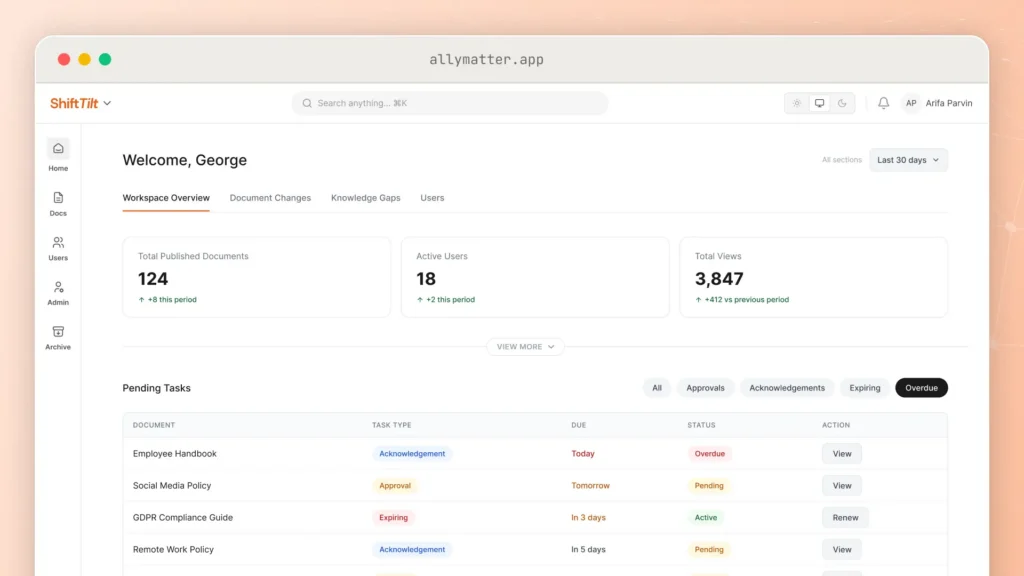
Start at the in-force dashboard: every active policy, its version, its owner, its acknowledgment coverage, and what is approaching review or expiry. This is the audit’s opening question, “show me your current program,” answered before anyone asks it. It is also where surprises surface early: the policy that lapsed quietly, the coverage number that stalled at 81 percent.
Step 2: Reconstruct the period
Audits examine a period, not a morning. Run the Point-in-Time Snapshot for the exam window: versions in force then, audiences as they stood then, acknowledgment state as of then. Whatever the snapshot shows is what the auditor will find, so this is the moment to understand your own past, not audit week.
Step 3: Close what can be closed
Two lists come out of steps 1 and 2. The outstanding list: people who have not acknowledged current versions, already being chased by the reminder cadence, now worth a manual nudge. And the exception list: people excluded from requirements, each needing the reason on record to be one you can say out loud to an examiner. A week is enough to close stragglers and tidy explanations. It is not enough to backfill a year. That is the honest argument for running this sequence quarterly, not annually.
Step 4: Map to the standard you brought
If your audit runs against a framework, the requirement references field shows your library grouped by the clauses you mapped: every document answering ISO 7.5.3 in one view, exportable as a column. References are your own mapping, in your own words, against whatever standard you follow.
Step 5: Produce the file
Generate the Audit Evidence Pack: policies at period versions, approval chains, acknowledgment rosters, exclusions with reasons, in the tamper-evident export an examiner can take away. Send it ahead or hand it over in the room; either way, the assembly step of audit prep is a button, not a two-week project.
What “easy” honestly means here
Easy does not mean the audit is trivial or the outcome guaranteed; auditors judge programs, and no software makes a weak program strong in a week. Easy means the preparation stops being reconstruction: the evidence assembled itself all year as the work happened, and prep becomes reading your own record, closing real gaps, and printing the file. The panic was never the audit. It was the archaeology, and the archaeology is the part that goes away.
Start your 30-day free trial. No credit card to start, and a 30-day money-back guarantee if you convert and change your mind.
Not ready for a trial? On annual plans, migration is on us: we’ll move your docs from SharePoint, Google Drive, Confluence, or Notion and have you running in about a week.

Vikas is a B2B marketing professional with over 14 years of experience in content strategy, messaging, and demand generation. He specializes in turning complex business challenges into clear, actionable stories to connect meaningfully with audiences.