
A customer emails support asking about your refund window. Your support rep says 14 days. Later that week, the same customer is on a call with their account manager, who confidently says 30 days. Two weeks after that, they see something different on a proposal from sales.
Nobody lied. Nobody was careless. They each pulled from whatever they’d had on hand.
This is the problem with having no single source of truth. Support, sales, and account managers all give slightly different answers, not because they’re not trying, but because they’re each working from a different version of what’s true.
This is one of the quieter operational problems in growing companies, and one of the more damaging ones. There’s no incident report for this. The cost lands as eroded trust, escalated tickets, and customers who’ve quietly stopped believing what your team tells them.
When I look at how customer-facing teams operate in companies between 100 and 500 people, the inconsistency pattern is almost universal. Sales has a shared drive with pitch materials that haven’t been reviewed in months. Support has a Confluence wiki that three people maintain and the rest ignore. Account managers keep their own notes and lean on Slack to get fast answers. Each team is doing its best with what it has. The problem is that what each team has is different.
Why the answers diverge
The root cause is simpler and more structural than most companies want to admit: there is no single source of truth that all customer-facing teams are actually using.
Most growing companies don’t set out to build fragmented documentation. It accumulates. Product launches get captured in a deck someone made. Policy changes get communicated in a Slack message that scrolls off in two weeks. An update to pricing terms goes into an email thread that only the people CC’d at the time have access to.
By the time a new support rep joins or a sales hire needs to answer a product question, the authoritative answer is hard to locate. So they ask a colleague. That colleague recalls something from memory or finds a document they saved six months ago. The answer they give may have been accurate at some point. Whether it still is, nobody’s sure.
Let me check what we have on that.” It sounds like a reasonable response. The problem is that what Marcus finds depends entirely on where he looks.
Consider Marcus, a senior account manager at a 200-person SaaS company. A customer asks him about service level commitments during a renewal conversation. He pulls up the sales deck from his last pitch, finds the SLA section, and reads it out. What Marcus doesn’t know is that the support team updated those terms three months ago after a product change. The support team knows. The updated version lives in their internal wiki. Marcus never saw the update.
That gap between what one team knows and what another team is working from is where customer trust quietly deteriorates.
The cost sits in the details
In B2B, customers have longer memories and more negotiating leverage than most companies give them credit for. A support rep quoting one return policy and an account manager quoting another is enough to make a customer question whether the company actually has its act together. The inconsistency doesn’t have to be dramatic to do damage.
For a COO or Head of Customer Success, the inconsistency is worth reading as an operational signal. If your customer-facing teams are giving different answers, it usually means your internal documentation is fragmented, outdated, or both. And that fragmentation has a cost beyond the customer conversation: longer support resolution times, more internal back-and-forth to verify answers, and the ongoing risk that a team member confidently states something that’s no longer true.
What a centralized knowledge base changes
A documentation sprint won’t solve this. Neither will another Slack channel for policy updates. What changes the pattern is a single source of truth: one shared knowledge base that every customer-facing team is working from, where the current version of any document is unambiguous and findable in seconds.
That sounds straightforward. In practice, it requires a few things to work consistently.
First, the information has to be in one place. Not one place per team, one place for the organization. Support, sales, and account management should all be pulling from the same source. When your support lead updates the refund policy, that update needs to be visible to the account manager preparing for a renewal call, not just to the three people who follow the support wiki.
The version in front of your team also needs to be the right one. A knowledge base where documents accumulate without version discipline is only marginally better than no system at all. If Marcus can find both an old pricing deck and a new one without knowing which is current, the problem hasn’t gone away. It’s just moved somewhere else. And finding the right document can’t require knowing exactly where to look.
A sales rep who joins your company has no mental map of your folder structure. If the answer to “what’s our SLA?” involves navigating four nested folders in a system they’ve used for two weeks, they’re going to ask a colleague instead. And that colleague’s answer may or may not be current.
How AllyMatter addresses the consistency gap
A centralized knowledge base works as a single source of truth only if the underlying platform supports both access and discipline. Here is how AllyMatter approaches the specific problems described above.
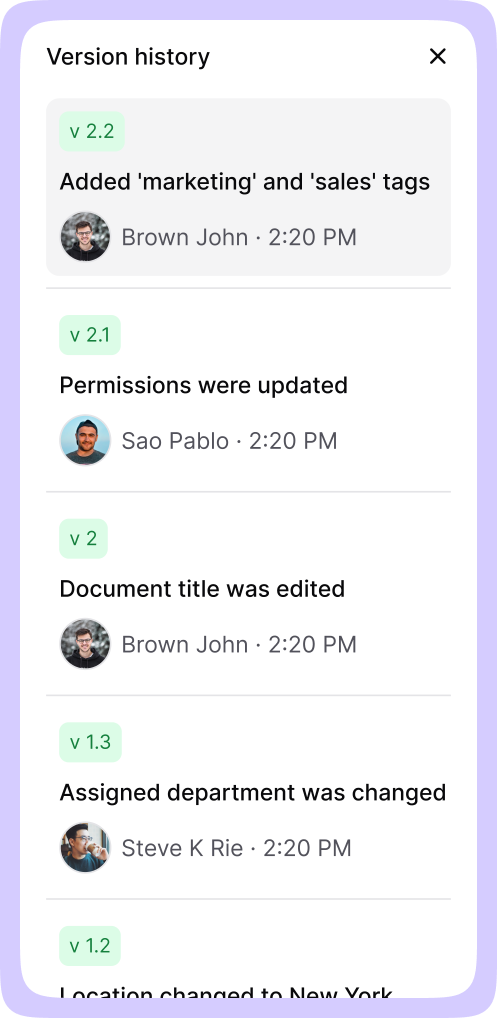
AllyMatter retains and logs every prior version of a document with a timestamp and author. When someone opens a document, they see the current published version. Nothing older, nothing unreviewed. If Marcus opens the SLA document, he sees the version the support team last published, not the one from his downloads folder. Version history is accessible to admins and owners, so if there’s ever a question about what changed and when, the record is there. For customer-facing teams, this means there’s no longer a question about which version is current. Everyone opens the same document and sees the same answer. You can read more about how this works in AllyMatter’s version control.
A sales rep searching for “refund policy” will surface the right document immediately, without needing to know which folder it lives in or which team originally wrote it. That’s the same document the support rep finds when they search the same term. One question, one answer, regardless of who’s asking. Because search respects the structure already set up in the knowledge base, results are relevant rather than cluttered with documents from unrelated teams or functions.
Tags also serve a structural purpose for customer-facing teams specifically. Tag a policy document for sales and support, and both teams see it automatically. Update it, and everyone with access sees the current version without anyone needing to send a notification. No one is working from a version they didn’t know had changed. The knowledge doesn’t live with the team that created it. It lives in a shared space that every relevant team pulls from, which is what makes consistency possible without relying on people to manually keep each other informed.
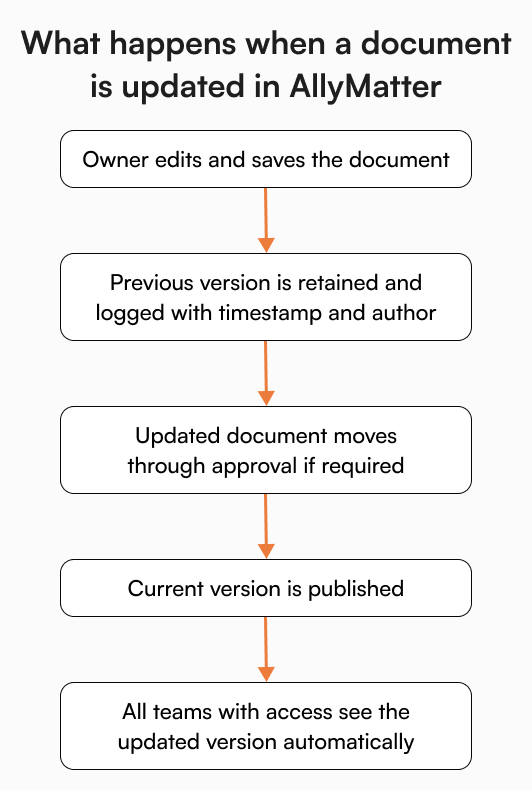
The result is that when a customer asks about your refund window, the rep who picks up the ticket, the account manager handling the renewal, and the sales rep on a demo call are all working from the same document. Not because someone remembered to send the update, but because the structure makes divergence harder than consistency.
Getting your customer-facing teams onto one source
If your teams are currently spread across Google Drive, Confluence, Notion, and individual inboxes, consolidation feels daunting. It doesn’t have to happen at once.
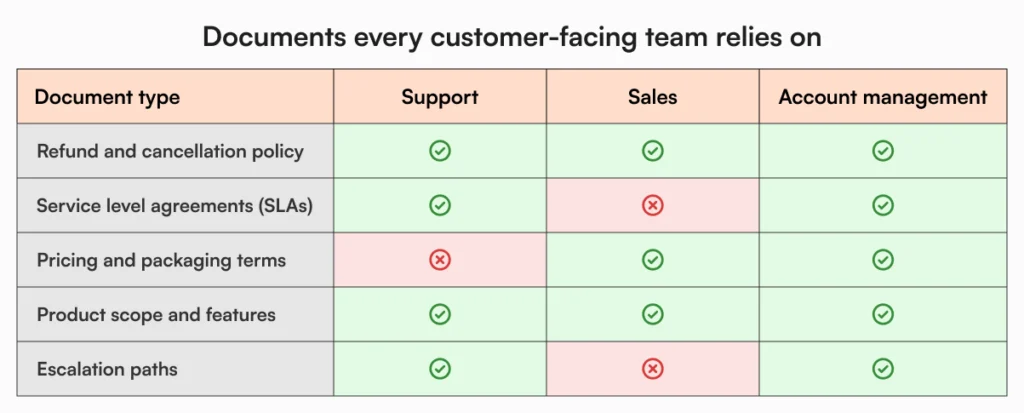
Start with the documents that cause the most inconsistency. Pricing terms, SLAs, refund and cancellation policies, product scope descriptions. These are the documents that surface repeatedly in customer conversations and carry the highest cost when they’re wrong or misaligned. Get those into a centralized knowledge base first, with clear ownership and a publishing process that requires review before changes go live.
From there, the pattern becomes self-reinforcing. When teams learn that the shared knowledge base reliably has the current version of the documents they need, they stop maintaining their own copies. The shadow documentation fades out not because anyone deletes it, but because it stops being the place people go.
A quick diagnostic for where you are right now: ask a support rep, a salesperson, and an account manager the same customer-facing question about your product or policy. If they give you three different answers, you know where to start.
One source, consistent answers
Inconsistency across customer-facing teams is almost always a structural problem. The people involved are competent, the processes exist in some form, and yet the answers diverge because nobody is pulling from the same place.
A centralized knowledge base works by making the right documentation the only documentation your teams are working from. More documents aren’t the answer. Fewer sources are. That’s the shift worth making. And the earlier you make it, the less re-work it takes. Cleaning up fragmented sources at 100 people is a different exercise than at 400, when the shadow documentation is older, deeper, and more entrenched.
Try AllyMatter free for 30 days and see what it looks like when your entire customer-facing team works from one source.
Frequently asked questions
Why do customer-facing teams end up with different information in the first place?
It usually starts with each team building documentation in their own tools, with no shared standard for where the authoritative version lives. Support builds a wiki, sales maintains a shared drive, account management works from pitch decks and personal notes. Each system works well enough for the team that built it. The problem surfaces in cross-team conversations with customers, where inconsistencies become visible. It’s a structural gap, not a people failure.
Is a centralized knowledge base the same as an internal wiki?
Not exactly. An internal wiki is typically a collaborative writing tool where teams contribute freely. A centralized knowledge base is built around structured ownership, version control, and access management. The distinction matters because a wiki without governance can develop the same fragmentation problem as scattered documents. A knowledge base with clear ownership and publishing controls keeps the authoritative version authoritative.
How do you get teams to use a centralized knowledge base once it’s set up?
Adoption follows utility. If the knowledge base reliably has the current version of the documents people need, they’ll use it. The failure mode is setting up a centralized system and then not maintaining it, so it becomes another place to look rather than the only place. Assigning clear document ownership and requiring updates to go through the knowledge base (rather than email or Slack) builds the habit over time.
What documents should go into a centralized knowledge base first?
Start with the documents that are used most frequently across multiple teams and carry the highest cost when they’re wrong: pricing, SLAs, refund and cancellation terms, product scope, and escalation paths. These are the documents most likely to cause customer-facing inconsistency and the ones where a single, trusted version delivers the most immediate value.
How does version control help customer-facing teams stay consistent?
Version control ensures that every time a document is updated, the previous version is retained and the current published version is clearly the active one. Team members can’t accidentally work from an old document because the current version is what the system surfaces. For customer-facing teams, this means that when a policy changes, every rep is working from the updated version from the moment it’s published, without anyone needing to send a notification or manually replace old files.

Founder of AllyMatter I’m founder of AllyMatter, an operations-first knowledge base for growing companies. Before AllyMatter, I co-founded Syren Cloud and helped scale it into a 300-person organization across two countries, leading marketing, operations, and HR. We moved fast, served demanding customers, and learned the hard way that internal knowledge systems built for help docs or IT don’t solve day-to-day operations. AllyMatter is my answer—tools that turn tribal knowledge into trusted, searchable processes. This blog shares the playbooks, checklists, and lessons I wish I’d had while scaling.