An HR manager at a growing company sends out an updated remote work policy. She emails it, attaches the PDF, copies everyone. Three months later, an employee files a dispute. His claim rests partly on never having seen the updated policy. HR is confident they sent it.
But “confident we sent it” is not a compliance record.
I’ve seen this come up across companies of very different sizes and sectors. The policies exist. They were shared. But proof of who received them, read them, and confirmed they understood them? Scattered across inboxes, old Slack threads, and the memory of whoever hit send. It was one of the first problems I wanted to solve when building AllyMatter.
This is the gap that employee acknowledgment tracking is designed to close. It’s worth understanding exactly what that means in practice, because the distinction matters more than most teams realize until they’re already in a difficult conversation.
When distribution masquerades as compliance proof
Growing companies tend to reach a stage where documentation exists but verification doesn’t. HR writes the policy, someone approves it, it gets distributed. The process stops there.
Email is the most common distribution channel for policies. It’s also the worst tool for this job. Read receipts are unreliable. Not everyone replies. Threads get buried. When you need to reconstruct what happened six months later, you’re searching sent folders, chasing colleagues, and hoping someone kept the right records.
I’ve watched HR managers spend hours on exactly this kind of reconstruction before a review. The policies were real and current. The distribution had happened. But building the evidence after the fact, under pressure, is a completely different problem from having it ready before anyone asks.
The gap between “we distributed this” and “we can prove who acknowledged it” is where compliance exposure quietly lives.
What actually breaks, and when
Take Alyssa, head of HR at a 180-person SaaS company. After a security incident, her team updated the data handling policy and sent it to all employees via email. Two months later, a second incident occurs. Legal wants to know who acknowledged the updated guidelines. Alyssa has the sent email. She doesn’t have individual confirmation records. She spends two days chasing responses and still can’t account for everyone.
This scenario repeats across functions. An operations lead updates an expense approval SOP and shares it via Slack. Some people click the link. Nobody tracks who actually read it. An external review asks for documentation showing that employees acknowledged the code of conduct from the prior year. The policy was distributed. Pulling timestamped, per-person confirmation records is a different matter entirely.
These aren’t edge cases. They’re the normal operating reality of a growth-stage company that has outgrown ad-hoc distribution but hasn’t yet built structured employee acknowledgment tracking into how it manages documentation.
Notification vs. acknowledgment: why the difference matters
A notification tells someone a document exists or has changed. An acknowledgment is an explicit confirmation from that person that they received it, read it, and understood it.
When a compliance question arises, a notification record shows you sent something. An acknowledgment record shows the employee confirmed receipt. Only one of those is defensible evidence, particularly for policies where misunderstanding or non-compliance carries real risk: data security guidelines, anti-harassment policies, financial controls, safety procedures, HR handbooks.
For those documents, “we believe everyone saw it” is not a sufficient answer.
How employee acknowledgment tracking actually works
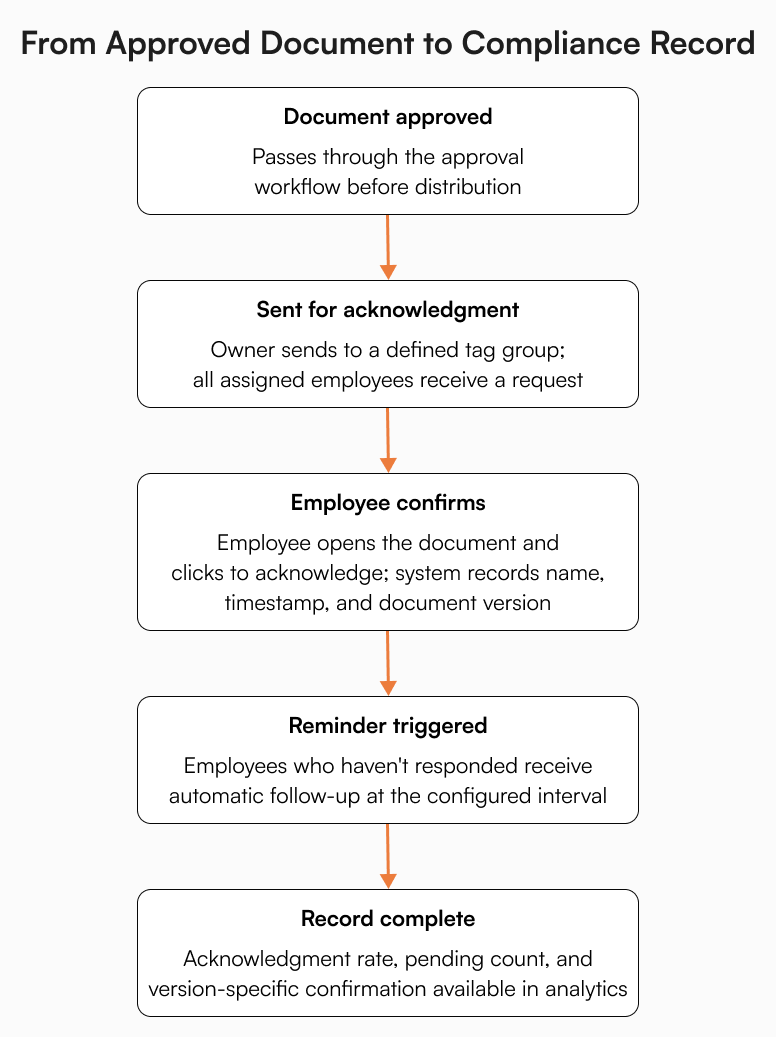
Once a document has been approved, it’s sent to a defined group of employees with a request to acknowledge it. Each employee receives a notification with a direct link to the document. They read it, click to confirm, and the system records who acknowledged, when, and which version was current at that moment.
Employees who haven’t responded after a set interval receive automatic reminders, at whatever cadence the admin configures, until they acknowledge or the deadline passes. The follow-up runs without anyone managing it manually.
The result is a time-stamped record tied to a specific document version, not just a list of names, showing exactly where each team member stands in real time.
When to require acknowledgment vs. notification
Use this as a practical guide:
- The document creates a compliance obligation for the employee: require acknowledgment
- Non-compliance creates legal or operational risk for the company: require acknowledgment
- The document has been materially updated and prior behavior may have changed: require re-acknowledgment
- You would need to prove employee awareness in a dispute or audit: require acknowledgment
- General update with no behavioral expectation: notification is sufficient
The reminder function matters more than most teams expect
One underappreciated part of a structured acknowledgment process is the reminder.
Employees don’t always respond immediately. Some are traveling. Some miss notifications. Some open the document and get pulled away before confirming. Without automatic, configurable reminders, the burden falls back on the HR manager or ops lead to chase individuals manually, which doesn’t scale and often doesn’t happen at all.
Reminders also strengthen the compliance record itself. If an employee later claims they were unaware of a policy, there’s documentation not just of the original acknowledgment request, but of every follow-up sent before the deadline. The conversation shifts from “we think we told you” to “here is the record of every notification and reminder you received.”
What the picture looks like before and after
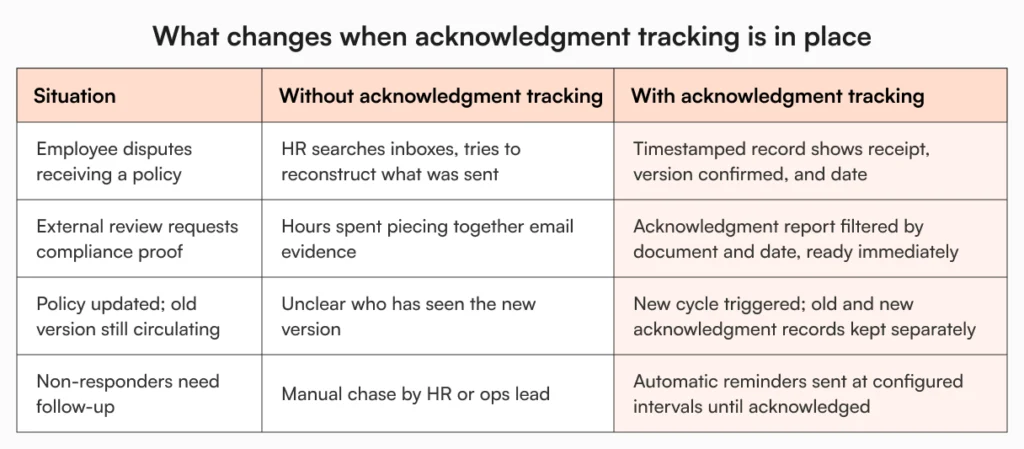
The difference between scattered distribution and structured employee acknowledgment tracking usually shows up at the worst moments. An employee disputes receiving a policy. An external review asks for compliance proof. A policy gets updated but the old version keeps circulating. A batch of non-responders need follow-up.
In each of these situations, the question isn’t whether the policy existed. It’s whether you can show, specifically and quickly, who confirmed it, when, and for which version.
Version control and acknowledgment belong together
Acknowledgment only means something if you know which version the employee confirmed.
Policies change. If an employee acknowledged your security guidelines in March but a significant update went out in July without triggering a new acknowledgment cycle, you don’t know whether they’ve seen the current version. A properly structured system ties each acknowledgment to a specific document version. When a material update is made and a new acknowledgment cycle runs, those responses are distinct from prior ones. Both records are retained. The history stays clean and specific.
This is where version control and employee acknowledgment tracking work together rather than independently.
Why AllyMatter is built for this
AllyMatter treats acknowledgment as a built-in step of the document lifecycle, not something layered on top of distribution.
Once a document is approved through the platform’s workflow, the Owner or Admin sends it for acknowledgment to a defined tag group. All employees assigned that tag receive the request. The Owner tracks responses through analytics, seeing acknowledgment rate, pending count, and reminder history in real time, without opening a single inbox.
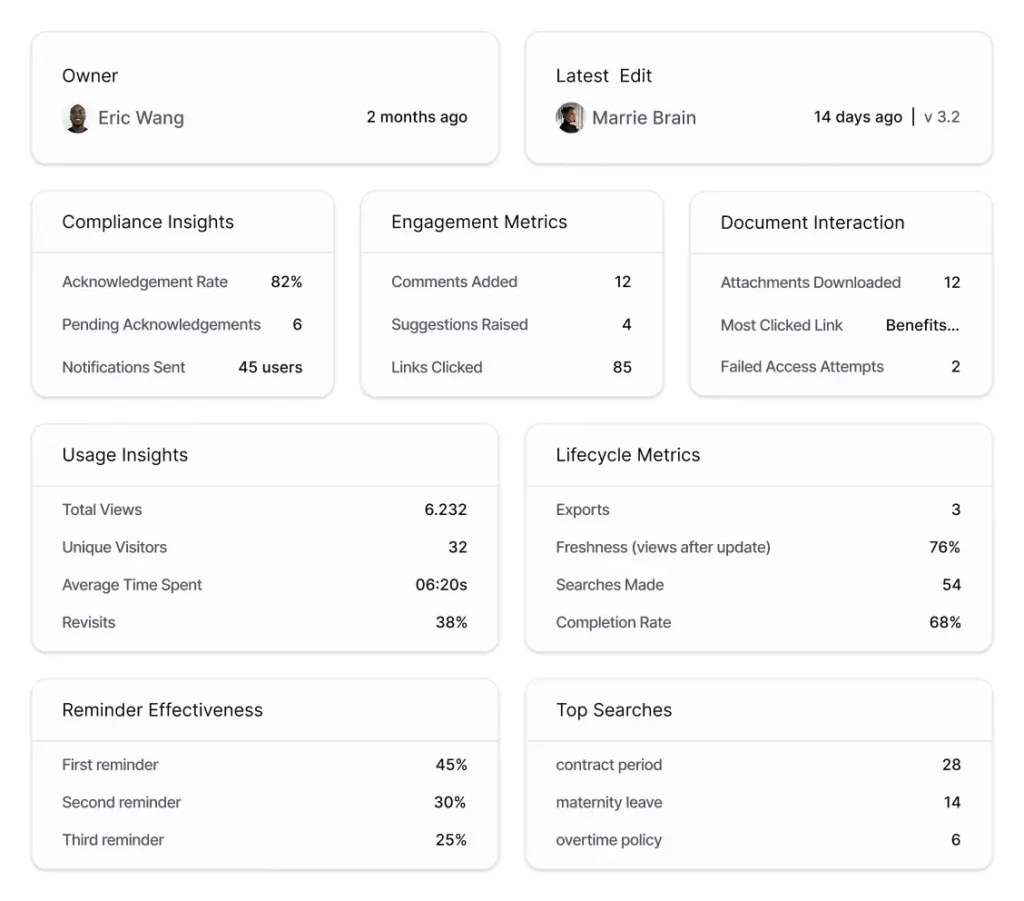
Reminders are configurable. The admin sets the interval and the system follows up with anyone who hasn’t responded, on that schedule, until they confirm or the deadline passes.
Because the acknowledgment is tied to an approved, version-controlled document, you always know exactly what was confirmed and when. There’s no ambiguity about which version the employee saw. For a deeper look at how the feature works end-to-end, AllyMatter’s acknowledgment tracking covers the full mechanics.
For teams managing this alongside broader company policy management, the combination of access control, version history, and acknowledgment tracking is what makes the difference between documentation that exists and documentation you can actually stand behind.
Building acknowledgment into your process, not onto it
If you’re currently relying on email distribution and manual follow-up, start by separating two jobs that often get conflated: distribution and verification. Distribution tells people something exists. Verification confirms they’ve seen it.
Start with the policies that carry the most risk if missed: data security guidelines, code of conduct, financial controls, HR policies, and SOPs where non-compliance creates real exposure. These are the documents where a clean, timestamped acknowledgment record matters most.
From there, build acknowledgment into how you distribute every material update. Not as an added step, but as the default. For growth-stage companies building this from scratch, startup compliance documentation is a practical starting point for the broader structure.
Compliance proof should not be something you scramble for
Alyssa eventually got her records together. It took two days, several Slack messages, and one conversation nobody wanted to have. The policies were fine. The process wasn’t.
Most growing companies only discover that their acknowledgment process is broken when they’re already under pressure. An audit is underway. A dispute has been filed. An investor wants documentation. At that point, the question isn’t how to build a better process. It’s how to piece together a case from whatever exists.
The record of who confirmed what, when, and for which version shouldn’t be something you piece together after the fact. With the right process in place, it exists before anyone asks for it. Building that starts now.
Start your 30-day free trial of AllyMatter.
Frequently asked questions
What is employee acknowledgment tracking and why does it matter for growing companies?
Employee acknowledgment tracking is a structured way to confirm that specific employees received, read, and actively confirmed a document or policy. Unlike sending an email or posting to a shared drive, it captures an explicit action from each employee, tied to a specific document version, with a timestamp. For growing companies, this matters because compliance questions, disputes, and audits require something concrete, not reconstructed email records.
How is acknowledgment different from simply notifying employees?
A notification tells an employee a document exists. An acknowledgment requires them to actively confirm they’ve read it. When you need to prove awareness during an audit, a dispute, or an investor review, a notification record shows you sent something. An acknowledgment record shows the employee confirmed receipt. Only the second is defensible evidence.
What happens if an employee doesn’t acknowledge a policy by the deadline?
In a properly configured system, they receive automatic reminders at set intervals until they acknowledge or the deadline passes. This removes the manual follow-up burden from HR or ops leads and creates a documented record of every reminder sent, which matters if an employee later claims they were unaware of the policy.
Which policies should require formal acknowledgment?
Start with documents where non-compliance creates real risk: data security guidelines, code of conduct, anti-harassment policies, financial controls, safety procedures, and materially updated SOPs. If you would need to prove employee awareness in a dispute or review, that document requires acknowledgment rather than simple notification.
When a policy changes, do employees need to acknowledge it again?
Yes, for material updates. Each acknowledgment is tied to a specific document version, so when you make significant changes, you need to run a new cycle. New acknowledgment records are distinct from prior ones and both are retained. This means you always know which version each employee confirmed, which matters as policies evolve over time.

Founder of AllyMatter I’m Sid Varma, founder of AllyMatter, an operations-first knowledge base for growing companies. Before AllyMatter, I co-founded Syren Cloud and helped scale it into a 300-person organization across two countries, leading marketing, operations, and HR. We moved fast, served demanding customers, and learned the hard way that internal knowledge systems built for help docs or IT don’t solve day-to-day operations. AllyMatter is my answer—tools that turn tribal knowledge into trusted, searchable processes. This blog shares the playbooks, checklists, and lessons I wish I’d had while scaling.