
Most resignations follow a predictable script. Someone gives notice, a two-week countdown starts, and suddenly the team is running knowledge transfer sessions trying to extract three years of context before Friday. It never fully works. You get the surface. The reasoning behind decisions, the vendor who only responds a certain way, the process step that looks arbitrary until you know why it exists. That stuff doesn’t transfer in a handover doc.
Building AllyMatter, I’ve had this conversation more times than I can count. Founders who just lost someone key. Ops leaders who realised, too late, that a critical process lived entirely in one person’s head. HR managers who couldn’t tell an auditor which version of a policy was current when a long-tenured employee left and took the context with her.
The exits didn’t cause the problem. They just made it visible.
Why the knowledge never gets captured
Most growing companies don’t have a knowledge problem. They have a documentation culture problem. And those aren’t the same thing.
Knowledge gets created constantly. Decisions get made, processes get refined, relationships get built. The issue is that none of it gets captured in a way that survives the person who created it. It lives in Slack threads, in email chains, in someone’s head, in a Google Doc that hasn’t been touched in fourteen months.
“Didn’t we write this down somewhere?” Almost certainly. But it’s in a folder nobody remembers, it’s three versions out of date, and the person who actually knew the current state just handed in their notice.
That’s a documentation culture failure. And it happens not because teams are careless, but because documentation was never treated as part of the work itself. It sat alongside the work, lower priority, something to do when things calmed down. Things don’t calm down. So the knowledge never gets captured.
When I talk to COOs and HR managers at growth-stage companies, the version I hear most often is this: the documentation exists, but nobody trusts it. Most of it was written by people for themselves, not for someone who’d join two years later. It describes what to do but rarely why, and hasn’t been updated since the process changed. Nobody knows which version is current. And the people who know all of this are exactly the people whose departures would hurt most.
What actually disappears when someone leaves
Take David, VP of Operations at a 200-person logistics company in Seattle. His team ran tight. SOPs existed for everything. When a senior ops manager left after four years, the documentation looked complete on paper.
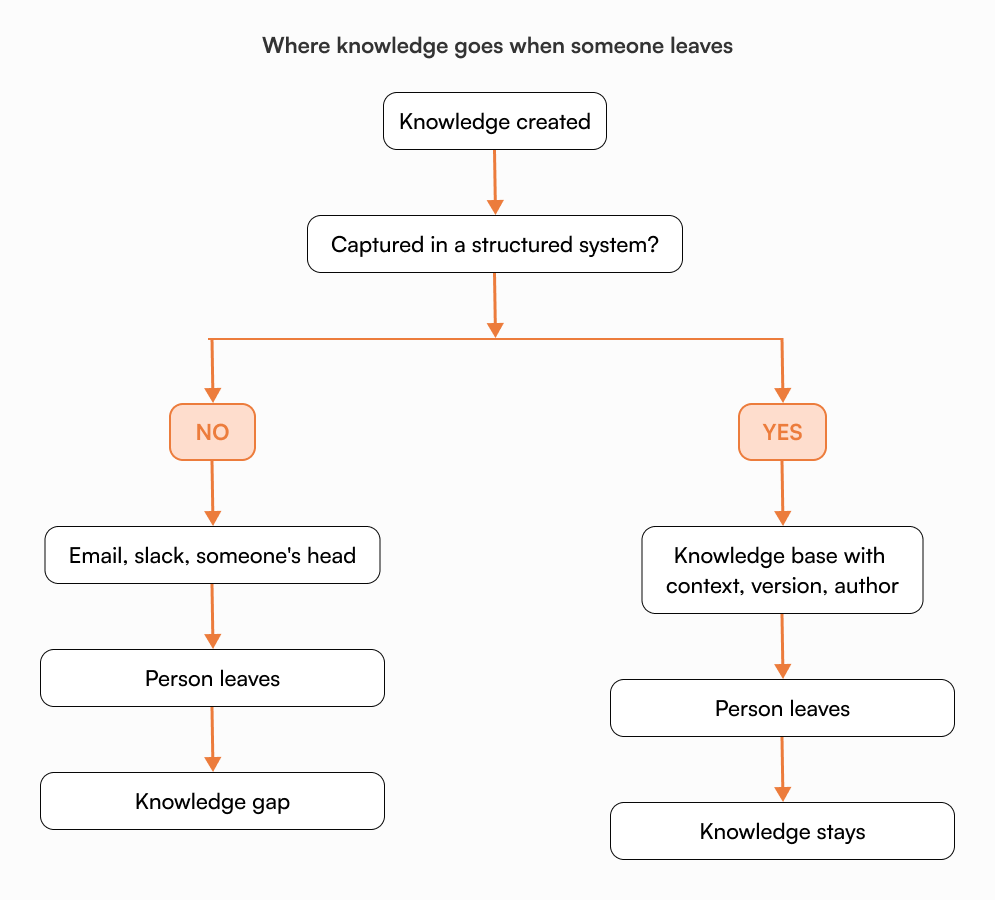
What it didn’t contain: the reasoning behind three non-obvious workflow steps she’d introduced after a vendor relationship soured. The name of the contact at their biggest carrier who’d go dark if you emailed the wrong address. The process workaround she’d built because the official SOP hadn’t kept up with how the work actually ran. None of that was in any document. It was in her head.
Her replacement found the SOPs. Understanding them took six months of asking around, making small errors, and slowly piecing together context that should have been written down years earlier.
That’s what poor knowledge capture costs. Not the absence of documentation, but the absence of the kind of documentation that actually holds institutional memory.
What documentation culture looks like when it works
Every company I’ve talked to that gets institutional knowledge retention right does one thing differently: they treat capturing the why as part of the deliverable, not something to get to later. Most teams think they document well. They have folders, SOPs, a shared drive. What they don’t have is a system anyone trusts. There’s a real difference between “we have docs” and “we trust docs.” One is a filing habit. The other is a documentation culture.
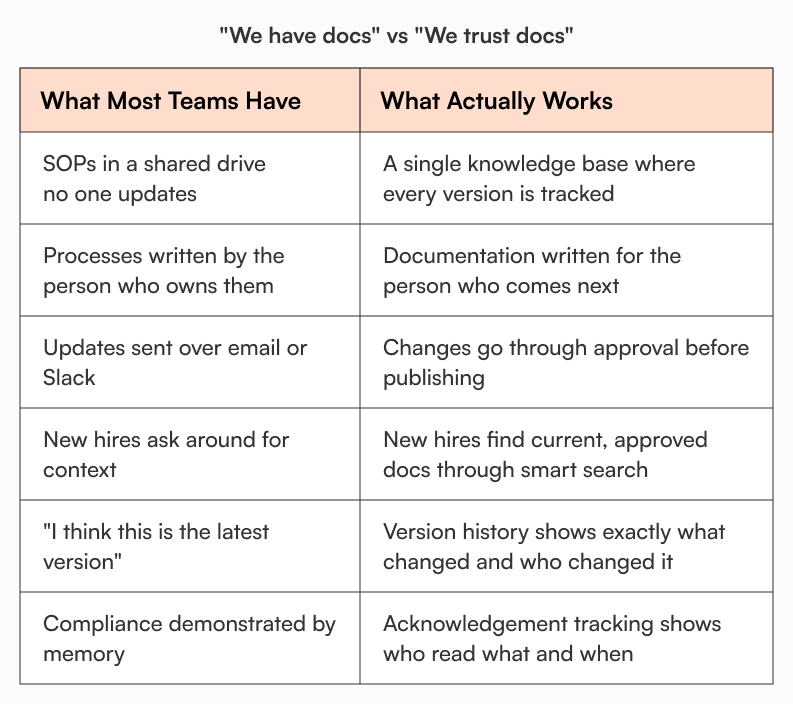
When a significant decision gets made, someone records the reasoning that day. Not a summary email. A document in the knowledge base, versioned, searchable by someone who joins next year. Processes are written for the person who wasn’t in the room. Edge cases, historical context, “we tried changing this once, here’s what happened” — all of it part of the record.
Exit interviews in these companies look different too. Less “why are you leaving,” more “what do you know that no document currently reflects.” The goal isn’t to capture everything in two weeks. It’s to catch what only that person knows.
New hires are actually useful here. Ask them to flag every time they had to ask a colleague for something they expected to find written down. Their first few weeks surface exactly where the documentation culture has gaps.
The honest question to ask yourself: if your three most knowledgeable people gave notice tomorrow, how much of what they know could their replacements find without asking anyone? If the answer is “not much,” the culture isn’t there yet. The tool is almost irrelevant at that point.
Before and after: the same situation, two different outcomes
A senior HR manager at a Boston-based software company updates the employee onboarding SOP after a difficult quarter. In one version of this story, she sends the new version to the team over email, drops a copy in a shared drive, and moves on. Six months later she leaves. Her replacement finds two versions of the SOP with different steps, no date on either, no indication of which is current, no record of what changed or why.
In the other version, the update goes through an approval workflow before anyone sees it. Her replacement opens the document, finds the current approved version, and can pull up exactly what changed and why from the version history. No emails to chase. No colleagues to interrupt.
Same knowledge. Same person leaving. Completely different outcome for the team she left behind.
How AllyMatter supports knowledge capture and documentation culture
Most document storage tools treat this as a filing problem. The real challenge is making knowledge capture reliable and documentation trustworthy over time, especially as teams grow and people move.
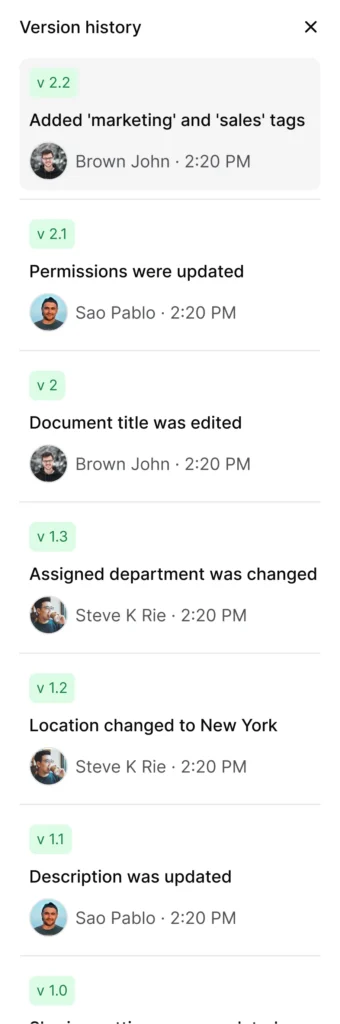
AllyMatter keeps all documentation in a single knowledge base. Every saved version of a document carries the author’s name and a timestamp, and admins or document owners can restore any earlier version if needed. That version history is what turns a knowledge base from a snapshot into a record. A new hire doesn’t just see the current SOP. They can see what it was before, who changed it, and when. For companies where context walks out the door with departing employees, that history is often more valuable than the current document. Without it, new hires guess. Audits fail. Teams ask around instead of looking it up.
When a process changes, the updated document goes through a defined approval workflow before it’s published. Approvers get notified, the document is locked during review, and nothing gets pushed out without a record of who signed off. Without that, documentation drifts. The SOP in the system stops reflecting how work actually runs, and nobody notices until something breaks. That’s what keeps documentation honest over time rather than quietly drifting from reality.
Once approved, a document can be sent to a tag group for acknowledgement. Every employee with the relevant tag gets a request to confirm they’ve read the current version, with automated reminders going to anyone who hasn’t responded. The admin sees exactly who has confirmed. “I sent the updated SOP” becomes “I know who’s working from the current version.” For HR managers handling compliance, that’s a verifiable record rather than an assumption. “I sent the updated policy” is the only proof you have. In a compliance review, that’s not enough.
Access is controlled by tags at the folder and document level. Assign someone a department tag and they see everything tagged for that department. Child documents inherit their parent folder’s tags automatically, so onboarding a new hire into a function doesn’t require manually configuring every document they’ll need. When someone’s role changes, one tag update adjusts their access across the entire knowledge base. Smart search returns results scoped to each user’s permitted content, so what people find is current, relevant, and accessible without navigating a folder structure built by someone who left two years ago.
Stop treating documentation as a departure task
The right time to work on institutional knowledge retention is before anyone hands in their notice. By the time the resignation lands, you’re already managing the gap, not preventing it.
From what I’ve seen, a documentation culture that works doesn’t require heroic effort. It requires consistency. Decisions documented when they’re made. Processes written for the person who wasn’t in the room. A system that keeps versions, enforces review, and confirms that updated knowledge actually reaches the people who need it.
The companies that build this tend to find that knowledge compounds. New hires ramp faster. Teams stop re-learning what’s already been learned. The knowledge base becomes something people actually trust, because it reflects how things actually work, not how they worked eighteen months ago.
The ones that don’t keep running the same exit scramble, every time, hoping the next handover goes better than the last.
Start your 30-day free trial of AllyMatter and give your institutional knowledge somewhere to live that outlasts the people who created it.
Frequently asked questions
What is institutional knowledge retention and why does documentation culture matter for it?
Institutional knowledge retention is keeping a company’s accumulated understanding, decisions, and processes accessible even as the people who hold it change. Documentation culture is what determines whether that knowledge ever gets captured in the first place. Without a culture that treats knowledge capture as part of the work, institutional knowledge stays in people’s heads. When they leave, it leaves with them. No tool fixes a culture problem on its own, but a culture of documentation needs a system to be sustainable.
What’s the difference between documentation and knowledge capture?
Most teams think they do both. They document processes but skip the reasoning, the history, the context that makes a document useful to someone who wasn’t there when it was written. That gap is where institutional knowledge slips through. The what gets written down. The why almost never does.
How does version history support institutional knowledge retention?
When documentation evolves alongside a process, version history preserves how it changed and who changed it. A new hire who can see the sequence of changes leading to the current SOP understands the process in context, not just in its current state. They can see who made a change and when, which often answers questions about why something works the way it does without needing to ask anyone. It also makes it possible to recover earlier content if an update removed something that still mattered.
How do you build a documentation culture in a fast-growing company?
Make knowledge capture part of how decisions get made, not a separate activity. Document the reasoning behind significant calls the day they happen. Write processes for the person who wasn’t in the room. Ask new hires to flag every time they had to ask a colleague for something they expected to find written down. Their early weeks are one of the most useful knowledge audits a company can run. The overhead of capturing knowledge as work happens is considerably lower than reconstructing it after the person who held it has already left.
When is the right time to address institutional knowledge retention?
Before anyone announces they’re leaving. Exit interviews and handover documents are useful, but they’re damage control, not a retention strategy. Knowledge that took years to build doesn’t transfer reliably in two weeks. The growing companies that handle this well build the infrastructure and the habits before a departure forces their hand, not after.

Founder of AllyMatter I’m founder of AllyMatter, an operations-first knowledge base for growing companies. Before AllyMatter, I co-founded Syren Cloud and helped scale it into a 300-person organization across two countries, leading marketing, operations, and HR. We moved fast, served demanding customers, and learned the hard way that internal knowledge systems built for help docs or IT don’t solve day-to-day operations. AllyMatter is my answer—tools that turn tribal knowledge into trusted, searchable processes. This blog shares the playbooks, checklists, and lessons I wish I’d had while scaling.