Marketing teams rarely lose momentum because of a lack of ideas. They lose it because nobody is sure which messaging is approved, where the latest campaign assets live, or whether sales is using the same positioning marketing finalized two weeks ago.
As they grow, information spreads across decks, Slack threads, agency folders, and shared drives. Brand guidelines drift. Campaign approvals stall. Institutional knowledge stays with whoever built the original process.
Most marketing teams already have the content they need somewhere. The harder problem is making sure teams can consistently find, trust, and reuse the right version at the right time.
What follows covers the specific places that tend to break, and how AllyMatter addresses each one.
1. Centralizing brand guidelines and messaging playbooks
Marketing consistency usually breaks down gradually. One campaign uses outdated positioning. Another team modifies messaging for a webinar and never updates the central document. Six months later, nobody knows which version legal approved.
AllyMatter gives marketing teams one controlled location for approved messaging, positioning, and brand documentation so campaigns across departments and channels stay aligned.
A financial services team launching a new investment product, for instance, might have three people writing copy from three different versions of the positioning doc. Centralizing that single approved document removes the guesswork before it becomes a brand consistency problem.
2. Streamlining content approval workflows
Marketing content often requires multiple approvals, from creative directors, product managers, legal teams, and executives. This review cycle becomes a major bottleneck when managed through email chains or chat messages.
AllyMatter’s smart approval flows automate the notification process, alerting each reviewer as soon as the previous step completes. Owners see real-time document status in the workflow panel and can configure automated reminders for pending steps, so there’s no more ‘whose desk is this sitting on?’ guesswork.
For example, when preparing quarterly campaign materials, a healthcare marketing team can set up a workflow where content moves automatically from creative review to medical accuracy verification to legal compliance check. Each stakeholder clearly sees what needs their attention and when.
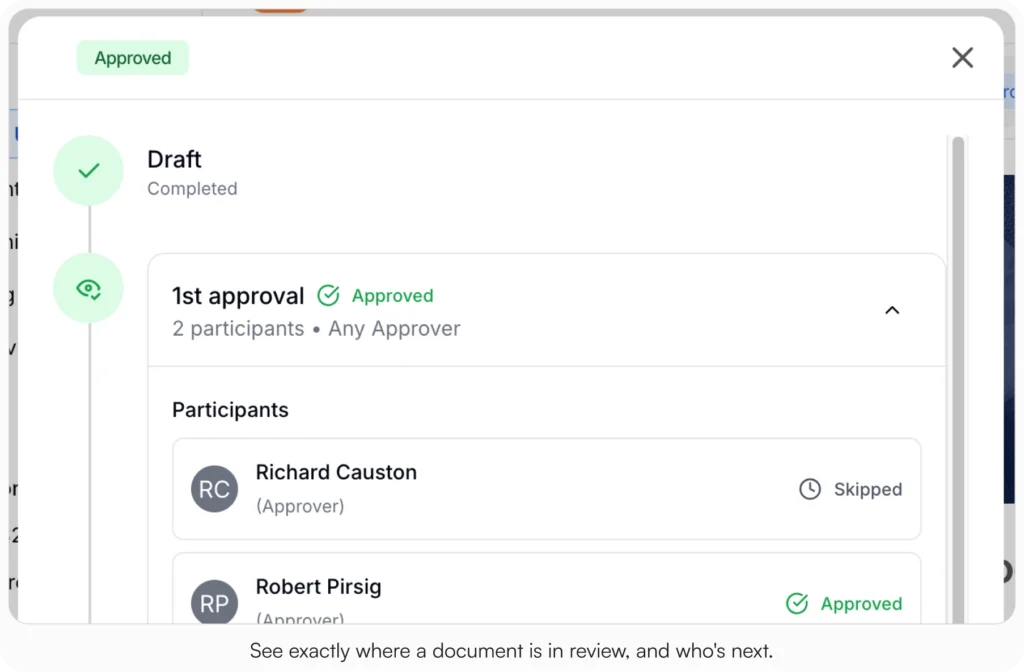
See how AllyMatter’s approval workflows work in practice.
3. Preserving institutional knowledge from top performers
When high-performing marketing team members leave, they often take valuable knowledge with them about successful campaigns, customer insights, and proven strategies.
AllyMatter captures this tribal knowledge in documented workflows and playbooks that remain with your company. That institutional memory matters most for seasonal campaigns, annual events, and recurring promotions.
A retail marketing team, for instance, can document their Black Friday campaign process, including timeline, creative approaches that worked previously, promotional strategies, and post-campaign analysis. Even if the original campaign manager departs, their expertise remains accessible to the team.
For a deeper look at how to structure this, see Building a Marketing Playbook That Evolves with Your Team.
4. Accelerating new marketing hire onboarding
Research from the Society for Human Resource Management indicates that it takes new hires 8-12 months to achieve full productivity in professional roles. For marketing teams, that ramp-up is especially costly when new hires have to piece together processes through scattered folders and informal knowledge instead of documented workflows.
AllyMatter gives new team members one place to access role-specific onboarding documentation, campaign workflows, and approved processes. A technology marketing team can create role-specific onboarding materials for content writers, campaign managers, and social media specialists. Without that structure, a new hire’s first two weeks are spent asking five different people where things live instead of contributing to campaigns.
5. Managing campaign assets across departments
The frantic “where’s our latest pitch deck?” search wastes valuable time. According to McKinsey, employees spend nearly 20% of their workweek looking for internal information or tracking down colleagues for help.
A campaign manager at a fast-growing software company spent 30 minutes searching Slack threads and email chains for the latest product demo video before a client presentation. That’s the version of the problem most marketing teams recognize immediately.
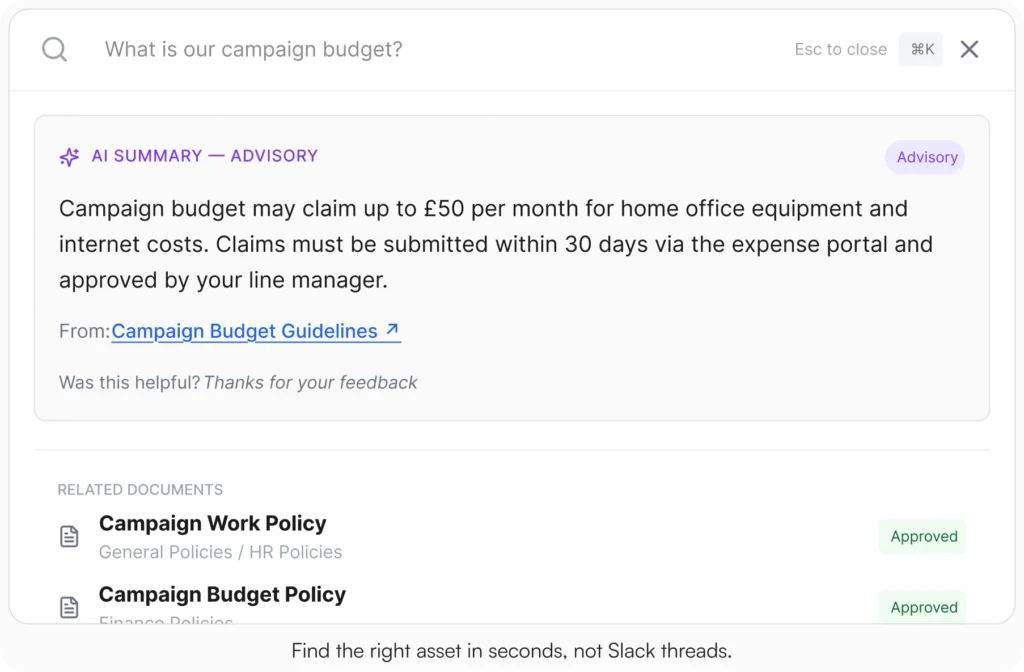
AllyMatter centralizes marketing assets in one searchable location. Tags and metadata search make it easier to retrieve the right version of any file without digging through shared drives or message history.
6. Enhancing marketing and sales alignment
Marketing and sales teams often operate from different playbooks, creating confusion for prospects and slowing down deals.
AllyMatter ensures both teams access the same approved messaging, value propositions, and positioning guides. The platform facilitates clear lead qualification definitions, reducing friction during lead handoffs and campaign follow-through.
For example, an education technology company can document exactly what makes a marketing qualified lead (MQL) versus a sales qualified lead (SQL), creating transparent handoff processes that both teams understand and follow.
7. Simplifying competitive intelligence management
Competitive intelligence becomes unreliable quickly when teams maintain separate battle cards or positioning docs without a clear update process. AllyMatter keeps competitive documentation centralized with visible revision history so teams are working from the most recent version, not a copy someone saved six months ago.
A software company can maintain up-to-date competitor analysis documents that marketing uses for differentiation messaging and sales references during prospect conversations, all while ensuring everyone sees the most recent information.
8. Improving agency collaboration and oversight
Marketing teams often work with external agencies and freelancers who need access to marketing policies and guidelines without compromising security.
For agency relationships, AllyMatter’s tag-based access control gives marketing leaders fine-grained control over which internal documents stay restricted to which teams. For docs you want agencies and freelancers to reference directly, you can publish them as standalone public pages, accessible through a shareable URL that doesn’t require external accounts. Every internal action stays in the audit trail.
For instance, a manufacturing marketing team working with creative agencies can publish brand voice documentation and campaign messaging frameworks as public pages – shareable URLs that agencies bookmark and reference – while sensitive internal strategy docs stay tag-restricted to internal users.
9. Supporting multi-version marketing materials
Marketing teams need different versions of key policies for different audiences, from internal teams to external partners.
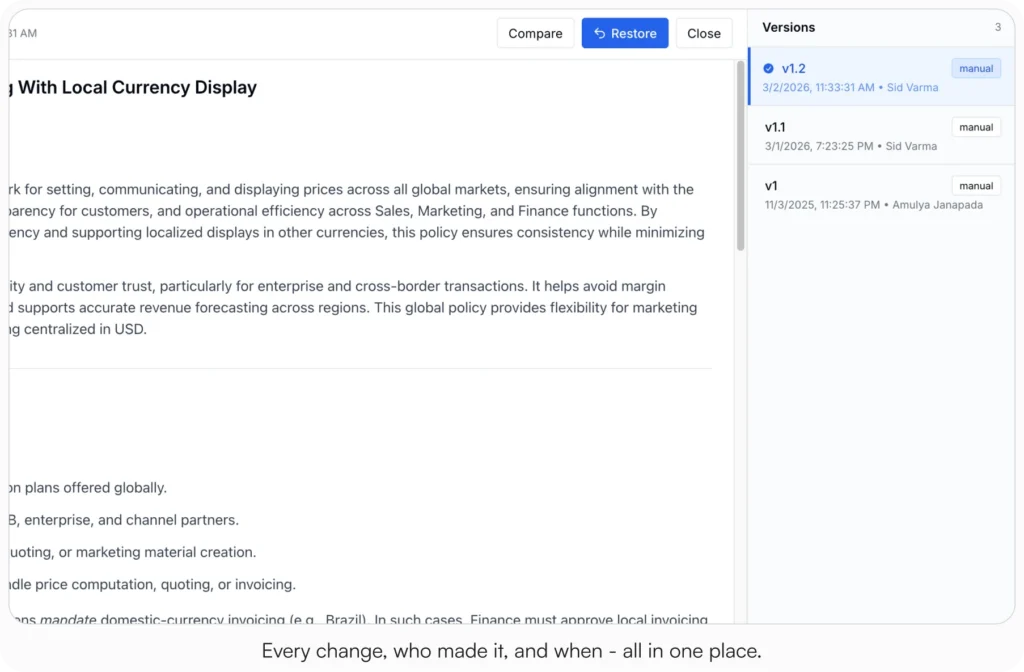
AllyMatter handles this in two ways. Tags let you maintain parallel versions of the same policy for different audiences, e.g., an internal-only campaign strategy and a partner-facing campaign brief, with access control applied to each. Version history tracks every edit to a single document, so you can see what changed, when, and by whom, and roll back if needed.
A legal services marketing team can maintain detailed internal messaging guidelines and simplified partner-facing versions as separate documents, tagged ‘Marketing-Internal’ and ‘Marketing-External’ so access stays in the right hands.
10. Measuring and optimizing marketing processes
Marketing teams repeat the same operational mistakes when campaign knowledge disappears after launch reviews end. Teams remember what shipped, but not what worked, what failed, or why specific decisions were made.
A product marketing team that documents its launch process, approval patterns, and post-campaign notes after every cycle builds a working playbook over time. The next launch doesn’t start from scratch. It starts from last time’s lessons.
AllyMatter gives teams a structured place to keep that documentation current, searchable, and accessible to the people running the next campaign, not just the ones who ran the last one.
Related: Why Every Lean Marketing Team Needs a What Worked Library.
Creating marketing excellence through knowledge management
Marketing problems often look like creative challenges on the surface. In reality, many of them are documentation and operational consistency problems. Teams move fast, messaging changes constantly, and knowledge gets scattered across too many systems.
The marketing teams that scale well are usually the ones that make campaign knowledge reusable instead of rebuilding processes from scratch every quarter.
- If your company is under 50 and your marketing docs are still informal, you don’t need a dedicated knowledge platform yet. Get a working process first.
- If you’re a scale-up between 50 and 1,000 employees and your brand guidelines, campaign assets, and playbooks are already scattered across drives, decks, and Slack threads, AllyMatter is built for this.
- If you’re in a regulated industry – financial services, healthcare, pharma, legal services – centralized governance and audit trails are necessary from day one.
Start your 30-day free trial. No credit card to start, and a 30-day money-back guarantee if you convert and change your mind.
Not ready for a trial? Migration from Confluence, Notion, or Google Drive is on us when you decide. We’ll move your existing docs over and have you up and running in about a week.
Frequently asked questions
How does a knowledge base improve marketing team productivity?
A centralized knowledge base reduces the time marketing teams spend searching for campaign assets, approval history, brand guidelines, and messaging documentation. As teams grow, productivity problems usually come less from content creation and more from inconsistent information spread across drives, chats, decks, and disconnected workflows.
What’s the difference between marketing knowledge management and general file storage?
Marketing knowledge management goes beyond simple file storage by organizing content with smart tagging, version control, and approval workflows specific to marketing needs. While tools like Google Drive store files, a dedicated knowledge base structures information for easy retrieval and maintains consistency across brand messaging and campaign materials.
How can marketing teams maintain brand consistency across different channels?
Centralizing brand guidelines, messaging frameworks, and approved assets in a knowledge base ensures all team members reference the same source of truth. This prevents brand dilution that occurs when different team members use outdated or inconsistent messaging across social media, email campaigns, and sales collateral.
What should marketing teams document in their knowledge base?
Marketing teams should document brand guidelines, messaging playbooks, campaign templates, approval workflows, competitive intelligence, and successful campaign processes. This includes everything from social media voice guidelines to product positioning statements and agency collaboration protocols.

Vikas is a B2B marketing professional with over 14 years of experience in content strategy, messaging, and demand generation. He specializes in turning complex business challenges into clear, actionable stories to connect meaningfully with audiences.