
Support teams rarely struggle because information doesn’t exist. The problem is usually that nobody knows where the latest troubleshooting step, escalation path, or product clarification actually lives.
Support knowledge gets fragmented quickly across Slack messages, ticket comments, outdated docs, internal chats, and individual team habits. Over time, agents stop trusting documentation because they’re never fully sure whether it’s current.
The result is familiar to most support leaders: longer handle times, inconsistent customer answers, repeated escalations, and experienced agents becoming the default source for information that should already be documented.
A centralized knowledge management system helps support teams keep troubleshooting workflows, product documentation, escalation procedures, and support guidance searchable and consistent across the organization.
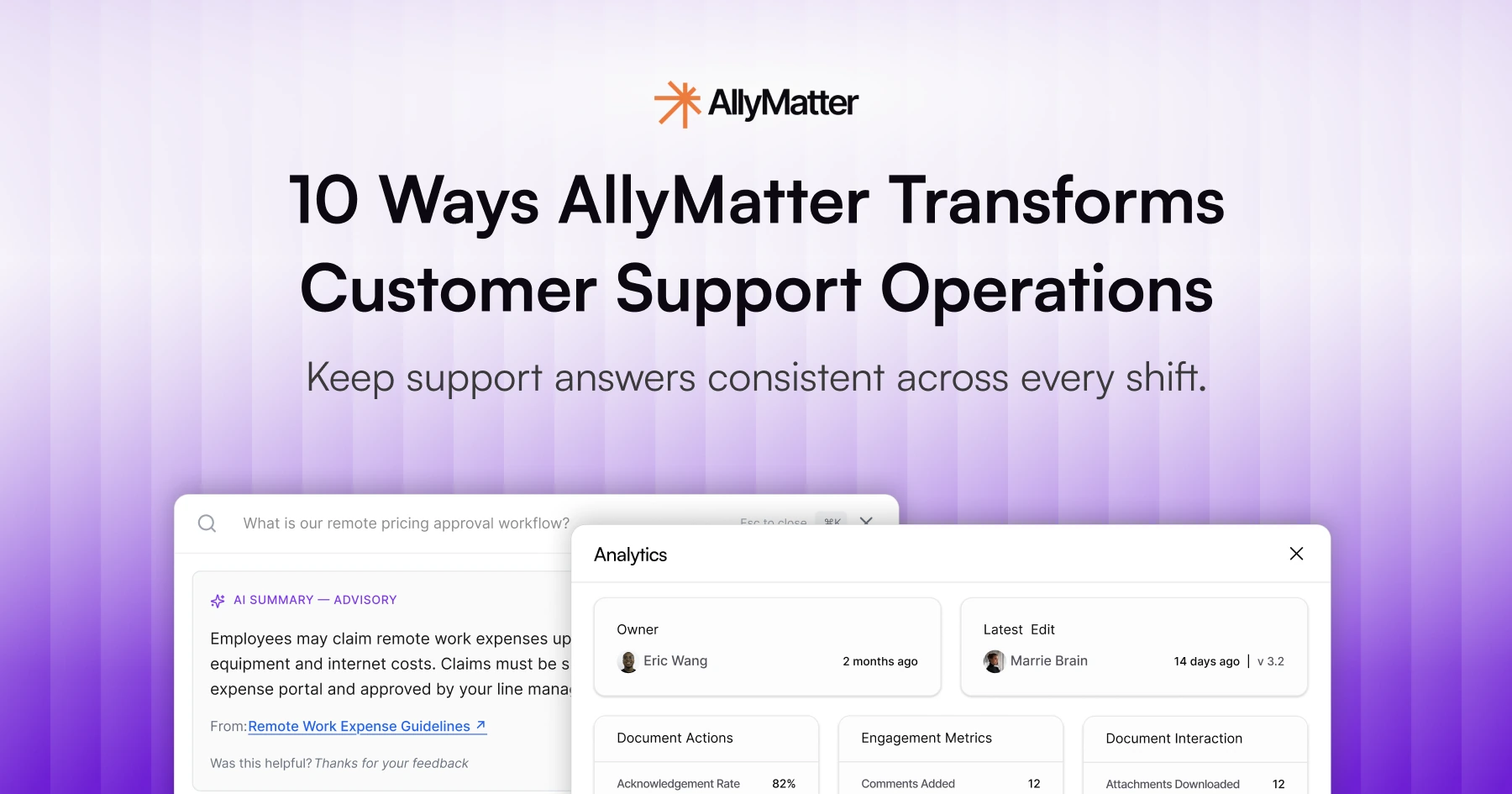
Here are ten practical ways AllyMatter helps customer support teams reduce documentation chaos and deliver more consistent support operations.
1. Keep product information current and findable
“Where’s the latest information about this feature?” When your product documentation is scattered across multiple knowledge bases, Slack channels, and emails, customers receive inconsistent answers that erode trust.
AllyMatter centralizes all product documentation in one searchable internal knowledge base, ensuring every support agent works from the same playbook. Agents can quickly locate accurate information during live customer interactions while product teams maintain clearer visibility into what support documentation needs updating. Version tracking and audit history also help teams maintain confidence that support guidance is current and consistent across the organization.
2. Document troubleshooting workflows that anyone can follow
Support teams repeatedly solve similar issues, yet many organizations fail to properly document resolution processes. AllyMatter helps support teams document troubleshooting workflows with enough context, explanation, and visual guidance that agents can follow consistent resolution paths even when edge cases emerge over time.
When a customer encounters a known issue, any agent, regardless of tenure, can follow the documented workflow to deliver a consistent resolution experience.
3. Standardize response templates for consistent communication
When customer experiences vary dramatically between agents, it creates an impression of disorganization that undermines confidence in your brand. Standardized templates help agents respond consistently without forcing them to reinvent the same explanations repeatedly.
When billing issues, account escalations, or product exceptions happen repeatedly, standardized response guidance helps agents handle conversations consistently without relying on memory or digging through old ticket threads.
4. Get new agents up to speed without months of shadowing
The traditional approach to onboarding support agents, weeks of shadowing experienced colleagues, is inefficient and inconsistent. New agents can work through documented workflows, product explanations, escalation paths, and historical support scenarios without depending entirely on shadowing experienced teammates for context.
5. Ensure consistent support across global teams
WWhen support teams span multiple regions and time zones, maintaining consistency becomes exponentially more difficult. AllyMatter ensures consistent knowledge access across locations by centralizing support documentation in one place that every agent, regardless of region or time zone, works from.
Customers receive more consistent answers regardless of which office, region, or shift handles the request.
Start your 30-day free trial. No credit card to start.
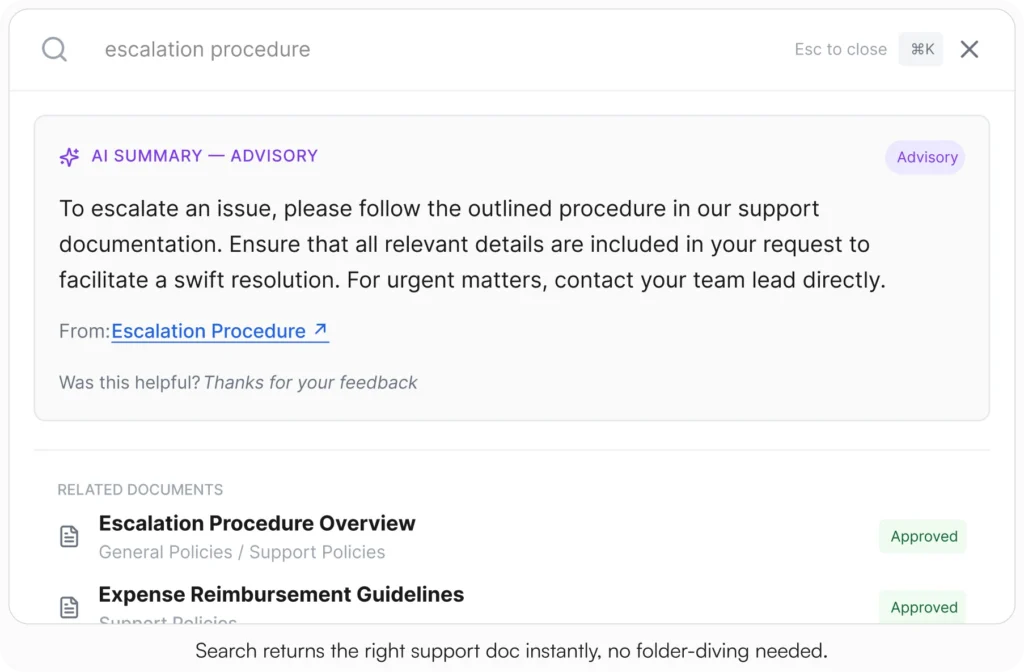
6. Organize support docs so agents find what they need fast
Knowledge workers often spend significant time searching across different platforms, asking coworkers, or contacting experts just to find the information they need to do their jobs. According to a Gartner survey, 47% of digital workers struggle to find the information needed to effectively perform their jobs. For support teams, this translates directly to longer handle times and customer frustration.
AllyMatter helps support teams organize documentation using searchable tags, categories, and metadata so agents can find relevant troubleshooting steps, escalation procedures, and policy guidance without bouncing between disconnected systems.
Better searchability matters most during live support interactions where agents don’t have time to ask coworkers or manually dig through old documentation while a customer waits.
7. Keep support and product teams on the same documentation
Support teams often identify product issues before anyone else, but without structured collaboration tools, this valuable feedback gets lost. AllyMatter gives support and product teams a shared place to document recurring issues, clarify product behavior, track changes to support guidance, and improve documentation based on real customer conversations.
8. Manage document access without slowing agents down
Support teams often need access to sensitive information to resolve customer issues, but oversharing creates security risks. Teams can control access based on department, role, or operational need while still making critical support documentation available to the people responsible for resolving customer issues.
For teams with tiered support structures, tags control which escalation paths, product documentation, or sensitive account procedures each tier can access, without manual permission management for every document.
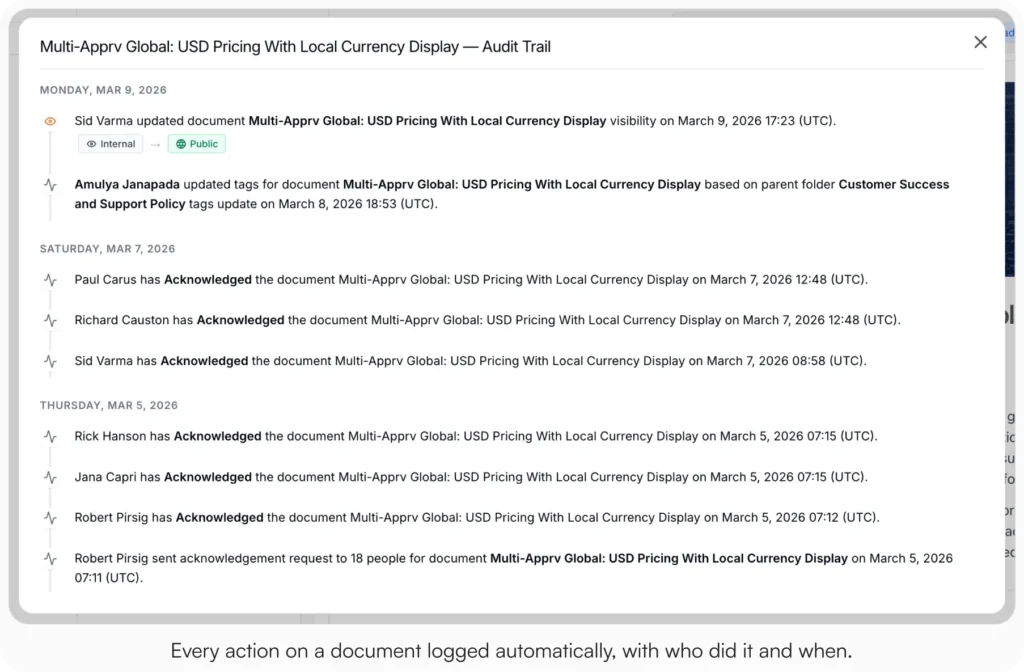
9. Maintain complete audit trails for accountability and compliance
In regulated industries, documenting who accessed what information and when is crucial for compliance. Beyond regulations, understanding how knowledge is used helps optimize support operations.
Teams can review who updated documentation, what changed, and when guidance was modified. In regulated industries, that visibility becomes especially important for compliance reviews, escalation tracking, and operational accountability.
When documentation is updated, support leads can also send revised guides for acknowledgment to the relevant team members and track who has confirmed they’ve read the latest version. That closes the loop between documentation updates and operational awareness.
10. Keep documentation reliable as the support team grows
As companies grow, maintaining consistent support becomes increasingly challenging. New products, new markets, and new team members all threaten knowledge continuity.
AllyMatter helps support teams maintain consistent documentation as products, support processes, and team structures become more complex over time. Institutional knowledge stays accessible when team members transition, and new hires get the same documentation from day one.
Support quality doesn’t have to deteriorate as headcount grows, as long as the documentation grows with it.
Support quality is a documentation problem
Support quality usually breaks down gradually as companies grow. New products launch, ticket complexity increases, experienced agents leave, and support knowledge spreads across too many disconnected systems.
Most support teams already have the information they need somewhere. The challenge is making troubleshooting guidance, escalation workflows, and product knowledge consistently accessible during live customer interactions.
AllyMatter gives support organizations a structured way to keep support documentation searchable, governed, and reusable as teams grow and support operations become more complex.
Start your 30-day free trial. No credit card to start, and a 30-day money-back guarantee if you convert and change your mind.
Not ready for a trial? Migration from your existing tools is on us when you decide. We’ll move your existing docs over and have you up and running in about a week.
Frequently asked questions
What does the impact look like for support teams?
The most immediate change is usually agents spending less time hunting for information during live interactions. When troubleshooting guides, escalation procedures, and product documentation are searchable and current, agents can find what they need without putting customers on hold or asking a colleague.
What makes AllyMatter different from other knowledge management platforms for support teams?
Support teams usually struggle when documentation becomes difficult to trust, search, or govern consistently across locations and workflows. AllyMatter focuses on keeping support guidance searchable, version-controlled, and easier to maintain as support operations grow.
How does AllyMatter ensure our support documentation stays current and accurate?
AllyMatter’s built-in version control and approval workflows ensure documentation accuracy. When product teams update specifications or processes change, stakeholders receive notifications to review and approve changes. The platform maintains complete audit trails, so you always know who made changes and when.
How does migration work?
AllyMatter handles migration from your existing documentation tools. You can be up and running with your existing docs moved over in about a week.

Founder of AllyMatter I’m founder of AllyMatter, an operations-first knowledge base for growing companies. Before AllyMatter, I co-founded Syren Cloud and helped scale it into a 300-person organization across two countries, leading marketing, operations, and HR. We moved fast, served demanding customers, and learned the hard way that internal knowledge systems built for help docs or IT don’t solve day-to-day operations. AllyMatter is my answer—tools that turn tribal knowledge into trusted, searchable processes. This blog shares the playbooks, checklists, and lessons I wish I’d had while scaling.