
Product Updates · 13 min read
10 Ways How AllyMatter Helps Executive Leadership
Executive teams rarely struggle because information doesn’t exist. The problem is usually that key decisions, policies, planning documents, and leadership context are spread across too many systems and too many conversations.
As companies grow, executives spend more time trying to reconstruct why decisions were made, whether teams are following approved processes, and where the latest version of a strategic document actually lives. The result isn’t usually a dramatic failure. It’s slower decision-making, inconsistent execution, duplicated work, and institutional knowledge that disappears when key leaders move on.
A centralized knowledge management system gives leadership teams one place where strategic documentation, governance records, decision history, and organizational knowledge stay searchable and accessible across the company. Here are ten practical ways AllyMatter helps executive teams do exactly that.
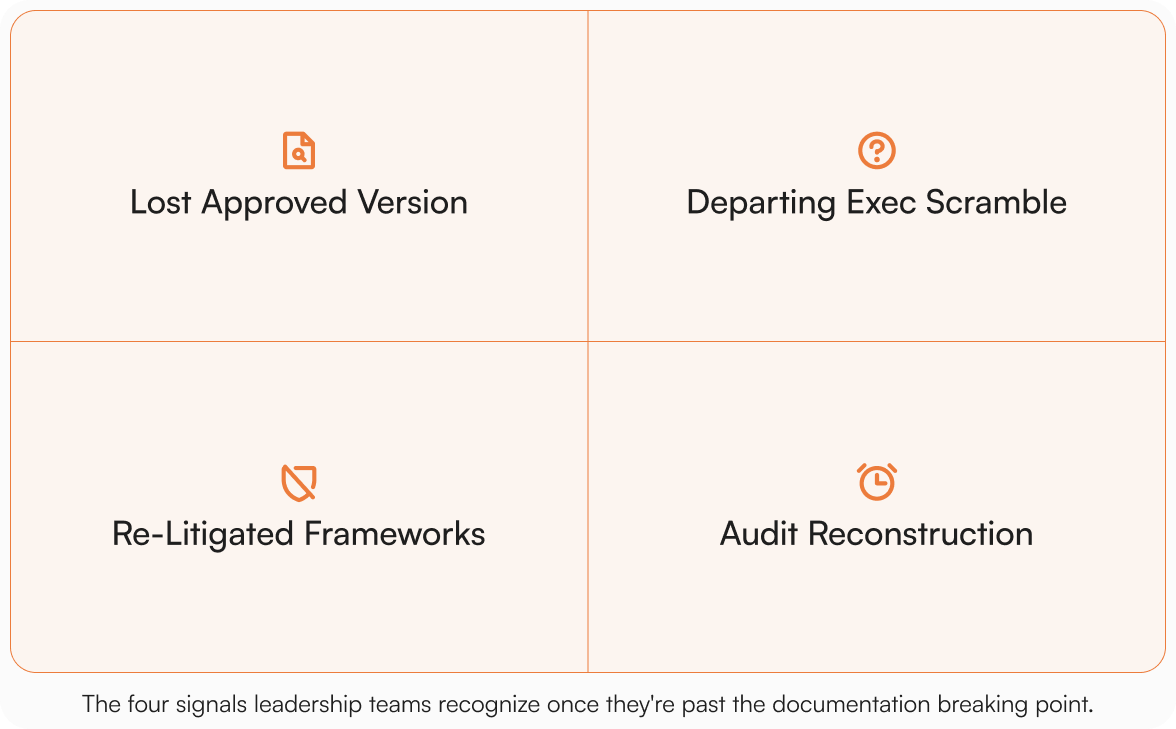
Four signals your leadership team is paying the documentation tax:
- A senior leader can’t find the approved version of last quarter’s plan, and three people give three different answers about where it lives
- A departing executive’s resignation triggers a two-month scramble to reconstruct vendor decisions, operating models, and reasoning that lived only in their head
- The same policy or framework gets re-litigated every quarter because nobody documented the rationale the first time
- An audit, board ask, or regulator request forces a multi-week document reconstruction project that should have taken half a day
If two or more of those have happened in the last year, the leadership team is operating in spite of the documentation system, not because of it. The ten capabilities below describe how that changes.
TL;DR
- Centralized strategic documentation, governance records, and decision history in one platform, with search scoped to permissions
- Institutional knowledge preserved across executive transitions: decisions captured with the reasoning, approvals, and supporting context behind them
- Policy distribution and acknowledgment tracking that gives leadership real-time visibility into who has seen what
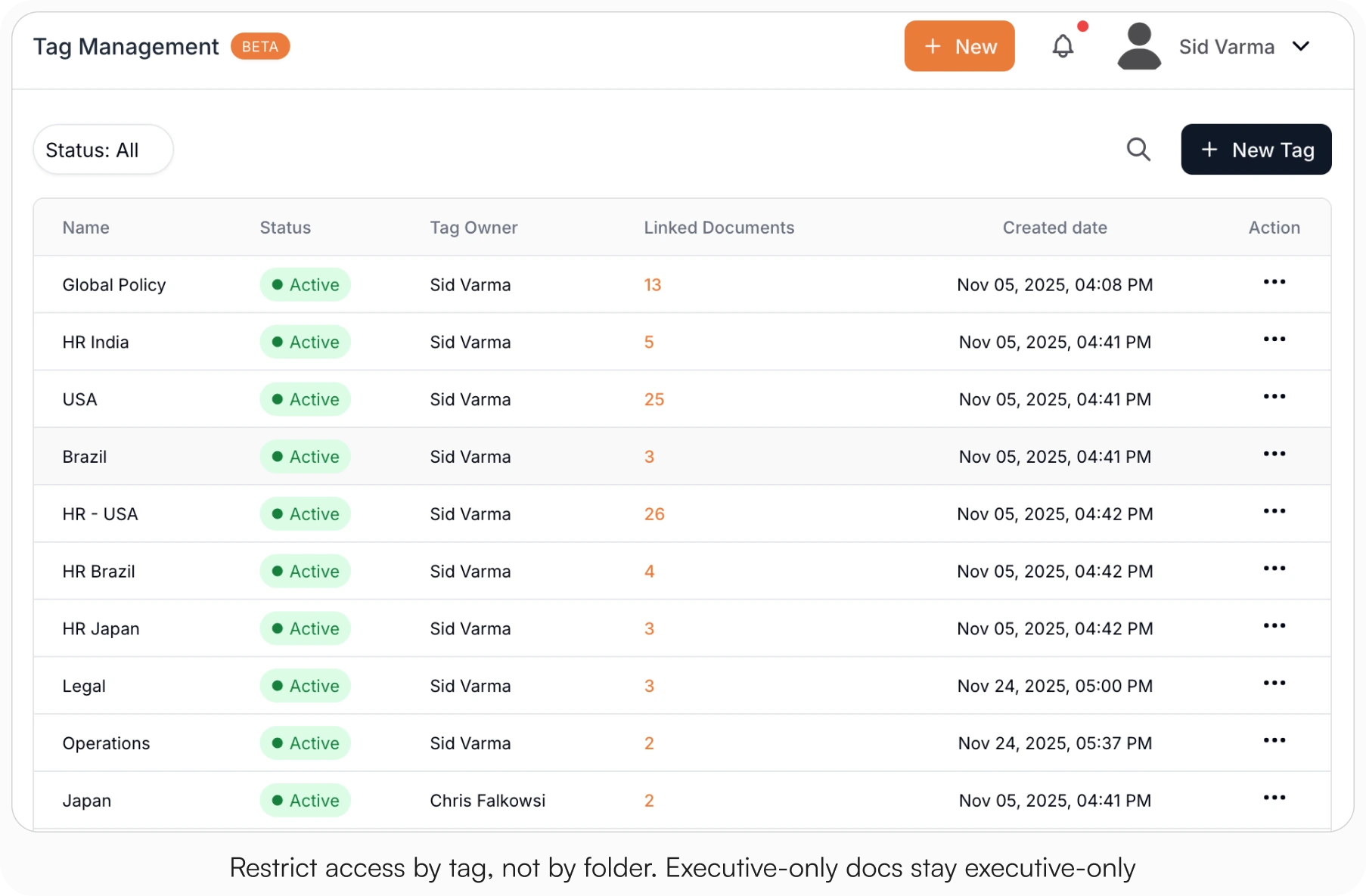
- Role-based access through tags, not folder permissions, so transparency and confidentiality coexist without a separate document repository
- Built for the AI future and as a modern replacement for SharePoint and legacy GRC platforms, with 1:1 setup and migration included on yearly plans
1. Centralizing strategic documentation for faster decision-making
Strategic decisions move at the speed of the slowest document hunt. When the quarterly plan, the board deck, and the latest acquisition memo live across three drives, two Notion workspaces, and someone’s inbox, every leadership meeting starts with a fifteen-minute “where is that doc” warm-up.
What’s less obvious is the compounding effect on decision quality. When executives make decisions without full context or historical data, they increase risk and limit strategic visibility. Past decisions that should inform current ones become invisible. Patterns that should be obvious across departments get missed.
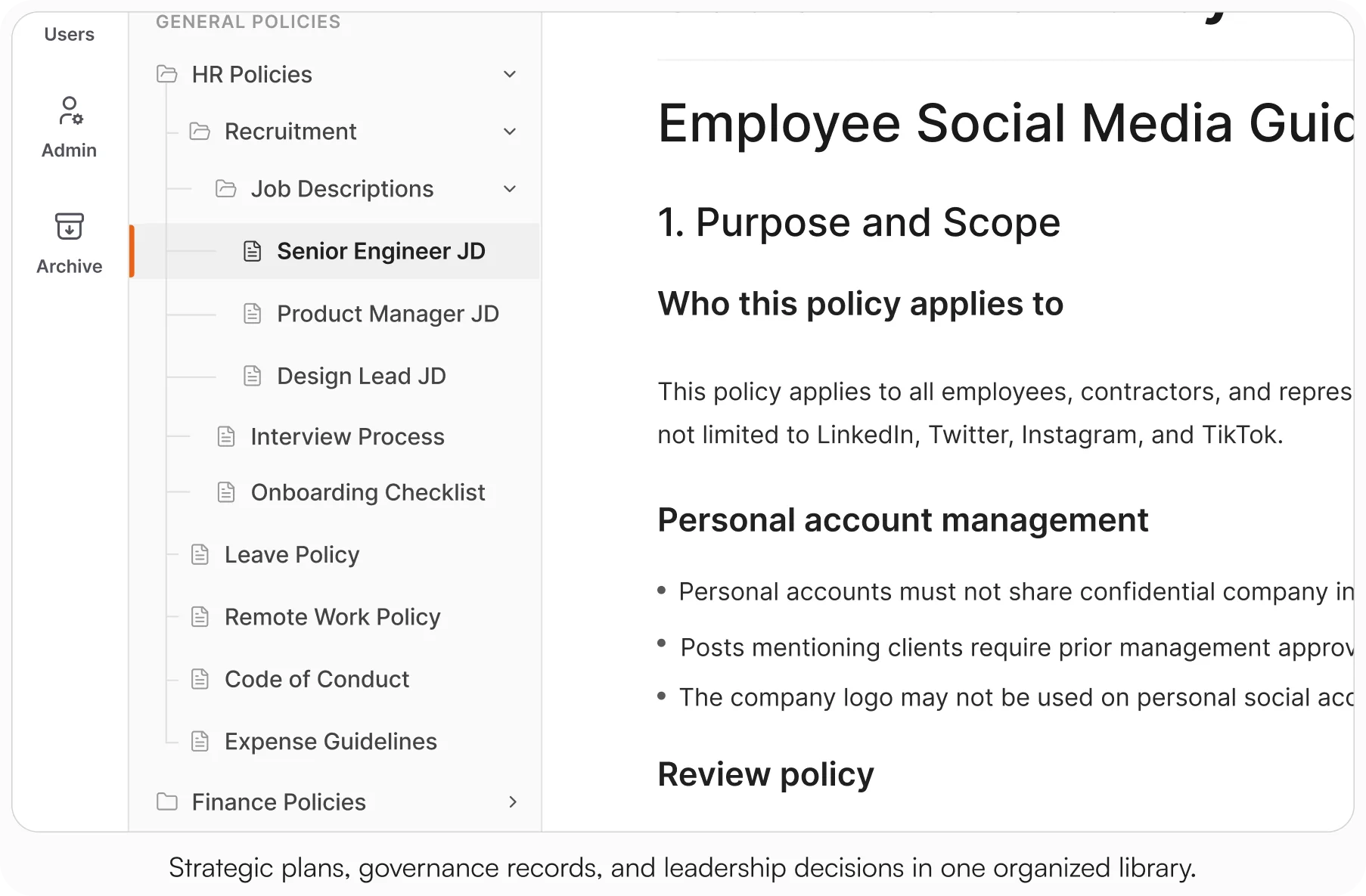
AllyMatter gives leadership teams a central place where strategic plans, governance policies, and leadership decisions stay organized, searchable, and accessible to the right people. The same document that the executive team reviews is the document that operating leaders implement against. No “which version is current” question, because there’s only one.
2. Preserving institutional knowledge during leadership transitions
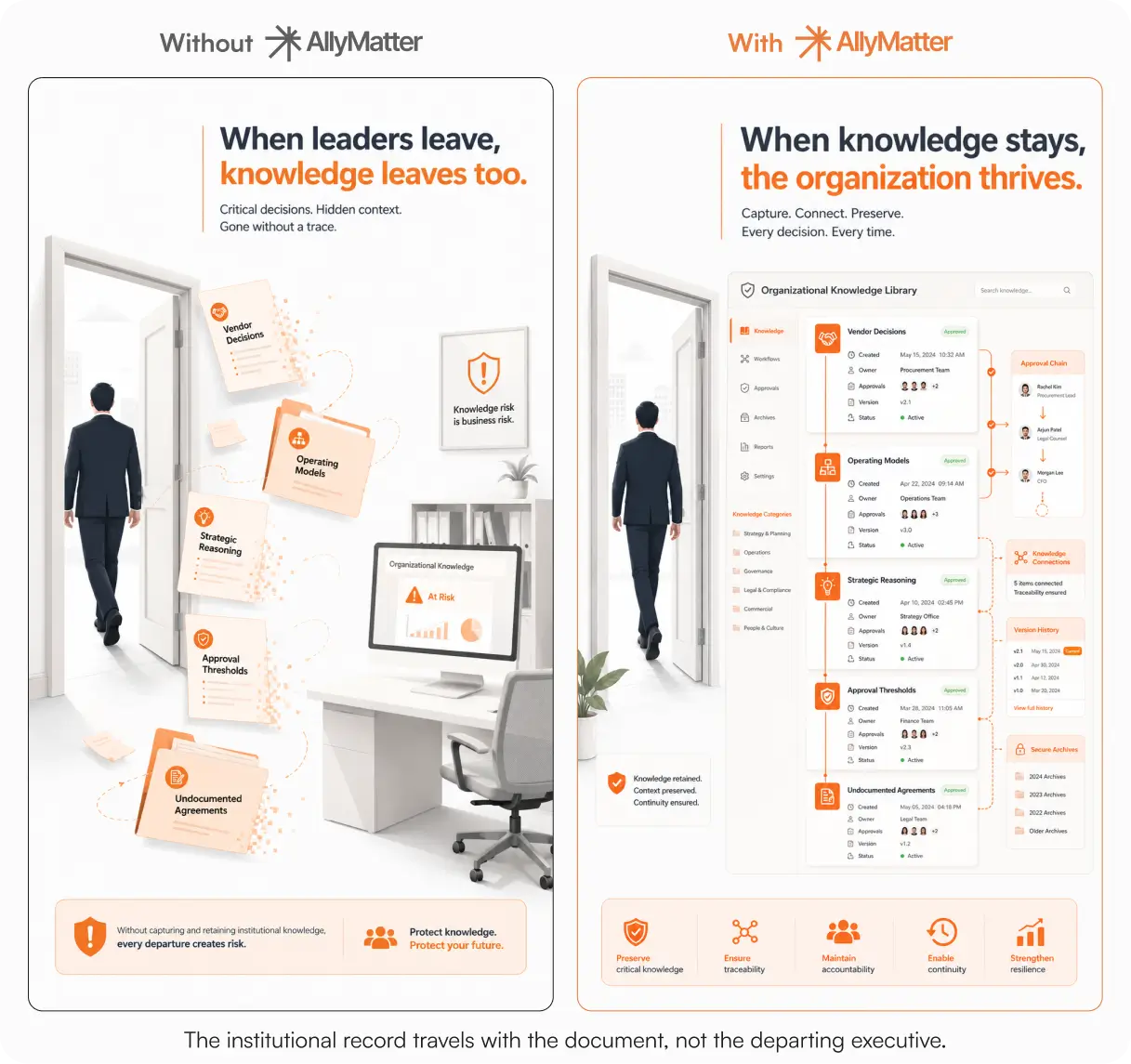
Leadership transitions expose how much organizational knowledge exists only in conversations, email threads, or individual experience. When a key leader leaves, teams can lose important context around vendor decisions, operating models, strategic priorities, and governance practices that took years to develop.
The cost is rarely visible in the moment. It shows up months later, when the new leader unknowingly reverses a previous decision, repeats a failed experiment, or rebuilds a process the previous team already optimized.
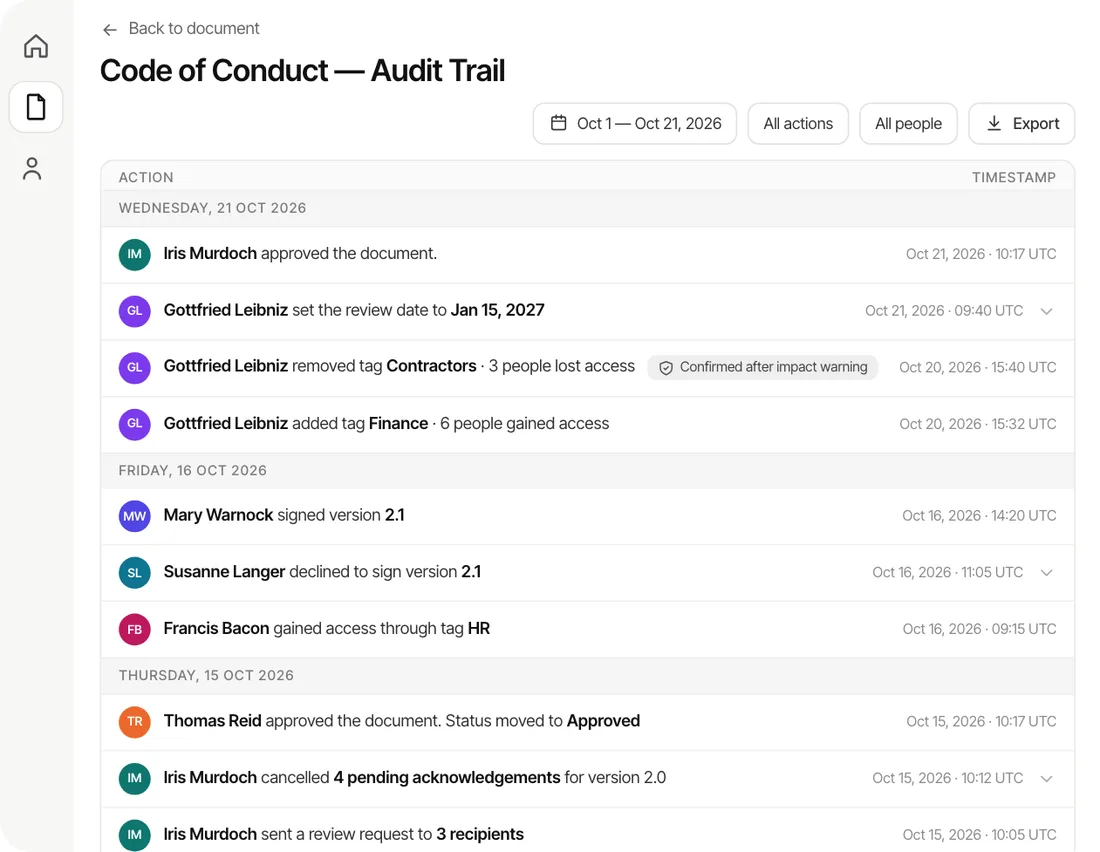
AllyMatter helps preserve that context by documenting decisions alongside the reasoning, approvals, and supporting information behind them. New leaders gain visibility into not only what was decided, but why. The audit trail captures who weighed in, what alternatives were considered, and when the decision was approved. That history travels with the document, not the departing executive.
3. Enhancing policy implementation and standardization
Policy inconsistency across departments creates operational risk and strategic misalignment. When policies are scattered across different systems, leadership loses visibility into how directives are being implemented. Two regions can quietly drift to different versions of the same compensation policy. Two business units can interpret the same compliance directive in two different ways. Neither team realizes it until something breaks.
AllyMatter’s policy management capabilities organize governance resources and strategic initiatives in one secure location. This ensures consistent policy implementation across departments, from finance procedures to compliance requirements. For a broader picture of how this scales, see the guide to corporate policy management.
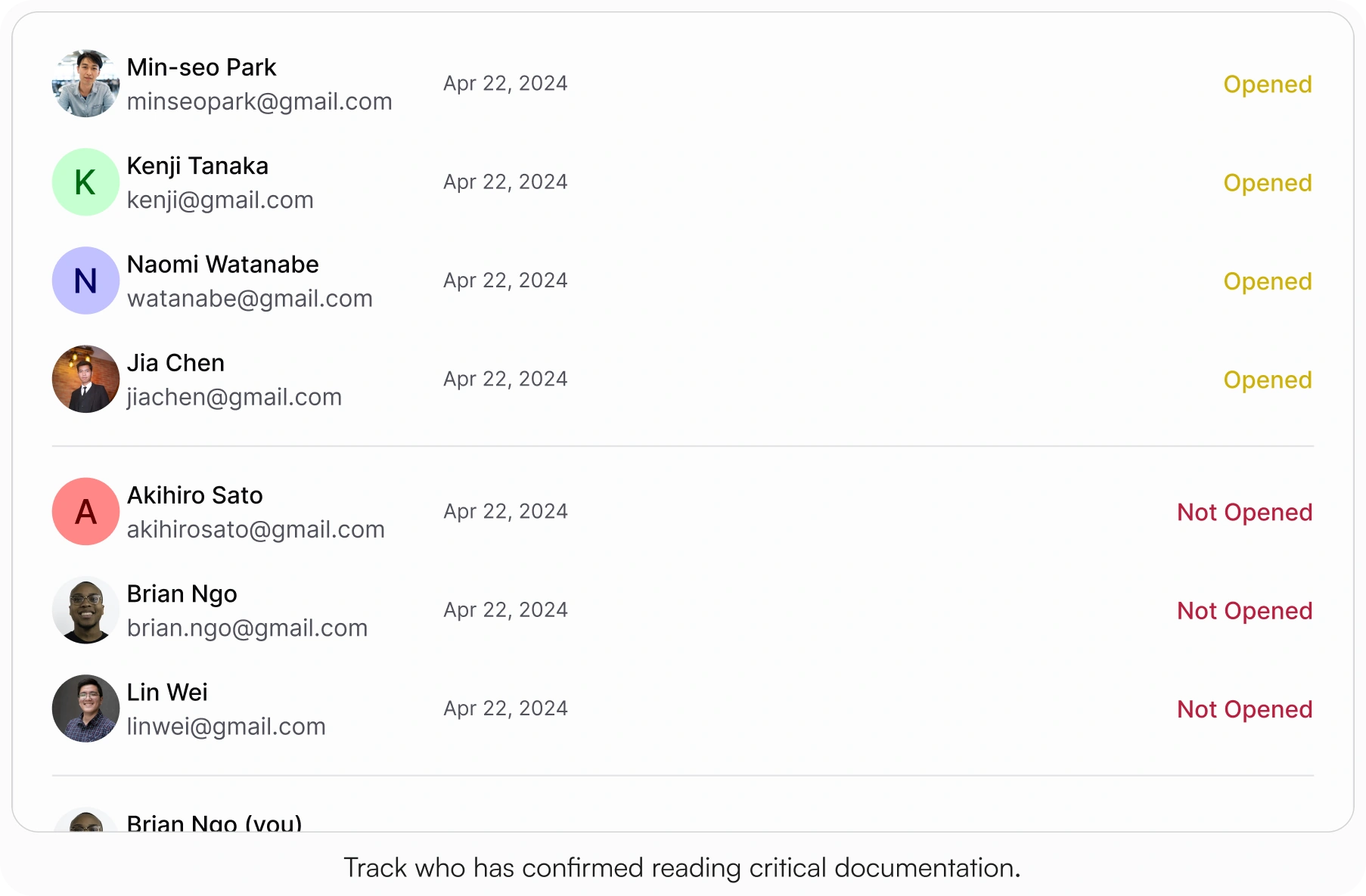
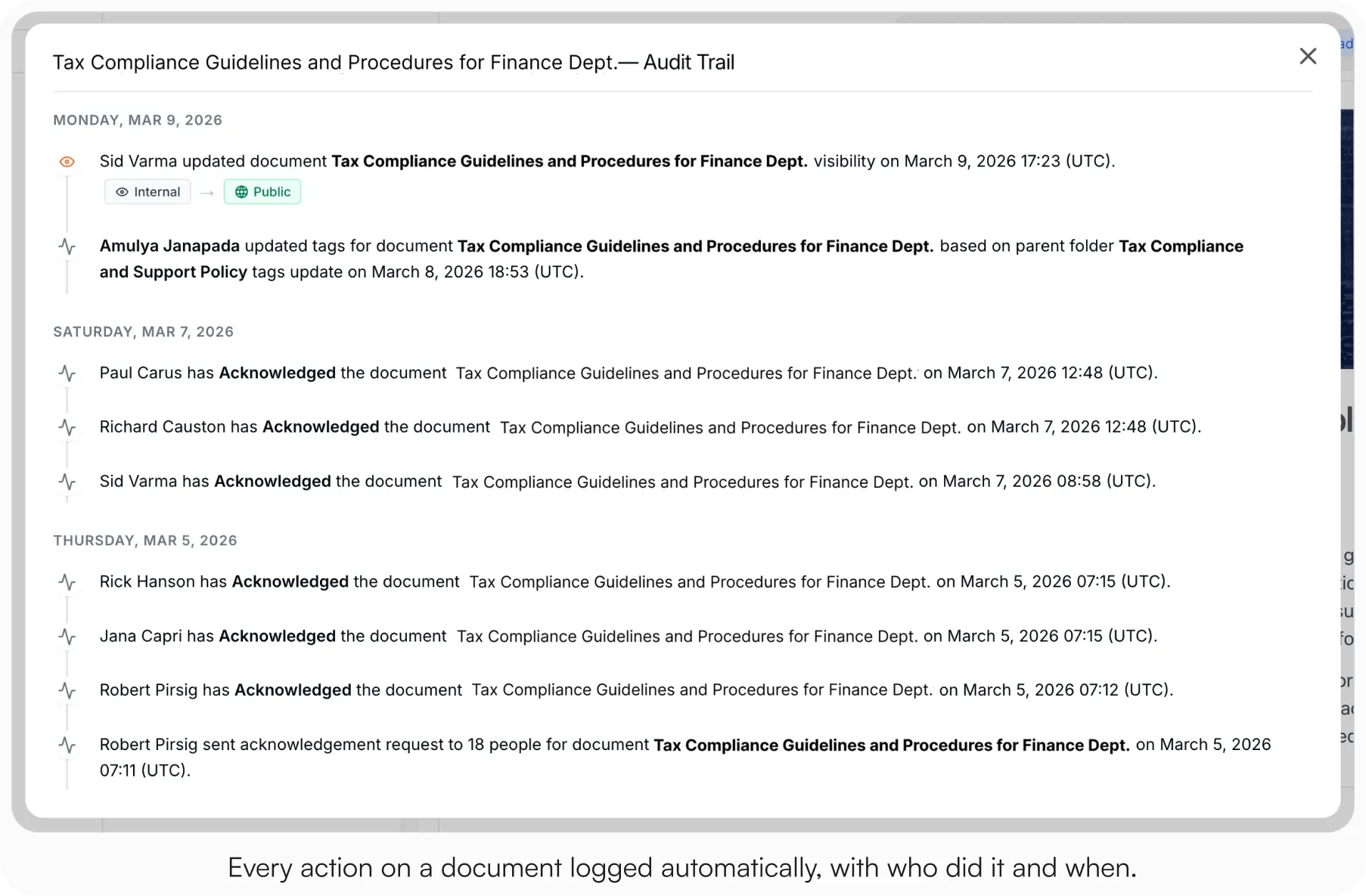
Leadership teams can distribute policy updates, send them for acknowledgment, and maintain visibility into who has confirmed receipt, without relying on email follow-ups or manual tracking. AllyMatter’s audit trail records every significant document action, so governance gaps are visible before they become operational problems.
4. Ensuring consistent execution of strategic priorities
Strategic priorities often become diluted as they move through departments. Different teams interpret goals differently, work from outdated information, or continue operating against previous priorities because updated guidance was never distributed consistently.
The gap between leadership intent and frontline execution usually comes down to distribution and visibility, not motivation.
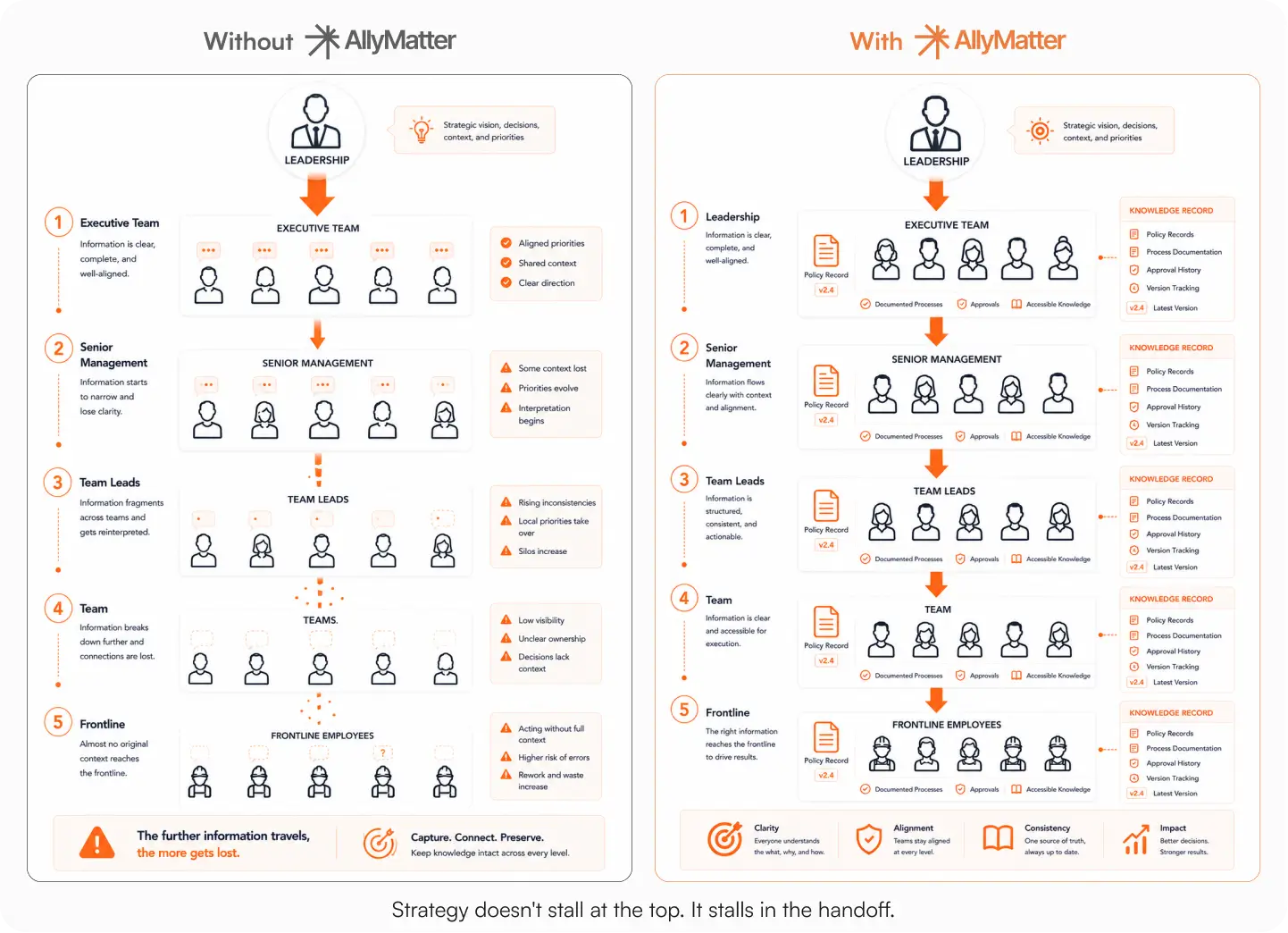
AllyMatter ensures every team works from the same approved priorities and direction. When strategic priorities change, AllyMatter helps document implementation plans across departments, capture acknowledgments, and verify that the updated direction has actually reached the people executing against it. Strategy stops being a deck that lives in someone’s drive and starts being an operating document with audit-grade visibility.
5. Creating scalable decision frameworks
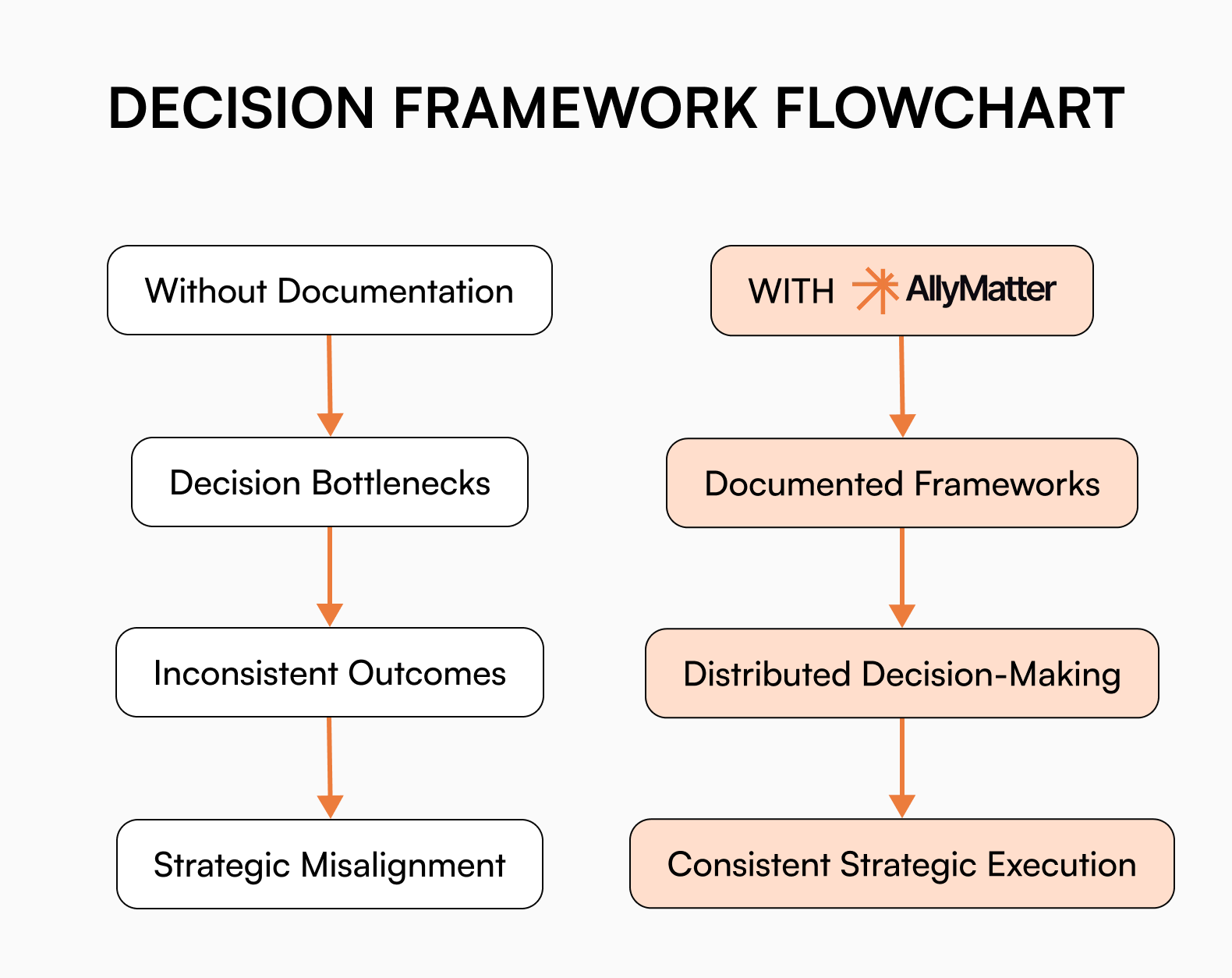
As organizations grow, decision-making criteria that worked when a handful of leaders were in the room become inconsistent when distributed across departments. Without documentation, those frameworks remain informal and don’t scale. New managers default to escalating decisions upward, or worse, making them inconsistently without realizing the executive team had an unwritten rule for handling exactly that situation.
AllyMatter captures decision-making frameworks and makes them accessible across the organization. This helps middle management make decisions that align with executive thinking, reducing escalations while maintaining consistency as the company grows. The frameworks become living documents that evolve as the organization learns, not folklore that gets passed down inconsistently.
6. Implementing governance and compliance processes
Governance requirements become more complex as organizations grow. Processes that once lived in conversations or informal approvals need clearer documentation, accountability, and visibility. Regulators, auditors, board members, and acquirers all increasingly expect a system of record that can produce evidence on demand, not assemble it in a panic the week before a deadline.
AllyMatter helps executive teams document approval thresholds, authority matrices, and compliance requirements that scale with the business. When regulatory requirements change or your business enters new markets, governance documentation evolves systematically rather than through scattered updates, reducing risk while maintaining operational speed.
This is also where AllyMatter’s modern architecture matters. Legacy GRC platforms and SharePoint policy implementations were built for a different era of compliance, where the audit trail was something you assembled after the fact. AllyMatter captures it as work happens, in a system designed for how executive teams operate today rather than how IT departments built things a decade ago.
7. Balancing transparency with confidentiality
Leadership teams constantly navigate what information to share, when to share it, and with whom. Different groups require different levels of visibility into strategic initiatives:
- Strategy documents may need “Executive-Only” access.
- Implementation plans might be appropriate for department heads.
- Communication materials require HR and Communications team access.
- The final announcement belongs to the whole company.
AllyMatter’s access controls let leadership manage this without maintaining separate document repositories or relying on manual permission updates. Access is governed by tags applied to documents and people, not by folder-by-folder permissions that fall apart the moment someone changes roles. When an employee moves departments, a single tag update changes their visibility across every policy and document that touches their new role.
Start your 30-day free trial. No credit card to start, and a 30-day money-back guarantee if you convert and change your mind.
8. Accelerating executive onboarding
New executives often spend their first months trying to understand historical decisions, organizational priorities, and operating practices before they can contribute effectively. Research by Egon Zehnder and Michael Watkins, published in Harvard Business Review, found that nearly 60% of executives reported it took six months or longer to reach full impact in their new roles, and close to 20% said it took more than nine months.
When that context is documented and searchable, new leaders spend less time reconstructing organizational history and more time understanding how decisions were made. AllyMatter gives new leaders immediate access to decision histories, approved processes, and governance records without requiring a series of knowledge-transfer meetings. The first ninety days become about understanding the operating system, not reverse-engineering it.
9. Enabling effective delegation through documented processes
As organizations grow, executive effectiveness increasingly depends on delegation. Without properly documented standard operating procedures, delegation creates uncertainty and inconsistent results. The executive ends up either re-explaining the same context every time or reabsorbing the work because the handoff keeps producing the wrong outcome.
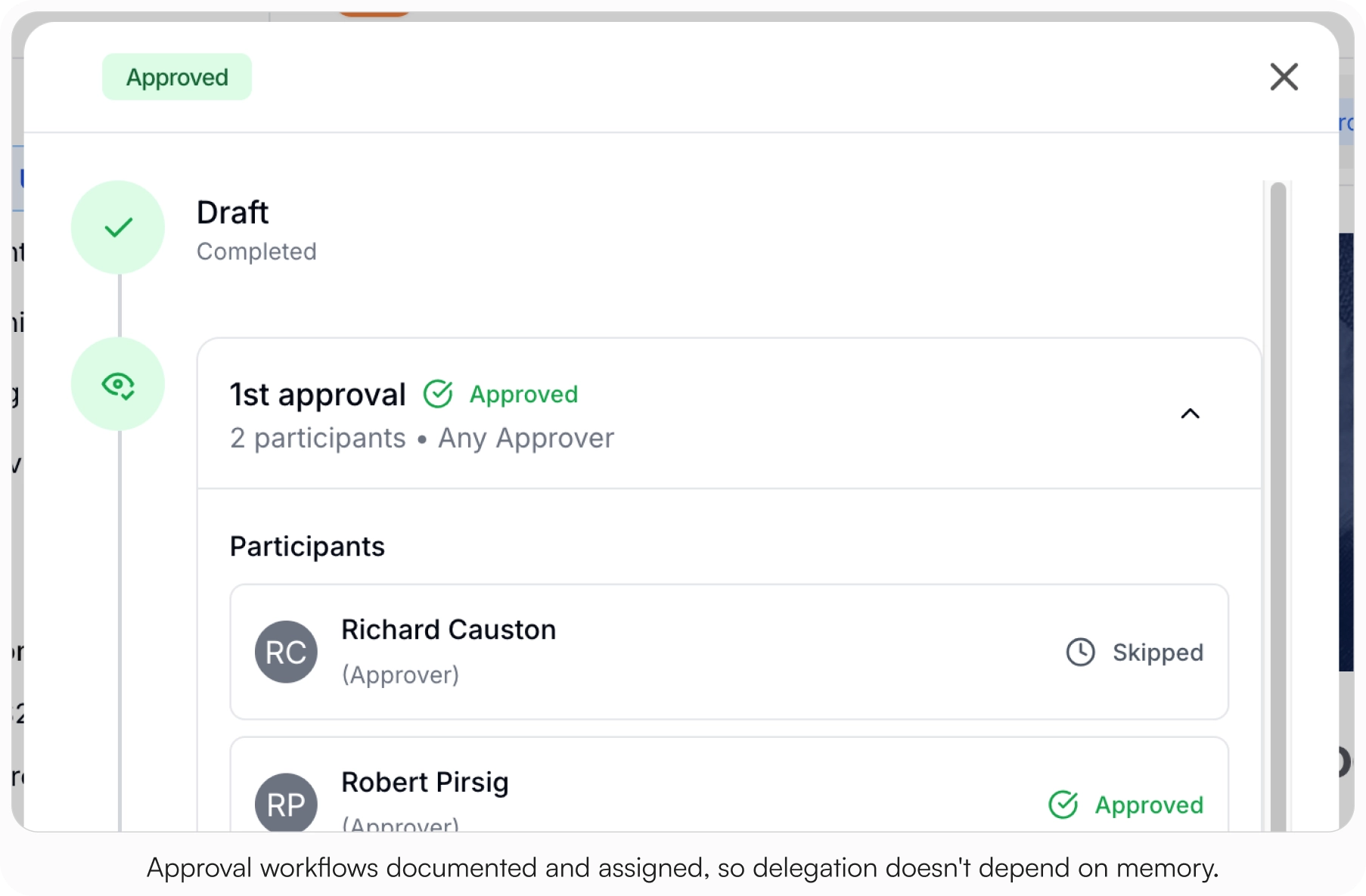
AllyMatter’s internal knowledge base capabilities make it straightforward to document critical processes, enabling executives to delegate with confidence. When an operations leader can hand off routine approval processes to their team because the steps are clearly documented, they recover time for strategic priorities while maintaining quality standards. The approval workflow shows who is responsible at each stage, what the criteria are, and when something needs to escalate. Delegation becomes a process, not a leap of faith.
10. Creating a data-driven leadership culture
Leadership teams often rely too heavily on intuition when documentation gaps prevent evidence-based decision-making. Evaluating the success of strategic initiatives becomes difficult without consistent records of what was decided, distributed, and acted on.
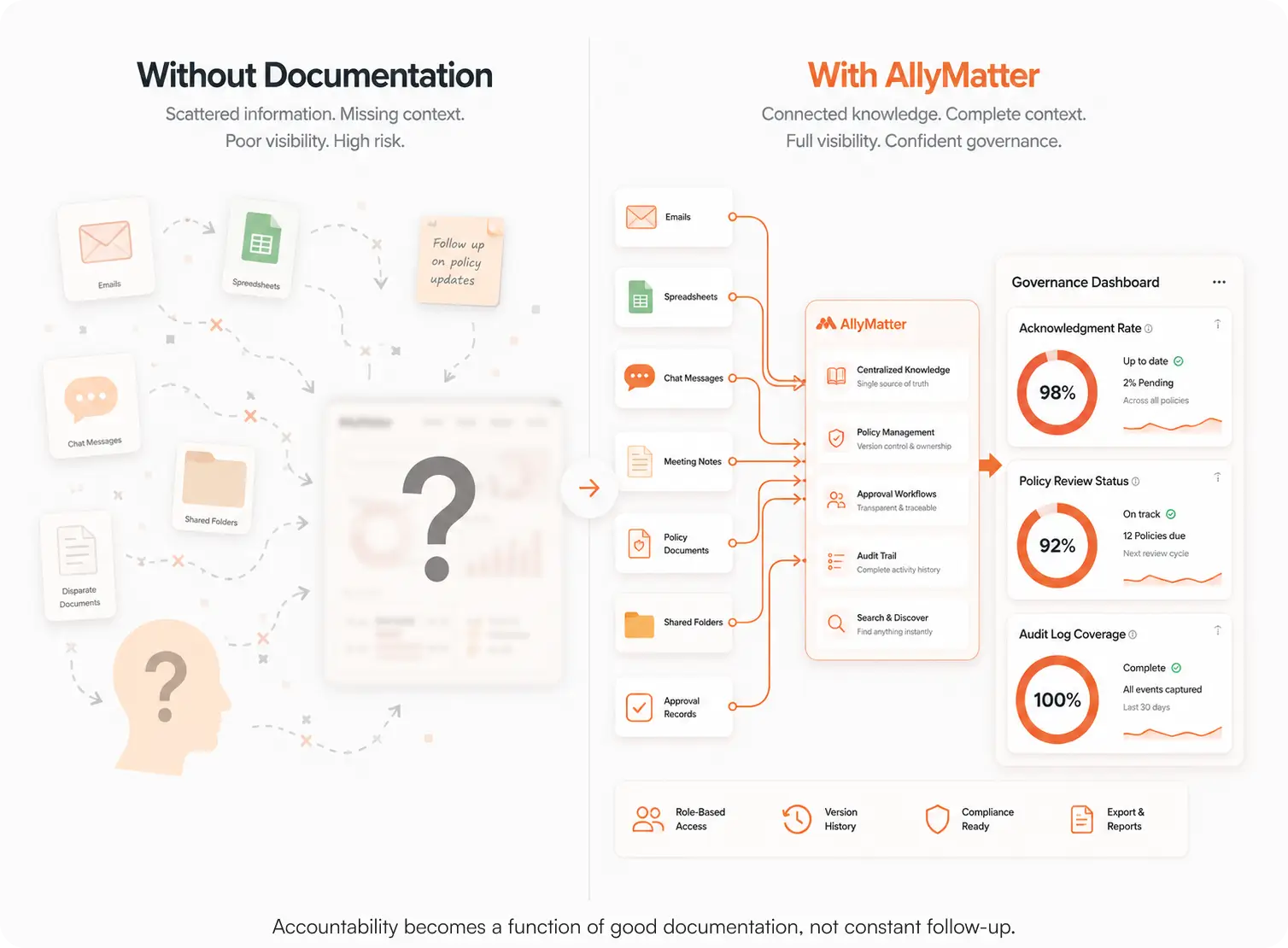
Documented processes, approvals, acknowledgments, and governance records give leadership teams clearer visibility into how decisions are communicated and implemented across the organization. When that information lives in one searchable system, accountability becomes a function of good documentation rather than constant follow-up. Patterns become visible. Bottlenecks become measurable. The leadership team gets to lead from data, not from anecdote.
AllyMatter is also built for the AI future, not the spreadsheet past. As leadership teams adopt AI tools to surface insight, run analysis, and accelerate decision-making, the underlying documentation has to be structured, governed, and trustworthy enough for an LLM to use safely. AllyMatter is built for that exact shape: a verified policy and knowledge layer that AI can query without producing the wrong answer because the source document was three versions out of date.
Three scenarios
An honest read on whether structured executive knowledge management is worth investing in right now:
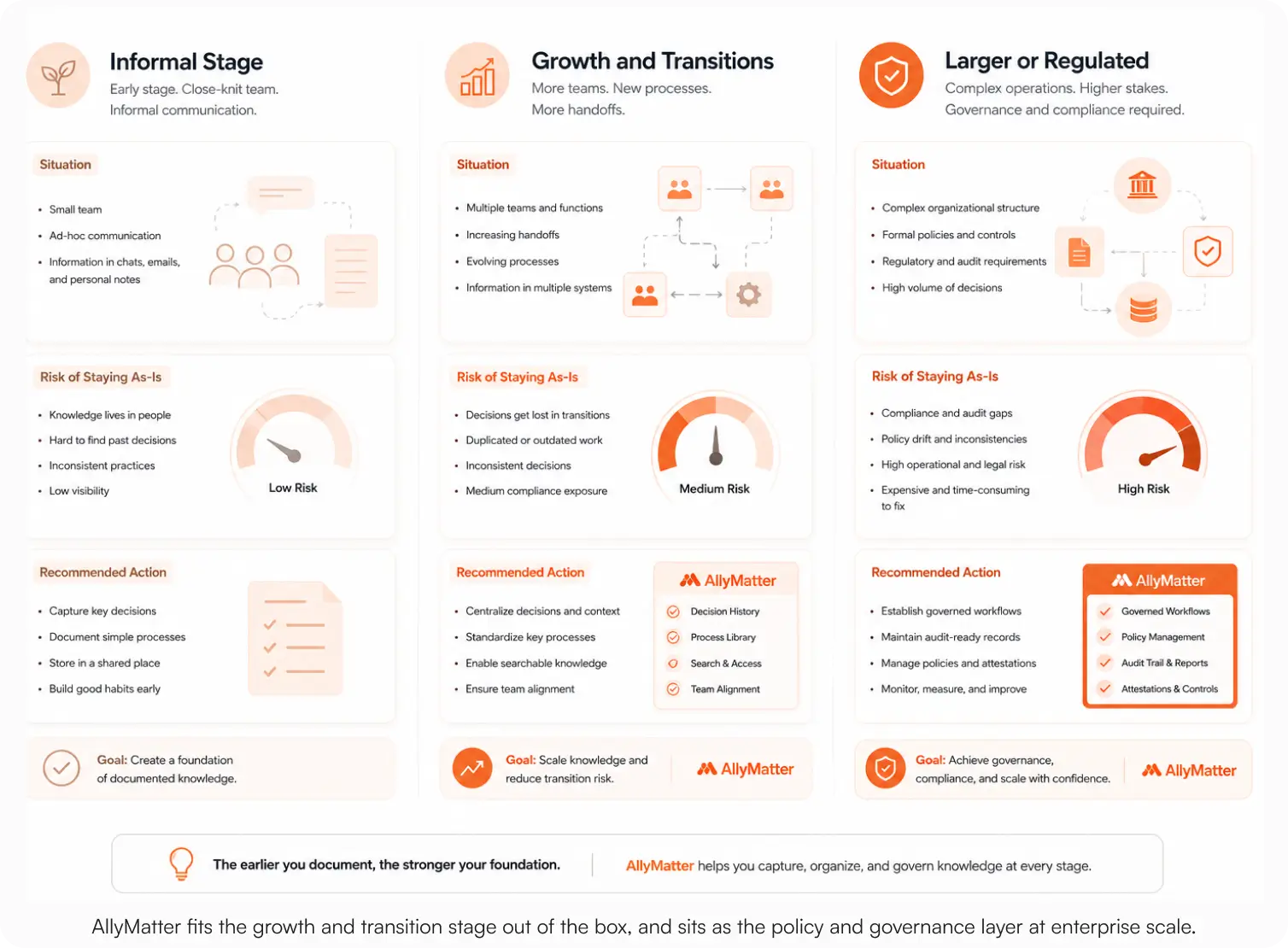
If your leadership team is small and most strategic context still lives in a few heads that talk every day, informal systems hold for a while. The structured investment pays off less than other priorities at this stage. Build the habit of documenting decisions and reasoning now, even informally. When the four signals at the top of this post start showing up, AllyMatter is the natural place to graduate that habit into a real system.
If your leadership team is growing, new executives are joining, departments are starting to interpret strategic priorities differently, or an audit, board ask, or transition has already exposed a documentation gap, this is the moment. AllyMatter is built for exactly this. The lifecycle, tag-based access, acknowledgment tracking, and audit trail handle the load without an IT project. Most of the cost shows up not as the software price but as the time and exposure of running without the system in place.
If your organization is larger, multi-location, or in a regulated industry (healthcare, finance, legal, government contracting), structured executive knowledge management is not optional. AllyMatter handles the GRC work modern leadership teams actually need, without the legacy IT footprint or the consulting engagement. Some leadership teams will also want a NAVEX, Workiva, or MetricStream connection to embed policy management inside a broader audit, SOX, or sustainability program. We’d start with AllyMatter as the executive knowledge and policy layer and add the enterprise GRC connection only if and when the wider program requires it.
When leadership challenges become knowledge management challenges
Leadership challenges often become knowledge management challenges. Decisions lose context. Policies become difficult to track. Institutional knowledge disappears as organizations grow. None of those are dramatic failures on their own. Together, they’re the difference between a leadership team that compounds its judgment over time and one that keeps rediscovering the same lessons every quarter.
Most executive teams already have the information they need somewhere. The challenge is keeping strategic documentation, governance records, and decision history accessible and trustworthy over time. That’s the gap AllyMatter is built to close.
On yearly plans, we provide 1:1 setup and migration. A real person on the other end during onboarding. Migration from SharePoint, Confluence, Notion, or Drive is done manually, by our team, in consultation with you, because setting it up right the first time matters more than setting it up fast. The same applies if you’re moving off a legacy GRC platform that the leadership team has outgrown or never fully implemented.
Start your 30-day free trial. No credit card to start, and a 30-day money-back guarantee if you convert and change your mind. Or try the live demo to see the strategic library, approval workflows, version history, and acknowledgment tracking with realistic executive content already loaded.
Not ready for a trial? On yearly plans, migration from Confluence, Notion, SharePoint, or Drive is on us when you decide. On yearly plans, we’ll move your existing docs over, usually within a week and often sooner.
Related reading
- Policy Management Software: The Complete Guide
- Scaling Your Business Using SOP Documentation
- Internal Knowledge Base Guide: Keep What Your Team Knows
- Internal Knowledge Base Guide: Keep What Your Team Knows
- Tags: The Secret Sauce Behind AllyMatter’s Access Control
Frequently asked questions
How does AllyMatter help preserve institutional knowledge during executive transitions?
AllyMatter documents not just decisions but the context and rationale behind them. When leadership changes occur, new executives can quickly understand what was decided and why, maintaining strategic continuity and protecting organizational memory. The audit trail captures who weighed in, what alternatives were considered, and when the decision was approved, so the institutional record travels with the document rather than the departing executive.
What makes AllyMatter different from tools like SharePoint or Google Drive for executive documentation?
File storage tools are built for saving and sharing. AllyMatter is built for keeping documentation governed, findable, and trustworthy over time, with tag-based access controls, multi-stage approval workflows, real-time acknowledgment tracking, and a continuously captured audit trail. It’s the modern replacement for SharePoint policy implementations and legacy GRC platforms that haven’t kept pace with how leadership teams actually operate today.
How quickly can new executives become productive using AllyMatter?
New executives have immediate access to decision histories, approved governance documents, and organizational context the day they log in. They spend less time piecing together background through knowledge-transfer meetings and more time understanding how the operating system actually works. Research from Egon Zehnder and Harvard Business Review pegs typical executive ramp at six to nine months. The right knowledge infrastructure compresses that materially.
Can AllyMatter handle confidential strategic documents while maintaining transparency?
Yes. AllyMatter’s tag-based access controls let leadership teams share appropriate information with different stakeholder groups while keeping sensitive strategic content protected. The same document library hosts the board-only material and the company-wide announcement, with visibility scoped automatically by the tags on each document and each person. No separate repositories. No manual permission management.
Is AllyMatter ready for AI-driven leadership workflows?
Yes. AllyMatter is built for the AI future as well as the document present. The library is structured so that policies, decisions, and governance records stay searchable, governable, and usable when an LLM is part of how leadership teams find context, run analysis, or draft new direction. The verified, current, audit-traced source of truth is exactly what AI assistance needs to produce trustworthy answers in a leadership context.
Does AllyMatter replace our compliance or GRC platform?
For many organizations, yes. AllyMatter handles policy management, governance documentation, approval workflows, acknowledgment tracking, and audit logs that legacy GRC suites cover, often more cleanly and without the IT project. For enterprises running a broader audit, SOX, or sustainability assurance program, AllyMatter sits as the policy and governance layer with platforms like NAVEX, Workiva, or MetricStream handling the wider GRC stack. The right fit depends on the scope of the program, which the team will help you assess during a 1:1 setup conversation.