Most HR teams adopt tools like Notion pragmatically, not naively. They deploy available resources to solve immediate problems. Early on, a shared workspace feels sufficient. Policies live somewhere. People can comment. Updates get announced in Slack.
The problem shows up later.
I’ve worked with HR teams at mid-sized startups who hit the same wall around 75 employees. A benefits policy change needs legal review, but there’s no clear approval workflow. Six months later, an employee claims they never saw the updated PTO policy. HR scrambles through Slack history and email threads, trying to prove notification happened. This challenge compounds when tracking who has actually read and acknowledged critical updates.
That’s when the question shifts from “Where is the policy?” to “Who approved this, who saw it, and when?”
Evaluation criteria: what actually matters in the HR policy lifecycle
This comparison examines HR policy management software through the jobs HR teams are responsible for, not generic collaboration features. The difference between notes tools and compliance systems becomes clear when you map actual HR workflows.
Drafting policies with ownership and accountability
HR policies aren’t shared notes. They’re owned documents with an accountable author.
In Notion, drafting is flexible, but ownership is informal. Anyone with edit access can change content unless the team manually locks pages. That flexibility works when policies are informational guidelines. It creates risk when policies carry legal weight.
AllyMatter starts with a defined owner for every policy. That distinction matters once policies become enforceable and time-bound. Ownership isn’t a page property someone might update. It’s a required field that determines who can authorize changes.
Approvals vs notes tool workflows
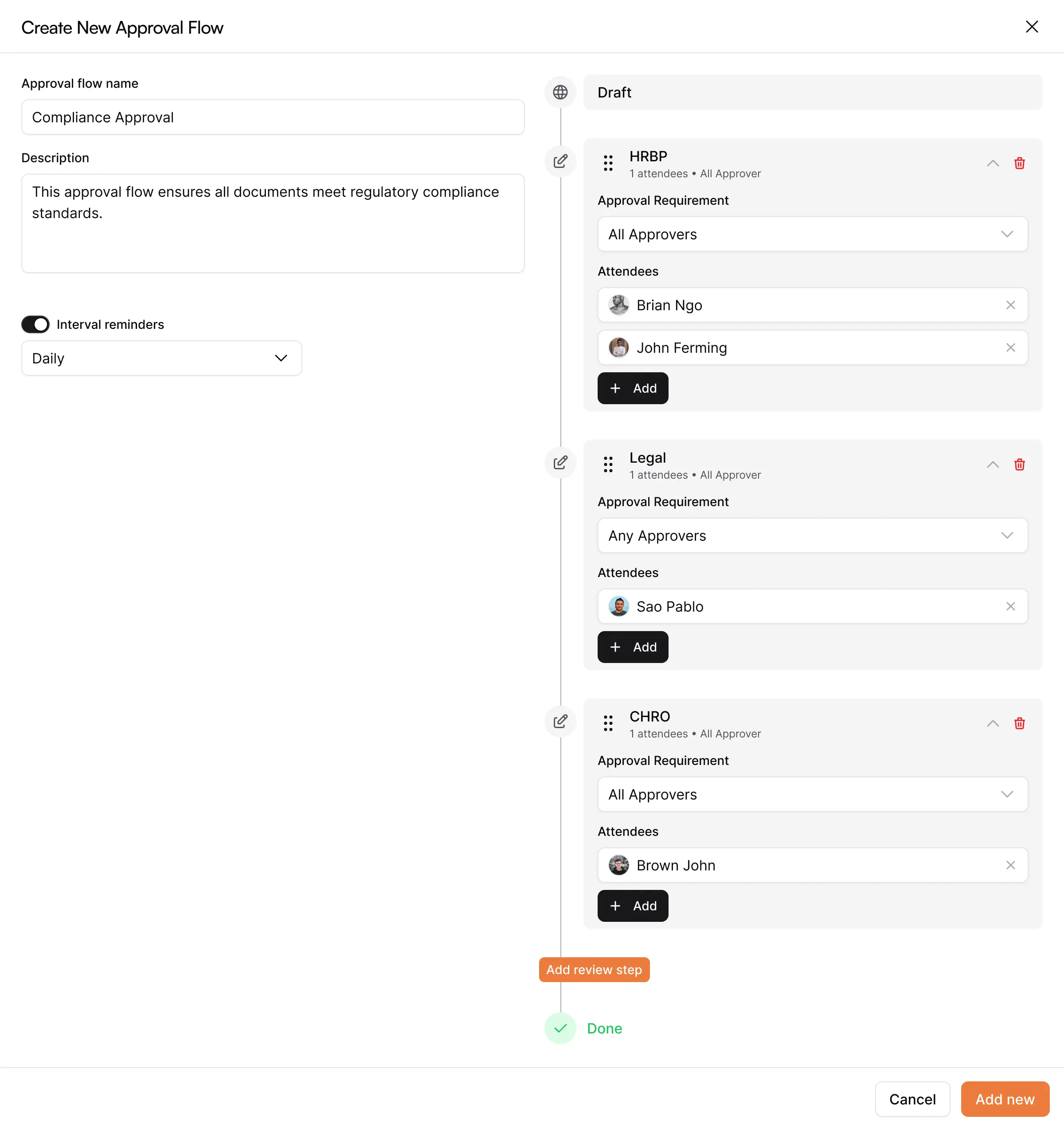
Approval workflows separate HR policy management software from general documentation tools.
Notion supports comments and mentions, but approvals are implied, not enforced. Someone saying “Looks good” in a comment isn’t an approval record. I’ve watched HR teams try to track approvals through emoji reactions, database checkboxes, or separate spreadsheets. The workaround becomes the workflow.
AllyMatter treats approvals as a governed step. Approvers are assigned, decisions are logged, and progress is visible without chasing people across tools. Multi-stage approval flows handle scenarios where legal reviews HR policies before the CFO signs off. The system tracks who approved, when they approved, and which version they reviewed.
Targeted updates instead of broadcast announcements
HR policy changes rarely apply to everyone equally. A remote work policy update might affect only your engineering team. An expense policy change might apply to managers only. Benefits updates often vary by location.
Notion updates tend to be broadcast-oriented. HR teams compensate with manual tagging, custom databases, or Slack follow-ups. The larger the team, the more notification noise this creates.
AllyMatter allows updates to be targeted by role, department, or geography through its tag-based access control system. That reduces noise and prevents the wrong people from missing the right update. Only affected employees receive notifications, and the system tracks who has viewed the changes.
For foundational knowledge management principles that support this structured approach, see our guide to internal knowledge base.
Acknowledgments HR teams can prove
Acknowledgments are where notes tools struggle the most.
Notion doesn’t natively track who has read and acknowledged a policy. HR teams build workarounds with Google Forms, checkboxes in databases, or external tools. Each workaround adds friction. More importantly, none create a tamper-proof audit trail connecting the specific employee to the specific policy version at a specific timestamp.
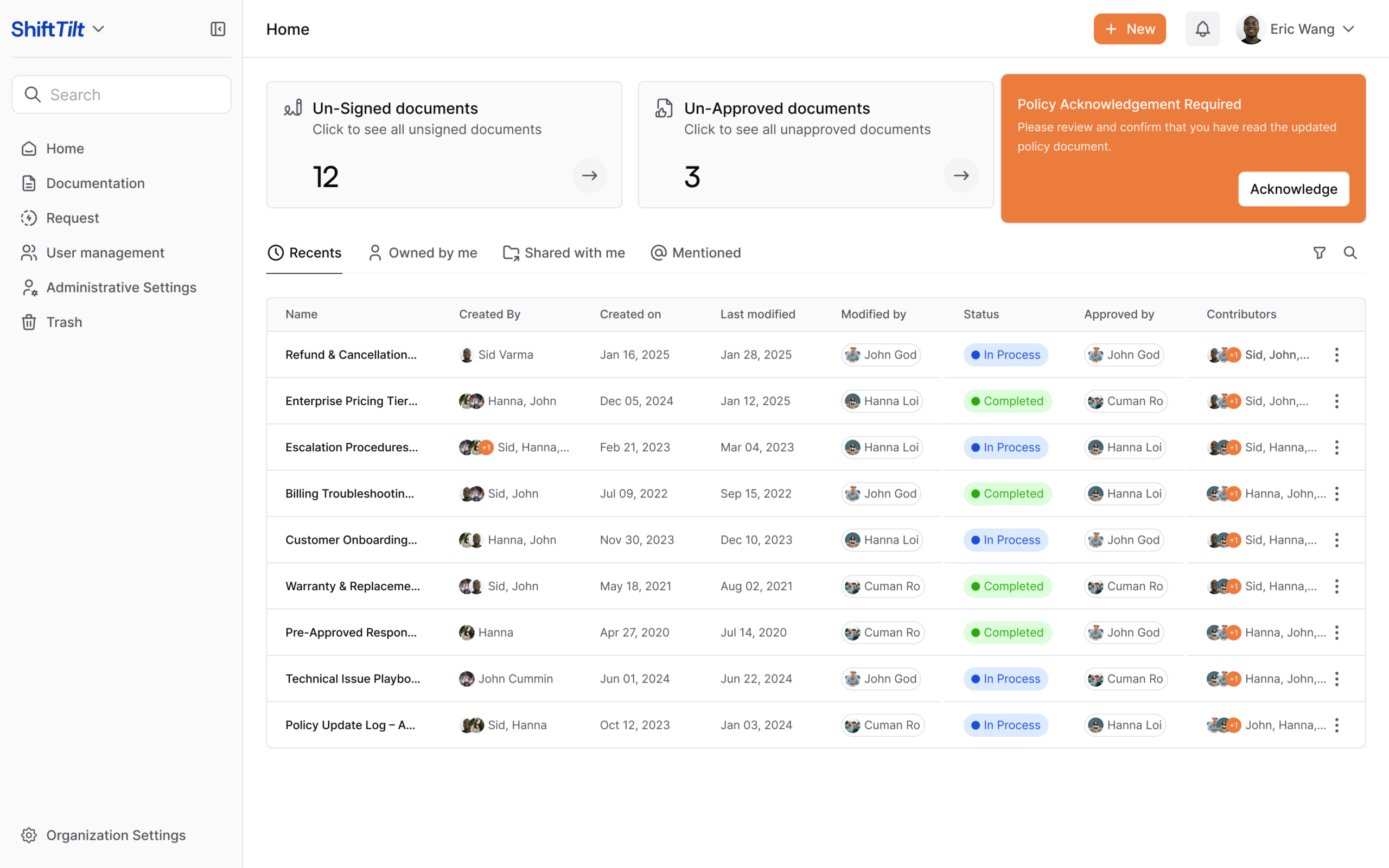
AllyMatter treats acknowledgment as a first-class requirement. HR teams can see exactly who has acknowledged, who hasn’t, and when. Automated reminders follow up with employees who haven’t responded. The acknowledgment dashboard shows compliance rates across departments, making it easy to identify gaps before audits.
Audit trail that survives scrutiny
An HR audit doesn’t care how collaborative your workspace feels. Auditors want to see who approved version 2.3 of your harassment policy, when it became effective, which employees saw it, and proof they acknowledged it.
Notion offers page history, but it’s designed for content recovery, not compliance documentation. Tracking who approved what, when a policy became effective, or which version an employee saw requires manual record-keeping. I’ve watched HR teams spend days before audits reconstructing approval timelines from email threads and Slack messages.
AllyMatter maintains a comprehensive audit trail across approvals, updates, and acknowledgments, designed specifically for policy governance and compliance tracking. Every action generates a timestamped, immutable log entry. Version control highlights specific changes between versions, making it easy to show exactly what changed and when.
Side-by-side HR policy lifecycle comparison
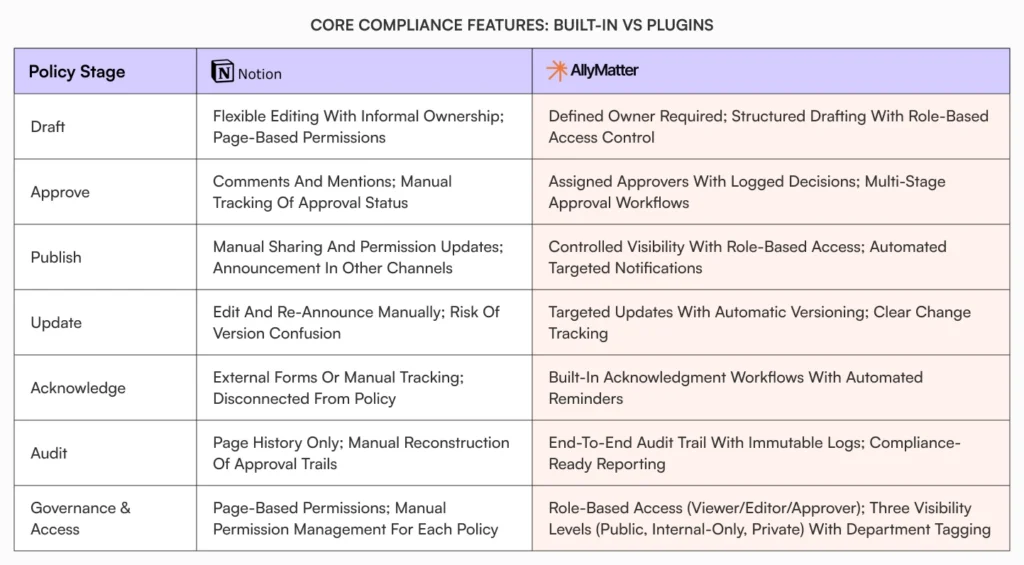
Here’s how the two approaches differ across the complete policy lifecycle:
Draft
- Notion: Flexible editing, informal ownership, page-based permissions
- AllyMatter: Defined owner, structured drafting, role-based access control
Approve
- Notion: Comments and mentions, manual tracking of approval status
- AllyMatter: Assigned approvers with logged decisions, multi-stage approval workflows
Publish
- Notion: Manual sharing and permission updates, announcement in other channels
- AllyMatter: Controlled visibility with role-based access, automated targeted notifications
Update
- Notion: Edit and re-announce manually, risk of version confusion
- AllyMatter: Targeted updates with automatic versioning, clear change tracking
Acknowledge
- Notion: External forms or manual tracking, disconnected from policy
- AllyMatter: Built-in acknowledgment workflows with automated reminders
Audit
- Notion: Page history only, manual reconstruction of approval trails
- AllyMatter: End-to-end audit trail with immutable logs, compliance-ready reporting
Findability using HR language, not wiki navigation
HR teams don’t search for “Page hierarchy” or “Q2 2024 folder.” They search for “remote work policy,” “leave eligibility,” or “code of conduct.” The gap between how HR thinks and how documentation is organized creates friction.
Notion findability depends heavily on how disciplined the team is with structure and naming conventions. I’ve seen excellent Notion setups degrade quickly as contributors multiply. Someone creates a duplicate “Benefits” page because they couldn’t find the existing one. Six months later, employees are confused about which version is current.
AllyMatter emphasizes findability through HR-relevant metadata and intelligent tagging. Policies surface based on how HR teams actually think and search. Tags like “remote-work,” “benefits,” and “compliance” work better than folder hierarchies. Full-text search indexes policy content, making it easy to find “parental leave” even if the policy title says “Family and Medical Leave Policy.”
The platform’s smart search also learns from usage patterns. Frequently accessed policies surface faster. Related policies appear as suggestions, helping employees find connected information without knowing exactly what to search for.
Governance: roles, permissions, and policy ownership
Who can edit, approve, and publish
Notion permissions are page-based and flexible, but that flexibility can blur responsibility. A page might have ten editors, but when something goes wrong, nobody remembers who made the change or whether it was approved.
AllyMatter separates viewers, editors, and approvers as distinct roles. Viewers can read. Editors can draft and propose changes. Approvers can authorize publication. That separation makes ownership clear, especially in regulated environments where unauthorized changes create liability.
Consider a scenario where your compensation philosophy document needs updating. In Notion, anyone with edit access can modify it. With AllyMatter, an editor can draft the changes, but publication requires explicit approval from designated stakeholders. The system prevents unauthorized modifications from going live.
Beyond role separation, controlling access to sensitive information matters. HR policies often contain compensation ranges, performance improvement plans, and confidential investigation details. AllyMatter enforces access through three visibility levels (public, internal-only, private) and role-based permissions. Department tagging ensures employees see policies relevant to them without exposing sensitive information.
For foundational knowledge management principles that support this structured approach, see our guide to internal knowledge base software.
Ownership that doesn’t disappear when people leave
I’ve watched policies lose owners when HR managers change roles or leave the company. Six months later, someone needs to update an expense policy, but nobody remembers who owns it or has authority to approve changes.
Research from Panopto indicates that 42% of an organization’s knowledge exists solely in the minds of individual employees, leaving it entirely undocumented. When those employees leave without proper handoffs, organizations lose critical context around policies and decisions.
Notion doesn’t enforce ownership continuity. Page properties might list an owner, but nothing requires updating that field when people transition. AllyMatter requires explicit ownership transfer before documents can be updated. The system flags orphaned policies and prevents them from entering limbo.
When Sarah, your Head of People Operations, transitions to a new role, the handoff checklist includes transferring ownership of her 12 policies to her successor. Until that transfer completes, the policies remain accessible but locked from unauthorized changes.
When Notion makes sense for HR teams
Notion works well in specific contexts:
Company size under 50 employees: At this scale, HR policy management is straightforward. Policies are informational guidelines rather than enforceable contracts. Everyone knows everyone, and informal communication works.
Policies are informational, not enforceable: When policies are best practices rather than binding agreements, formal approval workflows add friction without value. Early-stage companies often operate this way.
HR needs flexibility over control: Some HR teams prioritize collaboration and iteration over governance and compliance. Notion excels at rapid collaboration and content evolution.
Audits aren’t yet a concern: Pre-revenue startups and very early-stage companies typically aren’t subject to compliance audits. The flexibility of notes tools outweighs governance limitations.
For early-stage startups operating in these conditions, Notion can be a practical starting point. The question isn’t whether Notion is “wrong” but whether its design assumptions match your operational reality.
When Notion starts to break down
Notion struggles when organizational realities shift:
Policies require formal approval: Once policies carry legal weight or financial impact, informal approval through comments becomes insufficient. HR needs to prove who authorized changes and when.
Employees must acknowledge changes: When policies become enforceable, acknowledgment isn’t optional. HR needs verifiable proof that employees received, read, and accepted specific policy versions. I’ve seen companies face legal challenges where they couldn’t prove an employee had acknowledged a policy that led to termination.
HR needs proof for audits or disputes: Compliance audits, legal disputes, and regulatory investigations all require documentation trails. Page history isn’t enough when auditors ask for approval records and acknowledgment logs.
Multiple versions create confusion: As policies evolve, employees need to know which version is current. Notion’s version history helps with recovery but doesn’t prevent confusion when multiple versions circulate.
Onboarding delays emerge: Without structured policy acknowledgment, new hires can’t efficiently work through required reading and confirmations.
At this transition point, HR teams often compound complexity by layering workarounds rather than addressing the fundamental mismatch between collaboration tools and compliance requirements. They add external acknowledgment forms, create separate approval tracking spreadsheets, and build notification systems in other tools.
For a comprehensive view of HR knowledge base requirements at different company stages, see our complete 2025 HR knowledge bases guide.
Why AllyMatter fits growth-stage HR teams
AllyMatter is designed for HR teams managing real policy lifecycles and compliance requirements, not just documentation. The platform assumes policies need governance, not just storage.
Approval workflows instead of comment trails: Built-in approval routing handles single-approver and multi-stage scenarios. Legal reviews HR policies before executive sign-off. The system logs every approval decision with timestamps and version references.
Acknowledgments HR can rely on: Integrated acknowledgment tracking shows who has confirmed receipt of each policy version. Automated reminders follow up with employees who haven’t responded. Dashboard analytics highlight compliance gaps before they become audit findings.
Audit trails that stand up to scrutiny: Every action generates an immutable audit log entry. Auditors can see who drafted a policy, who approved it, when it was published, who viewed it, and who acknowledged it. Version comparison shows exactly what changed between versions.
Governance aligned with growing companies: Role-based permissions, ownership requirements, and structured access controls match the needs of companies scaling from 50 to 500 employees. These organizations have outgrown informal processes but don’t need enterprise complexity.
The platform doesn’t replace collaboration. It formalizes responsibility where responsibility matters, while keeping the process efficient enough that HR teams actually use it.
Moving from Notion to AllyMatter doesn’t require halting operations or losing existing content. Migration happens incrementally. Try a live demo of how policies move from draft to acknowledged.
Frequently asked questions
Is Notion considered HR policy management software?
Notion is a general-purpose workspace, not dedicated HR policy management software. HR teams can store policies in Notion, but approvals, acknowledgments, and audit trails require manual processes or external tools.
What’s the difference between approvals and comments for HR policies?
Comments indicate feedback. Approvals indicate accountability. HR policies require formal approval records, especially when policies are enforced or audited. A comment thread showing “LGTM” or “Approved” from your legal team isn’t a compliance record. It’s a conversation fragment that might be difficult to find six months later when an auditor asks for proof. Approval workflows create structured records connecting specific approvers to specific policy versions with timestamps and decision logs.
How important are acknowledgments for HR policies?
Acknowledgments provide proof that employees received and accepted a policy. Without them, HR teams rely on assumptions that can become liabilities. Acknowledgment tracking closes this loop in both directions: employees know what’s required of them, HR knows who’s compliant, and both parties have timestamps if disputes arise. This documentation becomes critical during wrongful termination claims, harassment investigations, or compliance audits.
Can HR teams migrate from Notion to AllyMatter without losing history?
Yes. Many HR teams start in Notion and migrate later. AllyMatter migration preserves your content while adding structure. Policies move into a governed environment where you immediately gain ownership, approval workflows, and acknowledgment tracking. The transition happens incrementally so you don’t need to halt operations. Most teams start with their highest-risk policies and migrate additional content over several weeks.
How does this fit into a startup knowledge base strategy?
HR policies are often the first documents that demand structure and governance. They’re also among the most frequently accessed documents during onboarding and the most scrutinized during audits. Choosing the right system early prevents knowledge silos, onboarding delays, and compliance risk as the company grows. A solid HR policy foundation sets expectations for how other critical documentation should be managed. To see how this comparison extends to other platforms, read our analysis of Confluence vs AllyMatter for HR teams.

Vikas is a B2B marketing professional with over 14 years of experience in content strategy, messaging, and demand generation. He specializes in turning complex business challenges into clear, actionable stories to connect meaningfully with audiences.