
Acknowledgments · 7 min read
Why HR Can’t Track Policy Acknowledgments in SharePoint
SharePoint wasn’t built for HR compliance, and policy acknowledgment tracking is where that becomes risky.
Most HR teams land on SharePoint for policy acknowledgments by default. It is already licensed, IT knows it, and the documents go there anyway.
The problem hits later. Usually during an audit. Sometimes during a termination dispute. Always when someone asks the simplest question you should be able to answer: who acknowledged this policy, and which version did they see?
We have watched HR directors spend entire weeks reconstructing acknowledgment trails from emails, folder timestamps, and a spreadsheet someone started three years ago. These were not disorganized teams. SharePoint just was not built for this kind of work.
Why the gaps don’t show up immediately
On paper SharePoint checks the boxes. Central storage, version history, permissions, and a Power Automate flow if you rope in IT. The issue is not features. It is what those features were never designed to prove.
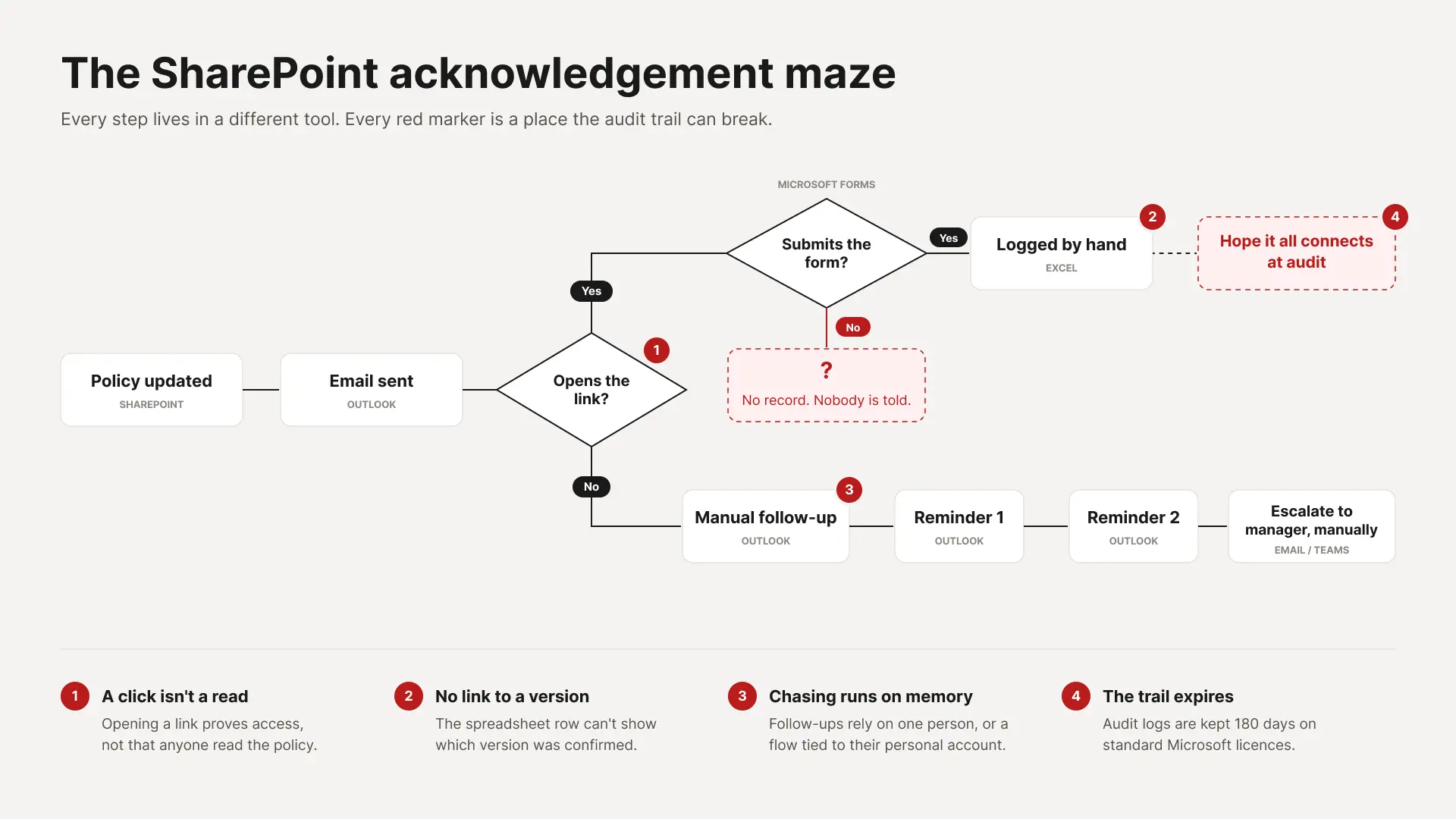
Acknowledgment tracking means documenting that someone reviewed a policy. Not that they clicked a folder. Not that they opened a file. That they saw a specific version and confirmed it, and you can demonstrate that later. Most SharePoint setups rely on implied acknowledgment: an email goes out, maybe someone clicks a form, possibly they download a PDF. Six months on, when legal asks for proof, you are piecing evidence together from three systems and hoping it tells a coherent story. That is where compliance confidence falls apart.
SharePoint treats acknowledgment as an afterthought
There is no native way in SharePoint to connect “Sarah Chen opened Policy_v3.docx” with “Sarah confirmed she read and understood this exact version.” Teams work around it with Forms, Lists, email confirmations, and a custom flow someone set up during an internship. When that person leaves, the whole thing breaks silently.
A click is not comprehension. SharePoint can tell you someone accessed a file. It cannot tell you they read it or kept the window open longer than three seconds. Version history makes it worse: SharePoint tracks document changes, but connecting which version an employee saw when they acknowledged is manual detective work. Update a safety policy four times in six months and try proving which version each warehouse worker reviewed.
Audit retention adds another trap. On standard Microsoft licensing, audit data is kept for 180 days, extended to a year on E5, and longer only with custom retention most teams skip. Someone files a complaint eighteen months later and the evidence trail you need may not exist anymore. What you have is not acknowledgment tracking. It is activity logging that might support your case if you are lucky.
The workarounds get worse at scale
HR teams compensate by inventing processes. The spreadsheet method works until you have 80 people and someone updates the PTO policy mid-year, and now you are tracking two versions, three offices, and nobody remembers if the Denver team got the memo.
One HR manager we worked with at a manufacturing company blocked two full weeks every January just to track acknowledgments for mandatory safety training. Not reviewing policies, not improving anything. Two weeks hunting down who had not clicked the link. Every year.
Power Automate flows look better until the person who built one leaves and you realize it was tied to their personal account. It stops, alerts go quiet, and you find out when the auditor asks why 40% of the team has no harassment-policy acknowledgment on file. SharePoint will send a notification once, maybe twice, but chasing the overdue and keeping a live compliance picture is all manual.
Growth exposes every crack
Small teams hide SharePoint’s limits. Twenty people, you can track acknowledgments in your head. Fifty across three departments with role-specific policies and you are in trouble. Safety policies apply to manufacturing but not sales. Remote-work policies differ by state. Contractor onboarding needs different documents than full-time staff. SharePoint permissions can technically model this, but managing it becomes a full-time IT project that still leaves HR without real visibility.
Re-acknowledgment is where it breaks hardest. When a policy actually changes, every affected employee needs to confirm the new version, and SharePoint has no clean way to tie that re-confirmation to the new version and chase the stragglers. Ownership creates orphans too: a policy and its flow live in one person’s account, that person leaves, and the process around the document dies with them.
What actually matters for compliance
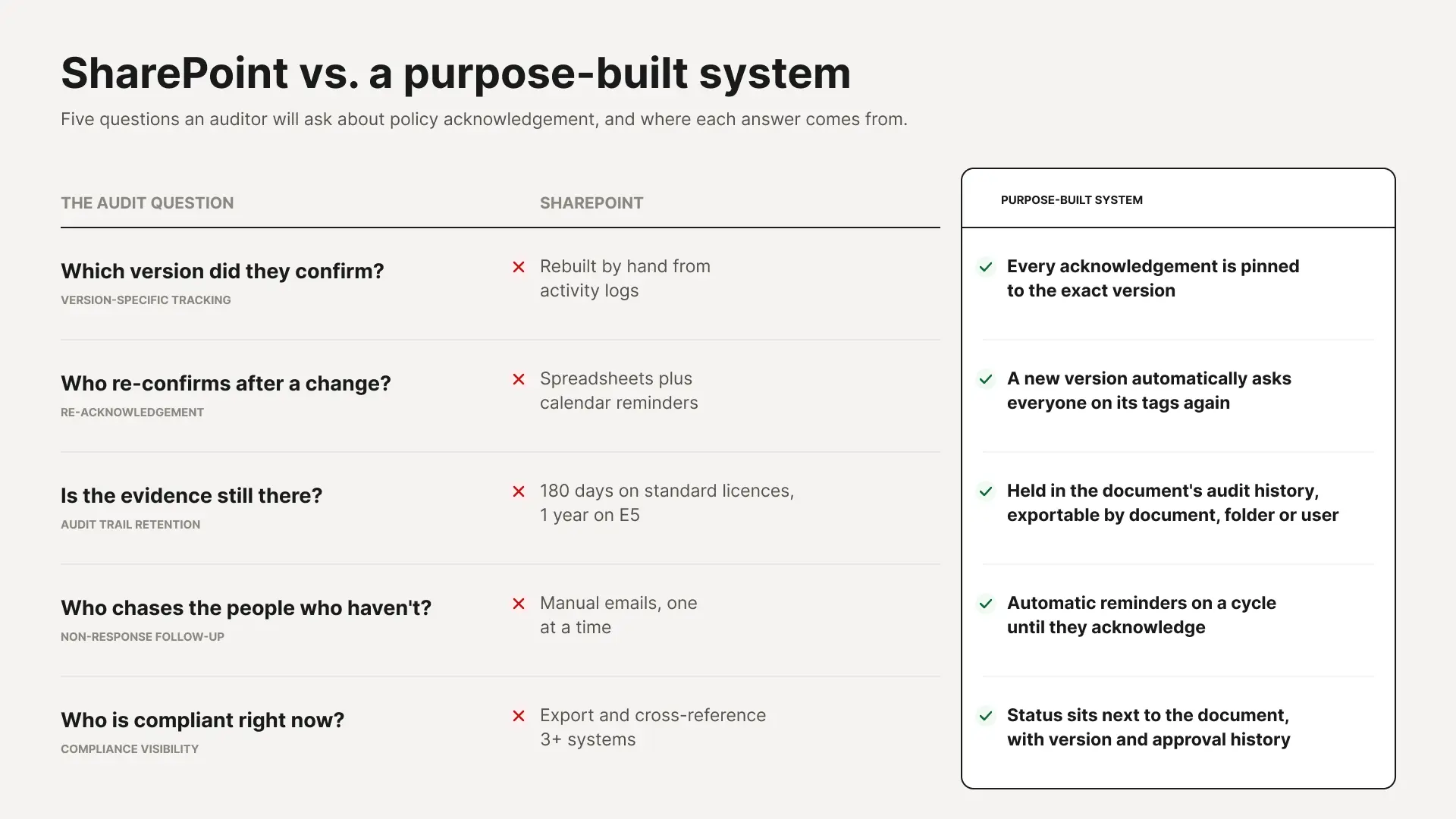
Strip away the tools and the requirements are simple. You need definitive answers to who saw a policy, when, which exact version, and whether they confirmed it. Not “probably” or “based on folder logs we can infer.” You need a live compliance picture that does not require exporting three spreadsheets and cross-referencing them by hand. And the system has to survive normal business: people leave, the org grows, policies change, audits happen, all without constant manual intervention.
For a deeper look at how HR teams are solving this, read our complete guide to HR knowledge bases.
Purpose-built systems work differently
What separates dedicated platforms from SharePoint workarounds? Acknowledgment is the point, not something bolted on later.
Policies become active records with their own lifecycle. Someone creates a policy requiring acknowledgment. The system automatically assigns it to relevant employees based on role, department, location. Tracks individual status. Escalates when someone doesn’t respond. Triggers new acknowledgment requirements when the policy updates.
No spreadsheets. No manual chasing. The system knows who’s compliant and who isn’t.
This changes audits completely. Instead of scrambling to assemble evidence, you have continuous documentation showing exactly who acknowledged what and when. Version-specific records tie each acknowledgment to a precise policy state.
The work shifts from proof-gathering to process management.
How AllyMatter handles acknowledgment tracking
AllyMatter builds acknowledgment into documentation governance instead of bolting it on. Policies live in a central knowledge base with version control and approval workflows, and you flag a document as requiring acknowledgment.
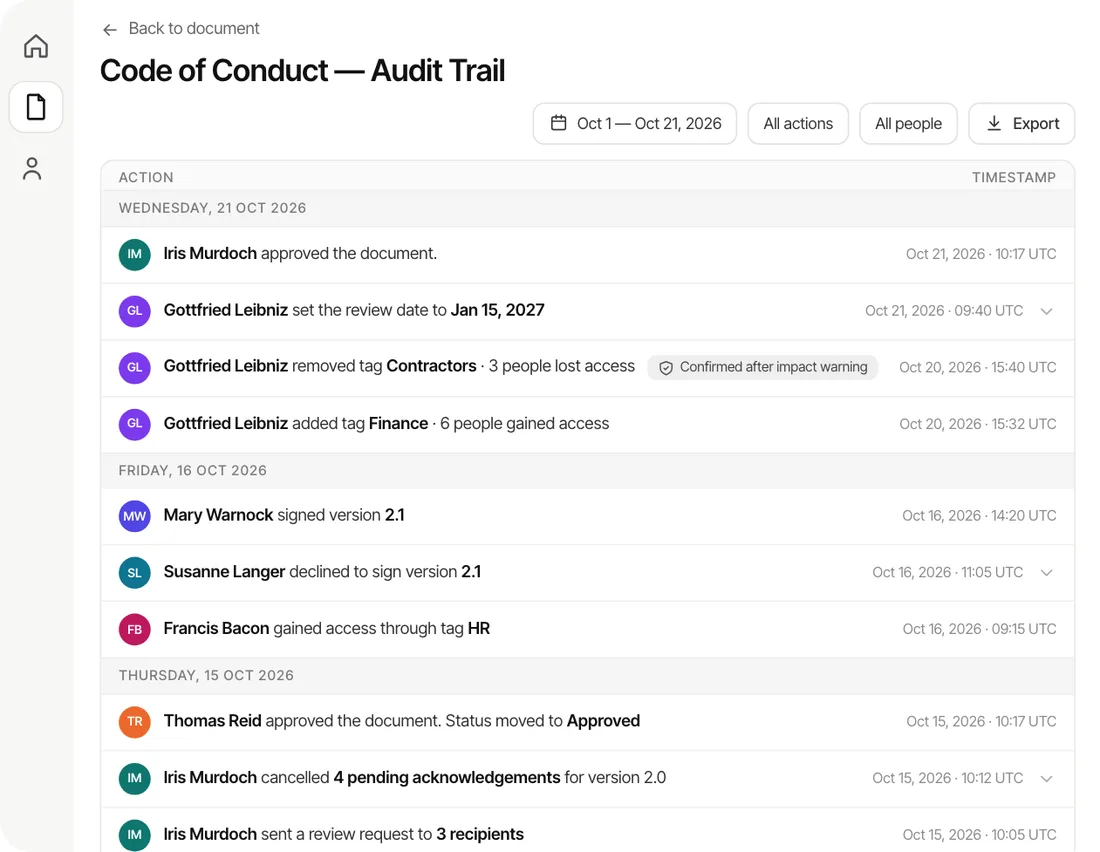
From there the platform tracks it. Tag the policy and everyone holding that tag (by role, department, or location) receives the request. You see who opened it, how long they actually spent reading, and who acknowledged, with automatic reminders to anyone who has not. Acknowledgments pin to the exact version: each person’s record shows the precise version they confirmed, so version confusion cannot undermine your position later. When a policy changes, the new version requires fresh approval and a new acknowledgment from everyone on the document’s tags, so a real change always triggers real re-confirmation rather than a silent gap. The whole trail lives in the document’s audit history and exports per document, per folder, or per user.
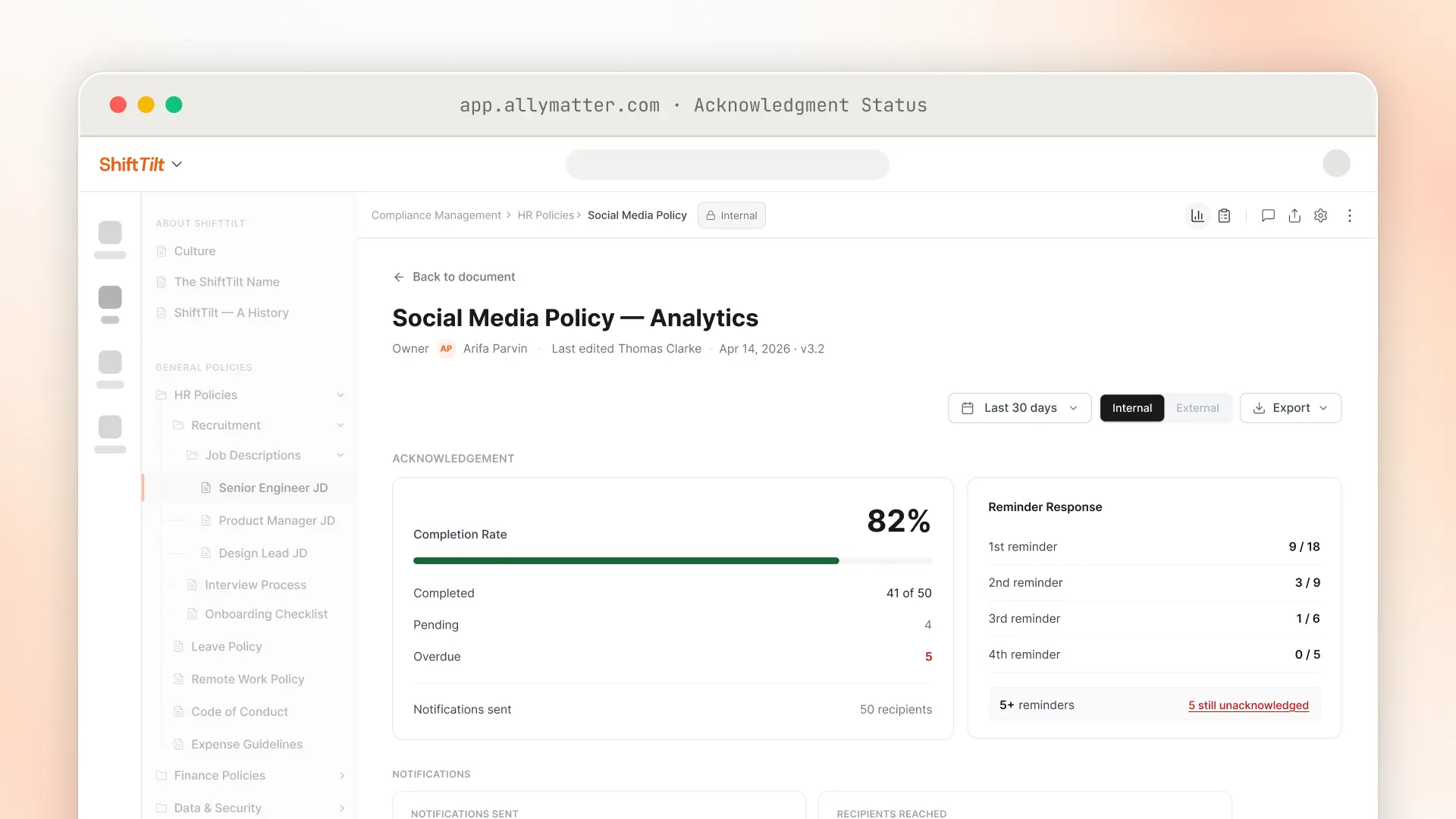
HR gets the compliance picture without building custom reports. Acknowledgment status sits next to the document, alongside version history and approval records, in one view.
Start your 30-day free trial. No credit card to start, and a 30-day money-back guarantee if you convert and change your mind. Start free or try the sandbox demo.
When storage tools become compliance risks
SharePoint is solid for document storage. Nobody disputes that. But storing documents and proving acknowledgment are different jobs. Teams stretch SharePoint to cover both with manual effort and constant vigilance, and that holds until scale, an audit, or a legal challenge exposes how fragile it is. Acknowledgment breaks first because it demands precision, and general-purpose collaboration tools optimize for flexibility, not compliance proof. At some point the question stops being “can we make SharePoint handle this” and becomes “should we keep trying while the risk keeps growing.”
If you decide to move on a yearly plan, migration is on us. We bring your existing HR documentation across, structure and permissions included, so the switch is not another project on your plate. The migrations page covers how it works.
Frequently asked questions
Can SharePoint be used to track employee policy acknowledgments?
Technically yes, through Forms, Power Automate, Lists, and spreadsheets, but you will spend more time maintaining workarounds than tracking compliance. What it cannot do natively is connect “John opened this file” with “John confirmed policy version 2.3 on March 15.” That proves interaction, not a defensible acknowledgment record.
Why do policy acknowledgments in SharePoint fail during audits?
Auditors want clear answers, and SharePoint gives you scattered activity data that needs interpretation. Proving everyone acknowledged the updated harassment policy means pulling email logs, checking Forms responses, and cross-referencing Lists, all while hoping the 180-day audit window has not closed. SharePoint also does not automatically tie an acknowledgment to a specific version, so confirming which version someone saw is manual work.
How do HR teams handle re-acknowledgment when a policy changes?
In SharePoint, mostly through spreadsheets and reminders, which collapses past 100 employees and multiple policy schedules. A purpose-built system ties acknowledgment to the version and automatically requires fresh confirmation from the right people when the policy changes, instead of leaving you to chase it by hand.
What is the risk of employees acknowledging outdated policies?
Confusion and liability. When acknowledgments are not tied to versions, an employee can confirm version 2.1 while a disputed requirement was added in version 3.0, and your acknowledgment record ends up undermining your position instead of supporting it.
When should HR teams move beyond SharePoint for policy compliance?
When the workarounds cost more than the solution. The signal is usually rapid growth, audit prep, or a dispute: the spreadsheet-and-email system that worked for 40 people does not scale to 150, and you are spending real time every month chasing acknowledgments and rebuilding broken flows.