“Where’s our latest pitch deck?” Someone checks Slack. Someone else pings the manager. A third person finds three versions in a shared drive and picks the most recent-looking one.
Sales teams lose time to this kind of friction every day, especially once the team grows past the point where everyone just knows where things live. The bigger problem is that nobody’s fully confident they’re using the correct version once documentation starts spreading across Slack, shared drives, email, and personal notes.
Here’s how AllyMatter helps.
Centralize sales documentation for instant access
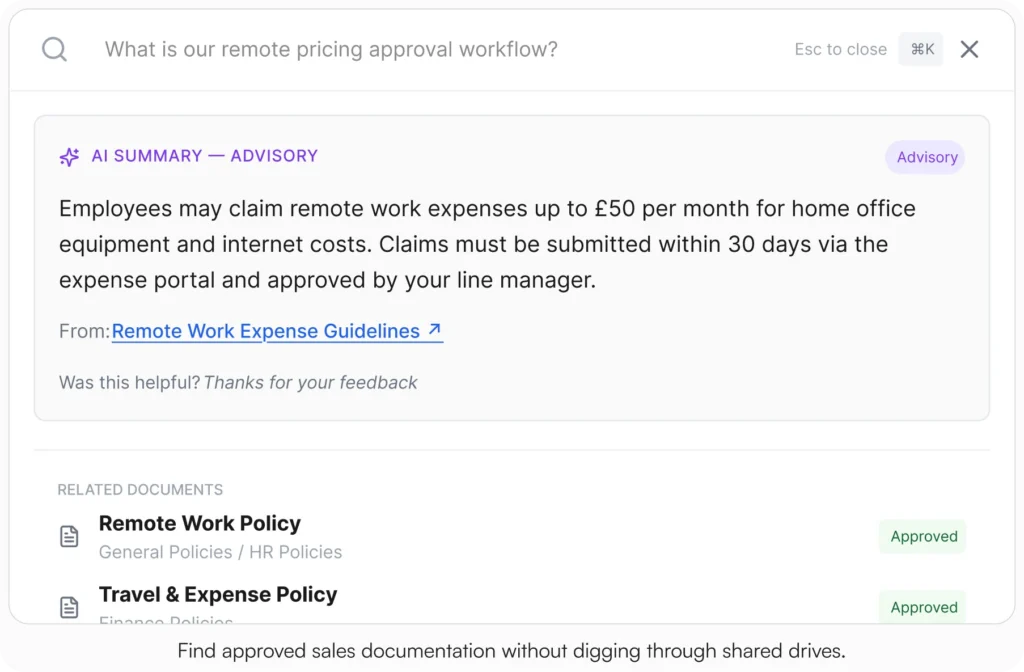
Your sales guidance, from pricing strategies to approval workflows, deserves better than being scattered across shared drives, email threads, and chat messages. AllyMatter transforms fragmented sales policies into an organized knowledge repository. When someone needs the latest discount approval process or pricing exception policy, they shouldn’t have to ask three people first.
With smart tags and powerful metadata search, your team always accesses exactly what they need, so reps always know they’re working from the latest approved version. AllyMatter gives every document a single, governed home, ending the guesswork around shared drives and duplicate files.
Most collaboration tools help teams draft documents. The harder problem is keeping finalized sales documentation searchable, current, and trusted six months later.
Preserve winning strategies with documented sales playbooks
When top performers leave your organization, their proven strategies often walk out the door with them. That usually includes discovery call structure, qualification instincts, negotiation timing, and customer objections nobody else has documented properly. This tribal knowledge, refined through countless customer interactions, represents one of your most valuable assets.
AllyMatter captures these insights in documented workflows and playbooks. Your star representative’s discovery process, objection handling techniques, and closing strategies become institutional knowledge that stays with your company. Even new team members can follow these proven approaches from day one, reducing the gap between your top performers and everyone else.
Ensure consistent messaging across the entire sales organization
When marketing and sales work from different playbooks, prospects receive mixed messages that undermine trust. AllyMatter ensures everyone accesses the same approved messaging, value propositions, and positioning guides.
When your marketing team updates product positioning, sales representatives see these changes immediately; no more discovering outdated messaging during crucial client presentations. One rep positioning your product as “enterprise-grade” while another calls it “startup-friendly” sounds harmless internally. Prospects notice the inconsistency immediately, especially once multiple sales teams, regions, or partners are involved.
Accelerate new hire productivity
According to the Society for Human Resource Management, it takes new hires 8-12 months to achieve full productivity in professional roles. Growing sales teams typically spend weeks getting new hires up to speed when processes lack documentation. Each recruit essentially reinvents the wheel, learning through trial and error what your experienced team members already know. In most growing sales teams, onboarding still depends heavily on shadowing whoever happens to be available. That works until hiring ramps up faster than your senior reps can train people.
AllyMatter provides easily accessible, step-by-step guides for every sales role. From understanding your sales methodology to navigating CRM workflows, comprehensive documentation streamlines the learning curve. Faster onboarding means new hires contribute sooner instead of spending months piecing processes together informally.
Keep competitive intelligence current and accessible
Nothing derails a promising deal faster than being blindsided by a competitor’s claim. AllyMatter keeps battle cards current and accessible so your sales team never gets caught unprepared.
When a competitor launches a new feature or changes pricing, your team can update this intelligence once, and the entire sales organization works from the same response framework. Competitive intelligence usually fails because updates happen in isolated Slack threads that disappear after two weeks. AllyMatter gives those updates a permanent, searchable home.
Streamline pricing strategy implementation
Inconsistent pricing decisions create customer satisfaction issues and damage your brand’s reputation. When different customers receive different pricing for similar solutions, market trust erodes quickly. Pricing inconsistency usually starts innocently. One rep offers an exception, another copies it, and six months later, nobody remembers what the actual policy is.
AllyMatter helps maintain pricing discipline by documenting clear guidelines, approval processes, and exception protocols. Sales teams can quickly reference the latest pricing models, discount thresholds, and bundling strategies. When discount guidance isn’t documented clearly, finance teams often spend more time resolving pricing exceptions than reviewing strategic decisions.
Improve marketing and sales alignment
The classic marketing-sales divide costs organizations dearly. When teams disagree about what constitutes a qualified lead or how handoffs should occur, promising opportunities fall through the cracks.
Shared documentation reduces the operational ambiguity between teams. Marketing knows what sales actually needs in the field, and sales stops improvising messaging because the approved positioning, qualification criteria, and campaign context are already documented in one place.
Track document versions and changes in real-time
Version control matters more in sales than most teams realize. One outdated contract clause or pricing document can create legal, financial, and trust issues fast. Reps need confidence that the document they’re sharing is the approved, current version.
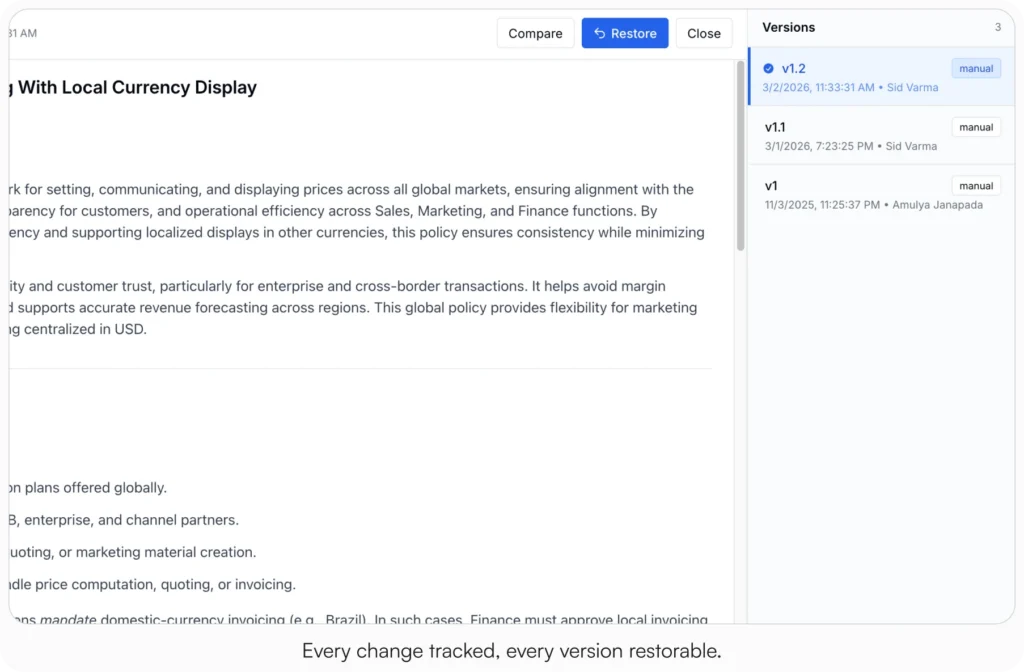
AllyMatter maintains a full version history for every document, tracking who changed what and when. Teams can audit past versions, see exactly what was updated, and restore earlier drafts if needed. That matters when legal, finance, and sales teams all depend on approved customer-facing documentation staying accurate.
Automate approval workflows for sales materials
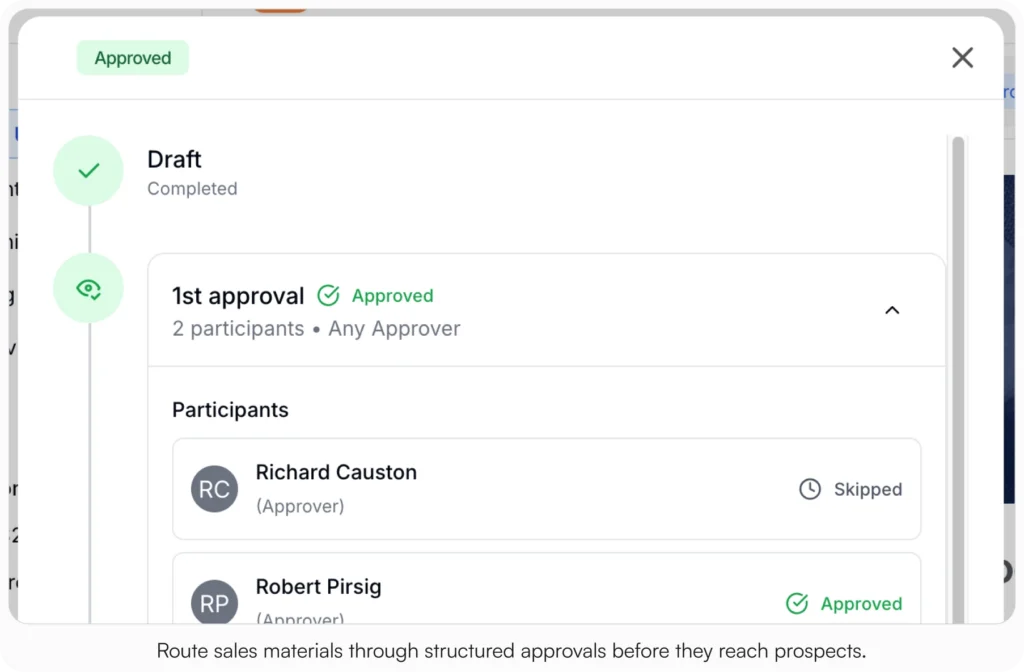
Getting new sales sheets or campaign briefs approved traditionally means endless email chains and confused stakeholders. These bottlenecks delay go-to-market timelines and frustrate teams. This becomes especially important once legal, finance, product marketing, and sales leadership all have a hand in approving customer-facing material.
AllyMatter’s streamlined approval workflows ensure the right people review documents at the right time. Reviewers automatically get notified when it’s their turn to approve, which keeps documents from stalling in inboxes for days.
Scale winning processes as your sales team grows
Most sales processes work fine until the team doubles. As organizations expand their sales teams, maintaining consistency becomes exponentially more difficult without proper documentation infrastructure.
AllyMatter supports growth by providing a scalable knowledge foundation. New territories, products, or vertical markets can leverage existing documentation while adapting for their specific needs. As your organization learns what works, these insights can be quickly documented and distributed through your knowledge base, without rebuilding your processes every quarter.
The real challenge in scaling sales isn’t adding headcount. Maintaining operational consistency while the organization changes underneath you is what separates teams that scale well from those that don’t.
Build a sales organization that remembers what works
Sales organizations generate enormous amounts of operational knowledge every week. Most of it disappears into disconnected tools, private notes, and temporary conversations.
The teams that scale well are usually the ones that document what works before growth makes consistency impossible.
If your sales organization is at the point where onboarding is slowing down, messaging is drifting, or key knowledge depends too heavily on a few experienced people, a structured internal knowledge base starts paying for itself operationally.
AllyMatter is built for exactly this kind of environment: growing companies that need finalized documentation to stay searchable, governed, and trusted over time.
Start your 30-day free trial. No credit card to start, and a 30-day money-back guarantee if you convert and change your mind.
Not ready for a trial? Migration from Confluence or Notion is on us when you decide. We’ll move your existing docs over and help your team get organized faster.
Frequently asked questions
How does an internal knowledge base differ from a CRM for sales teams?
While CRMs track customer interactions and pipeline data, an internal knowledge base stores your team’s collective wisdom, processes, and documentation. Think of your CRM as tracking what happened, while your knowledge base guides what should happen next.
Can sales teams rely only on Google Drive or Notion?
Usually yes, during the early stages. Smaller teams can operate reasonably well with shared folders and informal documentation.
Problems start showing up once pricing policies, approval workflows, onboarding processes, and sales playbooks need governance. Reps stop trusting documents when multiple versions exist or ownership becomes unclear. That’s usually the point where a dedicated internal knowledge base becomes necessary.
How do you prevent sales documentation from becoming outdated?
Assign clear ownership for each document type and build review cycles into your processes. When product marketing updates competitive intelligence or finance adjusts pricing structures, these changes should flow directly into your knowledge base.
Can an internal knowledge base help with sales and marketing alignment?
Yes. When both teams reference the same lead qualification criteria, messaging frameworks, and handoff processes, alignment improves dramatically. Shared documentation eliminates the “that’s not what marketing said” conversations.
What sales documents should always live in a centralized knowledge base?
At minimum: pricing guidelines, sales playbooks, approval workflows, contract templates, battle cards, onboarding SOPs, and escalation procedures. These are the documents that cause the most operational friction when they’re outdated, duplicated, or hard to find.
How long does it take to see results from implementing a sales knowledge base?
Teams usually notice the first improvement immediately: fewer interruptions asking where documents live. Longer-term gains come from better onboarding consistency, cleaner approvals, and preserving institutional knowledge as the team grows.

Founder of AllyMatter I’m Sid Varma, founder of AllyMatter, an operations-first knowledge base for growing companies. Before AllyMatter, I co-founded Syren Cloud and helped scale it into a 300-person organization across two countries, leading marketing, operations, and HR. We moved fast, served demanding customers, and learned the hard way that internal knowledge systems built for help docs or IT don’t solve day-to-day operations. AllyMatter is my answer—tools that turn tribal knowledge into trusted, searchable processes. This blog shares the playbooks, checklists, and lessons I wish I’d had while scaling.