
Product Updates · 2 min read
All Approvers or Any One – You Decide
There’s a moment in every approval workflow where someone asks, “Wait, does everyone need to sign off, or just one of them?”
The answer depends entirely on what’s being approved. A compliance policy that governs how your company handles customer data probably needs every reviewer to read it, weigh in, and explicitly say yes. A minor update to the office visitor guidelines probably just needs whoever gets to it first. Both are legitimate approval paths. Both make sense in their context. But most tools pick one model and force everything through it.
And so you end up in one of two uncomfortable places. Either every document, no matter how routine, requires three people to stop what they’re doing and formally approve it. Or sensitive policies sail through because a single person clicked “approve” on a Tuesday morning without realising two other reviewers were supposed to weigh in first.
I’ve watched both failure modes play out in real organisations. The “everyone must approve” default is the more common one, and it looks responsible on paper. In practice, it creates bottlenecks that slow everything down. A small formatting fix to an existing SOP sits in a queue for a week because one of three approvers is on leave. People start working around the system entirely, sending the document over email or Slack with “just confirm you’re okay with this” because the formal path takes too long for something that clearly doesn’t need it.
The other direction is worse but quieter. When any single person can approve anything, you lose the ability to ensure that the right set of eyes saw the right document. A policy goes live because one person approved it. Three months later someone asks, “Did legal actually review this?” and nobody can say for certain.
The underlying problem is that approval rigour should match document sensitivity, and that match should be decided once, at the workflow level, not improvised every time someone hits “submit.”
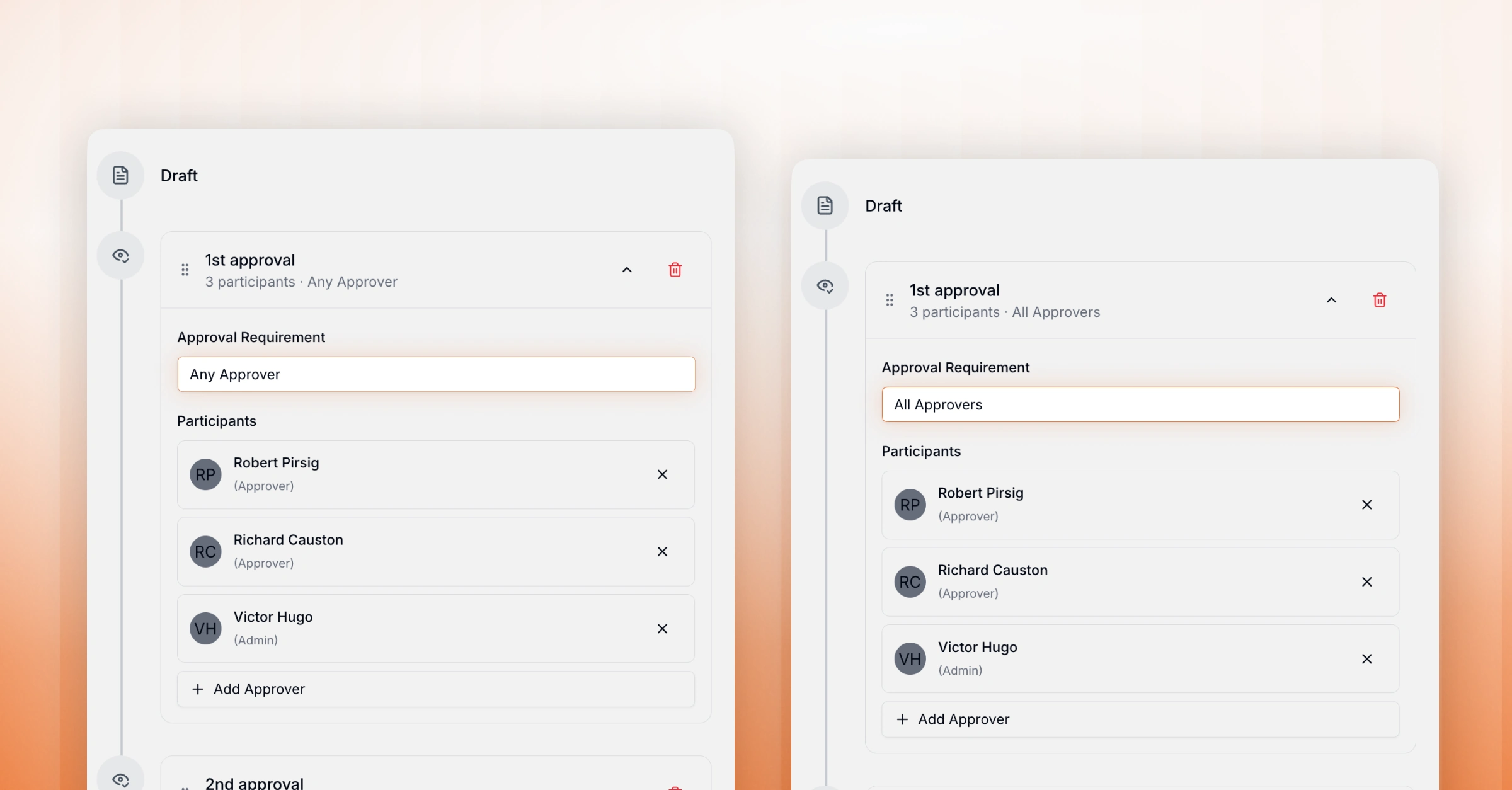
In AllyMatter, every approval workflow lets you choose: all approvers must sign off, or any single approver can move it forward. A compliance policy routes through legal, HR, and the department head, and all three must approve before it goes live. A routine process update goes to the same group, but whoever gets to it first can approve it and the document moves on. You set this once per workflow template, and every document that uses that template inherits the right level of rigour automatically.
The people writing and submitting documents never have to think about it. They pick the workflow, submit, and the system handles whether it needs unanimous approval or just one.
One setting which manages the right level of sign-off for every document. Consensus when it matters, speed when it doesn’t.
We hope you like this feature.
If you’d like to see this in action, our sandbox is open at https://sandbox.dashboard.allymatter.app/. No sign-up required, just click around and try it yourself.
And if you like what you see, start a 30-day free trial. Every plan comes with a 30-day money-back guarantee, so there’s genuinely no risk. On yearly plans, we’ll even migrate your existing documentation for free. You bring the content, we handle the move.