
Someone changed the document. You’re looking at it and something is different. A paragraph is gone. A number has been updated. A section that you’re fairly sure existed last week isn’t there anymore. You scroll through it trying to figure out what changed, when it changed, and who changed it. There’s no record. There’s no trail. There’s just the document as it exists right now, and your memory of what it used to say.
This happens constantly with shared documents. Especially the important ones. A vendor payment policy that six people contribute to over three months. An SOP that gets updated quarterly. A compliance document that someone “cleaned up” without telling anyone. The more people who touch a document, the more likely it is that something changes without anyone noticing until it matters.
The usual response is informal version control. Someone saves a copy called “Vendor Payment Policy FINAL.” Then someone else saves “Vendor Payment Policy FINAL v2.” Then there’s a “FINAL v2 reviewed by legal.” Three months later there are five files with nearly identical names and nobody can say with confidence which one is current or what changed between them.
I’ve spent more time than I’d like in meetings where the first twenty minutes were dedicated to establishing which version of a document everyone was looking at. Not debating the content. Not discussing improvements. Just figuring out if we were all reading the same thing. That’s time that never comes back and a problem that never needed to exist.
The real issue is that most tools treat a document as a single living object with no memory. It exists in its current state and that’s all you get. The history of how it got there, who contributed what, and when each change was made, is either buried in file names or lost entirely.
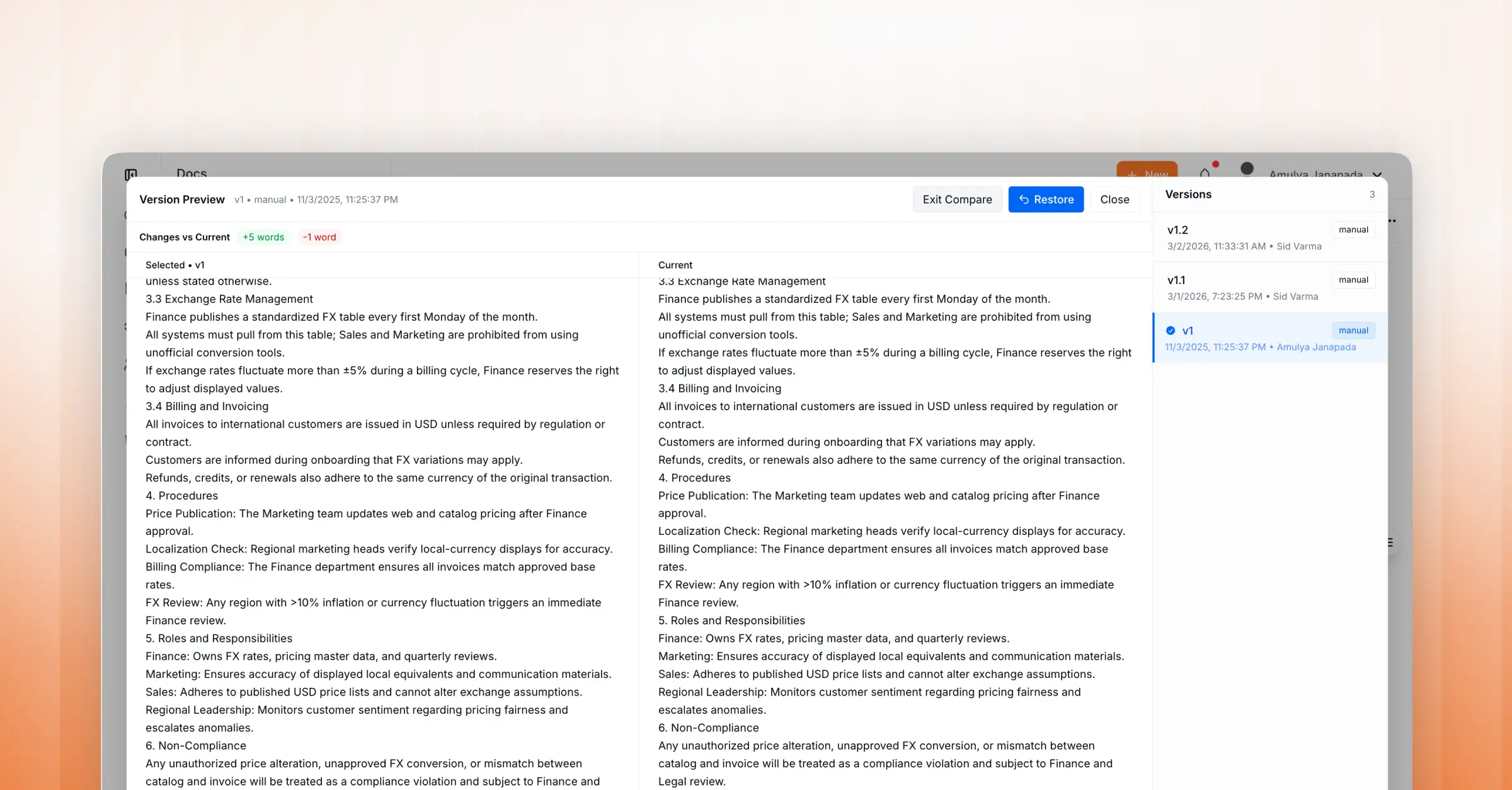
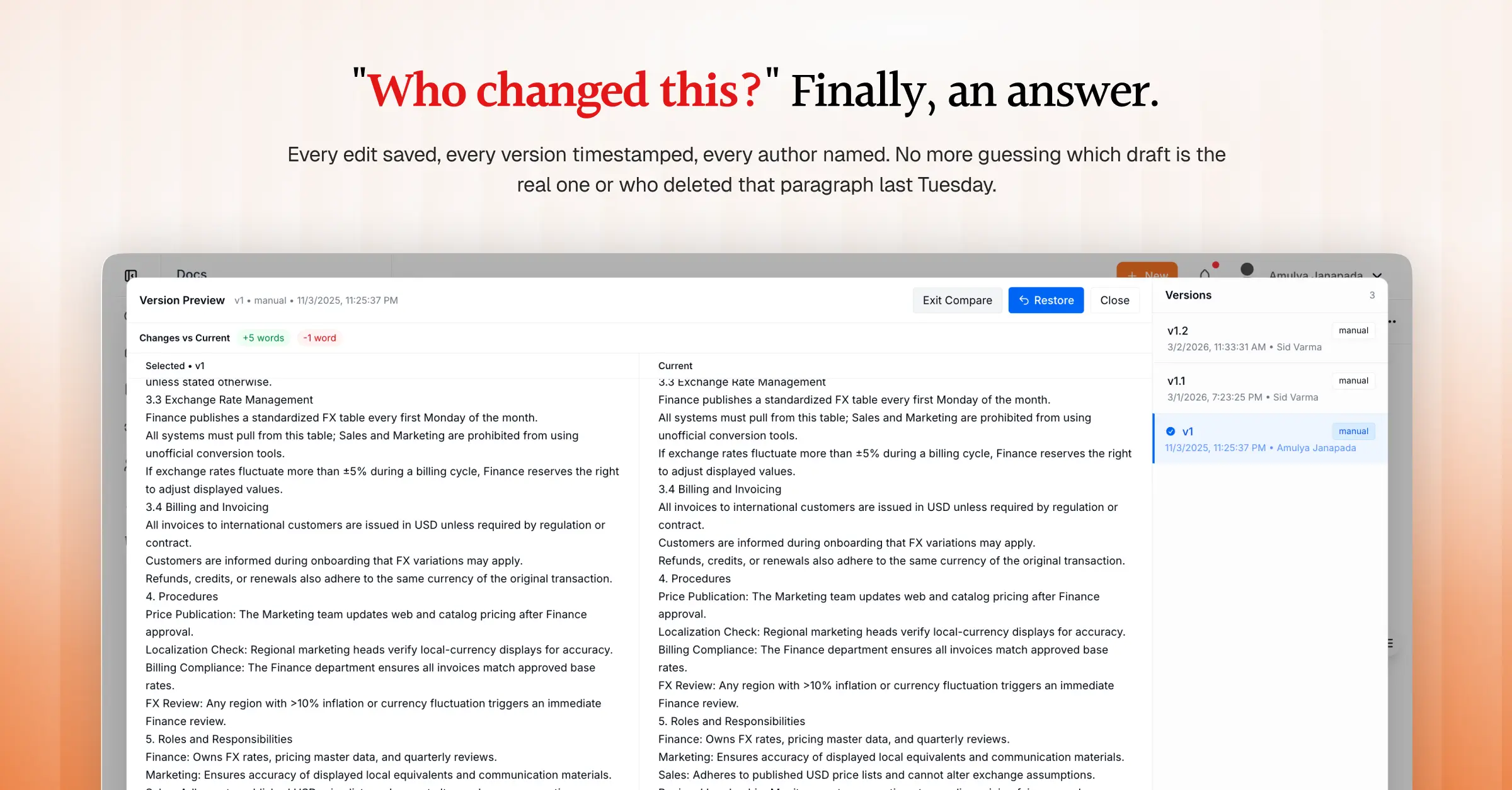
AllyMatter saves every version of every document automatically. Every edit is timestamped. Every author is named. You open the version history panel and see exactly who changed what and when. March 12 at 2:45 PM, Priya updated the payment terms. March 10 at 11:20 AM, Anne revised the escalation process. March 7 at 4:10 PM, Oliver created the original draft. If something changed that shouldn’t have, you can see it. If someone asks “who deleted that paragraph last Tuesday,” you have the answer.
No manual saving of copies. No file name conventions. No ambiguity about which version is real. The current document is always the latest version, and every version before it is one click away.
Every edit saved. Every version timestamped. Every author named. The document remembers what happened, even when you don’t.
That’s what we built.
If you’d like to see this in action, our sandbox is open at https://sandbox.dashboard.allymatter.app/. No sign-up required, just click around and try it yourself.
And if you like what you see, start a 30-day free trial. Every plan comes with a 30-day money-back guarantee, so there’s genuinely no risk. We’ll even migrate your existing documentation for free if it’s a reasonable size. You bring the content, we handle the move.

Founder of AllyMatter I’m founder of AllyMatter, an operations-first knowledge base for growing companies. Before AllyMatter, I co-founded Syren Cloud and helped scale it into a 300-person organization across two countries, leading marketing, operations, and HR. We moved fast, served demanding customers, and learned the hard way that internal knowledge systems built for help docs or IT don’t solve day-to-day operations. AllyMatter is my answer—tools that turn tribal knowledge into trusted, searchable processes. This blog shares the playbooks, checklists, and lessons I wish I’d had while scaling.