
Accounting firms rarely struggle because information is missing. The problem is usually that nobody can quickly find the right version of a procedure, prior client approach, or compliance guideline when deadlines are tight.
During tax season or audit prep, those gaps become operational problems fast. Teams recreate work that already exists somewhere else. Junior staff interrupt senior accountants for context that should already be documented. Different offices handle similar client situations differently because prior decisions were never centralized properly.
As firms grow, institutional knowledge spreads across folders, shared drives, email threads, and partner-specific workflows. A centralized knowledge management system helps firms keep accounting procedures, compliance documentation, and operational knowledge searchable and governed across the organization.
Here are ten practical ways AllyMatter helps accounting firms reduce documentation chaos and maintain more consistent operations.
Centralizing critical accounting documentation
Accounting documentation becomes difficult to maintain once firms grow across service lines, offices, and specialized teams. Tax procedures live in one folder, audit workflows in another, and client-specific guidance often stays trapped in individual partner habits or email chains.
AllyMatter gives accounting firms one searchable place for operational documentation, including billing workflows, compliance procedures, client onboarding processes, tax guidance, and audit preparation standards.
Tags and controlled visibility help firms organize documentation by department, compliance area, or operational context without relying on disconnected folder structures that become harder to maintain over time.
Teams spend less time hunting for the right version of a document and more time applying it.
Streamlining compliance and maintaining audit readiness
Staying audit-ready means more than having documents on file. It means being able to show exactly what was in place, when it changed, and who approved it.
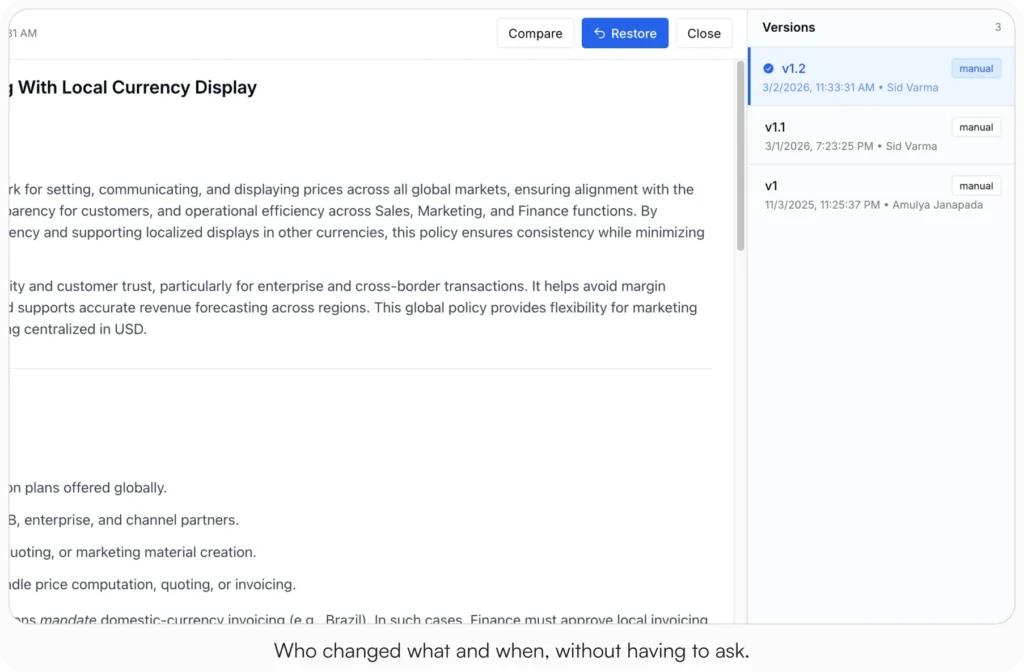
Version tracking becomes especially important in accounting environments where firms need visibility into how procedures changed, who approved updates, and when guidance was modified. Every edit is logged with a full audit trail, and previous versions can be restored if needed.
Read more: Manage Documentation Audit & History with AllyMatter
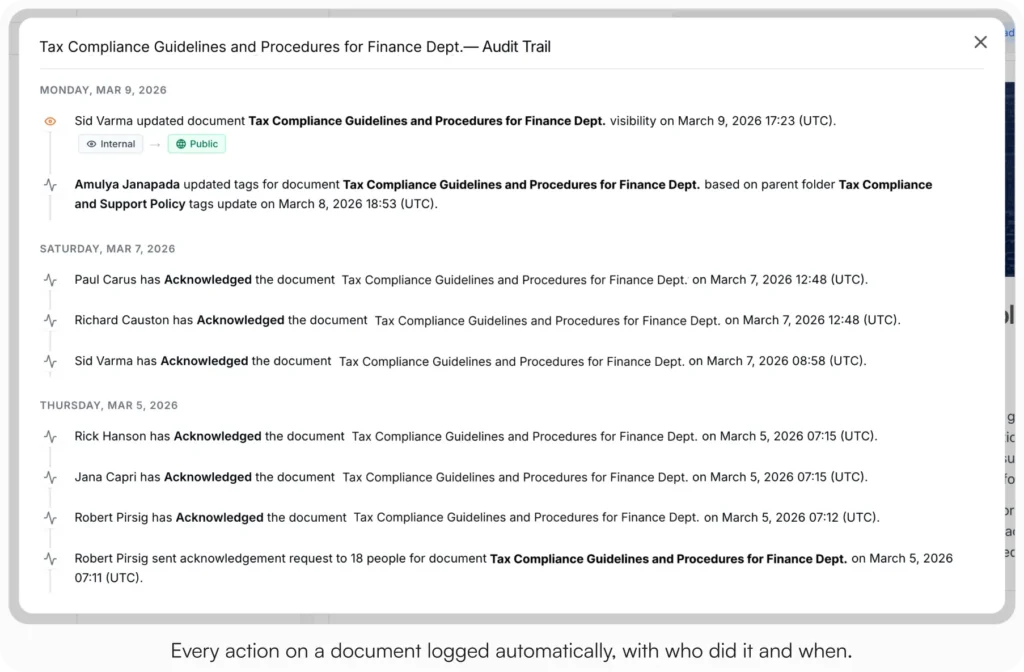
For firms dealing with regulatory requirements like SOX compliance, these audit capabilities matter beyond day-to-day operations. When auditors request documentation of your processes, you can quickly produce not just the current procedures, but the complete history of how those procedures have evolved.
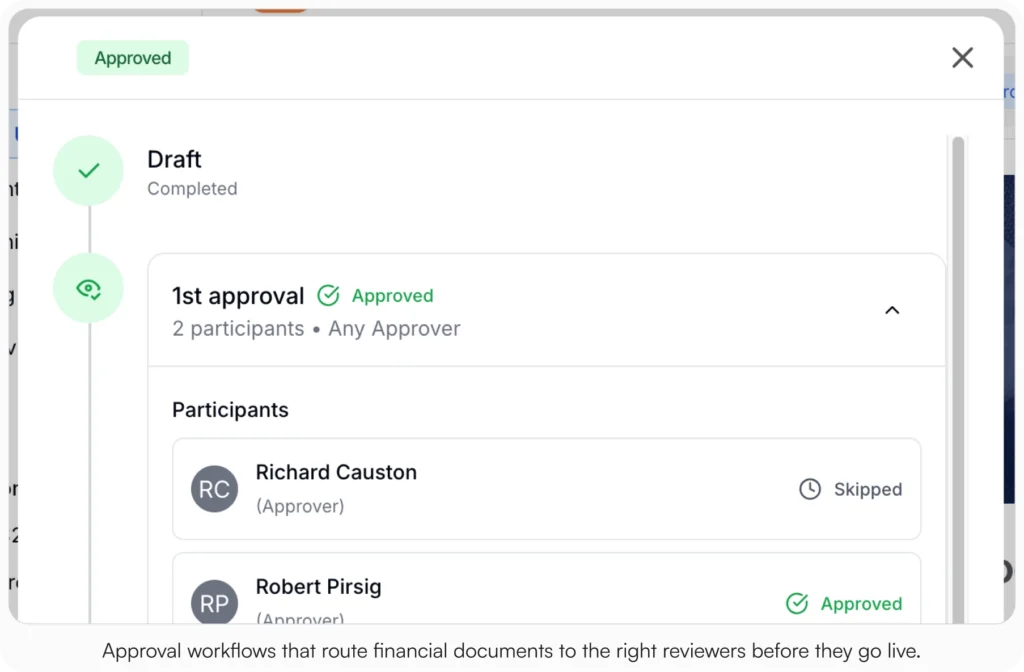
AllyMatter’s approval workflows ensure that financial documents follow proper review protocols before being finalized. This keeps critical procedures from changing outside the review process. Granular access controls let firms define exactly who can view, edit, or approve different types of financial documentation without creating access bottlenecks for everyday work.
Bridging knowledge gaps between senior and junior staff
Knowledge transfer is a real operational risk in accounting firms, especially as experienced CPAs retire and take years of client-specific decisions and process reasoning with them.
Knowledge gaps usually become visible during complex client work. A senior accountant develops a nuanced approach for a difficult tax scenario, but the reasoning never gets documented clearly enough for another team member to follow later. Six months later, the same analysis gets recreated from scratch because nobody can locate the original decision process.
AllyMatter gives firms a structured way to document tax interpretations, audit approaches, recurring client scenarios, review notes, and process decisions so institutional knowledge stays accessible beyond the individuals who originally handled the work.
For new hires, having documented procedures and prior client context available from day one means less time piecing together how the firm actually works from observation alone.
When a senior accountant leaves, the work they did and the decisions they made don’t have to leave with them. That’s only true if the knowledge was documented somewhere findable in the first place.
Enhancing collaboration across financial teams
Client work often crosses multiple accounting specialties. Tax, audit, payroll, compliance, and advisory teams all depend on shared documentation staying current and accessible across engagements.
AllyMatter gives teams a controlled way to collaborate on shared accounting documentation while maintaining visibility into changes, approvals, and access. For example: When preparing complex tax structures for multinational clients, teams from different specialties can collaborate on documentation while maintaining version control.
Each contributor can see who made specific changes and why, preventing confusion or conflicting guidance. When working with external auditors, you can grant limited access to specific documentation without exposing unrelated internal knowledge.
For firms with multiple offices, documented procedures and prior client approaches are accessible to every team, not just the one that originally developed them.
Accelerating decision-making with instant access to financial information
When a client calls with an urgent tax question or compliance concern, the answer usually exists somewhere in the firm already. The problem is how long it takes to find it.
AllyMatter makes it easier for teams to locate prior guidance, review notes, procedures, and client-related documentation without digging through disconnected systems.
AllyMatter’s approval workflows keep time-sensitive documents moving through review cycles without creating bottlenecks. When year-end closing procedures need updates or tax provision documentation requires approval, approval workflows help teams keep review cycles moving consistently.
When teams can pull up prior guidance, review notes, and documented approaches quickly, client recommendations are better informed and more consistent across the firm.
How to implement AllyMatter in your accounting firm
Accounting firms usually see better adoption when knowledge management starts with high-frequency operational documentation first. Tax procedures, audit workflows, onboarding checklists, compliance policies, and recurring client processes are often the best place to begin.
AllyMatter lets firms organize documentation by department, service line, compliance area, or operational context using tags and controlled visibility settings. Teams can define who owns each section, set up review processes, and keep documentation from going stale.
Start with what teams reach for most often: tax procedures, audit workflows, onboarding checklists. Build from there.
Building more consistent accounting operations
Most accounting firms already have the expertise they need internally. The bigger problem is making that knowledge consistently accessible when deadlines, reviews, and client requests start moving quickly.
AllyMatter gives accounting firms a structured way to keep institutional knowledge accessible long after the original client work, review process, or compliance decision was completed.
Firms that can scale consistent client work without depending too heavily on tribal knowledge are better positioned to grow without the operational drag that comes from scattered, outdated documentation.
Start your 30-day free trial. No credit card to start, and a 30-day money-back guarantee if you convert and change your mind.
Not ready yet? Migration from Confluence or Notion is included. We’ll move your existing documentation over and have you up and running in about a week.
Frequently asked questions
How does AllyMatter help accounting firms maintain SOX compliance?
AllyMatter logs every document edit, update, and action with a full audit trail. Teams can review change history, compare revisions, and maintain visibility into who updated critical accounting procedures over time. The platform’s approval workflows ensure financial documents follow proper review protocols, while granular access controls define exactly who can view, edit, or approve different types of financial documentation.
Can AllyMatter integrate with existing accounting software like QuickBooks or Sage?
While AllyMatter serves as a centralized knowledge management platform, it’s designed to complement your existing accounting software stack. You can document processes related to your current tools and create standardized procedures for using them across your firm. The platform helps organize knowledge about your existing systems rather than replacing them.
How does AllyMatter protect sensitive client information?
AllyMatter uses end-to-end encryption for data in transit and at rest, multi-factor authentication, and role-based access controls. You can set document visibility to “Private to User” for sensitive client-specific documentation or “Internal Users Only” for standard procedures. The platform’s security measures are designed to meet the stringent requirements accounting firms face for protecting client data.
What’s the typical implementation timeline for an accounting firm?
Implementation timelines depend on how much documentation already exists and how teams currently organize information. Most firms begin by centralizing high-priority documentation such as tax procedures, audit workflows, onboarding processes, and compliance policies before expanding usage across departments.
How does AllyMatter help with staff transitions when senior accountants retire?
The platform enables systematic capture of institutional knowledge through structured documentation templates and approval workflows. Senior staff can document complex processes, client-specific approaches, and nuanced interpretations before they leave. That knowledge stays in the firm’s knowledge base, accessible to anyone who needs it later.

Founder of AllyMatter I’m founder of AllyMatter, an operations-first knowledge base for growing companies. Before AllyMatter, I co-founded Syren Cloud and helped scale it into a 300-person organization across two countries, leading marketing, operations, and HR. We moved fast, served demanding customers, and learned the hard way that internal knowledge systems built for help docs or IT don’t solve day-to-day operations. AllyMatter is my answer—tools that turn tribal knowledge into trusted, searchable processes. This blog shares the playbooks, checklists, and lessons I wish I’d had while scaling.